
A tattoo looks still.
That is the illusion.
From the outside, it appears as a design frozen into the skin: a symbol, a memory, a prayer, a rebellion, a lover’s name, a geometric code, a sacred animal, a piece of art you decided to carry on your body. Once it heals, it seems permanent because nothing appears to be happening.
But beneath the surface, the tattoo is not passive.
It is not simply “ink sitting in skin.”
It is a living biological negotiation.
Every day, quietly, your immune system is managing the foreign material you placed inside your body. Not once. Not only during the healing process. Not only when the tattoo is fresh and red and swollen.
For years.
Possibly for life.
The strange truth is this: your tattoo remains visible not because your body ignored it, but because your body keeps trying to deal with it.
The Needle Does Not Place Ink “On” You
When you get a tattoo, the ink is not placed on the outer skin like paint on a canvas. The needle punctures through the epidermis, the constantly renewing outer layer, and deposits pigment deeper into the dermis. This matters because the epidermis sheds and renews regularly, but the dermis is more stable. If tattoo ink stayed only in the outer skin, the design would disappear as your skin naturally flaked away.
The dermis is different. It is vascular, structural, connective, alive. It contains immune cells, collagen, blood vessels, lymphatic pathways, nerve endings, and the deeper architecture that gives skin its strength. When pigment enters this layer, the body does not interpret it as art. It interprets it as intrusion.
The immune system responds immediately.
A tattoo is, biologically speaking, thousands of tiny controlled injuries filled with foreign particles.
Enter the Macrophages
One of the key immune cells involved is the macrophage.
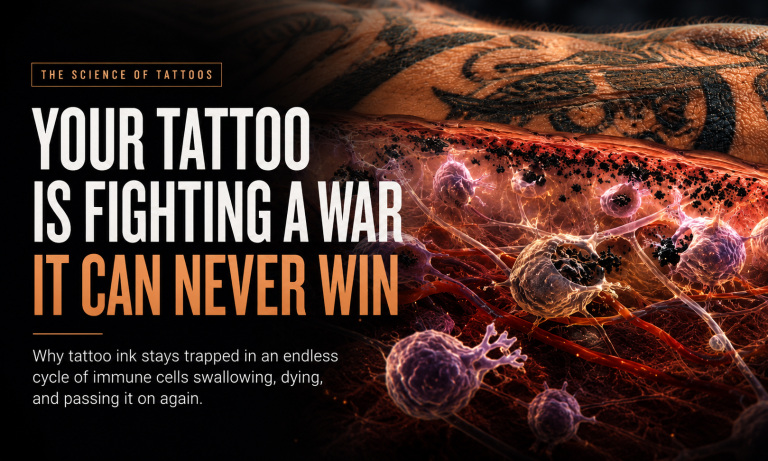
The word macrophage means “big eater.” These cells are part of the body’s cleanup and defense system. They patrol tissues, engulf debris, consume pathogens, and help coordinate repair. When tattoo pigment enters the dermis, macrophages move toward the site and begin swallowing ink particles through a process called phagocytosis.
From the body’s perspective, this is exactly what they are supposed to do.
Something foreign has entered the tissue.
The macrophages arrive.
They engulf it.
They attempt to contain the problem.
But tattoo ink is not bacteria. It is not a splinter of dead tissue. It is not something easily dissolved, digested, neutralized, and cleared.
Many pigment particles are simply too persistent. They are chemically stable, physically durable, and difficult for the immune system to break down. So the macrophage swallows the pigment, but instead of destroying it, the cell becomes a tiny living storage container.
The ink is trapped inside the macrophage.
And that is where the story gets fascinating.
The Tattoo Does Not Stay Because the Cells Live Forever
For a long time, many people assumed tattoos remain because pigment sits permanently in the dermis. But the skin is not a static wall. Cells age. Cells die. Cells are replaced. Tissue remodels. Immune cells come and go.
So how does the tattoo remain?
A 2018 study published in The Journal of Experimental Medicine explored exactly this question. Researchers from the Centre d’Immunologie de Marseille-Luminy studied how tattoo pigment persists in skin and found that dermal macrophages are central to retaining tattoo pigment particles. Their work showed that tattoo persistence depends on a cycle of pigment capture, release, and recapture. (Rockefeller University Press)
In simple language: macrophages swallow the ink, but when those pigment-loaded macrophages eventually die, the ink does not vanish with them.
It spills back into the surrounding tissue.
Then new macrophages arrive and swallow it again.
The tattoo survives because the pigment keeps getting passed from one immune cell to another.
Cell after cell.
Generation after generation.
A microscopic relay race with no finish line.
The French Experiment That Revealed the Relay
The study became especially powerful because of how the researchers tested the idea. Using tattooed mice, they eliminated pigment-bearing macrophages and observed what happened afterward. If those original macrophages were the reason the tattoo remained, then destroying them should have made the tattoo fade.
But that is not what happened.
The tattoo stayed.
New macrophages came in and took over the job of holding the pigment. Inserm summarized the finding clearly: the skin cells carrying tattoo pigment are not permanent, but when they die, they transmit the pigment to new cells. (Salle de presse de l’Inserm)
That one discovery changes the whole way we understand tattoos.
The tattoo is not a dead mark.
It is a maintained mark.
It persists because the immune system keeps re-containing it.
The body is not ignoring the tattoo.
The body is constantly remembering it.
Your Tattoo Is a Permanent Stalemate
This is where the “war” metaphor becomes useful, but only if we understand it carefully.
Your body is not necessarily losing in a dramatic, catastrophic way. The tattoo is not usually an active disease process. For many people, tattoos sit quietly without obvious problems.
But biologically, the tattoo is a stalemate.
The immune system cannot fully destroy the pigment.
The pigment cannot fully escape the immune system.
So the body does the next best thing: it contains the ink in place.
That containment is what creates the visual permanence.
The design remains not because nothing is happening, but because the same thing keeps happening over and over again. Macrophages capture the ink. Some eventually die. The ink is released. New macrophages recapture it. The image survives through cellular turnover.
This is a strange kind of immortality.
Your tattoo is not permanent because the original ink-holding cells live forever.
It is permanent because the responsibility keeps getting transferred.
The Skin Becomes an Archive
There is something almost poetic about this.
A tattoo begins as a conscious choice. You choose the design. You choose the location. You choose the pain. You choose the meaning.
Then your body takes over.
The immune system becomes the archivist.
It files the pigment into cells.
It guards the foreign material.
It prevents the ink from freely dispersing.
It keeps the design legible.
In a way, the immune system becomes the hidden artist preserving the visible art.
The tattoo artist creates the pattern.
The macrophages maintain it.
The body does not understand the story of the tattoo, but it preserves the evidence of the encounter.
A name.
A mantra.
A serpent.
A rose.
A skull.
A yantra.
A date.
A wound transformed into beauty.
The skin remembers because the immune system keeps holding the memory in place.
Why Tattoos Fade Slowly Over Time
Of course, tattoos can fade. Lines blur. Colors soften. Edges spread. Sunlight, skin aging, pigment chemistry, immune activity, and placement all influence how a tattoo changes over time.
But fading is usually gradual because the pigment is not simply washed away. The immune system can slowly move some material, and some pigment can shift deeper or disperse through tissue, but much of it remains trapped in this macrophage-mediated cycle.
This is why old tattoos often look less sharp but do not simply disappear.
The body is working on them.
Just very slowly.
And often, incompletely.
Why Laser Tattoo Removal Is So Difficult
Laser tattoo removal works by using concentrated light energy to target pigment particles. The energy fragments the ink into smaller pieces. Once the particles are broken down, the immune system has a better chance of processing and clearing them. Medical reviews describe laser removal as a process that breaks pigment into smaller fragments, which can then be handled by immune cells and cleared over time. (PMC)
This is why removal takes multiple sessions.
The laser is not simply “erasing” the tattoo like a rubber eraser on paper.
It is repeatedly breaking pigment apart so the body can finally move more of it out of the skin.
And even then, the immune system may recapture some of the pigment. This is part of why tattoo removal can be slow, painful, incomplete, and unpredictable. Some colors respond better than others. Some locations clear more easily than others. Some bodies respond more efficiently than others.
The American Academy of Dermatology notes that a healthy immune system is important for laser tattoo removal to work, because the body plays an active role in clearing the treated pigment. (American Academy of Dermatology)
The laser opens the door.
The immune system still has to carry the fragments away.
The Tattoo Is Not Just Art. It Is Biology.
This does not mean tattoos are bad.
It means tattoos are biologically profound.
A tattoo is not just ink.
It is injury, repair, immune surveillance, pigment chemistry, cellular death, cellular renewal, and long-term tissue memory.
It is an agreement between art and inflammation.
It is beauty held inside a wound that never fully returns to its pre-inked state.
The surface heals. The scab falls away. The redness calms. The skin closes.
But beneath that healed surface, the immune system continues its quiet work.
Not dramatically.
Not violently.
Not necessarily dangerously.
But persistently.
Your tattoo is not a static object.
It is an ongoing process.
The Body Never Truly Forgets
This is the haunting part.
We often think of memory as something that belongs to the brain.
But the body remembers in other ways.
Scar tissue remembers.
Immune cells remember.
Inflammatory pathways remember.
Pigments lodged in the dermis become part of the body’s physical history.
A tattoo is a chosen memory made visible.
And the immune system becomes the mechanism that keeps that memory from dissolving.
The tattoo says: this happened.
The macrophage says: I will hold it.
Then the macrophage dies.
Another arrives.
And the message continues.
A Living Symbol Beneath the Skin
So the next time you look at a tattoo, do not see only the design.
See the unseen labor beneath it.
See the immune cells that swallowed the ink.
See the pigment that refused to be digested.
See the cellular handoff happening quietly below the surface.
See the body’s strange devotion to containment.
A tattoo is not permanent because it is inert.
It is permanent because your body keeps participating in it.
The skin becomes the temple.
The ink becomes the relic.
The immune system becomes the priesthood that keeps passing the flame from one cell to the next.
And that is the real mystery of a tattoo.
It is not just something you carry.
It is something your body keeps carrying for you.