
Most people think water is simple.
Clear. Tasteless. Ordinary. The liquid we drink, bathe in, cook with, cry through, and are mostly made of.
But water has never behaved like an ordinary liquid.
It expands when it freezes. Ice floats instead of sinking. It reaches its maximum density at about 4°C, not at its freezing point. It stores heat unusually well, resists temperature changes, shapes climate, protects oceans and lakes from freezing solid, and creates the thermal conditions that make life on Earth possible.
For centuries, we have treated water as one substance with strange properties.
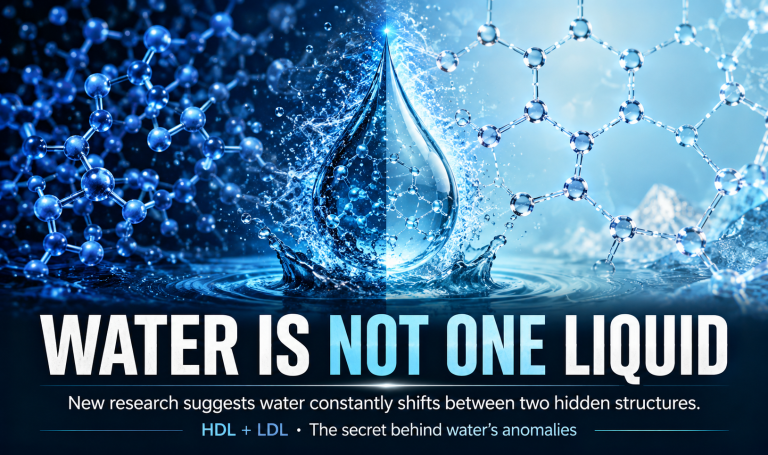
But a new study suggests something far more fascinating: liquid water may not be one uniform liquid at all.
It may be a constantly shifting molecular blend of two distinct local structures.
One is dense, compact, and more disordered.
The other is looser, more open, and more ordered.
In scientific language, these are often described as high-density liquid-like and low-density liquid-like structures. The new Nature Physics study, published on June 4, 2026, reports molecular-level evidence from simulations that these two local structures exist in liquid water and interconvert dynamically. (Nature)
This does not mean the glass of water in your hand visibly separates into two layers.
It means something subtler and more profound.
At the molecular level, water may be continuously reorganizing itself between two structural identities. Every moment, beneath its calm surface, water is performing a hidden dance of density, order, disorder, collapse, and expansion.
The most familiar liquid on Earth may have a dual personality.
The Mystery Water Has Been Hiding in Plain Sight
Water is everywhere, but it is also one of the most anomalous substances in physics and chemistry.
Most liquids behave predictably when cooled. Their molecules slow down, move closer together, and the liquid becomes denser. Water does this only up to a point. As it cools, it becomes denser until around 4°C. Then, as it approaches freezing, it begins to expand.
This is why ice floats.
If ice were denser than liquid water, frozen lakes would sink from the top, oceans could freeze downward, and aquatic life would face a radically different planet. Instead, ice forms a floating insulating layer, allowing liquid water beneath it to remain stable enough for life.
That one anomaly is not a small detail.
It is one of the reasons Earth works.
Water also has unusual compressibility, heat capacity, viscosity behavior, and structural flexibility compared with similar liquids. Scientists have long suspected that these strange properties may not be separate mysteries. They may all point back to one deeper molecular truth: water is not structurally uniform.
For decades, physicists and chemists have proposed a “two-state” model of water. According to this idea, liquid water contains two competing local arrangements. One arrangement is high-density and disordered. The other is low-density and more ordered, closer to the open tetrahedral structure associated with ice.
The problem was proving it.
Water molecules move incredibly fast. Their hydrogen-bond network is constantly breaking and reforming. Any local structure appears and disappears in a fraction of time so brief that catching it directly has been extremely difficult.
So the two-state model remained controversial.
Beautiful, useful, and mathematically compelling — but still debated.
Now, using large-scale molecular dynamics simulations and unsupervised deep learning, researchers have found what may be the clearest molecular-level evidence yet for this hidden two-structure behavior. (Phys.org)
The Two Faces of Liquid Water
The new study describes water as a shifting population of two local structures.
The first is the high-density structure.
This form is more compact. Molecules are packed closer together. The arrangement is more disordered, with the hydrogen-bond network less open and less ice-like. In this state, water behaves more like an ordinary dense liquid.
The second is the low-density structure.
This form is more open. The molecules arrange themselves in a more ordered, tetrahedral pattern. This structure creates more space between molecules, making it less dense. It resembles the kind of arrangement that becomes more prominent as water approaches freezing.
These two structures are not fixed objects.
They are not separate droplets.
They are not two different chemicals.
They are local molecular configurations, constantly appearing, dissolving, and transforming into one another.
That is the beauty of the discovery.
Water is not a static mixture. It is a living choreography of structure.
At any given instant, some regions of liquid water lean toward the dense, disordered identity. Others lean toward the open, ordered identity. The balance between these two forms changes with temperature, pressure, and phase conditions.
This helps explain why water becomes so strange near freezing.
As temperature falls, the low-density ordered structure becomes more important. Instead of molecules simply moving closer together, many begin organizing into a more open network. That open network occupies more volume. So water expands.
This is the microscopic logic behind one of the most important macroscopic facts on Earth: ice floats.
Why AI Was Needed to See It
The researchers did not simply look at water molecules and label them by eye.
The hidden structural difference is too subtle for that.
Traditional methods often use predefined physical measurements like local density, energy, or geometric order parameters. But the problem is that water’s two-state behavior may not reveal itself cleanly through any single obvious variable. The difference between the two structures may live in a high-dimensional molecular pattern that humans do not intuitively know how to define.
This is where unsupervised AI becomes powerful.
The team used an unsupervised deep learning approach, meaning the model was not simply told, “Find structure A and structure B.” Instead, it was allowed to search through enormous simulation data and uncover hidden patterns on its own.
According to Phys.org’s report on the study, the model was trained on roughly 74 million local water-molecule configurations generated from molecular dynamics simulations using the TIP4P/Ice water model, a computational model commonly used to study water across different temperatures and pressures. (Phys.org)
The goal was not to impose a theory onto the data.
The goal was to let the data reveal whether two distinguishable structures were actually present.
And when the model found the right way to look at the molecular landscape, two clusters emerged.
One corresponded to the denser, more disordered structure.
The other corresponded to the looser, more ordered structure.
This is important because it suggests that the two-state picture is not merely a convenient metaphor. It may reflect something physically real in the molecular organization of liquid water.
Water Is Constantly Switching Identities
The most fascinating part of the study is not simply that two structures appeared.
It is that they were shown to interconvert.
Water molecules do not remain permanently in one state. They shift. A local region can move from a high-density arrangement toward a low-density arrangement and back again.
This transformation is not random chaos. The simulations suggest that water follows specific interconversion pathways depending on pressure and temperature.
Most of the time, the switch appears to happen along what researchers describe as a semi-loop pathway, involving a single energy barrier. Near the boundary where high-density and low-density liquid behavior compete more strongly, the transformation can follow a more complex full-loop pathway with multiple barriers. (Phys.org)
This means the “two liquids” inside water are not simply sitting side by side.
They are reacting.
They are transforming.
They are exchanging identity through energetic pathways.
This gives water a kind of molecular memory of conditions. Temperature and pressure do not merely change how fast water molecules move. They change the structural routes available to them.
Water is not passive.
It is responsive.
The Secret Behind Water’s Anomalies
Once you understand the two-structure model, many of water’s strange behaviors begin to make more sense.
Why does water expand near freezing?
Because the more open, low-density structure becomes more dominant.
Why does ice float?
Because the freezing process locks water into an open crystalline network that is less dense than the liquid below it.
Why does water buffer temperature so well?
Because its hydrogen-bond network can absorb and redistribute energy through constant structural rearrangement.
Why is water so essential to biology?
Because life does not happen in a rigid solvent. It happens in a dynamic molecular environment that can reorganize around proteins, salts, membranes, DNA, enzymes, and cellular structures.
Water is not just the background of life.
It is part of the architecture of life.
Every cell in your body depends on water’s ability to form, break, and reform hydrogen bonds. Every protein folds inside a watery environment. Every membrane exists in relationship with water. Every biochemical reaction takes place in a liquid medium that is far more intelligent in its behavior than we usually imagine.
The two-state model adds another layer to this understanding.
It suggests that biological water may not simply be “wetness” surrounding molecules. It may be a responsive structural field, constantly shifting between density states, influencing how biomolecules move, fold, bind, dissolve, and communicate.
The study’s authors and commentators note that direct practical applications are still far away, but better understanding water’s structure could eventually matter for biology, pharmaceuticals, materials science, and confined environments such as cells, membranes, minerals, and geological systems. (Phys.org)
The Planetary Importance of Water’s Dual Nature
The implications go beyond the laboratory.
Water’s strange density behavior shapes Earth.
When lakes freeze, they freeze from the top down, not the bottom up. The ice layer floats, insulating the liquid water beneath. This allows fish, microbes, plants, and entire aquatic ecosystems to survive winter.
If water behaved like most liquids, ice would sink.
Bodies of water could freeze from the bottom upward.
Life in cold climates may have evolved very differently, if at all.
Water’s heat capacity also stabilizes climate. Oceans absorb vast amounts of thermal energy and release it slowly, moderating temperature swings across the planet. This helps regulate weather patterns, coastal climates, and the habitability of Earth.
The same molecular weirdness that makes water scientifically difficult is also what makes it biologically sacred.
Its anomalies are not accidents on the side of life.
They are part of the reason life can exist.
The new study gives us a deeper lens into how these anomalies may arise from the hidden competition between compact and open molecular structures.
Water is not merely adapting to Earth.
Water helped make Earth adaptable.
A Necessary Caution: This Is Not Final Proof in a Glass of Water
The discovery is exciting, but it must be framed carefully.
The study provides strong molecular-level evidence from simulations. It supports the two-state model of water. But researchers still need experimental verification using highly sensitive techniques.
This matters.
Simulation is powerful, especially when combined with machine learning, but physical reality still requires experimental confirmation. The AI has revealed a structural pattern in computational water models. The next step is to connect that pattern more directly to real-world measurements.
Even the researchers acknowledge that questions remain, including how to interpret the hidden physical variables identified by the AI and how to verify them experimentally. (Phys.org)
So the best way to say it is this:
Water has not been “proven” to be two separate liquids in the everyday sense.
Rather, the strongest evidence yet suggests that liquid water contains two distinct local molecular structures that continuously transform into one another.
That is still extraordinary.
Because it means the substance we thought we knew best may have been hiding one of nature’s most elegant structural secrets.
The Poetry of the Molecule
There is something humbling about this.
Water is the first thing we search for when looking for life beyond Earth. It is the substance we return to when we cleanse, heal, cook, grow, and survive. It is inside our blood, lymph, cells, tears, brain, fascia, organs, and breath.
And yet, at the deepest level, water is not simple.
It is relational.
It is transitional.
It is never merely one thing.
It is density and openness.
Disorder and order.
Collapse and expansion.
Fluidity and structure.
It is constantly becoming itself.
Perhaps that is why water is such a perfect medium for life. Life also depends on the ability to shift between states — stability and change, form and flow, compression and release, memory and adaptation.
The new research does not make water less mysterious.
It makes the mystery more precise.
The glass beside you is not just filled with a uniform liquid. It is filled with an invisible molecular negotiation, a rapid exchange between two structural possibilities. Beneath the stillness, water is choosing and re-choosing its form countless times.
And from that microscopic dance comes floating ice, living cells, planetary climate, biological resilience, and the delicate thermal balance of Earth.
Water was never ordinary.
We were simply looking at it from too far away.
Source
Liwen Li et al., “Evidence for the generic existence of two local structures in liquid water,” Nature Physics, published June 4, 2026. DOI: 10.1038/s41567-026-03301-8. (Nature)
I corrected the source line from “Li & Zeng” to “Liwen Li et al.” because the indexed article lists multiple authors.