
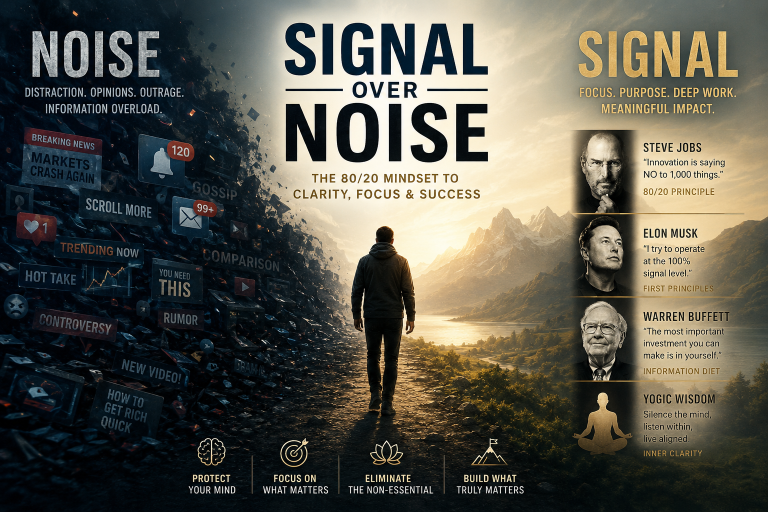
“The difference between extraordinary and average is not how much information you consume. It’s how little noise you allow into your mind.”
We live in the loudest period in human history.
Every morning begins with notifications.
News headlines compete for attention.
Social media algorithms fight to hijack your emotions.
Podcasts promise life-changing secrets.
Books promise seven new habits.
Experts contradict one another.
Friends offer opinions.
Strangers offer advice.
Most people believe success comes from finding more information.
The truth is often the opposite.
Success belongs to those who become masters of filtering.
It is not about collecting more.
It is about removing more.
The people who build extraordinary companies, write timeless books, discover scientific breakthroughs, or transform entire industries possess an unusually high signal-to-noise ratio.
What Is Signal-to-Noise Ratio?
The term originates from engineering.
In electronics and telecommunications, every message travels through interference.
The desired information is called the signal.
Everything that interferes is called noise.
A radio station with high signal and little interference produces crystal-clear sound.
A weak signal surrounded by static becomes impossible to understand.
Exactly the same principle governs human thinking.
Your goals…
Your intuition…
Your creativity…
Your deepest insights…
These are your signal.
Distractions, gossip, outrage, unnecessary meetings, endless scrolling, trivial problems, and emotional drama are the noise.
The quality of your life depends largely on the ratio between the two.
Most People Optimize the Wrong Variable
People ask:
“How can I become more productive?”
A better question is:
“How can I eliminate more noise?”
Because productivity is rarely about working harder.
It is usually about working cleaner.
Imagine two people.
Person A reads twenty productivity books.
Person B deletes Instagram, turns off notifications, says no to unnecessary meetings, and spends three uninterrupted hours each morning on meaningful work.
Who accomplishes more?
Almost always Person B.
Not because they know more.
Because they protect the signal.
Steve Jobs and the Power of Elimination
Steve Jobs was famous for simplicity.
People often admired Apple’s elegant products.
What they didn’t always appreciate was the thinking behind them.
Jobs believed that focus meant saying no hundreds of times.
He once remarked that innovation comes from saying no to a thousand things.
Apple repeatedly removed features competitors considered essential.
No floppy drive.
No removable battery.
One button.
Minimal packaging.
Simple interfaces.
Behind every product was ruthless subtraction.
This philosophy mirrors the Pareto Principle, commonly known as the 80/20 Rule.
Roughly 80% of outcomes come from about 20% of causes.
Jobs understood that not every feature deserved equal attention.
Not every project deserved equal investment.
Not every opportunity deserved a yes.
The world’s most valuable products were not built by adding everything.
They were built by protecting what mattered most.
Elon Musk and the Pursuit of Pure Signal
People who have worked with Elon Musk often describe an unusual characteristic.
He relentlessly strips problems down to their fundamentals.
Instead of asking,
“What does everyone else do?”
he asks,
“What is actually true?”
This approach resembles what he calls First Principles Thinking.
Instead of inheriting assumptions, he questions every layer.
Is this part necessary?
Can this cost disappear?
Why are we doing it this way?
Could physics allow something different?
Whether discussing rockets, electric vehicles, artificial intelligence, or manufacturing, Musk has shown an extraordinary ability to ignore social noise.
Many observers describe this as operating with nearly 100% signal—not because he knows everything, but because he spends remarkably little attention on irrelevant information.
Rather than reacting to consensus, he follows evidence.
That distinction changes everything.
The Hidden Cost of Noise
Noise doesn’t merely waste time.
It changes your brain.
Neuroscience tells us that every interruption carries a cognitive cost.
Each notification forces the brain to switch contexts.
Working memory becomes fragmented.
Attention residue remains behind after every interruption.
Eventually, thinking becomes shallow.
This explains why many people feel exhausted despite accomplishing very little.
Their minds are processing noise all day long.
Mental bandwidth is finite.
Every unnecessary input consumes some of it.
Warren Buffett’s Information Diet
Warren Buffett is famous for spending much of his day reading and thinking.
Not reacting.
Thinking.
He has often emphasized that successful investing requires temperament more than constant activity.
Markets generate endless noise.
Daily price movements.
Breaking news.
Predictions.
Rumors.
Speculation.
Yet Buffett focuses on long-term fundamentals.
His advantage isn’t faster information.
It’s cleaner information.
The Spiritual Meaning of Noise
Ancient traditions understood this long before neuroscience.
Meditation exists for one reason:
To reduce noise.
Yoga reduces physiological noise.
Pranayama reduces energetic noise.
Silence reduces mental noise.
Prayer reduces emotional noise.
Nature reduces sensory noise.
The Sanskrit word Dharma points toward one’s essential nature.
Noise obscures Dharma.
Signal reveals it.
The quieter the mind becomes, the easier it becomes to hear intuition.
Many people think intuition appears magically.
More often, intuition was already speaking.
The environment was simply too loud.
The Signal of the Body
Your body constantly sends signals.
Fatigue.
Energy.
Pain.
Appetite.
Breathing.
Posture.
Heart rate.
Unfortunately, modern life trains us to ignore these messages.
Instead, we listen to external stimulation.
Coffee instead of rest.
Sugar instead of nourishment.
Entertainment instead of reflection.
Your physiology becomes another radio overwhelmed by static.
Health begins improving when we start listening again.
Relationships Have Signal Too
Some relationships generate clarity.
Others generate confusion.
After certain conversations, you feel lighter.
After others, exhausted.
This isn’t accidental.
Some people amplify your signal.
Others amplify your noise.
One of the greatest forms of self-respect is learning which conversations deserve your energy.
Not every argument requires participation.
Not every opinion deserves your attention.
Peace is often the result of selective listening.
Social Media: A Noise Amplifier
Most platforms monetize attention.
Their objective is not your clarity.
It is your engagement.
Outrage spreads faster than wisdom.
Fear spreads faster than truth.
Novelty spreads faster than depth.
This creates an environment where emotional noise becomes more profitable than meaningful signal.
Without intentional boundaries, our minds slowly begin optimizing for stimulation instead of understanding.
Building Your Personal Signal Filter
Ask yourself these questions every week.
What deserves my attention?
What merely demands my attention?
Those are rarely the same thing.
Then simplify.
Unfollow accounts that create anxiety.
Turn off unnecessary notifications.
Protect uninterrupted work.
Spend time in silence.
Read fewer books—but apply them deeply.
Choose depth over novelty.
Speak less.
Observe more.
The quality of your thinking will improve dramatically.
The Signal of Purpose
Purpose is remarkably quiet.
It rarely screams.
Ego screams.
Fear screams.
Comparison screams.
Advertising screams.
Purpose whispers.
This is why solitude has always been sacred.
The quieter your environment becomes…
The easier it becomes to recognize what truly matters.
The Ultimate Competitive Advantage
Artificial intelligence will generate more content than humanity has ever seen.
Information will become abundant.
Attention will become scarce.
Discernment will become priceless.
The future will not belong to those who consume the most information.
It will belong to those who identify the highest-quality signal amid overwhelming noise.
That is wisdom.
Final Reflection
Perhaps success isn’t about becoming more.
Perhaps it’s about removing everything that isn’t you.
Steve Jobs eliminated.
Warren Buffett filtered.
Elon Musk questioned assumptions until only fundamentals remained.
The great sages withdrew into silence.
Different fields.
Same principle.
The strongest signal wins.
Not because it shouts the loudest.
Because it is the clearest.
So before asking what more you need to learn…
Ask a different question.
What noise must I remove so the signal of who I truly am can finally be heard?