Walk into any gym and you’ll hear the same language.
“Crush the workout.”
“Destroy the muscle.”
“No pain, no gain.”
The assumption is simple: if you lift enough weight, muscle automatically follows.
But biology tells a very different story.
Your muscles do not become stronger while you’re lifting.
In fact, during the workout, you are moving in the opposite direction.
You are breaking them down.
The gym is not where muscle is built.
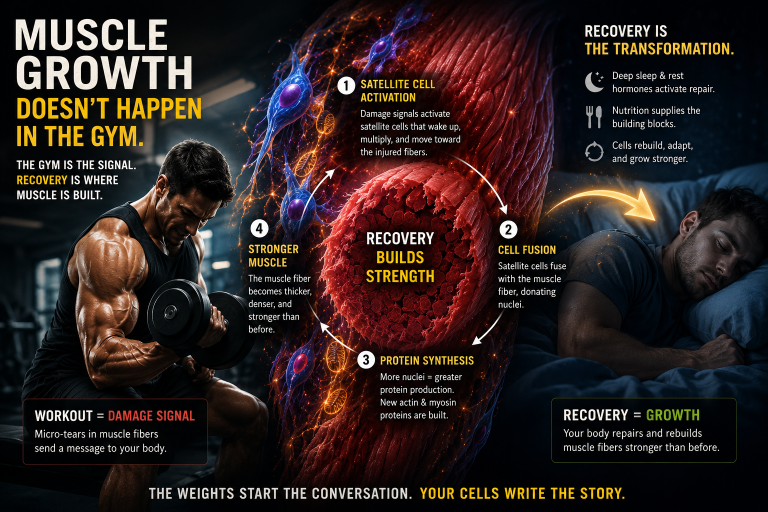
The gym simply sends the signal that muscle needs to be built.
The real transformation begins hours later—long after you’ve left the weights behind, eaten your meal, and gone to sleep.
Like many systems in the human body, adaptation doesn’t happen during stress.
It happens during recovery.
The Purpose of Muscle Damage
Every repetition you perform places mechanical tension on muscle fibers.
When enough force is generated, tiny microscopic disruptions occur throughout the contractile proteins that allow muscles to produce force.
These microscopic injuries are not failures.
They are messages.
Your body interprets them as evidence that the current muscular architecture is no longer sufficient for the demands being placed upon it.
Rather than viewing damage as something to avoid, evolution has turned it into one of the body’s most sophisticated communication systems.
Damage becomes information.
Information triggers adaptation.
Adaptation creates strength.
Without that signal, your muscles have no biological reason to become larger or stronger.
Your Body Immediately Begins Asking One Question
The moment your workout ends, your physiology shifts from performance mode into assessment mode.
The body begins asking:
“Can we rebuild this tissue stronger than before?”
If the answer is yes, growth begins.
If the answer is no, recovery stalls.
Everything depends on the environment your cells encounter after training.
Do they have adequate amino acids?
Do they have sufficient energy?
Is inflammation temporary or persistent?
Is cortisol chronically elevated?
Did you sleep deeply enough for growth hormone release?
Are nutrients actually reaching the damaged tissue?
These questions determine whether today’s workout becomes tomorrow’s strength—or tomorrow’s exhaustion.
The Hidden Architects: Satellite Cells
One of the most remarkable discoveries in muscle physiology is the existence of tiny stem-like repair cells called satellite cells.
These cells spend most of their lives quietly resting along the outer surface of muscle fibers.
Almost invisible.
Almost inactive.
Waiting.
Mechanical damage wakes them up.
Inflammatory molecules released after exercise signal these dormant cells to activate.
They begin multiplying rapidly.
They migrate toward injured fibers.
Eventually, they fuse directly into existing muscle tissue.
When they do, something extraordinary happens.
They donate their nuclei to the muscle fiber.
More nuclei mean greater capacity to manufacture proteins.
Greater protein production means larger, stronger muscle fibers.
In many ways, satellite cells are the body’s own biological construction crew.
Without them, significant muscle growth simply cannot occur.
Protein Isn’t Muscle Until Your Cells Build It
This is where many people misunderstand nutrition.
Eating protein does not automatically create muscle.
Protein provides raw materials.
Construction still has to occur.
Inside every muscle cell are microscopic factories called ribosomes.
These ribosomes receive instructions from powerful signaling pathways—most notably the mTOR pathway—to assemble amino acids into entirely new contractile proteins.
Those proteins are primarily:
• Actin
• Myosin
These are the molecular engines responsible for every movement your body makes.
Each workout creates a temporary deficit.
Recovery fills that deficit.
Repeated often enough, the muscle becomes thicker.
Denser.
Stronger.
This process is called muscle protein synthesis.
It is one of the most important regenerative mechanisms in the human body.
The Real Enemy Isn’t Training
Most people believe the danger lies in not training hard enough.
Ironically, the opposite is often true.
The greatest threat to muscle growth is failing to recover from the training you’ve already done.
Mechanical damage is only half the equation.
Repair must finish what exercise begins.
When recovery repeatedly falls short, the body remains trapped in breakdown mode.
Instead of becoming stronger, muscles accumulate incomplete repairs.
Inflammation lingers.
Protein synthesis slows.
Performance stagnates.
Eventually, the body begins borrowing from its own muscle tissue to meet metabolic demands.
This is why someone can train six days every week and still become weaker.
The issue isn’t effort.
The issue is biology.
When Recovery Begins to Fail
You rarely notice this process under a microscope.
You notice it in your everyday life.
The soreness that used to disappear within forty-eight hours now lasts nearly a week.
Weights that once felt comfortable suddenly feel impossibly heavy.
Energy disappears halfway through workouts.
Sleep becomes less refreshing.
Explosive power fades.
Your muscles lose their fullness despite consistent training.
Motivation quietly declines because your nervous system never fully resets.
Many people respond by training even harder.
But adding more stress to an already overwhelmed repair system is like asking construction workers to build a house while the foundation continues collapsing beneath them.
Recovery Is Controlled By Your Entire Body
Muscle tissue doesn’t regenerate in isolation.
Every major physiological system contributes.
The endocrine system regulates anabolic hormones.
The immune system coordinates inflammation.
The cardiovascular system delivers oxygen and nutrients.
The nervous system controls muscle recruitment and recovery.
The digestive system provides amino acids and energy.
The mitochondria generate ATP for rebuilding damaged proteins.
The fascia surrounding muscle fibers distributes force and influences circulation.
Even your psychological state influences muscular adaptation.
Chronic emotional stress elevates cortisol.
Persistently elevated cortisol shifts the body toward catabolism rather than growth.
Your muscles cannot fully recover while the rest of your physiology believes survival is more important than construction.
Sleep Is the Most Powerful Muscle Builder Most People Ignore
The strongest anabolic environment does not occur during your workout.
It occurs while you sleep.
During deep sleep, growth hormone secretion rises dramatically.
Protein synthesis accelerates.
Cellular repair increases.
Damaged tissues are rebuilt.
Memory consolidates.
The nervous system recalibrates movement patterns.
Meanwhile, cortisol naturally falls, allowing regeneration to dominate over breakdown.
Missing several nights of quality sleep doesn’t simply make you tired.
It directly reduces the body’s ability to convert training into muscle.
You cannot out-train poor sleep.
Biology doesn’t negotiate.
Nutrition Is More Than Calories
Calories matter.
Protein matters.
But recovery requires far more than simply hitting a number on an app.
Muscles require:
• Essential amino acids
• Adequate carbohydrates to replenish glycogen
• Healthy fats for hormone production
• Magnesium for muscular relaxation
• Zinc for tissue repair
• Vitamin D for muscle function
• Electrolytes for contraction
• Sufficient hydration for nutrient transport
A muscle fiber cannot build new architecture without access to construction materials.
Training creates demand.
Nutrition supplies the inventory.
When Science Turns Toward Botanical Recovery
Researchers have become increasingly interested in how certain botanicals may help support the recovery environment rather than acting as direct muscle builders.
The emphasis isn’t on replacing training or nutrition.
It’s on supporting the biological systems responsible for regeneration.
Ashwagandha (Withania somnifera)
Ashwagandha has been studied primarily for its ability to help regulate the body’s stress response.
Several clinical studies suggest it may help reduce chronically elevated cortisol levels while supporting strength gains and recovery when combined with resistance training.
By reducing excessive physiological stress, the body may remain in a more favorable environment for muscle protein synthesis.
Tart Cherry (Prunus cerasus)
Rich in anthocyanins and polyphenols, tart cherry has attracted attention for its effects on post-exercise recovery.
Studies suggest it may help reduce exercise-induced muscle soreness and support recovery by moderating oxidative stress and inflammatory responses after strenuous training.
The goal isn’t eliminating inflammation entirely.
Inflammation is necessary for adaptation.
The goal is helping the body resolve it efficiently.
Cordyceps (Cordyceps sinensis)
Cordyceps has traditionally been valued for endurance and vitality.
Modern research is exploring how compounds such as cordycepin may influence mitochondrial energy production and oxygen utilization.
Since muscle repair is an energy-intensive process, improving cellular energy availability may help support the demanding work of tissue regeneration.
While promising, these botanicals should be viewed as supportive tools rather than substitutes for adequate sleep, nutrition, and intelligent programming.
Growth Is an Agreement Between Stress and Recovery
Every biological system follows this principle.
Bones become stronger after controlled loading.
The immune system becomes more resilient after exposure.
The brain rewires itself after challenge.
Muscles are no different.
Stress initiates change.
Recovery completes it.
Without stress, there is no reason to adapt.
Without recovery, there is no ability to adapt.
Strength exists precisely at the intersection of both.
The Bigger Lesson
Perhaps muscle teaches us something far beyond fitness.
Life often glorifies constant effort.
More work.
More hours.
More productivity.
More pressure.
But your own physiology quietly demonstrates a deeper truth.
Growth never happens during endless struggle.
Growth happens after the struggle—when there is enough space to integrate what has been learned.
Your muscles understand something many people forget.
Challenge creates possibility.
Recovery creates transformation.
The weights only begin the conversation.
Your cells decide how the story ends.