
Aging is usually explained through familiar biological mechanisms.
We speak about genetics, oxidative stress, inflammation, hormonal change, cellular wear and tear, shortened telomeres, accumulated mutations, and declining mitochondrial function.
All of these processes matter.
Yet beneath nearly every chemical reaction occurring within the body lies something even more fundamental: the movement, separation, and regulation of electric charge.
Life is not merely chemical.
Life is electrochemical.
Every heartbeat, thought, breath, muscle contraction, sensory experience, and cellular repair process depends upon the controlled movement of electrically charged particles.
The human body is not powered by electricity in the same way that a machine is plugged into a wall. Its electrical activity is subtler, more dynamic, and inseparable from its chemistry. Living tissues continuously create gradients, exchange ions, transmit signals, and regulate voltage across microscopic membranes.
From this perspective, a healthy body is not simply a collection of organs.
It is an extraordinarily coordinated electrical ecosystem.
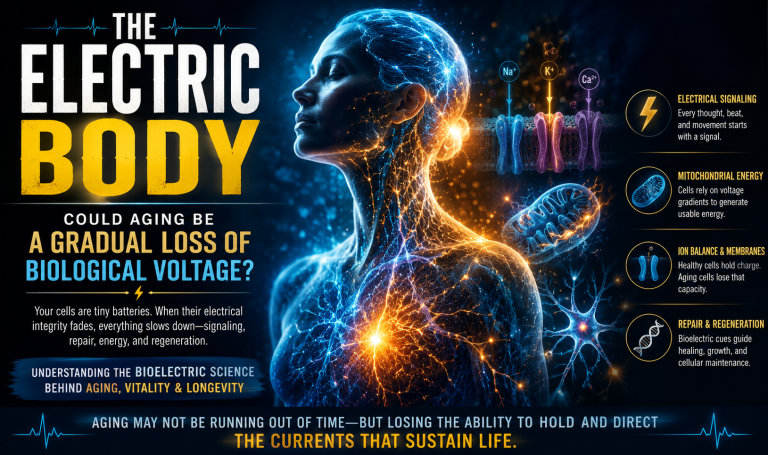
And aging may involve, among many other processes, a gradual decline in the body’s ability to create, maintain, and direct the electrical gradients upon which life depends.
Every Cell Is a Tiny Battery
Every living cell maintains a difference in electrical charge between its interior and its surrounding environment.
This difference is known as the membrane potential.
The membrane surrounding a cell selectively controls the movement of ions such as sodium, potassium, calcium, chloride, and hydrogen. Because these electrically charged particles are distributed unequally across the membrane, a voltage difference is created.
In this sense, each cell behaves somewhat like a microscopic biological battery.
This electrical gradient is not an optional feature of cellular life. It is central to how cells function.
Membrane potential helps cells communicate with neighboring cells, transport nutrients, remove waste, control calcium signaling, regulate metabolism, maintain internal stability, respond to hormones, and coordinate growth, repair, and regeneration.
In nerve cells, changes in membrane potential allow information to travel.
In muscle cells, electrical signals initiate contraction.
In cardiac tissue, carefully coordinated electrical impulses maintain the rhythm of the heart.
The electrical state of a cell also influences which proteins are activated, how molecules move across membranes, and how the cell responds to stress.
Healthy biology therefore depends not only on the availability of nutrients or energy, but also on the cell’s ability to maintain boundaries and preserve charge separation.
A battery produces useful energy because its charges remain separated.
When that separation collapses, its ability to perform work declines.
Living cells follow a far more complex version of the same principle.
Mitochondria and the Voltage of Life
At the center of cellular energy production are the mitochondria.
They are often described as the power plants of the cell, but this familiar phrase does not fully capture what they do.
Mitochondria generate energy by creating an electrochemical gradient across their inner membranes. As electrons move through the mitochondrial electron transport chain, protons are pumped across the membrane.
This produces what is known as the proton-motive force: a combination of electrical voltage and chemical concentration.
The cell then uses this gradient to produce adenosine triphosphate, or ATP, the molecule that powers much of biological activity.
In other words, the body does not manufacture energy through chemistry alone.
It creates a controlled electrical and chemical tension, then converts that tension into usable biological work.
Movement requires it.
Repair requires it.
Protein synthesis requires it.
Immune activity requires it.
Nerve function requires it.
Even the maintenance of cellular order requires a continuous supply of energy.
As people age, mitochondrial performance commonly becomes less efficient. Some mitochondria produce less ATP, generate greater amounts of reactive by-products, or become less effective at maintaining their membrane potential.
The consequences can spread throughout the cell.
When mitochondrial energy production weakens, the cell may struggle to maintain ion gradients, repair damaged structures, regulate inflammation, and respond appropriately to stress.
The decline is not merely a vague feeling of having less energy.
It can represent a reduction in the cell’s ability to maintain the organized tension necessary for life.
Aging as a Loss of Electrical Precision
Young, resilient biology is highly regulated.
Signals are generated quickly.
Ion channels open and close at the appropriate time.
Membranes remain responsive.
Mitochondria adjust energy production according to demand.
Cells communicate efficiently with one another.
Repair systems activate when needed and quieten when their work is complete.
Aging biology often becomes less precise.
Signals may still be present, but they can become slower, weaker, delayed, or less clearly interpreted.
This is visible across multiple systems.
Nerve-conduction speed may decline.
Muscle fibers may respond less powerfully to stimulation.
Cardiac electrical regulation can become more vulnerable to disruption.
Calcium signaling may become less tightly controlled.
Cellular membranes may lose some of their fluidity and structural integrity.
Ion channels and transport systems may function less efficiently.
None of these changes is caused by one single mechanism. Aging is multifactorial and cannot be reduced to the idea of low voltage.
However, declining electrical regulation may help connect several apparently separate features of aging.
Reduced mitochondrial output makes ion regulation more difficult.
Impaired ion regulation disrupts signaling.
Disrupted signaling affects metabolism, contraction, immune function, and repair.
Over time, small losses in electrical precision can become larger losses in biological coordination.
When the Signal Becomes Noise
A useful way to understand aging is through the relationship between signal and noise.
In a youthful system, signals tend to be strong, well-timed, and clearly interpreted.
A nerve impulse travels efficiently.
A hormone reaches its receptor.
A cell recognizes damage.
An immune response activates proportionately.
A repair process begins and ends at the appropriate time.
With age, the biological environment can become noisier.
Chronic inflammation may create persistent background signaling.
Oxidative stress may alter receptors and membranes.
Damaged mitochondria may release distress signals.
Ion channels may become less selective.
Cells may respond too weakly to important instructions or too strongly to harmless stimulation.
The problem is not always the complete absence of communication.
Sometimes the problem is that the message is being transmitted through interference.
This loss of signal clarity can affect the nervous system, immune system, endocrine system, and the communication occurring between tissues.
Aging may therefore be understood not only as declining energy, but also as declining coherence.
The individual parts remain alive, yet they become less capable of acting as one integrated system.
Bioelectricity and Tissue Repair
Electrical fields are also involved in how tissues organize and repair themselves.
When tissue is injured, changes in ion flow and local electrical gradients occur around the wound. These signals can help influence cell migration, inflammation, blood-vessel formation, and tissue reconstruction.
Cells do not repair damage through chemistry alone.
They respond to spatial and electrical information that helps indicate where damage has occurred and where rebuilding is needed.
Research into developmental biology and regenerative medicine has shown that bioelectric signals participate in controlling cell behavior, tissue patterning, and regeneration.
This does not mean electricity acts as a magical force capable of independently rebuilding the body.
It means electrical gradients form part of the language through which cells coordinate their actions.
As aging progresses, wound healing often becomes slower and less efficient.
Several factors contribute, including reduced circulation, impaired immune coordination, decreased collagen production, hormonal changes, stem-cell exhaustion, mitochondrial dysfunction, chronic inflammation, and altered cellular signaling.
A decline in bioelectrical responsiveness may be one component within this larger network.
When cells cannot generate, detect, or respond to signals as effectively, coordinated repair becomes more difficult.
Electricity, DNA, and Cellular Maintenance
DNA is frequently discussed as though it were simply a written code stored inside the nucleus.
But DNA is also a charged molecule operating within an electrically active environment.
The interactions between DNA, proteins, enzymes, water, minerals, and cellular membranes are governed partly by electromagnetic forces.
DNA replication and repair require energy.
Repair proteins must identify damage, bind to specific regions, alter molecular structures, and coordinate a sequence of precisely timed reactions.
These processes are chemical, but chemistry itself depends upon charge distribution, molecular attraction, electron transfer, and energy gradients.
When mitochondrial energy is reduced, oxidative stress is elevated, or cellular ion balance becomes disrupted, DNA-maintenance systems may function less effectively.
This does not mean a loss of membrane voltage directly causes all genetic damage.
The relationship is more complex.
Electrical regulation, metabolic health, oxidative balance, and genetic maintenance are deeply interconnected.
A decline in one area can increase stress upon the others.
Redox Biology: The Movement of Electrons
Another important field in understanding aging is redox biology.
The word redox refers to reduction and oxidation: the transfer of electrons between molecules.
Electron transfer is fundamental to life.
It allows cells to extract energy from nutrients, produce ATP, neutralize reactive molecules, regulate proteins, and communicate information.
Oxidation is not inherently harmful.
Without controlled oxidation, the body could not produce energy.
The problem arises when the generation of reactive molecules exceeds the body’s ability to regulate and use them.
For many years, oxidative stress was described almost entirely as random molecular damage.
Modern biology offers a more nuanced understanding.
Reactive oxygen species can also act as signaling molecules. At appropriate levels, they help regulate adaptation, immunity, exercise responses, and cellular repair.
The body does not simply need to eliminate oxidation.
It needs to regulate electron flow intelligently.
Healthy redox biology is therefore less about achieving a permanently antioxidant state and more about maintaining flexibility, balance, and responsiveness.
Aging is often accompanied by a loss of this redox adaptability.
Cells may have greater difficulty producing clean energy, managing reactive molecules, or returning to equilibrium after stress.
Once again, the underlying issue is not only damage.
It is the gradual weakening of regulation.
Membranes: The Boundaries That Hold Charge
A cell can maintain voltage only because its membrane creates a selective boundary.
The quality of that boundary matters.
Cell membranes are made largely from lipids and proteins. They must remain stable enough to protect the cell while fluid enough to allow receptors, channels, and signaling molecules to function.
Over time, membrane composition can change.
Lipids may become oxidized.
Receptors may become less responsive.
Transport proteins may work less efficiently.
Membrane fluidity may decline.
These changes can influence how well the cell communicates, absorbs nutrients, releases waste, and maintains its electrical potential.
This reveals an important principle of living systems:
There can be no useful charge without structure.
Electrical tension requires a boundary capable of holding separation.
When biological boundaries become damaged, porous, rigid, or disorganized, the system becomes less capable of preserving the gradients that sustain function.
Longevity may therefore depend partly upon maintaining the structures that allow the body to hold charge without losing flexibility.
The Heart and Brain as Electrical Organs
The body’s electrical nature becomes especially visible in the heart and brain.
The heartbeat is coordinated through electrical impulses that move across cardiac tissue. Electrocardiograms measure these patterns because the heart’s electrical activity can be detected at the surface of the body.
The brain likewise depends upon electrochemical signaling.
Neurons communicate through changes in membrane potential, neurotransmitter release, and coordinated patterns of electrical activity.
Thought, memory, movement, sensation, emotion, and attention all depend upon these processes.
Yet the electrical activity of the heart and brain does not exist separately from the rest of the body.
It depends on oxygen, glucose, minerals, circulation, mitochondrial energy, hormonal balance, sleep, and nervous-system regulation.
This is why biological voltage should not be treated as an isolated metric.
The electrical body is the chemical body.
The chemical body is the structural body.
The structural body is shaped by behavior, environment, rhythm, and relationship.
Every layer influences the others.
Is Aging Really a Loss of Voltage?
It is tempting to reduce a complex idea to a compelling phrase:
“Aging is a loss of voltage.”
The phrase is evocative, but it should be understood as a metaphor grounded in genuine biology rather than as a complete scientific theory.
There is no single universal voltage reading that determines how old or healthy a person is.
Different cells maintain different membrane potentials.
Electrical states change according to tissue type, metabolism, activity, injury, and disease.
Aging is influenced by genetics, epigenetics, lifestyle, immune regulation, environmental exposure, metabolic health, and countless interacting processes.
Nevertheless, the concept of declining biological voltage offers a valuable lens.
It reminds us that aging is not merely the accumulation of broken parts.
It is also a gradual loss of coordination.
The body may become less capable of maintaining strong electrochemical gradients, producing energy efficiently, transmitting signals rapidly, distinguishing meaningful signals from noise, adapting to changing conditions, restoring equilibrium after stress, and coordinating repair across tissues.
From this perspective, aging involves a reduction in organized biological tension.
Not tension in the psychological sense, but the dynamic gradients that allow living systems to perform work.
Coherence: More Than Energy
A person can consume sufficient calories and still feel depleted.
A cell can contain nutrients and still fail to use them efficiently.
A tissue can remain structurally present while losing functional coordination.
This is because life requires more than energy.
It requires organized energy.
A thunderstorm contains enormous electrical power, but it is not biologically coherent.
A living cell uses comparatively tiny electrical gradients, yet directs them with extraordinary precision.
Coherence is what allows energy to become meaningful.
It enables millions of cells to communicate, synchronize, specialize, and respond as part of a larger organism.
Aging may therefore be understood as a gradual drift from coherence toward diffusion.
Signals take longer to travel.
Feedback loops become less responsive.
Repair becomes less complete.
The organism expends more energy to produce the same result.
The system is still alive, but it becomes less efficient at directing its own vitality.
Supporting the Body’s Electrical Integrity
There is no single lifestyle intervention that can guarantee the preservation of cellular voltage.
However, many established foundations of healthy aging also support mitochondrial function, membrane integrity, circulation, nervous-system regulation, and ion balance.
Movement
Physical activity increases mitochondrial demand and encourages the body to maintain or produce healthier mitochondria.
Resistance training supports muscle mass and neuromuscular communication.
Aerobic activity improves circulation and oxygen delivery.
Balance and coordination practices challenge the nervous system to preserve communication between the brain and body.
Movement is not merely calorie expenditure.
It is electrical stimulation, metabolic training, and informational input.
Sleep
Sleep supports mitochondrial repair, hormonal regulation, brain clearance processes, immune balance, and nervous-system recovery.
Chronic sleep deprivation increases biological noise.
Signals related to hunger, stress, inflammation, mood, and blood-sugar regulation become less precise.
Deep rest helps the body restore the conditions required for coherent signaling.
Mineral Balance
Sodium, potassium, calcium, magnesium, and chloride are essential to electrical function.
However, more is not always better.
The body requires appropriate balance, not indiscriminate supplementation.
Kidney function, hydration, hormones, medications, and overall health all influence electrolyte needs.
Mineral supplementation should be approached responsibly, particularly when a person has cardiovascular, kidney, or metabolic conditions.
Metabolic Health
Stable blood-sugar regulation helps protect mitochondria, blood vessels, nerves, and cellular membranes.
Repeated metabolic overload can increase inflammation, oxidative stress, and mitochondrial dysfunction.
A diet centered on nutrient-dense foods, sufficient protein, healthy fats, fiber, and appropriate energy intake helps provide the raw materials required for cellular maintenance.
Light and Circadian Rhythm
The body’s electrical and metabolic systems are organized around time.
Morning light helps regulate circadian rhythms.
Regular sleep and meal timing support hormonal coordination.
Mitochondria, body temperature, cortisol, melatonin, and cellular repair all follow daily rhythms.
Health is not only about what enters the body.
It is also about when biological signals arrive.
Breath and Nervous-System Regulation
Breathing directly influences the autonomic nervous system, carbon-dioxide balance, heart rhythm, and emotional state.
Slow, comfortable breathing practices may support parasympathetic regulation and improve the coordination between respiration and cardiovascular activity.
Breath does not charge the body in a simplistic electrical sense.
It does, however, influence the regulatory systems that determine how energy is used, conserved, and distributed.
Meaningful Stress and Recovery
The body becomes stronger through appropriate challenge followed by adequate recovery.
Exercise, temperature exposure, fasting, cognitive effort, and emotional growth can all create adaptive stress when used intelligently.
Too little challenge may reduce resilience.
Too much challenge without recovery may accelerate dysfunction.
Longevity depends not upon avoiding all stress, but upon preserving the ability to respond, adapt, and return to balance.
The Ancient Language of Prana
Long before the development of electrophysiology, many traditional systems described life as animated by a subtle organizing force.
In yogic philosophy, this force is called prana.
In Chinese traditions, it is called qi.
Other cultures have used terms such as vital force, life breath, or animating spirit.
It would be scientifically inaccurate to claim that prana is simply another word for electrical voltage.
The concepts arise from different systems of knowledge and cannot be equated without losing their depth.
Yet there is an interesting resonance between them.
Traditional teachings often describe vitality as something that must flow through clear channels.
When flow is obstructed, weakened, scattered, or depleted, health declines.
Modern physiology describes the body through circulation, nerve conduction, ion gradients, mitochondrial energy, fascial communication, and electromagnetic interactions.
The languages are different.
But both recognize that life depends upon movement, regulation, and relationship.
Vitality is not a substance stored in one location.
It is the capacity of the whole system to remain responsive and connected.
The Future of Longevity Science
The future of aging research may require greater integration between fields that have traditionally been studied separately.
Genetics explains inherited predispositions.
Epigenetics reveals how experience alters gene expression.
Mitochondrial biology explains cellular energy production.
Redox science examines electron transfer and oxidative signaling.
Electrophysiology studies electrical activity in cells and tissues.
Bioelectricity explores how voltage gradients influence growth, organization, and repair.
Systems biology investigates how these processes interact as part of a unified organism.
The most promising insights may emerge not from choosing one explanation over another, but from understanding how they connect.
Electrical gradients influence chemistry.
Chemistry maintains structure.
Structure allows signaling.
Signaling coordinates repair.
Repair protects genetic integrity.
Genetic expression influences metabolism.
Metabolism, in turn, sustains electrical gradients.
Aging unfolds within this entire loop.
Aging as a Loss of Direction
Perhaps the most profound implication of the bioelectric perspective is that aging may not be only a decline in quantity.
It may be a decline in direction.
The body still has energy, but uses it less efficiently.
Signals still exist, but become less distinct.
Repair mechanisms remain present, but activate more slowly.
Cells remain alive, but communicate with less precision.
The system gradually loses its ability to direct its resources toward the right place at the right time.
Seen this way, longevity is not merely about extending the number of years a person remains alive.
It is about preserving the body’s ability to organize itself.
To maintain boundaries.
To transmit clear signals.
To respond intelligently.
To repair damage.
To return to coherence after disruption.
The goal is not to create a permanently stimulated or electrically intensified body.
Health is not maximum charge.
Health is regulated charge.
It is the ability to generate energy when needed, conserve it when appropriate, and direct it with precision.
Holding the Current of Life
Aging is real, complex, and unavoidable.
No single theory explains it completely.
Yet viewing the body as an electrochemical system offers an illuminating perspective.
Life depends upon gradients.
It depends upon differences in charge, concentration, pressure, temperature, and potential.
These differences allow work to occur.
The heart beats because ions move.
The brain thinks because membranes change voltage.
Muscles contract because electrical signals release calcium.
Mitochondria create energy because protons are separated across a membrane.
The body lives because it can create order without becoming rigid and maintain tension without losing flow.
Perhaps aging is not simply the body running out of time.
Perhaps it is also the gradual weakening of its ability to hold, regulate, and direct the currents that sustain life.
The emerging science of bioelectricity invites us to look at longevity differently.
Not merely as the prevention of damage.
Not merely as the replacement of failing parts.
But as the preservation of charge, communication, structure, rhythm, and coherence across time.
This article is intended for educational purposes and does not constitute medical advice. Bioelectricity is an important area of biological research, but no single voltage measurement or device should be treated as a complete indicator of health, biological age, or disease.