
Absolutely. I’ll keep all future writing in US English—using spellings such as “honor,” “recognize,” “center,” and “practice.”
I’ll also remove the external references and newspaper-style timing language. The opening should read more naturally in your voice:
There are moments in the lunar calendar that invite us to move outward—to create, celebrate, initiate, and expand.
Amavasya carries a different instruction.
It asks us to become still.
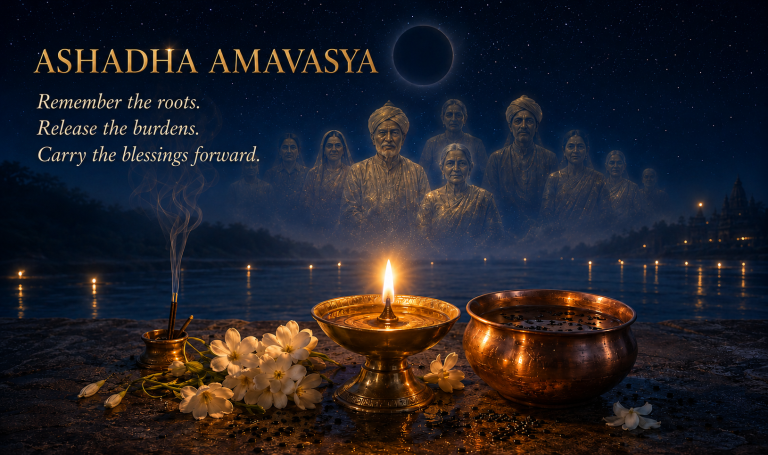
The 13th and 14th of July mark Ashadha Amavasya, the sacred new moon of the lunar month of Ashadha. The Amavasya Tithi begins on the evening of the 13th and continues through much of the 14th, creating a powerful window for introspection, ancestral remembrance, prayer, purification, and release.
Because the Amavasya extends across both dates, the evening of the 13th may be used for cleansing, quiet reflection, and preparing the ancestral altar, while the morning and early afternoon of the 14th are especially appropriate for Tarpana, prayer, food offerings, charity, and remembrance.
Yet we should not become so preoccupied with exact minutes that we lose the heart of the observance. If the formal Tithi has already passed where you live, you can still remember your ancestors, light a lamp, feed someone, and offer a sincere prayer.
Love does not become invalid because the clock has moved.
Amavasya is the darkest night of the lunar month, when the Moon is no longer visible from Earth. In the yogic and Vedic understanding, this absence of reflected light creates a natural inward pull. The external world becomes quieter so that subtler memories, emotions, and ancestral impressions can be felt.
Ashadha Amavasya is not merely a date on the spiritual calendar. It is an invitation to pause before the unseen foundation of our lives—to remember those who came before us, to recognize what they gave us, and to consciously decide what we will and will not carry forward.
We Are the Living Continuation of Our Ancestors
In Sanatana Dharma, we are not regarded as isolated individuals who appeared out of nowhere. We are part of a living stream.
Our bodies carry the biological substance of our parents and grandparents. Our language, mannerisms, strengths, fears, beliefs, talents, and emotional patterns have traveled through generations.
Some of what we inherit is visible: a face, a voice, a family profession, a recipe, a piece of land, or a particular way of moving through the world.
Much of it remains invisible: resilience, grief, interrupted dreams, unspoken loyalties, unfinished conflicts, spiritual merit, and ways of responding to love, loss, money, family, and responsibility.
The Sanskrit word Pitṛ refers to the ancestors. Sacred acts performed to remember, nourish, and honor them may include Tarpana, Shraddha, and Pinda Dāna.
Tarpana carries the meaning of satisfying, refreshing, or nourishing. When we offer water, sesame seeds, food, and prayer, we are symbolically saying:
May those who came before me be remembered.
May they be at peace.
May what remains incomplete find resolution.
May the blessings of the lineage continue.
May its suffering no longer need to be repeated through me.
This is not ancestor worship in the simplistic sense. It is the recognition of relationship.
We did not create ourselves.
We stand upon lives that preceded ours.
The Spiritual Meaning of Ashadha Amavasya
Ashadha arrives during the monsoon season across much of India. The earth softens, dormant seeds awaken, and the boundary between sky and soil becomes fluid. Rain descends into the earth and nourishes what cannot yet be seen.
This makes Ashadha Amavasya an especially beautiful time for ancestral remembrance.
Our ancestors are like the invisible roots beneath the visible tree of our lives. We may not see them, know all their names, or understand their stories, yet something of them continues to live through us.
In several parts of India, this Amavasya is also associated with cleaning, consecrating, and lighting lamps. The symbolism is profound: on the darkest lunar night, we clean the vessel that carries the flame.
The lamp becomes both an external offering and an inner teaching.
We may not be able to illuminate every chapter of our family history, but we can become a light within the lineage.
Honoring the Ancestors Is Not About Fear
Ancestral practice should not be driven by fear.
We do not need to believe that every difficulty in life is a punishment from an unhappy ancestor. Nor should we live with anxiety that one missed ritual or incorrectly pronounced mantra will bring misfortune.
At its healthiest, ancestral practice cultivates humility, gratitude, responsibility, and belonging.
We honor our ancestors because:
- Life came to us through them.
- Their choices and sacrifices created possibilities for us.
- Some of their pain may still be moving through the family.
- Remembering restores a sense of belonging.
- Gratitude transforms inheritance into conscious stewardship.
- We can continue what was noble and end what was harmful.
Honoring the lineage does not require us to idealize it.
Some people come from loving, supportive families. Others carry memories of neglect, addiction, violence, exclusion, secrecy, or abandonment.
An ancestor does not need to have been perfect to be acknowledged. Nor must you deny your pain to perform a spiritual practice.
You may honor the fact that life traveled through them while creating a clear boundary around what must not continue through you.
Sometimes the most powerful ancestral prayer is:
The suffering may have reached me, but it will not pass unconsciously through me.
Preparing for the Ancestral Practice
Begin by cleaning your body and the space around you.
Take a bath or shower and wear clean, simple clothing. Clean your altar, lamp, and the area where you intend to sit.
This physical cleansing is part of the prayer. As you clear the space, inwardly ask that confusion, resentment, stagnation, and inherited fear also be cleared from the ancestral field.
You may create a simple altar with:
- A clean white cloth
- A small oil or ghee lamp
- A bowl or copper vessel filled with water
- Black sesame seeds
- White flowers
- Incense, if you use it
- Fresh fruit or simple sattvic food
- Photographs of deceased family members
If you use photographs, it is generally better to keep photographs of deceased ancestors separate from photographs of living family members.
If you do not have photographs, or if you do not know the names of your ancestors, the practice remains complete.
Your remembrance can include every known and unknown being through whom your life arrived.
Light a Lamp for the Lineage
Clean the lamp before lighting it. This act is especially meaningful on Ashadha Amavasya.
As you light the flame, say:
I light this lamp for those whose lives made my life possible.
May there be light upon their path.
May there be peace within our lineage.
May wisdom continue, and may suffering be released.
Sit quietly before the flame.
Before asking for blessings, protection, prosperity, or assistance, begin with gratitude.
Remember the goodness that came through your family: courage, intelligence, devotion, generosity, humor, creativity, skill, endurance, or the capacity to survive difficult circumstances.
Every lineage contains pain, but every lineage also contains medicine.
Offer Water and Black Sesame Seeds
Prepare a small vessel of clean water and add a pinch of black sesame seeds.
If it is part of your tradition, sit or stand facing south. Slowly offer the water onto clean earth, at the roots of a tree, or into a separate bowl that can later be emptied respectfully onto the earth.
Do not pour the offering in a place where it will be stepped upon.
As you offer the water, chant:
Om Pitribhyo Namah
Salutations to the ancestors.
You may also say:
Om Sarvebhyo Pitribhyo Swadha Namah
Reverence and nourishment to all the ancestors.
Make three offerings:
- For the maternal lineage
- For the paternal lineage
- For all unknown, forgotten, excluded, or unrecognized ancestors
If you know the names of deceased parents, grandparents, or elders, speak their names gently.
To speak someone’s name with love is itself a form of restoration.
You may also remember teachers, guardians, and those who cared for you even if they were not connected to you by blood.
Offer Food and Feed the Living
Prepare a simple sattvic meal. Depending on your family tradition, this may include rice, dal, vegetables, fruit, kheer, or food that was loved by your ancestors.
Before eating, place a small symbolic portion before the ancestral lamp.
After the prayer, follow your family tradition for returning the offering to nature. Avoid leaving cooked food in a way that creates litter or harms animals.
More importantly, feed a living being.
You may:
- Offer food to someone in need.
- Provide groceries to a family.
- Feed cows, birds, or animals responsibly.
- Sponsor a meal.
- Support an elderly person.
- Donate to an organization that provides food.
- Cook for someone who is sick, grieving, or alone.
The dead are honored through how we care for the living.
Mantras and Prayers for the Ancestors
You may recite any prayer that belongs naturally to your spiritual path. Suitable practices include:
- The Maha Mrityunjaya Mantra
- The Gayatri Mantra
- Vishnu Sahasranama
- Chapter 15 of the Bhagavad Gita
- Om Namah Shivaya
- Om Namo Bhagavate Vasudevaya
- Wahe Guru
- A prayer from your own faith tradition
The Maha Mrityunjaya Mantra may be recited 11, 21, or 108 times:
Om Tryambakam Yajamahe
Sugandhim Pushtivardhanam
Urvarukamiva Bandhanan
Mrityor Mukshiya Maamritat
The prayer asks for liberation from fear, attachment, and bondage, just as a ripe fruit is naturally released from its stem.
When offered for the ancestors, it may carry the intention that everyone connected with the lineage be released from suffering and guided toward peace.
An Ancestral Meditation
After completing the offerings, close your eyes and feel the support of the earth beneath you.
Imagine a long line of ancestors standing behind you—not only your parents and grandparents, but countless lives extending beyond memory.
You do not need to visualize their faces. Simply sense the river of life flowing through them and reaching you.
Silently say:
I receive the gift of life.
I honor the price that was paid for it.
I return what is not mine to carry.
I keep the wisdom, courage, and love.
May the burdens stop here.
May the blessings continue through me.
Remain in silence for several minutes.
If emotion rises, allow it.
Tears can also become Tarpana.
When the Relationship Was Painful
Not everyone can approach ancestral practice with uncomplicated gratitude.
If a deceased parent, grandparent, or family member caused deep pain, you do not need to manufacture forgiveness. Spirituality should never require you to deny what happened.
Place your hand on your heart and say:
I acknowledge that life came through you.
I also acknowledge the pain that came through you.
I do not excuse what was harmful, and I do not agree to repeat it.
I release myself from carrying your unfinished suffering as my identity.
May you find peace.
May I become free.
This is not a declaration that everything has been resolved. It is a direction given to your consciousness.
Forgiveness, where possible, is a process—not a performance demanded by a sacred day.
What Are You Ready to Release?
Amavasya is not only about remembering those who have died. It is also an opportunity to recognize the ancestral patterns that are still living through us.
Ask yourself:
- What pattern has repeated in my family?
- What was never safely spoken?
- What emotional burden have I mistaken for loyalty?
- Which family strength deserves to be consciously cultivated?
- What must end with me?
- What blessing do I want to pass to the next generation?
You may write down one pattern you are ready to release:
- Fear of scarcity
- Emotional silence
- Addiction
- Abandonment
- Anger
- Controlling relationships
- Shame around the body
- Conflict over money or property
- The exclusion of women or particular family members
- The belief that suffering is necessary for belonging
Then write:
I honor the lives that came before me, but I do not need to repeat their pain in order to belong.
Tear the paper and dispose of it respectfully.
Next, write the quality you choose to cultivate in its place: truth, generosity, sobriety, tenderness, integrity, prosperity, inclusion, spiritual discipline, or peace.
If You Have Only Ten Minutes
A meaningful Amavasya observance does not need to be elaborate.
- Wash your hands and face.
- Light a lamp.
- Place a glass of water with a few black sesame seeds before it.
- Remember your ancestors by name, or remember the entire lineage.
- Chant “Om Pitribhyo Namah” eleven times.
- Offer gratitude for the gift of life.
- Donate food or feed someone.
- Pour the sesame water respectfully onto clean earth.
Sincerity is more important than complexity.
Honor the Ancestors by Changing the Future
Lighting a lamp is beautiful. Offering water is sacred. Reciting mantras can purify and steady the mind.
But the deepest ancestral ritual begins after the altar has been cleared.
If addiction harmed the family, choose sobriety and support healing.
If money created division, practice financial integrity.
If women were silenced, listen to women.
If children were neglected, protect and nurture children.
If prejudice excluded members of the family, choose inclusion.
If emotions were suppressed, learn to speak with tenderness.
If spiritual wisdom was lost, restore a living spiritual practice.
Every conscious choice sends a message both backward and forward through the lineage:
From this point onward, we choose differently.
Perhaps this is what it means to become a good ancestor before we die.
A Closing Prayer for Ashadha Amavasya
To my mother’s lineage and my father’s lineage,
to those whose names I know
and those whose names have disappeared from memory,
I offer my gratitude.Thank you for carrying life far enough to reach me.
May those who suffered find peace.
May those who caused suffering be released from ignorance.
May those who were forgotten be remembered.
May those who were excluded be restored to belonging.I return the burdens that are not mine to continue.
I receive the courage, wisdom, and love that are mine to carry.May the patterns of fear end.
May the patterns of truth grow stronger.May my life bring honor to those who came before me
and greater freedom to those who will come after me.May all beings in all realms be at peace.
May the merit of this practice serve the healing of the whole.Om Shanti, Shanti, Shanti.
Becoming the Light Within the Lineage
Amavasya reminds us that darkness is not necessarily the absence of grace.
A seed germinates in darkness.
A child develops in the darkness of the womb.
Roots deepen where the eye cannot see them.
The new lunar cycle begins before the first crescent becomes visible.
Ancestral healing also happens quietly. It may begin with a lamp, a bowl of water, a spoken name, a compassionate act, or the first honest conversation a family has been able to hold in generations.
During this Ashadha Amavasya, we bow to the roots.
We remember that we are not alone, not self-created, and not condemned to repeat everything we have inherited. We can receive the gift of life without carrying every wound that accompanied it.
May the ancestors be peaceful.
May the living be reconciled.
May those yet to come inherit more light.