
Ancient Wisdom, Modern Neuroscience, and the Sacred Space Between the Eyebrows
“Sometimes the smallest gesture becomes the doorway to the deepest transformation.”
Social media loves miracle claims.
“This 15-second trick switches off fight-or-flight.”
“This one pressure point instantly calms anxiety.”
While these statements are often exaggerated, they usually contain a grain of truth.
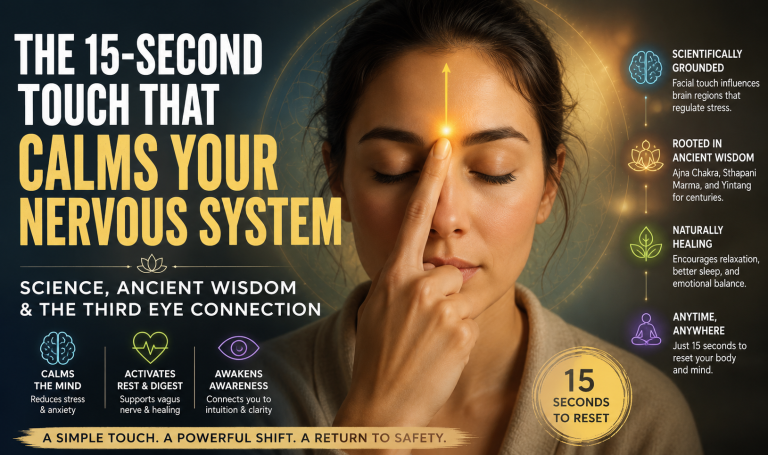
The point shown in the image—the area between the eyebrows, gently stroked upward toward the hairline—is not magic.
Yet it represents one of the most fascinating intersections between neuroscience, anatomy, meditation, Ayurveda, Yoga, Traditional Chinese Medicine, and spiritual traditions across the world.
Let’s explore why.
The Body Was Designed to Feel Safe
Your nervous system has one primary question it asks every second of your life:
“Am I safe?”
Everything else is secondary.
When your brain perceives danger—whether it is a charging tiger or an angry email—the sympathetic nervous system activates.
Your body instantly prepares for survival.
Heart rate increases.
Breathing becomes shallow.
Muscles tighten.
Blood leaves digestion and moves toward your limbs.
Stress hormones like adrenaline and cortisol flood your bloodstream.
This is commonly called the Fight-or-Flight Response.
It is one of evolution’s greatest gifts.
The problem?
Modern humans rarely face predators.
Instead, we experience…
- Financial stress
- Relationship conflict
- Endless notifications
- Traffic
- News
- Deadlines
- Emotional uncertainty
The nervous system often cannot distinguish between physical danger and psychological stress.
Eventually it remains partially activated all day.
Many people don’t live in survival mode.
They become survival mode.
Why Touch Changes the Brain
Human skin is the largest sensory organ in the body.
It contains millions of specialized receptors constantly sending information to the brain.
Gentle, slow touch activates unique nerve fibers known as:
C-Tactile Afferents
Unlike pain fibers or pressure receptors, these nerves specialize in pleasant, comforting touch.
When activated they communicate with brain regions involved in:
- Emotional regulation
- Social bonding
- Stress reduction
- Safety perception
Slow touch increases activity within the parasympathetic nervous system.
This is often called:
Rest and Digest
or
Feed and Breed
It is the physiological opposite of Fight or Flight.
Why This Particular Spot?
The point between the eyebrows is remarkable anatomically.
Several important structures lie beneath this region.
These include branches of the:
- Supraorbital nerve
- Supratrochlear nerve
Both originate from the ophthalmic division of the trigeminal nerve.
The trigeminal nerve is the largest cranial nerve in the body.
It constantly communicates with the brainstem.
Gentle stimulation here may influence brain regions involved in autonomic regulation.
Although research is still developing, facial touch is known to influence:
- Emotional processing
- Parasympathetic tone
- Pain modulation
- Relaxation
It is not because there is a hidden “off switch.”
Rather, the brain interprets gentle facial touch as:
“Nothing dangerous is happening right now.”
Safety signals accumulate.
Stress responses begin to soften.
Repetition Matters More Than Pressure
Notice that the technique is not pressing.
It is slowly stroking upward.
That matters.
The nervous system responds far more favorably to:
- predictable movement
- slow rhythm
- gentle repetition
than sudden force.
Rhythm is one of the oldest languages of biology.
The heartbeat.
Breathing.
Walking.
Ocean waves.
Mother rocking a baby.
The nervous system loves rhythm because rhythm predicts safety.
The Vagus Nerve Connection
Although this touch does not directly stimulate the vagus nerve itself, it may indirectly encourage parasympathetic activation.
The vagus nerve regulates:
- Heart rate
- Digestion
- Immune responses
- Emotional regulation
- Inflammation
- Social engagement
When we feel safe,
vagal activity increases.
Heart rate slows.
Digestion resumes.
Breathing deepens.
Inflammation decreases.
Healing begins.
This is why calming practices often combine:
- slow breathing
- soft facial muscles
- gentle touch
- stillness
Together they create a powerful message.
“You are safe.”
The Trigeminal-Vagal Conversation
Scientists increasingly recognize the close relationship between:
- facial sensory nerves
- brainstem nuclei
- autonomic regulation
The trigeminal nerve communicates with regions closely associated with vagal pathways.
While touching your forehead doesn’t “activate the vagus nerve” directly as many videos claim, it may contribute to an overall shift toward parasympathetic dominance.
Science supports the broader principle.
Not necessarily the sensational headline.
The Role of Slow Breathing
If you combine this gentle stroke with slow breathing, the effects become stronger.
For example:
Inhale for four seconds.
Exhale for six seconds.
Repeat while gently stroking upward.
Longer exhalations naturally encourage parasympathetic activation.
Your breathing becomes another safety signal.
The Spiritual Perspective
Long before neuroscience existed,
ancient yogis paid extraordinary attention to this exact location.
They called it:
Ajna Chakra
The Command Center.
The Third Eye
Ajna literally means:
“To perceive.”
or
“To command.”
It is considered the center of:
- intuition
- insight
- discrimination
- inner vision
- awareness
Many meditation traditions naturally draw attention to this point.
Not because of superstition,
but because attention itself changes consciousness.
Why Meditation Often Begins Here
When awareness rests gently between the eyebrows,
something interesting happens.
Mental chatter gradually slows.
The eyes become still.
Breathing softens.
Internal awareness increases.
Modern neuroscience would describe this as changes within:
- attentional networks
- the default mode network
- emotional regulation circuits
Ancient yogis simply called it:
Entering meditation.
Different language.
Similar observation.
The Pineal Gland Myth
Many people claim this point directly stimulates the pineal gland.
That is unlikely.
The pineal gland sits deep inside the brain.
Touching the forehead does not physically activate it.
However,
meditative practices focused here may influence brain activity in ways that indirectly affect sleep, circadian rhythms, and states of awareness.
The pineal gland is important.
The internet simply gives it more credit than current science supports.
Ayurveda and Marma Therapy
Ayurveda recognizes this region as:
Sthapani Marma
One of the vital energy points of the body.
Marma therapy teaches that gentle stimulation here helps balance:
- mental clarity
- emotional stability
- concentration
- sleep
Ayurvedic practitioners often apply warm oils to this area.
Perhaps the most famous example is:
Shirodhara
A continuous stream of warm herbal oil flowing over the forehead.
Many people experience profound relaxation during this treatment.
Research suggests Shirodhara may reduce stress markers, improve sleep quality, and support autonomic balance, though larger clinical studies are still needed.
Traditional Chinese Medicine
In acupuncture this region corresponds closely with:
Yintang
Often called:
“The Hall of Impression.”
Yintang is traditionally used for:
- anxiety
- insomnia
- headaches
- agitation
- emotional restlessness
Whether approached through meridians or neurophysiology,
different healing traditions independently recognized this location as calming.
Why Human Touch Heals
Perhaps the greatest lesson is not about a pressure point.
It is about touch itself.
Healthy touch releases:
- Oxytocin
- Endorphins
- Serotonin
It lowers stress hormones.
It regulates emotions.
It reminds the nervous system that we are connected.
This is why a parent’s hand on a frightened child often calms them faster than words.
The body understands touch long before language.
Kundalini Yoga and the Brow Point
Within Kundalini Yoga, the space between the eyebrows is known as the Brow Point, a primary focal point for meditation. Many practices ask practitioners to gently direct the eyes toward this point (with the eyelids closed) while maintaining a steady breath and mantra.
This is not simply symbolic.
Maintaining a gentle internal gaze helps reduce external sensory distraction, increases concentration, and supports a shift from reactive thinking toward witnessing awareness. Over time, practitioners often report greater emotional stability, clearer intuition, and a quieter mind.
In yogic language, the Brow Point is the seat of intuitive intelligence.
In neuroscience, it reflects changes in attention, self-regulation, and executive control.
Again, two traditions are often describing the same human experience through different frameworks.
A Simple Practice
The next time you notice yourself becoming overwhelmed:
- Sit comfortably.
- Relax your shoulders.
- Place one finger gently between your eyebrows.
- Slowly stroke upward toward your hairline.
- Repeat for 15–60 seconds.
- Breathe in through the nose for four seconds.
- Exhale slowly for six to eight seconds.
- Allow your jaw and forehead to soften.
- Observe any change without forcing an outcome.
Think of this practice as a gentle invitation rather than a guaranteed switch. For some people, it may feel immediately calming; for others, the effects may be subtle or emerge only when combined with slow breathing and regular practice.
What Science Actually Says
Current evidence suggests that gentle touch, slow breathing, and focused attention can reduce stress and support parasympathetic activity. However, there is no strong scientific evidence that a single forehead stroke “turns off” the fight-or-flight response instantly or that this specific point is a unique neurological switch.
Its benefit is more likely the result of several mechanisms working together:
- Pleasant tactile stimulation.
- Focused attention.
- Reduced muscle tension in the forehead and face.
- Slow, rhythmic movement.
- Conscious breathing.
- A subjective sense of safety.
In other words, the technique is plausible and may be genuinely helpful—but not because of a hidden “magic button.”
The Deeper Lesson
Perhaps the most profound truth is this:
Your nervous system does not require dramatic interventions to begin healing.
It responds to consistency more than intensity.
A gentle breath.
A compassionate touch.
A quiet moment of stillness.
These small acts, repeated day after day, gradually teach the body a new language—the language of safety.
The yogis discovered this through meditation.
Ayurvedic physicians refined it through Marma therapy.
Chinese physicians described it through meridians.
Modern neuroscience explores it through cranial nerves, sensory pathways, and autonomic regulation.
Each tradition points toward the same realization:
When the mind becomes still, the body remembers how to heal.
Sometimes, the journey back to peace begins with nothing more than a fingertip placed gently between the eyebrows—and the willingness to pause long enough to listen.