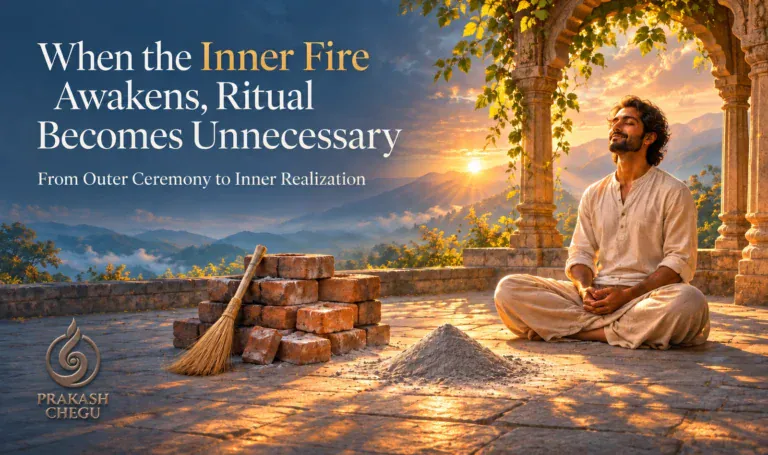
From Outer Ceremony to Inner Realization: The Forgotten Purpose of Spiritual Practice
The Sacred Fire Code · Part 12 of 15
There is a beautiful paradox at the heart of spiritual practice.
We begin by learning what to do.
How to sit.
How to breathe.
How to chant.
How to prepare a sacred space.
How to perform a ritual.
How to direct attention.
How to approach a teacher.
How to develop discipline.
And if we are sincere, we may spend years learning these things.
Yet many of the deepest spiritual teachings eventually ask us to recognize something quite different.
What if the purpose of all these practices is not to make us dependent upon increasingly elaborate techniques, but to help us discover a freedom that no longer depends upon them?
This question brings us to the philosophical culmination of our exploration of sacred fire.
We began with a single oil lamp.
We explored Deepavali.
Akasha.
The six chakras.
Panchagni.
Bhuta Shuddhi.
The fires of Ayurveda and Yoga.
The Dhuni of the sadhu.
And the sacred traditions of Yajna.
But if we stop at the external arrangements, we may miss their deepest possibility.
The lamp can illuminate a room.
The fire can transform an offering.
The ritual can organize attention.
The mantra can become a focus for devotion.
But none of these automatically guarantees liberation.
At some point, we must ask whether the practice is transforming our relationship with existence—or merely adding another layer to our spiritual identity.
This is where the teachings of the Upanishads and Bhagavad Gita become especially important.
1. The Difference Between the Means and the Destination
Imagine a person learning to swim.
At first, they may need instruction.
They may need assistance.
They may use flotation devices.
They must learn how to coordinate breathing, movement, and balance.
These supports are valuable.
Without them, the learning process might be much more difficult or unsafe.
But eventually, the swimmer must develop the ability to swim.
If they remain permanently convinced that they cannot enter the water without the original supports, something important has not been completed.
The same distinction appears in spiritual life.
A meditation technique can be valuable.
A sacred space can be valuable.
A ritual can be valuable.
A mantra can be valuable.
But the purpose of practice is not necessarily to accumulate an endless collection of supports.
It is to cultivate a transformation in the practitioner.
The outer discipline prepares the ground.
What grows from that preparation must eventually become part of the person’s way of being.
Otherwise, the practice remains confined to a particular time and place.
We may experience peace only when the room is silent.
Devotion only when the music is playing.
Clarity only when the ritual is being performed.
And spiritual confidence only when our familiar symbols are present.
This is not necessarily failure.
It may simply be a stage of development.
But it invites a question.
Can the qualities we cultivate through practice become available when the practice itself is no longer occurring?
2. The Bhagavad Gita: From Material Offering to Knowledge
One of the clearest statements appears in Bhagavad Gita 4.33.
श्रेयान्द्रव्यमयाद्यज्ञाज्ज्ञानयज्ञः परन्तप।
सर्वं कर्माखिलं पार्थ ज्ञाने परिसमाप्यते॥
Śreyān dravya-mayād yajñāj jñāna-yajñaḥ parantapa,
sarvaṃ karmākhilaṃ pārtha jñāne parisamāpyate.
The sacrifice of knowledge is superior to a sacrifice consisting of material offerings, and all action culminates in knowledge.
The verse is profound.
It does not simply condemn ritual.
It distinguishes between the material dimension of offering and a deeper transformation through knowledge.
A ritual action may have religious significance.
It may be prescribed within a tradition.
It may support devotion.
But its outward performance is not identical to realization.
The Gita places extraordinary importance on knowledge, discernment, devotion, and freedom from attachment.
This creates a hierarchy of spiritual understanding in which external actions are not necessarily the ultimate end.
But we must be careful.
The verse does not mean that all religious rituals are useless or that every practitioner should abandon them immediately.
Nor do all schools of Hindu philosophy interpret the relationship between ritual and knowledge identically.
The philosophical context matters.
The deeper insight is that the performance of a sacred act and the realization toward which it points are not the same thing.
That distinction is essential.
3. The Fire of Knowledge
Another remarkable verse appears in Bhagavad Gita 4.37.
यथैधांसि समिद्धोऽग्निर्भस्मसात्कुरुतेऽर्जुन।
ज्ञानाग्निः सर्वकर्माणि भस्मसात्कुरुते तथा॥
Yathaidhāṃsi samiddho’gnir bhasmasāt kurute’rjuna,
jñānāgniḥ sarva-karmāṇi bhasmasāt kurute tathā.
Just as a blazing fire reduces fuel to ashes, the fire of knowledge reduces karma to ashes.
The image is extraordinary.
We began this series by examining the physical flame.
Now the Gita speaks of knowledge itself as fire.
The analogy is not that knowledge literally performs combustion.
The verse describes spiritual transformation using the familiar power of fire as a metaphor.
Within traditional commentarial interpretations, knowledge changes the binding relationship between the individual and karma.
The precise philosophical explanation varies among commentators.
But the central image is unmistakable.
Fire transforms its fuel.
Knowledge transforms our relationship to bondage.
This raises an important question.
What kind of knowledge is being discussed?
Certainly not merely accumulated information.
A person can memorize philosophical teachings and remain deeply attached to anger, pride, or fear.
A person can quote the Upanishads while behaving without compassion.
Information becomes spiritually meaningful when it contributes to a transformation in understanding.
The distinction is between knowing about freedom and becoming free from the forms of ignorance that bind us.
4. The Ritual Can Become Another Form of Attachment
This is a difficult subject.
Because spiritual practitioners are often deeply attached to their practices.
We may become attached to the exact time of meditation.
The specific number of repetitions.
The arrangement of sacred objects.
The sound of a particular mantra.
The atmosphere of a particular teacher’s presence.
The sensations produced by a particular kriya.
These attachments may begin innocently.
A practice offers something meaningful.
We repeat it.
We begin to associate it with peace, identity, belonging, or progress.
Eventually, the method becomes emotionally indispensable.
And then something interesting happens.
The very practice intended to support freedom begins to produce anxiety when its familiar conditions are unavailable.
A missed meditation becomes a source of fear.
A change in routine creates distress.
The absence of a particular ritual makes us feel spiritually vulnerable.
The method has become more than a support.
It has become part of the identity we are trying to protect.
This does not mean that discipline is unnecessary.
Consistency is extraordinarily important.
But discipline and dependency are not the same.
Discipline supports a chosen direction.
Dependency makes our well-being conditional upon preserving a particular arrangement.
The distinction may be subtle.
Yet it deserves serious attention.
5. The Bhagavad Gita’s Vision of the Sacred Offering
Bhagavad Gita 4.24 offers one of the most beautiful descriptions of the internalization of sacrifice.
ब्रह्मार्पणं ब्रह्म हविर्ब्रह्माग्नौ ब्रह्मणा हुतम्।
ब्रह्मैव तेन गन्तव्यं ब्रह्मकर्मसमाधिना॥
Brahmārpaṇaṃ brahma havir brahmāgnau brahmaṇā hutam,
brahmaiva tena gantavyaṃ brahma-karma-samādhinā.
The offering is Brahman.
The oblation is Brahman.
The fire is Brahman.
The offering is made by Brahman.
And Brahman is the goal for one whose awareness is absorbed in action as Brahman.
This is a nondual interpretation of ritual action articulated within the verse.
Different philosophical commentators elaborate the meaning according to their traditions.
Yet the imagery is remarkable.
The ordinary structure of sacrifice contains distinctions.
There is the one who offers.
The substance being offered.
The instrument of offering.
The fire receiving the offering.
And the sacred purpose of the act.
But here the distinction is transformed through an understanding of Brahman.
The ritual becomes a way of contemplating a deeper unity.
This is no longer merely an external transaction.
It is a transformation in perception.
The practitioner is invited to reconsider the apparent separation between the actor, the action, and the ultimate reality toward which the action is directed.
6. The Upanishadic Movement Beyond External Action
The Upanishads contain important reflections on the limits of ritual when considered in relation to ultimate knowledge.
The Mundaka Upanishad is especially relevant.
Its first chapter distinguishes between lower and higher knowledge.
The lower includes the Vedas and associated disciplines within its particular philosophical framework.
The higher is that through which the imperishable is known.
In the second section of the first Mundaka, the text discusses ritual action and its limitations.
Mundaka Upanishad 1.2.10 declares:
इष्टापूर्तं मन्यमाना वरिष्ठं
नान्यच्छ्रेयो वेदयन्ते प्रमूढाः।
Iṣṭāpūrtaṃ manyamānā variṣṭhaṃ
nānyac chreyo vedayante pramūḍhāḥ.
The passage criticizes those who regard sacrificial and meritorious works as the highest good and fail to recognize something beyond them.
The text continues by explaining that the fruits of such works do not provide ultimate liberation.
This is important.
The Upanishad does not merely say that a poorly performed ritual is insufficient.
It challenges the assumption that ritual merit is the highest spiritual achievement.
Within its philosophical vision, the imperishable must be known through a deeper form of realization.
But once again, we should not generalize one Upanishadic argument into the claim that every Hindu tradition rejects ritual.
The relationship between action, devotion, knowledge, and liberation is interpreted differently across schools.
Still, the Upanishadic challenge is powerful.
What if we become very skilled at performing sacred actions while never questioning the fundamental ignorance that makes us feel separate, incomplete, and bound?
That is the problem the text invites us to confront.
7. The Difference Between Experience and Realization
This distinction has become increasingly important in modern spiritual culture.
People seek extraordinary experiences.
A powerful meditation.
A dramatic emotional release.
A sensation of energy rising.
An altered state of consciousness.
A vision.
A feeling of boundless love.
A period of intense bliss.
These experiences can be meaningful.
They may influence a person’s understanding of life.
But experience and realization should not automatically be treated as identical.
An experience arises.
It remains for some duration.
It changes.
And eventually, it ends.
A person may have a powerful meditative experience and later become angry, frightened, jealous, or confused.
That does not invalidate the experience.
But it should make us cautious about interpreting it as permanent liberation.
The deeper question is what remains when the experience is gone.
Has our relationship with suffering changed?
Have we become more compassionate?
Are we less identified with our habitual reactions?
Can we tolerate uncertainty?
Can we admit when we are wrong?
Can we remain engaged with life without becoming entirely dependent upon its outcomes?
These questions may reveal more about the integration of spiritual practice than the intensity of any single experience.
8. What Does It Mean to Be Established Within?
Sadhguru suggests that a person who knows how to turn inward and remain established in a certain inner condition does not require external ritual support in the same way.
The person’s presence itself becomes sufficient.
This belongs to his spiritual teaching framework.
It should not be interpreted as a scientifically demonstrated claim that one person’s body generates a measurable energy field millions of times stronger than a sacred-fire arrangement.
But the philosophical message is worth examining.
What would it mean to become less dependent upon favorable circumstances?
Not indifferent to life.
Not emotionally numb.
Not incapable of receiving support.
But less easily governed by every external change.
Imagine someone who can remain attentive during disagreement.
Someone who can experience disappointment without immediately collapsing into resentment.
Someone who can enjoy comfort without becoming unable to tolerate discomfort.
Someone who can experience praise without becoming inflated and criticism without losing all stability.
Such a person has developed a valuable form of freedom.
It may not be complete enlightenment.
But it represents a meaningful transformation in the relationship between inner experience and outer conditions.
A practice that moves us toward this kind of responsiveness has served an important purpose.
9. The Danger of Rejecting Ritual Too Early
There is another side to the question.
Sometimes people hear that the highest realization transcends ritual and conclude that ritual is therefore unnecessary for them.
They reject practices they have barely understood.
They dismiss discipline.
They claim to be beyond techniques.
They announce that everything is already perfect.
And sometimes this becomes another subtle expression of ego.
There is a difference between no longer needing a support because one has genuinely developed the capacity it was designed to cultivate and rejecting the support because one dislikes discipline.
The musician who has internalized rhythm may no longer require a metronome in every session.
But the beginner who refuses to practice with one has not thereby become advanced.
Similarly, the language of transcendence can become an excuse for avoiding the ordinary work of spiritual development.
We may declare ourselves beyond meditation because sitting still reveals our restlessness.
Beyond ethical discipline because responsibility feels restrictive.
Beyond teachers because correction threatens our identity.
Beyond tradition because careful study requires patience.
This is not necessarily freedom.
It may be resistance disguised as realization.
A mature practitioner does not need to prove independence by rejecting every method.
They recognize the appropriate role of each method.
And they remain willing to learn.
10. Patanjali: Practice and Non-Attachment
Patanjali’s Yoga Sutra 1.12 states:
अभ्यासवैराग्याभ्यां तन्निरोधः॥
Abhyāsa-vairāgyābhyāṃ tan-nirodhaḥ.
The stilling of the mind’s fluctuations is through practice and dispassion.
Two principles are presented together.
Abhyasa.
Vairagya.
Practice.
Non-attachment.
This pairing is significant.
Without practice, we may lack the steadiness needed for deeper inquiry.
Without non-attachment, practice itself may become another source of identification.
We begin to accumulate achievements.
Longer meditation.
More advanced techniques.
Greater experiences.
Recognition from others.
But spiritual practice is not simply another competition.
Non-attachment invites us to examine our relationship with the results.
Can we practice sincerely without turning every session into a judgment of our spiritual worth?
Can we remain committed without becoming rigid?
Can we value the method without worshipping our own proficiency?
This is an important balance.
The method supports discipline.
Non-attachment prevents discipline from becoming another prison.
11. When the Teacher Becomes More Important Than the Teaching
External ritual is not the only possible source of dependency.
A practitioner may also become overly dependent upon a teacher.
A lineage.
A community.
A particular vocabulary.
Or an identity built around belonging to a spiritual tradition.
Genuine teachers can be extraordinarily valuable.
They preserve knowledge.
Correct mistakes.
Offer perspective.
Provide structure.
And sometimes help students recognize possibilities they would not have discovered alone.
But the relationship should not require surrendering discernment.
A teacher who encourages awareness should not demand unquestioning obedience in every aspect of a student’s life.
A lineage should not become an excuse to avoid ethical responsibility.
And devotion should not require the abandonment of reason.
The deeper purpose of guidance is not to make students permanently incapable of independent understanding.
It is to support their maturation.
This is particularly important for anyone who teaches yoga.
The goal should not be to produce dependence.
It should be to cultivate capable, discerning practitioners.
People who can practice sincerely.
Question responsibly.
Recognize their limits.
And participate in life with greater awareness.
12. Can Ordinary Life Become the Yajna?
Perhaps one of the most beautiful possibilities emerges when ritual no longer remains confined to a special occasion.
A person prepares a meal.
Could the act become an expression of care?
A parent listens to a child.
Could listening become a conscious offering?
A teacher enters a classroom.
Could teaching become an act of service rather than performance?
Two partners face a difficult conversation.
Could they approach it with the willingness to understand rather than simply win?
Someone encounters a person in need.
Could generosity become a natural expression of responsibility?
These are not formal replacements for traditional Vedic rituals.
But they express the broader philosophical possibility of sacred action.
The Bhagavad Gita repeatedly challenges the assumption that spiritual freedom requires the abandonment of all worldly participation.
Action can be performed with a different relationship to attachment and outcome.
This is particularly important in Grihastha life.
The householder does not necessarily have the opportunity to sit beside a Dhuni for years.
There are children to raise.
Elders to care for.
Food to prepare.
Responsibilities to fulfill.
Communities to support.
But these activities need not be considered spiritually inferior simply because they occur outside a monastery.
They can become the field in which awareness matures.
The deepest question is not how to escape responsibility.
It is how to act without becoming entirely bound by self-centered motives.
13. A Contemplation: What Would Remain Without the Ritual?
I would like to offer an exercise for practitioners who have developed an established Sadhana.
This is not an invitation to abandon essential practices or ignore legitimate guidance.
It is an inquiry into the relationship between method and awareness.
Begin with your ordinary meditation or devotional practice.
Perform it sincerely.
Then sit quietly.
Notice the experience that remains when the deliberate technique has ended.
Do not immediately search for another practice.
Do not try to reproduce the most pleasant sensation.
Simply observe.
Ask yourself:
What quality of awareness has this practice helped me cultivate?
Then consider another question:
Can I remain connected to that quality when the external conditions change?
Perhaps the room becomes noisy.
Perhaps a responsibility interrupts the schedule.
Perhaps the day does not unfold as expected.
The inquiry is not whether you can remain perfectly calm through every difficulty.
The inquiry is whether the fruits of practice are gradually becoming available beyond the ritual setting.
Later, reflect on your ordinary interactions.
Did the practice influence how you listened?
How you spoke?
How you made decisions?
How you responded to disappointment?
That is where the investigation becomes meaningful.
14. The Final Paradox: Nothing Needs to Be Added
There is a reason the language of light appears so frequently in spiritual traditions.
Light reveals.
A lamp does not need to create the objects already present in a room.
It makes them visible.
This is a powerful contemplative metaphor.
Perhaps the deepest work of awareness is not always to manufacture something extraordinary.
Perhaps it is to recognize what has been obscured by habitual identification.
The constant movement of thought.
The compulsion to define ourselves.
The fear of uncertainty.
The belief that fulfillment must arrive through one more achievement.
One more experience.
One more relationship.
One more spiritual technique.
One more stage of progress.
The mind can turn spirituality into an endless project of becoming.
But what happens when we begin to examine the one who insists upon becoming?
Who is seeking?
What is missing?
What exactly do we believe realization will give us?
These are not questions that can be resolved through slogans.
They require sustained inquiry.
And perhaps that is why the outer practices exist.
To help us become quiet enough, attentive enough, and honest enough to encounter questions that ordinary distraction allows us to avoid.
15. The Flame Has Fulfilled Its Purpose
We began with a lamp.
A small flame rising from a cotton wick.
Then we moved through a civilization’s extraordinary relationship with fire.
Vedic offerings.
Sacred geometry.
Tantric purification.
The Dhuni of the sadhu.
The fire of digestion.
The fire of knowledge.
The symbolism of Akasha.
And the preparation of sacred space.
Each revealed another way human beings have attempted to understand the relationship between the visible and the invisible.
The outer and the inner.
Action and awareness.
Transformation and realization.
But the most important question remains personal.
What is happening to us through these practices?
Are we becoming more conscious?
More compassionate?
More available to life?
Less dominated by our habitual reactions?
More capable of meeting reality without immediately needing to change it?
If the answer is yes, the practices are serving us.
If the answer is no, we may need to examine our relationship with them.
Because the purpose of spirituality is not merely to create impressive rituals.
It is not to accumulate unusual experiences.
It is not to decorate an identity with sacred terminology.
And it is not to establish superiority over those who practice differently.
The deepest possibility is liberation.
Freedom from compulsive identification.
Freedom from ignorance.
Freedom from the assumption that the outer world must constantly conform to our preferences before we can be at peace.
This does not mean that an enlightened person must abandon every ritual.
A realized practitioner may continue performing ceremonies out of devotion, compassion, or respect for tradition.
The difference lies in the relationship to the act.
A ritual may remain meaningful without being experienced as the source of one’s fundamental freedom.
That is a subtle but essential distinction.
Ritual becomes unnecessary not when we reject it, but when the freedom it was meant to support is no longer dependent upon its performance.
And perhaps this is the most profound lesson the fire can teach us.
The lamp burns.
It illuminates.
It consumes its fuel.
And eventually, it goes out.
But the awareness through which we contemplated it need not disappear with the flame.
The outer fire was a teacher.
The ritual was a preparation.
The sacred space was a sanctuary.
The practice was a path.
And the ultimate invitation has always been to turn inward.
Not to escape the world.
But to participate in it from a freedom that is no longer entirely determined by circumstances.
When that becomes possible, the spiritual journey has entered a different dimension.
The practitioner no longer needs to make every place sacred through elaborate arrangements.
Their presence can become an expression of reverence.
Their work can become service.
Their relationships can become opportunities for awareness.
And their ordinary life can become a field of realization.
The fire has not disappeared.
Its meaning has been internalized.
Continue Exploring The Sacred Fire Code
Previously: Agnihotra, Homa, Havan and Yajna — Are They Really the Same?
Next: The Flame and the Brain — What Happens When We Meditate by Firelight?
Related articles: The Forgotten Science of Lighting an Oil Lamp; Bhuta Shuddhi; The Fires Within; Panchagni Vidya — The Five Fires of the Upanishads.
Sources and Further Reading
-
Bhagavad Gita 4.24 — The offering, oblation, fire, and act of sacrifice understood through Brahman. https://heritage.iitk.ac.in/SBG/4.24
-
Bhagavad Gita 4.33 — The superiority of Jnana Yajna to material offering. https://heritage.iitk.ac.in/SBG/4.33
-
Bhagavad Gita 4.37 — The fire of knowledge and the transformation of karma. https://heritage.iitk.ac.in/SBG/4.37
-
Mundaka Upanishad 1.1.4–5 and 1.2.7–12 — Higher knowledge, ritual action, and the imperishable.
-
Patanjali, Yoga Sutra 1.12–14 — Practice, non-attachment, and continuity.
-
Bhagavad Gita 3.9 — Action performed for the purpose of Yajna.
-
Traditional commentaries of Shankaracharya and Ramanujacharya on Bhagavad Gita chapter 4, for differing philosophical interpretations.
-
Sadhguru’s teachings on inner mastery, sacred fire, and the secondary role of external ritual.
Research note: The philosophical internalization of ritual should not be confused with the claim that all Hindu traditions regard ritual as obsolete. Traditions differ in their understanding of the relationship between action, devotion, knowledge, and liberation.
Series Navigation
Previous: Part 11 · Agnihotra, Homa, Havan and Yajna: Are They Really the Same?
View the Complete Sacred Fire Code series
Next: Part 13 · The Flame and the Brain: What Happens When We Meditate by Firelight?