Trataka, the Neuroscience of Attention, Circadian Biology and the Ancient Practice of Gazing Into Light
The Sacred Fire Code · Part 13 of 15
There is something remarkable about the relationship between the human eye and a small flame.
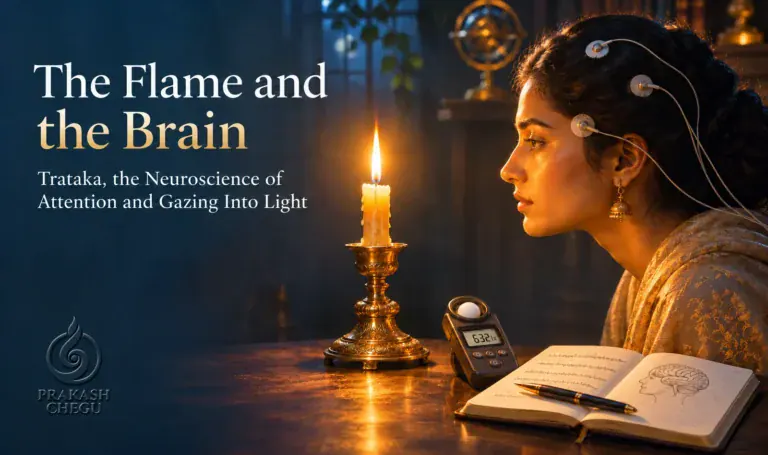
Place a diya in a quiet room.
Turn down the surrounding lights.
Sit comfortably.
And simply observe.
Almost immediately, something interesting begins to happen.
The flame moves, but it does not travel very far.
It changes shape, yet remains recognizable.
Its brightness fluctuates.
Its colors shift.
And the mind, ordinarily occupied with a hundred different concerns, is invited to become interested in one simple phenomenon.
Why?
What is happening to our visual system when we observe a flame?
What is happening to attention?
And why did traditional yogic practices develop disciplined methods of gazing at an object?
These questions become particularly interesting when we explore Trataka, one of the classical practices described in Hatha Yoga.
But to understand Trataka properly, we must distinguish several different things.
The physical properties of the flame.
The way the visual system processes light.
The biological effects of illumination.
The training of attention.
And the spiritual meaning assigned to the practice.
These dimensions may interact, but they are not identical.
As an engineer, I find this distinction essential.
And as someone who has spent years teaching meditation, I find the relationship between attention and experience even more interesting than the flame itself.
Perhaps the deepest question is not what the flame does to our brain.
Perhaps it is what we discover about the mind when we finally give it something simple enough to observe.
1. Why Is a Flame So Captivating?
Consider the extraordinary complexity of ordinary vision.
Every moment, light enters the eyes.
The retina transforms patterns of illumination into neural signals.
These signals participate in complex processes involving visual pathways and multiple brain regions.
The brain identifies edges, movement, contrast, color, spatial relationships, and meaningful objects.
Yet what we experience is not a conscious analysis of millions of individual signals.
We simply see.
The complexity is hidden beneath the apparent simplicity of perception.
A flame offers an interesting visual object because it combines continuity with change.
It has a relatively stable location.
Yet its shape is never entirely fixed.
Its edges move.
Its brightness changes.
Air currents alter its form.
The flame invites ongoing observation without requiring us to follow a completely new object every moment.
This does not establish that flames possess a unique neurological property unavailable to other visual objects.
But it helps explain why a flame can function as an engaging focus for contemplation.
A flower can serve as an object of meditation.
So can a geometric figure.
A point on a wall.
A sacred image.
Or a carefully chosen visual symbol.
The important question is not necessarily which object produces the most dramatic sensation.
It is how the act of observation changes the quality of attention.
2. Trataka: The Ancient Practice of Steady Gazing
Trataka is described in the Haṭha Yoga Pradīpikā, a foundational text of Hatha Yoga associated with Svātmārāma.
In a commonly used verse numbering, chapter 2, verse 31 states:
निरीक्षेन्निश्चलदृशा सूक्ष्मलक्ष्यं समाहितः।
अश्रुसम्पातपर्यन्तमाचार्यैस्त्राटकं स्मृतम्॥
Nirīkṣen niścala-dṛśā sūkṣma-lakṣyaṃ samāhitaḥ,
aśru-sampāta-paryantam ācāryais trāṭakaṃ smṛtam.
A close rendering is:
The concentrated practitioner gazes steadily at a small target, without moving the gaze, until tears arise; the teachers call this Trataka.
The following verse describes traditional benefits attributed to the practice.
Two points deserve particular attention.
First, the text specifies a small target.
It does not insist that the target must be a flame.
The identification of Trataka exclusively with candle gazing is narrower than the wording of this verse.
Second, the traditional instruction concerning tears should not become a universal recommendation for modern beginners.
Deliberately suppressing blinking can cause discomfort and worsen dryness, especially for people with vulnerable ocular surfaces.
We should understand the historical instruction without assuming that every traditional detail is appropriate for unsupervised practice.
There is also a textual complication.
Different editions of the Hatha Yoga Pradipika use slightly different verse numbering. The Trataka instruction appears as 2.31 in some editions and 2.32 in others.
For serious teaching, it is worth identifying the edition being cited.
A tradition deserves that level of care.
3. Trataka Is More Than Looking at a Candle
In many contemporary yoga classes, Trataka is described simply as staring at a candle flame.
But the classical context is broader.
Trataka is included among the Shatkarmas, the six cleansing practices described in Hatha Yoga literature.
These practices belong to a particular system of bodily preparation and yogic discipline.
That context matters.
Trataka was not originally presented merely as a productivity technique for improving concentration during office work.
Nor should it be reduced to a universal treatment for eye disorders.
Within its traditional setting, it forms part of a larger path of disciplined practice.
The practitioner’s attention, conduct, physical preparation, and relationship with the teacher may all be significant.
But we can still investigate one particular aspect of Trataka scientifically.
Does repeatedly directing visual attention toward a stable object influence measurable cognitive performance?
That is a legitimate question.
And recent research has begun to examine it.
4. What the 2026 Randomized Controlled Trial Found
In 2026, researchers published a randomized controlled trial titled Effects of Jyoti Trataka Practice on Reaction Time and Visual Perception in Young Adults in the International Journal of Yoga.
The study enrolled 120 healthy young adults.
Participants were randomized into two groups.
Sixty participants practiced Jyoti Trataka for eight weeks, twenty minutes per day, six days per week.
The other sixty formed a no-intervention control group.
The researchers measured aspects of reaction time and visual perception.
Visual perception was evaluated partly through susceptibility to the Müller-Lyer illusion, a familiar visual illusion in which line lengths can appear different depending upon surrounding arrow-like configurations.
The Trataka group demonstrated statistically significant improvements in certain reaction-time measures and reductions in the measured degree of visual illusion.
These findings are interesting.
They suggest that regular Trataka practice may influence particular aspects of visual attention or perceptual performance.
But we must be careful with interpretation.
The participants were healthy young adults.
The study lasted eight weeks.
The comparison group did not receive a matched alternative attentional intervention.
This means the trial does not fully distinguish the specific contribution of flame gazing from the benefits of sustained visual concentration, practice expectations, or other nonspecific factors.
It also does not demonstrate that Trataka improves eyesight in every person.
Nor does it establish that the flame produces an Akashic field.
And it certainly does not prove spiritual enlightenment.
The evidence supports a narrower conclusion.
A structured Trataka intervention was associated with improvements in certain measured cognitive and perceptual outcomes under the conditions of this study.
That is already worth investigating.
We do not need to exaggerate it.
5. Trataka, Eye Strain and the Problem of Interpretation
Another randomized trial examined Trataka in people experiencing computer-related eye strain.
The study involved 300 volunteers and compared Trataka, a cold eye-pack intervention, and a waitlist control over two weeks.
Both the Trataka and cold eye-pack groups showed improvements in self-reported symptoms compared with the waitlist group.
The researchers did not identify a significant difference between the two active interventions on the principal reported symptom scales.
This distinction is important.
When two very different interventions produce similar improvements, we should not immediately conclude that one possesses a unique energetic mechanism.
The observed results may involve relaxation, changes in attention, reduced visual demand, expectation, or other effects.
Further studies with stronger controls are needed to identify the mechanisms.
This is precisely how scientific inquiry should develop.
A study produces an observation.
Researchers investigate possible explanations.
Further experiments test those explanations.
And conclusions become more reliable as evidence accumulates.
One study is not the final word.
It is part of a continuing investigation.
6. The Eye Is Not Simply a Camera
The human visual system does much more than create images of the external world.
Light also influences biological processes that do not primarily concern conscious image formation.
Specialized retinal cells, including intrinsically photosensitive retinal ganglion cells containing melanopsin, contribute to the regulation of circadian rhythms.
Their signaling helps the body respond to environmental light.
This is one reason the timing of illumination matters.
Light in the morning can have different circadian effects from light late in the evening.
And the effects depend on spectral composition, intensity, exposure duration, and individual circumstances.
This is not a vague spiritual claim.
It is an extensively investigated area of physiology.
In 2022, an international group of researchers published expert consensus recommendations concerning indoor light exposure for healthy adults.
The recommendations distinguish daytime, evening, and nighttime environments.
They emphasize relatively strong biologically effective illumination during the day and substantially reduced melanopic light exposure in the period preceding sleep.
The important principle is that the human body responds to light according to biological timing.
More illumination is not always better.
And less illumination is not always better.
The appropriate conditions depend upon when and why the light is being used.
7. Why Evening Firelight Feels Different
A small oil lamp typically produces warm, relatively low-intensity illumination compared with a brightly lit modern room.
It may create a visually intimate environment.
The surroundings become less dominant.
The flame becomes more noticeable.
The room acquires a different sensory character.
For a practitioner, that shift may support contemplative attention.
However, it would be a mistake to claim that warm light automatically causes spiritual perception.
The experience depends upon many factors.
The brightness of the flame.
Its distance from the eyes.
The surrounding illumination.
The duration of exposure.
The person’s expectations.
Their familiarity with meditation.
And the broader psychological setting.
A warm electric light can also create a quiet visual environment without combustion.
The physiological effects of illumination do not depend upon the light having been produced through a sacred ritual.
At the same time, the emotional meaning of lighting a traditional diya may differ substantially from switching on a lamp.
A person’s memories, cultural associations, devotional intentions, and sense of continuity with family traditions can all shape the experience.
We should distinguish the biology of light from the psychology of ritual.
Both can matter.
But they explain different aspects of the event.
8. Melatonin, Circadian Rhythms and the Problem With Bright Nights
A study published in 2011 examined how room lighting before bedtime influenced melatonin in healthy young adults.
Compared with very dim light, ordinary room-light exposure delayed melatonin onset in nearly all participants and shortened the period of melatonin secretion.
The findings helped demonstrate that even familiar indoor lighting can meaningfully influence human biological rhythms.
This has important implications for modern living.
We regularly surround ourselves with bright screens and artificial illumination long after sunset.
Our ancestors lived under very different lighting conditions.
But we must avoid romanticizing all historical conditions.
Before modern lighting, people also experienced smoke exposure, limited visibility, and the practical dangers associated with open flames.
The past was not automatically healthier.
And a traditional oil lamp is not necessarily the best modern lighting technology.
The useful lesson is more precise.
Light is a biological signal.
Its timing matters.
An evening environment designed to support the transition toward sleep may benefit from reduced brightness and appropriate spectral characteristics.
But during the day, adequate daylight exposure remains important.
This is particularly relevant when considering seasonal mood and sleep.
The solution is not simply to replace every electric light with a diya.
It is to understand the relationship between illumination and biological rhythm.
9. The Flame, Attention and the Restless Mind
Now let us return to meditation itself.
What happens when we sit and observe a small flame?
One of the first things we notice is how quickly attention moves.
We begin with the flame.
Then a thought appears.
Perhaps about work.
A conversation.
An unresolved decision.
A memory.
A future possibility.
A bodily discomfort.
Before we realize it, several minutes may have passed.
We are looking in the direction of the flame, but we are no longer consciously observing it.
This is an extraordinary discovery.
Not because the flame has revealed a supernatural secret.
But because it has shown us something about the mind.
We are often much less conscious of our attentional habits than we imagine.
We assume we are directing attention.
Yet attention is continually being pulled by memories, emotional reactions, and expectations.
A simple visual object allows this movement to become more noticeable.
And with repeated practice, the practitioner may develop a different relationship with distraction.
The purpose is not necessarily to eliminate every thought.
It is to recognize when attention has moved and return deliberately.
That act of returning may be more important than the duration of uninterrupted concentration.
10. Is the Flame Hypnotic?
People sometimes describe the movement of fire as hypnotic.
But the term can be misleading.
Hypnosis has specific meanings in psychology and clinical research.
A person becoming absorbed in the sight of a flame is not necessarily entering a hypnotic state.
What we can say is that a flame provides a dynamic visual stimulus capable of sustaining interest.
Its movement and luminosity may encourage absorption.
But absorption is not automatically equivalent to meditation.
We can become absorbed in a film.
A sporting event.
A video game.
A conversation.
Or an emotionally intense memory.
The content of attention is not the only issue.
What matters is the quality of awareness accompanying it.
A person may watch a flame while remaining entirely lost in thought.
Another may observe the same flame with careful attention.
A third may use the flame as a devotional symbol.
These are different experiences.
We should not assume that the physical object determines the inner state.
11. The Akashic Circle Around the Flame
In a contemporary teaching that inspired this series, Sadhguru describes an etheric or Akashic region surrounding an oil-lamp flame.
He suggests that particular types of fire may support subtle perception.
This belongs to a spiritual framework in which Akasha is understood as the fifth element.
The claim is interesting and worthy of respectful examination.
But it has not been independently demonstrated through established scientific measurement.
A flame certainly creates measurable physical effects.
Heat is transferred to the surrounding air.
Convection currents develop.
Light and infrared radiation are emitted.
Chemical substances are released.
The local environment changes.
These phenomena can be studied.
But observing these effects does not establish the existence of a separate Akashic sphere with a particular diameter.
Nor does a subjective sense of expanded awareness prove the proposed mechanism.
I believe it is possible to respect the contemplative teaching without overstating the evidence.
The practitioner may experience something meaningful.
The scientist may investigate measurable changes.
The philosopher may ask what perception itself means.
Each inquiry has value.
But the integrity of the investigation requires us to know which question we are answering.
12. The Hidden Cost of Oil-Lamp Combustion
There is another dimension we must not ignore.
An oil lamp is a combustion device.
And combustion can produce indoor pollutants.
A 2024 study examining carbonaceous aerosol emissions from secondary lighting sources reported substantial elemental-carbon emissions from sesame-oil lamps under laboratory conditions.
The measured emissions demonstrate that the ritual importance of a fuel does not guarantee clean combustion.
This matters especially when someone recommends burning numerous oil lamps for hours inside an enclosed room.
Even a beautiful ritual can create undesirable air quality.
The risk depends on several factors, including ventilation, fuel, wick design, burn duration, and the number of lamps.
Children and people with respiratory or cardiovascular vulnerabilities may be particularly sensitive to indoor air pollution.
A practitioner should not assume that inhaling combustion emissions is spiritually purifying.
Nor should a meditation teacher advise prolonged smoke exposure as a therapeutic practice.
If the purpose is to establish a quiet visual environment, safer alternatives are available.
A single brief, attended diya may be meaningful in an appropriate setting.
A flameless lamp can preserve the symbolic act of illumination without introducing combustion.
The spiritual value of a practice should never require us to disregard basic physical safety.
13. A Gentle Flame Contemplation
For those who wish to explore flame-based attention, I suggest a brief, cautious approach rather than attempting to reproduce the demanding classical instruction.
This is not an advanced Trataka protocol.
It is a general contemplative exercise.
Choose a well-ventilated, safe place.
If you use a real diya, place it on a stable noncombustible surface, away from fabrics and other flammable materials.
Keep water and electrical equipment away from the flame.
Sit comfortably.
Allow the spine to rise naturally.
Begin with your eyes closed or with a soft downward gaze.
Notice the body.
Observe the natural breath.
Then, if your eyes are comfortable, look gently toward the flame for a short period.
Do not force the eyes to remain open.
Blink naturally.
Do not stare through pain or dryness.
If the light is uncomfortable, stop.
Return to a soft gaze or close your eyes.
Notice the movement of attention.
When thoughts arise, recognize them.
When attention moves away, return without frustration.
After a few minutes, end the observation.
Sit quietly.
Notice whether you feel more settled, distracted, or unchanged.
All three possibilities are legitimate observations.
Those with eye disorders, significant light sensitivity, migraine triggered by visual stimuli, or other relevant conditions should seek appropriate medical guidance rather than forcing flame gazing.
Never gaze at the sun or other intensely bright sources.
And never leave a flame unattended.
14. What Is the Real Measure of Perceptual Refinement?
There is a tendency in spiritual culture to define progress through increasingly extraordinary experiences.
Seeing colors.
Perceiving lights.
Feeling vibrations.
Experiencing visions.
Sensing invisible fields.
These experiences can be meaningful to the person having them.
But they are not automatically evidence of spiritual maturity.
A more reliable practical question may be:
Does meditation help us perceive ordinary life more accurately?
Can we recognize when we are projecting our fears onto another person?
Can we notice the moment anger begins before it becomes harmful speech?
Can we distinguish what someone actually said from the interpretation we immediately created?
Can we remain attentive when an experience does not confirm our expectations?
Can we see the humanity of someone with whom we disagree?
These are profound forms of perceptual refinement.
And they matter enormously.
A practitioner may spend years gazing at a flame.
But if they remain unable to listen carefully to another human being, what has been illuminated?
We should not measure spiritual depth only through the capacity to sustain a visual fixation.
The practice must eventually influence the way we participate in life.
15. The Flame Was Never the Destination
I began with a small diya in a quiet room.
We examined its light.
Its movement.
The science of vision.
The biology of circadian rhythms.
The traditional discipline of Trataka.
The research on attention.
And the spiritual claims surrounding Akasha.
But perhaps the most important discovery is simpler.
A flame can become a mirror for attention.
Not because it reflects our face.
But because it reveals how quickly the mind wanders.
How strongly we seek stimulation.
How easily thoughts become identities.
And how difficult it can be to remain with one simple experience.
The act of observing may become an invitation to greater awareness.
Yet the flame is not the ultimate object of spiritual life.
It is a support.
A teacher.
A reminder.
When the eyes close, the inquiry can continue.
When the lamp is extinguished, attention need not disappear.
When the ritual ends, awareness can remain available.
The true purpose of gazing into a flame is not merely to become better at looking at fire. It is to discover whether we can become more conscious of the one who is looking.
That is where the science of attention and the contemplative wisdom of yoga can enter into a meaningful conversation.
Not by pretending they are identical.
But by allowing each to illuminate a different dimension of our experience.
The flame gives us light.
The practice gives us an opportunity to observe.
And awareness asks what we will do with what has become visible.
Continue Exploring The Sacred Fire Code
Previously: When the Inner Fire Awakens, Ritual Becomes Unnecessary.
Next: Copper, Water, Earth and Fire — Why Sacred Rituals Use Natural Materials.
Related articles: The Forgotten Science of Lighting an Oil Lamp; Deepavali — The Festival That Keeps the Inner Fire Alive; Akasha — The Fifth Element and the Forgotten Dimension of Perception; Conscious Stillness vs. Compulsive Inertia.
Sources and Further Reading
-
Svātmārāma, Haṭha Yoga Pradīpikā, chapter 2, Trataka verses 31–32 in one common numbering.
https://www.sanskrit-trikashaivism.com/en/hatha-yoga-pradipika-shatkarma-and-pranayama/624 -
Yadav, K., Yadav, A., Singh, S., & Singh, D. (2026). Effects of Jyoti Trataka Practice on Reaction Time and Visual Perception in Young Adults: A Randomized Controlled Trial. International Journal of Yoga, 19(2), 195–200.
https://doi.org/10.4103/ijoy.ijoy_252_25 -
Exploring the Effect of Trataka and Cold Eye Pack on Eye Strain During COVID-19 Pandemic: A Randomized Three-Arm Trial (2024).
https://doi.org/10.1089/jicm.2023.0175 -
Brown, T. M., et al. (2022). Recommendations for Daytime, Evening, and Nighttime Indoor Light Exposure to Best Support Physiology, Sleep, and Wakefulness in Healthy Adults. PLOS Biology, 20(3), e3001571.
https://doi.org/10.1371/journal.pbio.3001571 -
Gooley, J. J., et al. (2011). Exposure to Room Light before Bedtime Suppresses Melatonin Onset and Shortens Melatonin Duration in Humans. Journal of Clinical Endocrinology & Metabolism, 96(3), E463–E472.
https://doi.org/10.1210/jc.2010-2098 -
Carbonaceous Aerosol Emissions from Secondary Lighting Sources: Emission Factors and Optical Properties (2024).
https://www.sciencedirect.com/science/article/pii/S1309104224002861 -
Isha Foundation, The Significance of Lighting Oil Lamps, for the contemporary spiritual interpretation of Agni and Akasha.
Research note: Trataka’s traditional claims concerning ocular purification and extraordinary perception are not equivalent to established medical outcomes. Published research supports limited, specific findings on attention and visual performance, while the existence of a measurable Akashic flame field remains unverified.
Series Navigation
Previous: Part 12 · When the Inner Fire Awakens, Ritual Becomes Unnecessary
View the Complete Sacred Fire Code series
Next: Part 14 · Copper, Water, Earth and Fire: Why Sacred Rituals Use Natural Materials