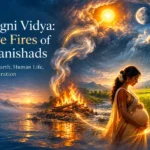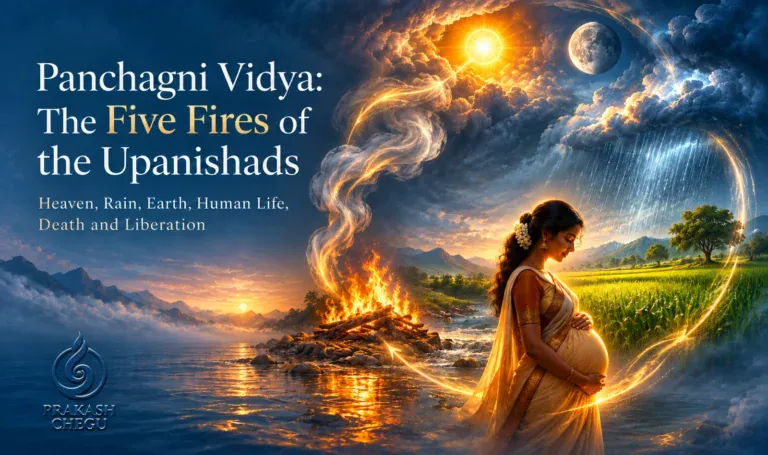
The Extraordinary Teaching That Connects Heaven, Rain, Earth, Human Life, Death and Liberation
The Sacred Fire Code · Part 15 of 15
What if the entire universe could be contemplated as a sacred offering?
Not merely the fire burning on an altar.
Not merely the ghee placed into the flame.
Not merely the mantras recited by a priest.
But the movement of the heavens.
The formation of clouds.
The falling of rain.
The growth of food.
The generation of human life.
And the mysterious journey through birth, death, and whatever lies beyond.
This is the extraordinary vision we encounter in the Panchagni Vidya of the Chandogya Upanishad.
And I believe it is one of the most important teachings to understand if we are serious about exploring the deeper meaning of sacred fire.
Throughout this series, we have examined the visible flame.
The oil lamp.
Deepavali.
Akasha.
The five elements.
Sacred geometry.
Bhuta Shuddhi.
The Dhuni of the sadhu.
The fires of Ayurveda.
And the transformation of ritual into knowledge.
But Panchagni Vidya brings us to an entirely different dimension.
Here the five fires are not five diyas arranged in a home.
They are not five flames surrounding an ascetic.
They are not five chemical processes.
They are five vast stations in a cosmological vision of existence.
And each becomes part of a sequence of offering and transformation.
The teaching is profound.
But it has also been misunderstood.
In modern yoga conversations, the term Panchagni is sometimes used as though it always refers to the same practice.
It does not.
The household five-lamp arrangement taught by Sadhguru is a contemporary ritual instruction.
The five-fire austerity practiced by certain ascetics belongs to another context.
The Panchagni Vidya of the Upanishads is a philosophical and cosmological teaching with its own scriptural structure.
To understand it properly, we must return to the original text.
And we must begin with a young student who believed he had already been educated.
1. The Student Who Could Not Answer Five Questions
The teaching appears in the Chandogya Upanishad, chapter 5, sections 3 through 10.
It begins with Shvetaketu, the son of Aruni.
Shvetaketu arrives at the assembly of the Panchalas.
There he encounters King Pravahana Jaivali.
The king asks whether the young man has been instructed by his father.
Shvetaketu answers that he has.
The king then begins asking questions.
Where do people go after departing from this world?
How do they return?
Where do the paths of the gods and ancestors diverge?
Why does the other world not become full?
And how does water, at the fifth offering, come to be called a human being?
Shvetaketu is unable to answer.
This is a remarkable beginning.
A young man who believes he has received an education encounters questions that expose the limits of his understanding.
He returns to his father.
And the father acknowledges that he too does not know the answers.
The father then approaches King Pravahana to receive the teaching.
The episode contains a lesson that is relevant even before we examine the cosmology.
Education is not the same as the willingness to recognize what we do not know.
A person can become highly accomplished within one field and remain unaware of the boundaries of their knowledge.
As an engineer, I find this familiar.
Understanding how a system operates does not automatically mean we understand every system.
And as a student of yoga, I consider the lesson even more important.
Spiritual knowledge becomes dangerous when familiarity with terminology is mistaken for realization.
Shvetaketu had studied.
But the king’s questions revealed an area in which his understanding was incomplete.
His journey toward knowledge begins with that recognition.
2. Why Is the Teacher a King?
There is another interesting feature of this episode.
The knowledge is transmitted by a Kshatriya king.
The text presents Pravahana Jaivali as possessing a teaching that had not previously passed to Brahmins in the way described in the narrative.
This challenges a simplistic image of all spiritual knowledge moving exclusively through one social category.
The episode is part of the complex relationship between priestly and royal traditions in early Indian thought.
But we should not exaggerate the conclusion.
One Upanishadic narrative does not establish that every important philosophical teaching originated among kings.
Nor does it provide a complete history of social relations in Vedic India.
Its significance lies in the particular transmission it portrays.
A king becomes the teacher.
A learned Brahmin becomes the student.
Knowledge crosses a familiar social boundary.
And the subject of that knowledge is nothing less than the journey of life through the cosmos.
This is a powerful reminder that wisdom should not be confused with social position.
The capacity to learn begins when we are willing to recognize understanding wherever it genuinely appears.
3. What Does Panchagni Vidya Mean?
The Sanskrit expression Pañcāgni Vidyā combines three terms.
Pañca: five.
Agni: fire.
Vidyā: knowledge or a disciplined teaching.
The phrase is commonly rendered as the knowledge of the five fires.
But the word Vidya is important.
We are not simply being given instructions to light five physical flames.
We are being introduced to a cosmological contemplation.
The universe is described through the structure of sacrifice.
Each of the five fires receives an offering.
From that offering, another form emerges.
The sequence continues until human birth becomes possible.
This is not a modern biological theory.
It is a religious-philosophical account linking sacrifice, cosmology, fertility, death, and rebirth.
Its meaning must be explored within that context.
If we attempt to turn it into a scientific explanation of rainfall, metabolism, or human reproduction, we will misunderstand the text.
But if we recognize its contemplative structure, something extraordinary becomes visible.
The individual is placed within a vast network of transformations.
Human birth is not treated as an isolated event.
It belongs to a cosmic sequence.
4. The First Fire: Heaven
The first fire is the heavenly world.
Chandogya Upanishad 5.4.1 states:
असौ वाव लोको गौतमाग्निः।
तस्यादित्य एव समित्।
रश्मयो धूमः।
अहरर्चिः।
चन्द्रमा अङ्गाराः।
नक्षत्राणि विस्फुलिङ्गाः॥
Asau vāva loko gautamāgniḥ.
Tasyāditya eva samit.
Raśmayo dhūmaḥ.
Ahar arciḥ.
Candramā aṅgārāḥ.
Nakṣatrāṇi visphuliṅgāḥ.
The heavenly world is the fire.
The sun is its fuel.
The sun’s rays are its smoke.
Day is its flame.
The moon is its embers.
And the stars are its sparks.
The imagery is extraordinary.
The familiar elements of a sacrificial fire are expanded into the heavens.
The sun becomes fuel.
Day becomes flame.
The moon becomes embers.
The stars become sparks.
The next verse describes the offering of Shraddha—faith or the ritual principle named in the text—into this fire, from which Soma arises.
It is important not to reduce Soma here to a modern chemical substance.
Soma occupies a complex role in Vedic and Upanishadic literature.
Within this passage, it belongs to the cosmological sequence of the five offerings.
The heaven-fire establishes the first transformation.
And the sequence moves toward the second fire.
5. The Second Fire: Rain
The second fire is Parjanya, the rain-bearing power.
Chandogya Upanishad 5.5.1 describes:
पर्जन्यो वाव गौतमाग्निः।
Parjanyo vāva gautamāgniḥ.
Parjanya, O Gautama, is a fire.
The passage then describes the wind as fuel, clouds as smoke, lightning as flame, the thunderbolt as embers, and thunder as sparks.
Into this fire, Soma is offered.
From that offering, rain arises.
The symbolism is magnificent.
What we ordinarily experience as weather becomes part of a sacred cosmological process.
The atmosphere is not presented merely as empty space above the earth.
It becomes a dynamic field of transformation.
Of course, modern meteorology explains rainfall through atmospheric moisture, condensation, cloud microphysics, and other physical processes.
The Upanishad is not offering an alternative experimental account of cloud formation.
Its language is sacrificial and cosmological.
The aim is not to teach modern weather science.
It is to connect the movement of life with the larger religious order of the universe.
Yet the image can inspire a meaningful contemporary reflection.
Rain does not belong to any individual.
It participates in vast cycles of movement and transformation.
The water that nourishes a field has passed through processes extending far beyond the field itself.
Life depends upon relationships that no individual can control.
The Upanishadic image invites us to contemplate that dependence within a sacred framework.
6. The Third Fire: Earth
The third fire is the earth.
Chandogya Upanishad 5.6.1 begins:
पृथिवी वाव गौतमाग्निः।
Pṛthivī vāva gautamāgniḥ.
Earth, O Gautama, is a fire.
The text describes the year as its fuel.
Akasha as its smoke.
Night as its flame.
The directions as embers.
And the intermediate directions as sparks.
Into this fire, rain is offered.
From that offering, food arises.
This is a beautiful transition.
The movement from heaven to rain now reaches the earth.
And the earth becomes the setting in which nourishment appears.
The symbolism connects cosmic conditions to biological sustenance.
But again, we should not interpret it as a scientific account of photosynthesis.
The actual biological production of food involves solar energy, carbon dioxide, water, nutrients, ecological relationships, and complex biochemical processes.
The Upanishadic account is concerned with the religious meaning of transformation.
Still, there is a powerful contemplative lesson.
Our food does not simply originate in a supermarket.
It depends upon soil.
Water.
Sunlight.
Climate.
Seeds.
Living organisms.
Farmers.
Transport.
And countless forms of human cooperation.
The act of eating is therefore an encounter with an extraordinary network of dependence.
We may not recognize it every time we take a meal.
But the relationship exists whether or not we are aware of it.
Perhaps this is one reason so many Indian traditions include gratitude and offering in the relationship with food.
To eat consciously is to recognize that nourishment is never produced by the isolated individual alone.
7. The Fourth Fire: The Human Being
The fourth fire is described as the man.
Chandogya Upanishad 5.7.1 states:
पुरुषो वाव गौतमाग्निः।
तस्य वागेव समित्।
प्राणो धूमः।
जिह्वार्चिः।
चक्षुरङ्गाराः।
श्रोत्रं विस्फुलिङ्गाः॥
Puruṣo vāva gautamāgniḥ.
Tasya vāg eva samit.
Prāṇo dhūmaḥ.
Jihvā arciḥ.
Cakṣur aṅgārāḥ.
Śrotraṃ visphuliṅgāḥ.
The human male is described as a fire.
Speech is its fuel.
Breath is its smoke.
The tongue is its flame.
The eyes are its embers.
And the ears are its sparks.
The following verse describes food being offered into this fire.
From the offering arises reproductive seed.
The sequence has moved from the cosmic scale toward embodied human life.
Heaven.
Rain.
Earth.
Food.
The human organism.
This is a profound ritual imagination.
The act of nourishment becomes connected to reproduction and continuity.
But we must be careful with the historical language.
The text presents the male body through a particular reproductive model and does not provide a modern comprehensive account of reproductive biology.
Nor should its imagery be used to make claims about gender roles or biological processes that extend beyond the text.
It belongs to an ancient cosmological framework.
The philosophical significance is that human life is not disconnected from the chain of transformation that precedes it.
What appears to be an individual body is dependent upon the entire sequence.
8. The Fifth Fire: Woman and the Mystery of Birth
The fifth fire is woman.
Chandogya Upanishad 5.8.1 begins:
योषा वाव गौतमाग्निः।
Yoṣā vāva gautamāgniḥ.
Woman, O Gautama, is a fire.
The passage continues with explicit sexual and reproductive imagery.
It describes aspects of the woman’s reproductive anatomy and sexual union through the sacrificial vocabulary of fuel, smoke, flame, embers, and sparks.
The following verse describes the offering of reproductive seed and the arising of the embryo.
Modern readers may find the imagery intimate, powerful, or unsettling.
We should not conceal its literal content.
Nor should we pretend that the passage is merely a vague metaphor for creativity.
It is part of a specific ancient account of conception and birth.
At the same time, its reproductive explanation reflects the conceptual world of its historical setting.
Modern embryology describes fertilization and gestation through mechanisms that the Upanishad does not attempt to establish.
The importance of the text lies in the way it connects human generation with a sacred cosmological sequence.
The first fire begins in heaven.
The fifth reaches the womb.
The cosmos and human birth are brought into a single sacrificial vision.
9. The Fifth Offering: Water Becomes a Human Being
Now we arrive at the extraordinary question introduced at the beginning of the teaching.
How does water become a human being at the fifth offering?
Chandogya Upanishad 5.9.1 states:
इति तु पञ्चम्यामाहुतावापः पुरुषवचसो भवन्तीति।
Iti tu pañcamyām āhutāv āpaḥ puruṣa-vacaso bhavanti iti.
Thus, at the fifth offering, the waters come to be spoken of as a human being.
The passage continues by describing gestation and birth.
This is the culmination of the five-fire sequence.
A transformation that begins with the heavenly world proceeds through rain, earth, nourishment, and reproduction.
The water that participates in the cosmic process becomes associated with human embodiment.
It would be inaccurate to claim that the text is secretly explaining DNA, molecular biology, or a modern theory of embryogenesis.
The five-fire sequence is not a laboratory model.
But it expresses something remarkable.
The individual is not imagined as a separate creation appearing independently of the universe.
Birth belongs to a larger order.
And in the next verse, the Upanishad introduces death.
The person lives out their lifespan.
When life ends, the body is carried to the funeral fire.
The cycle returns to fire.
The image is profoundly moving.
Human life emerges within a vast sequence of transformations.
And death becomes part of a larger cosmological inquiry.
10. The Funeral Fire and the Continuity of Existence
The second verse of section 5.9 describes the person who has lived out their allotted life being carried to the funeral fire.
The text thus connects the beginning and end of embodied life through the language of Agni.
Fire appears at the beginning of the cosmological sequence.
And fire appears again at death.
The symbolism is powerful.
What we ordinarily experience as a distinct human existence is placed within a larger cycle.
Birth is not isolated.
Death is not ignored.
The human body is understood as participating in transformations that extend beyond its individual lifespan.
But what happens after death?
This is where the Upanishad moves beyond the five-fire sequence into the teaching of different paths.
And the distinction is crucial.
The text is not merely describing the physical recycling of matter.
It is addressing postmortem destiny within a religious and karmic cosmology.
The question is not simply what happens to the chemical elements of the body.
It concerns the journey of the person in relation to knowledge, action, and rebirth.
11. Devayana: The Path of the Gods
Chandogya Upanishad 5.10 describes a path associated with those who possess the relevant knowledge and with certain forest practitioners devoted to faith and austerity.
This is called Devayāna, the path of the gods.
The text describes an ascent through a sequence of luminous stages.
Flame.
Day.
The bright fortnight.
The six months associated with the sun’s northern course.
Further stages include the year, the sun, and other cosmological stations, depending on the textual sequence and its interpretation.
The journey culminates in a nonhuman guide leading the traveler to Brahman.
This is a traditional religious account.
It should not be converted into a physical description of a soul traveling along a measurable astronomical route.
The symbolism of light is central.
But its precise meaning is interpreted differently among Vedantic traditions.
The text associates this path with a destiny distinct from ordinary return.
It is therefore closely connected to questions of knowledge and liberation.
And that brings us to another important distinction.
12. Pitriyana: The Path of the Ancestors
The text also describes Pitṛyāna, the path of the ancestors.
This path is associated with those devoted to forms of meritorious action, sacrifice, and giving within the terms of the passage.
Its sequence is different.
Smoke.
Night.
The dark fortnight.
The six months associated with the sun’s southern course.
The world of the ancestors.
And the lunar realm.
The passage subsequently describes return.
This is part of the Upanishadic account of rebirth.
The traveler eventually participates in a return through cosmic processes associated with rain, vegetation, food, and reproduction.
Again, we should understand this as a religious cosmology.
It is not an experimentally verified description of what happens to consciousness after death.
There is no established scientific evidence demonstrating the literal postmortem routes described in the text.
Yet the philosophical importance remains profound.
The Upanishad distinguishes between different kinds of spiritual and ritual attainment.
It does not treat all actions and all knowledge as producing the same result.
And it raises the question of whether ordinary meritorious action is sufficient to bring about ultimate freedom from return.
13. Is Panchagni Vidya About Rebirth or Liberation?
The answer is both, but not in a simplistic way.
The five-fire sequence explains the process through which human birth is understood to arise within the text’s cosmological system.
The subsequent teaching of the two paths addresses postmortem destiny.
Together, they place birth, death, ritual action, knowledge, and rebirth into a larger framework.
But different commentators interpret the significance of the teaching differently.
Shankaracharya’s commentary explains the five fires through the relationship among ritual offering, karmic results, and the stages of return.
Madhva’s commentary develops a different theological reading.
In that interpretation, the five fires are understood in relation to forms of the Supreme Lord rather than merely as cosmological locations.
This distinction is extraordinarily important.
A Sanskrit passage does not always possess one uncontested philosophical interpretation.
The same text may be read within different Vedantic systems.
The responsible student must recognize those differences.
We can compare interpretations.
Examine their arguments.
Study their historical contexts.
And consider what each tradition seeks to establish.
But we should not silently present one commentary as though every school necessarily agrees.
14. The Five Fires and the Five Elements Are Not the Same System
One of the most common mistakes in contemporary spiritual explanation is to confuse Panchagni Vidya with the five Mahabhutas.
Both use the number five.
Both belong to Indian philosophical and religious traditions.
Both include the language of fire.
But their structures are different.
The Pancha Mahabhutas are earth, water, fire, air, and Akasha.
The five fires of Chandogya Upanishad 5.4–8 are:
Heaven.
Rain.
Earth.
Man.
Woman.
The relationship between these frameworks may be explored philosophically.
But they are not identical lists.
Likewise, the household Panchagni arrangement described by Sadhguru uses five lamps and six triangles within a different symbolic configuration.
That practice should not be presented as a direct reproduction of the five fires described in Chandogya Upanishad.
Nor should the advanced ascetic practice of Panchatapas be confused with either of them.
The shared name does not erase the distinctions.
And these distinctions are exactly what make the study so rewarding.
15. Is This an Ancient Scientific Theory of the Water Cycle?
There is a temptation to interpret Panchagni Vidya as evidence that ancient seers understood every stage of modern meteorology and reproductive biology.
The text describes rain.
Food.
Reproduction.
Birth.
And return.
These are real aspects of life.
But the Upanishadic explanation operates through sacrificial cosmology.
It does not describe condensation nuclei, atmospheric pressure systems, cellular respiration, gamete fusion, or embryonic development through modern scientific methods.
We should not pretend otherwise.
Yet we need not dismiss the teaching because it is not a modern scientific theory.
It is asking a different kind of question.
How is human existence related to the larger cosmos?
What does it mean to be born?
How are action and destiny connected?
What continues through death?
What is the relationship between knowledge and freedom?
These questions belong to philosophy, religion, and existential inquiry.
Some may intersect with scientific investigation.
Others cannot be settled simply by measuring physical processes.
The mistake is not in allowing ancient and modern questions to meet.
The mistake is in assuming they are always identical.
16. What the Teaching Reveals About Interdependence
There is a contemporary reflection I find particularly meaningful.
The Upanishadic sequence places human birth within a network of dependence.
The heavens.
Rain.
Earth.
Food.
The reproductive processes of embodied beings.
The individual does not appear independently.
Of course, modern science describes these relationships differently.
But the recognition of dependence remains powerful.
We are not self-created beings.
The food that nourishes us depends upon ecological systems.
The atmosphere sustains us.
Our bodies develop through biological processes extending far beyond conscious control.
Our language comes from others.
Our knowledge is inherited.
Our culture is transmitted across generations.
Even our most personal achievements depend upon conditions we did not create.
To recognize this is not to diminish the individual.
It is to place individuality within reality.
And perhaps the recognition can make us more grateful.
More responsible.
Less arrogant.
More aware of the conditions supporting our existence.
A person who recognizes dependence may become less interested in pretending to be entirely self-sufficient.
And more interested in participating intelligently with the world.
17. The Upanishadic Challenge to Spiritual Pride
I want to return briefly to Shvetaketu.
The young student thought he had been instructed.
But he could not answer the king’s questions.
His father acknowledged that he too lacked the knowledge.
And together, the narrative moves toward a new transmission of understanding.
This is a beautiful image of intellectual humility.
The spiritual journey is filled with opportunities to become proud of what we know.
A practitioner learns a mantra.
Masters a technique.
Studies a scripture.
Receives a title.
Completes a training.
Gains recognition.
And gradually begins to identify with knowledge rather than remain open to learning.
But the Upanishadic inquiry begins with a disruption of that certainty.
The student encounters the limits of his education.
The teacher admits what he does not know.
And the possibility of greater understanding emerges.
This is an important lesson for anyone who teaches.
Knowledge should not make us less curious.
Experience should not make us less humble.
And the responsibility of guiding others should not make us unwilling to examine our own assumptions.
The deepest teachers do not merely provide answers.
They cultivate the capacity for inquiry.
18. A Contemplation on the Five Fires
I would like to offer a reflective practice inspired by the Upanishadic teaching.
This is not a reproduction of a traditional initiated Panchagni Vidya meditation.
It is an accessible philosophical contemplation.
Sit comfortably.
Allow the breath to settle naturally.
Begin by contemplating the first fire.
Heaven.
The vastness of existence.
The sun, moon, stars, and the extraordinary scale of the universe.
Recognize how small our personal concerns can appear within that vastness.
Then contemplate the second fire.
Rain.
The movement of water through atmosphere, cloud, earth, and life.
Reflect on the processes that sustain existence beyond your control.
Now contemplate the third fire.
Earth.
Food.
Nourishment.
The countless relationships required to sustain one human body.
Allow gratitude to arise naturally if it does.
Next contemplate the fourth fire.
Human life.
The extraordinary processes through which nourishment participates in growth, movement, and continuity.
Recognize the body not merely as a possession, but as a living expression of conditions that precede you.
Then contemplate the fifth fire.
Birth.
The generations that made your existence possible.
Parents.
Ancestors.
The human relationships through which life continues.
Finally, contemplate mortality.
Not with fear.
Not as a dramatic exercise.
But with the quiet recognition that our individual lifespan is finite.
What deserves our attention while we are here?
What should we offer through the way we live?
What responsibility follows from the privilege of being alive?
Allow the questions to remain open.
There is no need to manufacture an answer.
The purpose is to deepen our relationship with existence.
19. From Cosmic Sacrifice to the Ethics of Living
The five-fire teaching is not merely a set of extraordinary images.
It places human existence within a larger order.
And this has ethical implications for how we choose to live.
If life is supported by countless conditions, gratitude becomes meaningful.
If nourishment depends upon the earth, care for the environment becomes important.
If we inherit knowledge from previous generations, responsible transmission becomes a duty.
If our lives are finite, the use of time becomes significant.
And if we are part of a larger community of living beings, our actions cannot be evaluated only according to personal benefit.
This does not mean every ethical conclusion can be derived directly from the Sanskrit verses.
It means the cosmological teaching can inspire a contemporary reflection on responsibility.
In the life of a householder, this becomes especially meaningful.
The food we prepare.
The children we raise.
The elders we care for.
The people we teach.
The strangers we help.
The way we participate in society.
These are not trivial activities.
They are part of the network through which life continues.
A meaningful spiritual life should not make us indifferent to these responsibilities.
It should help us recognize their deeper significance.
20. The Fire That Connects All Existence
We have reached the end of our exploration of The Sacred Fire Code.
We began with the simplest possible object.
A small oil lamp.
A cotton wick.
A little fuel.
One flame.
From there, we traveled through the Vedic understanding of Agni.
The symbolism of Deepavali.
The philosophical mystery of Akasha.
The geometry of Panchagni.
The six chakras.
Bhuta Shuddhi.
The fires of Ayurveda.
The Dhuni of the sadhu.
The science of visual attention.
The properties of copper, water, earth, and fire.
And finally, the extraordinary Upanishadic vision of five cosmic fires.
What have we discovered?
Perhaps most importantly, that fire cannot be understood through one explanation alone.
In physics and chemistry, fire is a measurable process.
In human culture, it is a source of warmth, light, protection, and gathering.
In Vedic ritual, Agni participates in the sacred relationship between human beings and the Divine.
In Ayurveda, the language of Agni describes transformation within a traditional medical framework.
In Tantra, fire can participate in ritual purification and deity worship.
In meditation, a flame may become a support for attention.
And in the Panchagni Vidya, the structure of sacrifice becomes a way of contemplating the very journey of existence.
These are not identical explanations.
But each reveals a different aspect of the relationship between human beings and fire.
I believe the greatest mistake would be to reduce all of them to one simplistic claim.
Fire is not merely chemistry.
But neither is every spiritual claim about fire scientifically established.
The traditions deserve historical accuracy.
Science deserves methodological honesty.
And spiritual experience deserves sincere inquiry.
There is room for all three.
The Upanishadic teaching brings us to a particularly profound recognition.
Our lives do not exist independently of the whole.
We are sustained by conditions we did not create.
We participate in transformations we do not fully understand.
And we inherit a mysterious opportunity to become conscious of existence itself.
Perhaps the question is no longer simply how to create a sacred fire.
Perhaps it is how to recognize the sacred responsibility of being alive.
We may light a lamp.
Perform a ritual.
Practice meditation.
Study the scriptures.
And undertake years of Sadhana.
But what becomes of that effort when we return to ordinary life?
Do we become kinder?
More discerning?
More grateful?
More responsible?
Less governed by the compulsions of our own identity?
More willing to serve?
These questions may reveal the true direction of our spiritual development.
A sacred fire can transform an offering.
But the deepest question is whether sacred practice transforms the one who offers.
The outer flame illuminates the space before us. The fire of inquiry invites us to illuminate the life we are living.
And perhaps that is where the entire journey of The Sacred Fire Code finds its meaning.
Not in the accumulation of rituals.
Not in the fascination with unseen energies.
Not in the claim that ancient wisdom and modern science always say the same thing.
But in the cultivation of a consciousness capable of participating in life with greater clarity, reverence, and responsibility.
The lamp will eventually go out.
The ritual will end.
The sacred geometry will be erased.
The offerings will return to the earth.
But the quality of awareness we cultivate may continue influencing how we live.
And that is a transformation worth pursuing.
May our knowledge lead to humility.
May our discipline lead to freedom.
May our devotion lead to compassion.
May our actions become offerings.
And may the light we seek outside remind us of the extraordinary possibility of becoming conscious within.
The Sacred Fire Code — Series Conclusion
This is the fifteenth and final article in The Sacred Fire Code: Agni, Akasha and the Forgotten Wisdom of the Five Elements.
To revisit the journey, begin with:
-
Article 1: The Forgotten Science of Lighting an Oil Lamp
-
Article 3: Akasha — The Fifth Element and the Forgotten Dimension of Perception
-
Article 4: Panchagni — Creating a Sacred Meditation Space at Home
-
Article 6: Bhuta Shuddhi — The Ancient Art of Purifying the Five Elements
-
Article 11: Agnihotra, Homa, Havan and Yajna
-
Article 12: When the Inner Fire Awakens, Ritual Becomes Unnecessary
Each article explores one dimension of the broader relationship between sacred tradition, human experience, philosophical inquiry, and scientific understanding.
Sources and Further Reading
Original scriptural sources
-
Chandogya Upanishad 5.3.1–7 — Shvetaketu, Pravahana Jaivali, and the five questions.
-
Chandogya Upanishad 5.4.1–2 — The heavenly fire.
-
Chandogya Upanishad 5.5.1–2 — The rain fire.
-
Chandogya Upanishad 5.6.1–2 — The earth fire.
-
Chandogya Upanishad 5.7.1–2 — The human male as fire.
-
Chandogya Upanishad 5.8.1–2 — Woman as the fifth fire.
-
Chandogya Upanishad 5.9.1–2 — The fifth offering, birth, and funeral fire.
-
Chandogya Upanishad 5.10.1–10 — Devayana, Pitriyana, return, and the fruits of knowing the five fires.
Complete Sanskrit text:
https://sanskritdocuments.org/doc_upanishhat/chhaandogya.html
Translations and commentaries
-
Chandogya Upanishad, translation and commentary based on Swami Lokeswarananda’s discourses, including excerpts from Shankara’s Bhashya.
https://www.wisdomlib.org/hinduism/book/chandogya-upanishad-english -
Chandogya Upanishad with Shankara Bhashya, translated by Ganganatha Jha, especially chapter 5, sections 3–10.
https://www.wisdomlib.org/hinduism/book/chandogya-upanishad-shankara-bhashya -
Chandogya Upanishad with Madhva’s Bhashya, chapter 5, sections 3–10.
https://www.wisdomlib.org/hinduism/book/chandogya-upanishad-madhva-commentary -
Brihadaranyaka Upanishad 6.2 — Parallel teaching on the five fires and the postmortem paths.
Modern scholarship
-
Cambridge University Press, scholarly discussion of Devayana and Pitriyana in Brihadaranyaka Upanishad 6.2 and Chandogya Upanishad 5.3–10.
https://assets.cambridge.org/97810094/61139/excerpt/9781009461139_excerpt.pdf -
Patrick Olivelle, The Early Upaniṣads: Annotated Text and Translation, Oxford University Press, for the historical and philological study of early Upanishadic literature.
-
Brian K. Smith, Reflections on Resemblance, Ritual, and Religion, Oxford University Press, for broader historical scholarship on Vedic sacrificial correspondences.
Research note: Panchagni Vidya is presented as a classical religious-philosophical teaching, not as an experimentally established theory of embryology, cosmology, or postmortem consciousness. The contemporary contemplative exercise is an interpretation inspired by the text, not a replacement for lineage-specific instruction.
Series Navigation
Previous: Part 14 · Copper, Water, Earth and Fire: Why Sacred Rituals Use Natural Materials
View the Complete Sacred Fire Code series