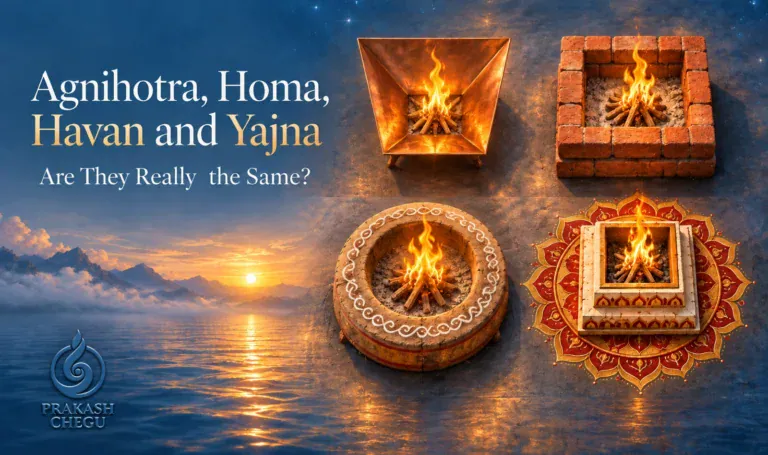
Understanding the Sacred Fire Traditions of Sanatana Dharma—From Vedic Sacrifice to Tantric Transformation
The Sacred Fire Code · Part 11 of 15
There is something profoundly moving about sitting around a sacred fire.
A group gathers.
The space has been prepared.
Offerings are placed nearby.
Mantras are recited.
The fire is kindled.
And for a little while, people who may have arrived carrying entirely different thoughts, emotions, and expectations participate in one shared action.
The experience can be beautiful.
A sacred fire ceremony may become an occasion for gratitude, devotion, remembrance, service, and the conscious marking of a transition in life.
But there is a question I believe every serious practitioner and teacher should ask.
What exactly are we performing when we conduct a sacred fire ritual?
Is it an Agnihotra?
A Homa?
A Havan?
A Yajna?
Are these simply different names for the same ceremony?
Or do they refer to distinct practices with different historical origins, ritual requirements, and spiritual purposes?
In contemporary yoga communities, these terms are frequently used interchangeably.
A simple fire ceremony may be called a Vedic Yajna.
A small household offering may be described as Agnihotra.
A Tantric Homa may be presented as though it were identical to a classical Shrauta sacrifice.
And sometimes the ceremony is so completely improvised that the only thing connecting it to a traditional fire ritual is the presence of flames and Sanskrit words.
I do not think this serves the traditions well.
Nor does precision make a ceremony less beautiful.
In fact, the more carefully we understand these practices, the more deeply we may appreciate their significance.
Let us begin with the oldest and most encompassing concept.
1. Yajna: The Language of Sacred Offering
The Sanskrit word Yajña is commonly associated with sacrifice, worship, or ritual offering.
It derives from the verbal root yaj, connected with worship, sacrifice, and honoring.
In Vedic religion, Yajna occupies a central position.
A sacrifice involves prescribed actions, offerings, mantras, ritual spaces, and relationships among the sacrificer, priests, and deities.
But we must remember that the Vedic tradition is not one single ceremony.
The ritual literature describes a complex variety of sacrifices.
Some are relatively modest.
Others require extensive preparation, multiple priests, specific altars, carefully maintained fires, and elaborate sequences of recitation.
The word Yajna therefore should not automatically be translated as a small fire ceremony.
Its historical scope is considerably broader.
It can refer to a structured sacrificial act, while later literature also expands its significance into philosophical and ethical dimensions.
That expansion becomes particularly important in the Bhagavad Gita.
But first, we must understand the Vedic ritual framework.
2. Shrauta Ritual: The Formal Vedic Sacrificial Tradition
The word Śrauta is related to Śruti, the authoritative revealed Vedic tradition.
Shrauta rituals are associated with the Vedic ritual corpus and the instructions preserved in Shrauta Sutras.
These ceremonies can involve elaborate sacrificial procedures.
A central feature of the classical system is the maintenance of three principal ritual fires.
Garhapatya Agni
The householder’s established fire, traditionally associated with a circular hearth.
Ahavaniya Agni
The fire into which important offerings are made, traditionally associated with a square hearth.
Dakshinagni
The southern fire, associated with additional ritual functions.
These fires have specific roles within the ritual system.
They are not simply three decorative flames representing three abstract spiritual qualities.
Their arrangement, preparation, use, and continuity belong to a highly structured sacrificial tradition.
Some Vedic ritualists maintain prescribed fires through a long period of household life.
The ritual fire is therefore connected to an entire way of living.
It is not an accessory assembled whenever an event requires atmosphere.
This should inspire respect.
A formal Vedic sacrifice involves knowledge, preparation, and procedural responsibilities that cannot be recreated merely by placing a few objects around a fire pit.
The term Vedic should not be used casually as a promise of authenticity.
A ceremony may be spiritually meaningful without claiming to reproduce a formal Shrauta rite.
3. Agnihotra: A Specific Offering, Not a Universal Name for Fire Ritual
Agnihotra is one of the most recognizable terms associated with Vedic fire practice.
But the classical Shrauta Agnihotra has a particular ritual identity.
It is a recurring offering associated with the established Vedic fires and traditionally performed at the relevant daily times by a qualified ritual householder.
Its procedures are described within the Vedic ritual literature.
Offerings may involve milk or other prescribed substances according to the textual and ritual context.
The role of the sacrificer, the fires, and the mantras is not arbitrary.
The practice is embedded within the larger obligations of Vedic ritual life.
Today, the word Agnihotra is also used in modern revival movements that prescribe a simplified sunrise-and-sunset fire practice, often using a copper pyramid vessel, cow-dung fuel, rice, and ghee.
These contemporary practices should be studied in their own historical context.
They are not simply identical to the full classical Shrauta Agnihotra.
Both may be meaningful to their practitioners.
But historical accuracy requires us to distinguish them.
The name alone does not establish that two ceremonies are the same.
This matters particularly when people claim that Agnihotra has been scientifically proven to purify the atmosphere, eliminate pathogens, or treat disease.
Such claims require carefully controlled studies.
A ritual’s traditional significance does not establish that breathing its smoke is medically beneficial.
Combustion may release fine particles, carbon monoxide, and other substances.
A sacred intention does not cancel the chemistry of a flame.
4. Homa: The Ritual Act of Offering Into Fire
The word Homa refers to fire offering or oblation.
It is used across several Indian ritual traditions.
In domestic Vedic ritual, Homa can be part of the rites associated with household life.
In Tantric traditions, Homa appears within different ritual frameworks, often involving deity worship, mantras, mandalas, and particular aims.
The distinction is important.
A Homa performed within a Tantric tradition may organize the ritual space and the offering process according to principles that differ from a Shrauta rite.
The practitioner may ritually identify the fire with a deity.
The altar may be understood as a mandala.
Offerings can carry specific symbolic significance.
The ritual may be integrated with mantra, visualization, and other forms of worship.
Scholars of Tantric ritual have documented the transmission and adaptation of Homa beyond Hindu traditions, including Buddhist contexts in different parts of Asia.
This is a reminder that sacred-fire ritual has a complex religious history.
It cannot be reduced to one uniform Indian practice.
5. Havan: A Familiar Name for Fire Offering
The word Havan is widely used in modern Hindi and several North Indian religious contexts.
It is related to Sanskrit terminology for offering into fire.
In many communities, Havan and Homa are used for broadly similar ceremonies.
A family may organize a Havan for a housewarming.
A community may conduct one during a festival.
A teacher may use the term for a ceremonial offering associated with a spiritual gathering.
But we should be careful not to invent an absolute distinction where living usage is fluid.
It would be misleading to declare that every Havan is one exact class of ritual and every Homa belongs to another entirely separate category.
The terminology overlaps.
The actual practice depends on the lineage, community, text, and purpose.
This is why I prefer to examine the ceremony itself.
What is being invoked?
What offerings are prescribed?
Which mantras are used?
What tradition authorizes the sequence?
Who is qualified to conduct it?
And what is the intended purpose?
These questions tell us much more than the title alone.
6. The Grihya Tradition: Sacred Fire in Household Life
The Vedic ritual tradition also includes rites associated with the household.
These are discussed in the Gṛhya Sūtras.
The term gṛha refers to the home or household.
Grihya practices include ceremonies connected with important transitions in life, family obligations, and domestic religious observances.
Some involve fire offerings.
Others do not.
The household context is crucial.
A sacred fire need not belong exclusively to a renunciate living in the forest.
It also participates in the religious life of families.
Birth.
Marriage.
Domestic transitions.
Daily responsibilities.
Remembering ancestors.
The organization of household life.
But again, the details vary among Vedic schools and later traditions.
We should not imply that one modern family ceremony reproduces every ancient household custom.
The historical traditions were diverse and changed over time.
Yet a beautiful principle remains.
Sacred action was not confined to the temple.
The household itself could become a field of religious responsibility.
This is a particularly meaningful insight for anyone exploring Grihastha Dharma.
Spiritual life does not necessarily require withdrawal from family.
It may instead require bringing consciousness into the relationships and responsibilities that sustain society.
7. Svaha: What Does It Mean to Offer?
During many fire ceremonies, the word Svāhā is pronounced when an offering is made.
The word has a long Vedic ritual history and appears in contexts connected with oblations.
Its precise interpretation depends upon usage.
In contemporary ceremonies, practitioners may experience its pronunciation as marking the moment of offering.
That ritual moment is worth contemplating.
Something is brought forward.
It is released into the fire.
The offering changes form.
And the participant witnesses the transformation.
Within a devotional understanding, the act is directed toward the deity or sacred presence invoked.
Within a philosophical interpretation, the gesture may also become an opportunity to contemplate release, surrender, and transformation.
But the symbolic meaning should not erase the original ritual function.
Svaha is not merely a generalized affirmation for letting go of unwanted emotions.
It belongs to a specific vocabulary of offering.
If we choose to add contemporary reflective meaning, we should identify it as interpretation rather than ancient textual certainty.
8. Offerings Are Not Arbitrary
Modern fire ceremonies sometimes invite participants to throw whatever objects they wish into the flames.
This may be presented as a symbolic release of burdens or obstacles.
But traditional ritual offerings are generally prescribed rather than arbitrary.
Depending on the ceremony, offerings may include ghee, grains, herbs, wood, or other substances specified within the relevant tradition.
Not every material is suitable for burning.
Certain substances release toxic fumes.
Others create excessive smoke.
Some may produce dangerous flare-ups.
Plastic, treated wood, synthetic materials, and unknown powdered substances should never be introduced into a ritual fire.
Even materials considered natural can release pollutants when burned.
The idea that a substance is spiritually meaningful does not make its combustion harmless.
This is especially important for teachers conducting ceremonies with students.
A fire ritual should never require participants to expose themselves to avoidable hazards in order to demonstrate devotion.
Safety is part of responsible leadership.
9. The Ritual Geometry of the Fire Altar
Sacred fire traditions frequently involve carefully prepared ritual spaces.
In Shrauta contexts, altars and hearths may have prescribed shapes, dimensions, construction methods, and relationships to the larger sacrificial ground.
The famous Vedic fire altars include elaborate geometries.
Their construction is discussed in the ritual literature associated with the Shulba Sutras.
These texts are of considerable historical interest because they preserve sophisticated practical geometric procedures used in altar construction.
But we should avoid exaggerating their implications.
Ancient altar geometry should not automatically be claimed as evidence that Vedic ritualists possessed every mathematical concept or physical theory later developed by modern science.
The genuine achievements are interesting enough without embellishment.
A carefully measured altar reveals the importance of precision within ritual practice.
The geometry is not simply decoration.
It is part of the prescribed form.
In Tantric Homa, geometric forms may also be related to mandala structures and deity symbolism.
Yet these geometries belong to their specific traditions.
A six-pointed star in one practice should not be assumed to perform the same function as a square fire altar in another.
The meaning depends upon context.
10. The Role of Mantra
A sacred fire ritual is not merely the burning of substances.
Mantra frequently plays a central role.
In Vedic sacrifice, particular mantras belong to particular ritual actions.
Their textual form, pronunciation, meter, and placement may matter within the tradition.
In Tantric Homa, mantras are similarly integrated into the ritual structure, though according to different theological and procedural frameworks.
This is why indiscriminately combining mantras from multiple traditions is not necessarily an expression of inclusivity.
Sometimes it produces confusion.
A ceremony may be welcoming to people of different backgrounds while remaining faithful to a particular ritual form.
Inclusivity does not require erasing distinctions.
When leading a group, it may be helpful to explain the meaning of the ceremony and provide accessible ways to participate.
But one should not claim ritual authority that has not actually been received.
A simple, clearly identified contemporary devotional ceremony may be more responsible than an improvised event presented as an ancient Vedic initiation.
The integrity of the teacher matters.
11. The Tantric Homa: When the Altar Becomes a Mandala
One particularly interesting development appears in Tantric fire rituals.
In scholarly descriptions of Tantric Homa, the fire altar may be understood in relation to a mandala.
The invoked deity occupies a central role.
The fire itself becomes associated with the deity.
And the practitioner may undergo ritual identification with the sacred presence.
The symbolic structure is more complex than a simple act of burning offerings.
The offering may be understood as participating in the transformation of obstacles, ignorance, or other conditions within the specific ritual framework.
But these meanings vary.
Some Tantric Homas are associated with protection.
Some with purification.
Others with specific ritual aims.
We should not assume that every Tantric fire ceremony is designed for general emotional healing or personal empowerment.
Its meaning depends upon the tradition.
This is one reason the study of ritual history is so valuable.
It reveals how easily modern explanations can flatten the extraordinary range of Indian spiritual practices.
12. The Bhagavad Gita Expands the Meaning of Yajna
Now we arrive at one of the most important philosophical developments.
The Bhagavad Gita does not restrict the significance of Yajna to a physical fire altar.
In chapter 4, Krishna describes different forms of sacrifice.
Verse 4.28 refers to sacrifices involving material offerings, austerity, yoga, study, and knowledge.
Verse 4.29 speaks of practices involving Prana and Apana.
The ritual language becomes a means of describing disciplined transformation.
But the culmination is particularly important.
Bhagavad Gita 4.33 states:
श्रेयान्द्रव्यमयाद्यज्ञाज्ज्ञानयज्ञः परन्तप।
सर्वं कर्माखिलं पार्थ ज्ञाने परिसमाप्यते॥
Śreyān dravya-mayād yajñāj jñāna-yajñaḥ parantapa,
sarvaṃ karmākhilaṃ pārtha jñāne parisamāpyate.
The sacrifice of knowledge is superior to sacrifice consisting of material offerings; all action culminates in knowledge.
This is a profound statement.
It does not necessarily abolish external ritual.
But it places knowledge and realization above the mere performance of material offerings.
The outward action is not the ultimate destination.
Its deeper significance belongs to the transformation of understanding.
13. Yajna as Selfless Participation
Another important verse appears in Bhagavad Gita 3.9:
यज्ञार्थात्कर्मणोऽन्यत्र लोकोऽयं कर्मबन्धनः।
तदर्थं कर्म कौन्तेय मुक्तसङ्गः समाचर॥
Yajñārthāt karmaṇo’nyatra loko’yaṃ karma-bandhanaḥ,
tad-arthaṃ karma kaunteya mukta-saṅgaḥ samācara.
Action undertaken apart from the purpose of Yajna binds; therefore, act for that purpose without attachment.
The interpretation varies across philosophical traditions.
But the verse makes it possible to understand sacred action in a much wider ethical and spiritual context.
What happens when we approach work as an offering?
When we teach without making recognition the central purpose?
When we serve without constantly calculating what we will receive in return?
When we prepare food with gratitude?
When we care for another person without treating them as an instrument of our own satisfaction?
We should not claim that every such activity is formally identical to a Vedic Yajna.
It is not.
But the Gita’s philosophical expansion allows the language of offering to illuminate ordinary life.
And this is where the teaching becomes especially relevant for householders.
14. What Makes a Fire Ceremony Truly Meaningful?
A ritual can be technically elaborate and spiritually empty.
It can also be simple and deeply meaningful to the participants.
But we should be careful not to make sincerity an excuse for ignoring tradition.
Meaningfulness and authenticity are distinct questions.
A contemporary ceremony can be meaningful without claiming to reproduce a classical Shrauta rite.
A teacher may create a reflective gathering around a symbolic fire without presenting it as formal Agnihotra.
A group may express gratitude through a shared offering while clearly identifying the ceremony as an adapted practice.
The essential responsibilities are straightforward.
Know what tradition you are drawing from.
Explain what the ritual means.
Do not invent historical authority.
Do not promise medical or supernatural outcomes.
Ensure the ceremony is safe.
And create space for participants to engage sincerely.
The outer ritual may be beautiful.
But its greatest value may appear in what the participants carry away.
Gratitude.
Clarity.
Humility.
A willingness to serve.
A recognition of their interdependence.
Or a deeper understanding of responsibility.
15. An Inclusive Practice Without Misrepresenting Tradition
Suppose a group wishes to mark the completion of a period of study.
Perhaps a yoga teacher training.
A retreat.
A course.
Or an important transition.
There are several ways to honor the symbolism of Yajna.
The first is to invite a properly trained ritual specialist to conduct a ceremony within a specific tradition.
This is appropriate when the group wishes to participate in a formal rite.
The second is to create a clearly identified contemporary contemplative gathering inspired by the principle of offering.
In such a gathering, a safe symbolic light may be sufficient.
Participants can reflect on what they have learned.
What they wish to cultivate.
Whom they wish to serve.
And what responsibilities they are now prepared to accept.
There is no need to invent mantras, imitate priestly procedures, or burn large quantities of substances.
The gathering can include silence, gratitude, meaningful words, and a commitment to ethical action.
It should be presented honestly as a modern adaptation.
The distinction is not a limitation.
It is an expression of respect.
16. The Fire Beyond the Fire
The most important thing about Yajna may ultimately be what happens to our understanding of action.
At the beginning, there is a visible offering.
A substance is placed into fire.
The ritual is performed.
A sacred relationship is invoked.
But the philosophical development of the tradition asks us to go further.
What happens when life itself becomes an offering?
Not in a sentimental sense.
But in the way we actually participate.
Can our work become an expression of service?
Can our relationships become opportunities for responsibility?
Can knowledge reduce our attachment to recognition?
Can we act fully without making every outcome a measure of personal worth?
The Bhagavad Gita does not present liberation as the result of merely abandoning all activity.
It invites a transformation in the relationship between action, knowledge, devotion, and attachment.
This is where the fire becomes a profound teacher.
A material offering changes form.
But the deeper question is whether the person making the offering has also changed.
A ritual may last an hour.
A marriage may last decades.
A period of teaching may shape generations.
A single act of kindness may influence a life in ways we never witness.
The highest significance of sacred offering is not measured only by what we place into the fire, but by the quality of consciousness with which we participate in the world.
That is the movement from ritual toward Dharma.
From ceremony toward responsibility.
From the external act toward the inner transformation that gives the act meaning.
And perhaps that is why the language of Yajna remains so relevant.
Not because every person must maintain a physical fire.
But because every person must eventually answer a question.
What am I offering through the way I live?
Continue Exploring The Sacred Fire Code
Previously: Conscious Stillness vs. Compulsive Inertia.
Next: When the Inner Fire Awakens, Ritual Becomes Unnecessary.
Related articles: The Forgotten Science of Lighting an Oil Lamp; Why the Sadhu Keeps His Own Fire; Panchagni Vidya — The Five Fires of the Upanishads.
Sources and Further Reading
-
Rigveda 1.1.1 — Opening invocation to Agni.
-
Bhagavad Gita 3.9 — Action for the purpose of Yajna.
-
Bhagavad Gita 4.24–33 — Sacrifice, knowledge, and the philosophical expansion of Yajna.
-
Gṛhya Rites, academic reference chapter, Oxford University Press. https://academic.oup.com/reference/62357/reference-article-abstract/554516735
-
The Vedic Homa and the Standardization of Hindu Pūjā, Oxford University Press. https://academic.oup.com/book/7549/chapter-abstract/152530795
-
Homa: Tantric Fire Ritual, Oxford University Press. https://academic.oup.com/edited-volume/62249/chapter-abstract/551424951
-
Government of India, Vedic Heritage Portal, Vedic Tradition in Karnataka, for the three fires and traditional Agnihotra.
-
Selected Shrauta Sutras, Grihya Sutras, and Shulba Sutras for formal ritual and altar-construction procedures.
Research note: Traditional Shrauta Agnihotra, modern simplified Agnihotra movements, Grihya fire offerings, and Tantric Homa belong to historically related but distinguishable ritual frameworks. The practical guidance here is not a substitute for lineage-specific ritual training.
Series Navigation
Previous: Part 10 · Conscious Stillness vs. Compulsive Inertia
View the Complete Sacred Fire Code series
Next: Part 12 · When the Inner Fire Awakens, Ritual Becomes Unnecessary