There are festivals we celebrate.
And then there are moments in the cosmic calendar that recalibrate the human soul.
Rama Navami is not merely the celebration of the birth of Lord Rama—it is the remembrance of what it means to live as a conscious human aligned with Dharma.
It is a mirror.
It asks:
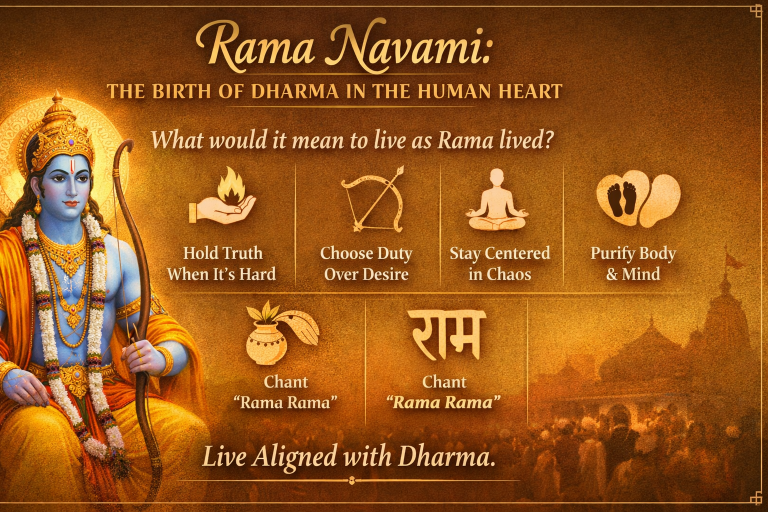
What would it mean to live as Rama lived?
The Birth of Rama: Not Just an Event, But a Blueprint
According to the Ramayana, Rama was born in the Treta Yuga, a time when righteousness had already begun to decline.
King Dasharatha, longing for a child, performed a sacred yajna. From that fire emerged not just a blessing—but a divine intervention into human evolution.
Rama was born.
Not as a god who escapes human life…
…but as a god who fully enters it.
He is called Maryada Purushottam—
The one who lives within the highest boundaries of human conduct.
This is what makes Rama different.
Krishna bends the rules.
Shiva transcends them.
But Rama embodies them.
He shows us:
- How to hold truth when it costs you everything
- How to choose duty over desire
- How to remain centered in chaos
- How to love without losing Dharma
The Timing: Why Rama Navami Is So Precise
Rama Navami is not celebrated randomly—it is observed during a very specific cosmic alignment.
In 2026:
- Navami Tithi begins: March 26 (late morning)
- Most auspicious time (Madhyahna): ~11:13 AM – 1:41 PM
- Exact symbolic birth moment: ~12:27 PM
This midday window is not symbolic—it is energetic precision.
Midday represents:
- Peak solar energy
- Maximum pranic intensity
- Full activation of the Pingala Nadi (solar channel)
Rama is solar consciousness embodied.
To celebrate his birth at midday is to align with clarity, purpose, and righteous action.
Rama as Inner Architecture
Most people worship Rama externally.
Very few understand:
Rama is an inner state of organization.
He represents:
- Nervous system regulation under pressure
- Moral clarity under emotional turbulence
- Consistency across thought, speech, and action
This is why his life feels “impossible” to modern people.
Because we live fragmented lives.
Rama lived a coherent life.
The Rituals: Not Religion—Neuro-Spiritual Engineering
The rituals of Rama Navami are often misunderstood as cultural habits.
But when you look deeper, they are precise interventions into the body, mind, and energy field.
1. Cleansing the Space
Before inviting Rama, the home is cleaned.
This is not symbolic.
It is a recognition that:
Consciousness cannot stabilize in disorder.
Your environment reflects your inner field.
2. The Ram Darbar
The installation of Rama, Sita, Lakshmana, and Hanuman is not decorative.
It is psychological architecture:
- Rama → Dharma (truth and order)
- Sita → Shakti (devotion and purity)
- Lakshmana → Discipline (focused action)
- Hanuman → Bhakti (devotion in motion)
This is the complete human system.
3. The Cradle Ceremony at Midday
At the exact birth moment, devotees rock a cradle with baby Rama.
This is one of the most profound rituals.
Because it is asking:
Can you allow Dharma to be born within you again?
Not as an idea.
As a living force.
4. Chanting “Rama”
The repetition of “Rama” is not devotional sentiment.
It is vibrational science.
“Ra” → activates solar fire
“Ma” → dissolves into silence
Together:
Expansion + dissolution = liberation
The Food: Ayurveda Meets Spiritual Precision
Rama Navami falls at a seasonal threshold—
spring moving into summer.
The body is vulnerable to:
- Dehydration
- Heat accumulation
- Digestive instability
So the entire culinary tradition is designed to cool, stabilize, and nourish.
Panaka — The Original Electrolyte Drink
- Jaggery → steady energy
- Lemon → alkalizing + cooling
- Ginger → digestion
- Black pepper → absorption
This is ancient biohacking.
Not Gatorade.
Neer Majjige — Nervous System Cooling
Diluted yogurt with herbs:
- Restores gut bacteria
- Reduces internal heat
- Grounds the system
Kosumbri — Light, Living Nutrition
Raw soaked lentils + vegetables:
- Easy to digest
- High prana (life force)
- Keeps the body alert during fasting
This is Sattvic eating:
Not restrictive.
Intelligent.
Fasting: The Discipline of Clarity
Fasting on Rama Navami is not about denial.
It is about refinement.
Three primary approaches:
- Nirjala → extreme discipline (no food/water)
- Phalahari → fruits and milk
- Sattvic meal → light, conscious eating
The purpose:
Reduce noise so Dharma can be heard.
Public Celebrations: Dharma in Motion
While home rituals are inward, public celebrations expand the field.
Rath Yatras (Processions)
Moving the deity through the streets represents:
Dharma entering society.
Sita-Rama Kalyanam
The divine wedding celebrated in South India symbolizes:
- Union of consciousness (Rama) and energy (Sita)
- Alignment of masculine and feminine principles
This is not mythology.
It is inner integration.
The Real Question: What Does Rama Navami Ask of You?
Not:
“Did you perform the ritual correctly?”
But:
- Are you truthful when it is inconvenient?
- Do you act from clarity or emotion?
- Can you stay aligned when life becomes difficult?
- Are your actions consistent with your inner knowing?
Because Rama’s life was not easy.
It was precise.
The Modern Relevance: Why This Matters More Than Ever
We live in a time of:
- Overstimulation
- Emotional reactivity
- Weak boundaries
- Confusion disguised as freedom
Rama Navami is not a festival.
It is a reset protocol.
It reminds you:
You are not here to feel everything.
You are here to stand for something.
Closing Transmission
Rama is not asking you to be perfect.
He is asking you to be aligned.
Not occasionally.
Consistently.
This is Dharma.
And Rama Navami is the invitation to begin again.
Mantra for Integration
Om Sri Ram Jai Ram Jai Jai Ram
Repeat it not as prayer…
…but as reprogramming.