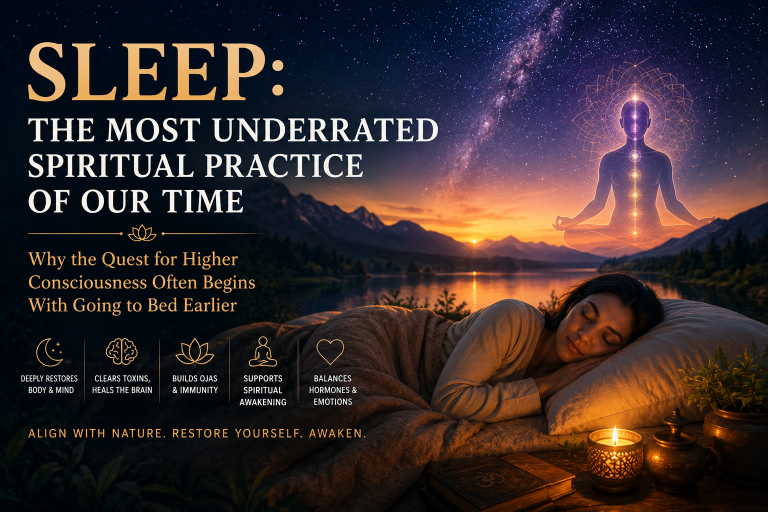
Why the Quest for Higher Consciousness Often Begins With Going to Bed Earlier
People want enlightenment.
They want intuition.
They want abundance.
They want deeper meditation.
They want emotional healing.
They want radiant skin.
They want longevity.
They want a stronger memory.
They want a calmer nervous system.
They want to awaken their Kundalini.
Yet many of these same people are going to bed at midnight, scrolling on their phones until 1 a.m., sleeping six hours, and wondering why they feel exhausted, anxious, reactive, and disconnected.
We live in a culture that glorifies productivity and minimizes restoration.
A culture that celebrates the entrepreneur who sleeps four hours.
The parent who sacrifices sleep for everyone else.
The student who studies all night.
The spiritual seeker who wants mystical experiences but ignores the biological vessel through which those experiences must arise.
The truth is simple:
You cannot consistently access higher states of consciousness through a depleted nervous system.
Before we talk about awakening, we must talk about recovery.
Before we talk about transcendence, we must talk about sleep.
Nature Does Its Deepest Work in the Dark
Everything in nature follows cycles.
The sun rises.
The sun sets.
The moon waxes and wanes.
The seasons change.
The tides move.
The breath expands and contracts.
The heart beats and rests.
Your body is no different.
It was designed around rhythms.
The problem is that modern life encourages us to live as though rhythms do not matter.
Artificial light extends the day.
Screens stimulate the brain late into the night.
Work follows us home.
Stress follows us into bed.
Notifications follow us everywhere.
As a result, many people never truly enter the regenerative states their bodies were designed to experience.
Yet it is during the night that some of the most profound healing processes occur.
Collagen is synthesized.
Growth hormone is released.
Immune cells become active.
Memory is consolidated.
The brain clears metabolic waste.
The nervous system recalibrates.
The emotional experiences of the day are integrated.
Nature performs surgery while you sleep.
The Ancient Wisdom of Early Sleep
Long before sleep laboratories existed, traditional healing systems understood that not all sleep is equal.
Ayurveda teaches that the period between 10 p.m. and 2 a.m. is governed by Pitta—the transformative principle.
This is the body’s maintenance shift.
The repair crew comes online.
The liver works.
The tissues regenerate.
The subtle body reorganizes.
Traditional teachings often state that an hour of sleep before midnight is worth far more than an hour after midnight.
Whether or not the ratio is exact is beside the point.
The observation remains remarkably accurate.
The earlier portions of sleep are often the most restorative.
Miss them consistently and the debt accumulates.
Not merely as fatigue.
But as aging.
Inflammation.
Brain fog.
Emotional volatility.
Hormonal imbalance.
Loss of vitality.
Ojas: The Hidden Currency of Life
In Ayurveda, there is a concept called Ojas.
Ojas is often translated as vitality, resilience, radiance, immunity, and spiritual strength.
When Ojas is abundant:
You feel grounded.
You recover quickly.
Your mind is clear.
Your skin glows.
Your emotions remain stable.
Your presence becomes magnetic.
When Ojas is depleted:
You become reactive.
Exhaustion sets in.
Anxiety increases.
The immune system weakens.
Sleep becomes fragmented.
The spark in the eyes begins to fade.
One of the greatest builders of Ojas is deep, nourishing sleep.
Not sedation.
Not unconsciousness.
Not passing out from exhaustion.
True restorative sleep.
The kind that leaves you feeling renewed rather than merely less tired.
Why Sleep Is a Kundalini Practice
Many people assume Kundalini Yoga is about powerful breathing techniques, dynamic movements, mantras, and meditation.
Those are important.
But Kundalini Yoga is fundamentally a science of energy.
Energy requires a vessel.
That vessel is your nervous system.
Every meditation.
Every kriya.
Every breath practice.
Every mystical experience.
Must pass through the nervous system.
If the nervous system is exhausted, overstimulated, inflamed, and depleted, the capacity to hold higher frequencies diminishes.
This is one reason many spiritual practitioners burn out.
They seek expansion without restoration.
Intensity without integration.
Activation without recovery.
Sleep is where integration occurs.
Sleep is where the nervous system digests spiritual experience.
Sleep is where the body catches up with consciousness.
The Modern Epidemic of Tiredness
Many people believe fatigue is normal.
It is not.
Common?
Yes.
Normal?
No.
We have normalized:
- Waking tired
- Afternoon crashes
- Brain fog
- Dependency on caffeine
- Difficulty concentrating
- Emotional reactivity
- Poor memory
These are not signs of aging.
They are signs of a system struggling to recover.
The body speaks through symptoms.
Fatigue is often its way of saying:
“I need restoration more than stimulation.”
Yet most people respond with another coffee.
Another energy drink.
Another supplement.
Another productivity hack.
The answer is often much simpler.
The body wants sleep.
The Sacred Hours Before Dawn
Yogic traditions speak of Amrit Vela—the ambrosial hours before sunrise.
These hours are prized because the mind is naturally quieter.
The world is still.
The subconscious is more accessible.
Meditation deepens effortlessly.
But there is a forgotten prerequisite.
To rise early consistently, one must sleep early consistently.
The yogis did not wake at 4 a.m. after going to bed at midnight.
Their practices were supported by alignment with nature.
The morning begins the night before.
The Longevity Secret Nobody Wants to Hear
We live in an age obsessed with optimization.
Biohacks.
Supplements.
Peptides.
Wearables.
Cold plunges.
Hyperbaric chambers.
Red light therapy.
Many of these tools have value.
But none of them can replace sleep.
Sleep remains the most powerful regenerative process available to the human body.
It costs nothing.
Requires no equipment.
Has no side effects.
And influences nearly every system in the body.
The challenge is that it is too simple to market.
No one becomes a millionaire telling people to go to bed at 10 p.m.
Yet it may be one of the most profound health interventions available.
The Invitation
Tonight, instead of asking:
“What can I do to improve my health?”
Ask:
“What is preventing me from honoring sleep?”
Because sleep is not laziness.
It is not weakness.
It is not lost productivity.
It is biological intelligence.
It is spiritual intelligence.
It is one of nature’s most sophisticated healing technologies.
Every night the body offers you an invitation.
A chance to repair.
To integrate.
To cleanse.
To restore.
To rebuild.
To return to yourself.
The question is not whether the body knows how to heal.
The question is whether we are willing to get out of its way long enough for it to do so.
Perhaps the most advanced wellness practice is not found in a supplement bottle, a retreat center, or a laboratory.
Perhaps it begins with a simple act of humility.
Turning off the lights.
Closing the eyes.
And trusting the wisdom that has carried humanity through countless generations.
Sleep well.
Your future self is being built while you dream.