A Kundalini Yoga Perspective on Sleep, Restoration, and the Hidden Cost of Modern Living
Most conversations about sleep begin with the same question:
“How many hours do I need?”
Six?
Seven?
Eight?
Nine?
Modern science continues to debate the exact number, while wearable devices, sleep trackers, and health experts compete to optimize every minute.
Yet I believe we may be asking the wrong question.
The more important question may be:
How much recovery do we actually need?
Because sleep and recovery are not the same thing.
And understanding the difference may transform how we think about health, vitality, longevity, and spiritual growth.
The Assumption Nobody Questions
Most people assume that sleep is the body’s primary method of recovery.
That assumption seems obvious.
When we are tired, we sleep.
When we are exhausted, we sleep more.
When we are sick, we sleep longer.
Sleep is clearly restorative.
But what if sleep is not the goal?
What if restoration is the goal?
And what if sleep is merely one pathway through which restoration occurs?
This is where many yogic traditions begin to diverge from conventional thinking.
The Strange Observation of the Yogis
Throughout history, yogis, monks, sages, and advanced meditators have repeatedly reported something curious.
As their practice deepened, their need for sleep often decreased.
Not because they forced themselves to sleep less.
Not because they were trying to be productive.
Not because they were surviving on caffeine and adrenaline.
Rather, something changed within their nervous system.
Their sleep became deeper.
Their recovery became more efficient.
Their energy became more stable.
Their awareness became more continuous.
Many traditions contain references to practitioners who naturally required fewer hours of sleep after years of dedicated practice.
This observation appears in yogic, Buddhist, Taoist, and contemplative traditions throughout the world.
The question is:
Why?
Perhaps Sleep Is Paying a Debt
Imagine two individuals.
The first person spends the day:
- Stressed
- Rushing
- Multitasking
- Consuming constant information
- Processing emotional conflict
- Eating poorly
- Sitting under artificial light
- Checking their phone hundreds of times
The second person spends the day:
- Breathing consciously
- Moving regularly
- Meditating
- Eating nourishing foods
- Spending time in nature
- Maintaining emotional balance
- Living with a regulated nervous system
Would these two people require the same amount of recovery?
Common sense suggests they would not.
Yet most discussions about sleep ignore this entirely.
The quantity of recovery needed may be directly related to the amount of imbalance accumulated during waking hours.
In this sense, much of modern sleep may be devoted to paying back the energetic debt we create during the day.
The Nervous System Is the Real Story
Kundalini Yoga places tremendous emphasis on the nervous system.
Not because the nervous system is merely biological.
But because it is the instrument through which consciousness is experienced.
A strong nervous system can process stress without becoming overwhelmed.
A weak nervous system becomes exhausted by ordinary life.
Many Kundalini kriyas appear designed to increase resilience, improve recovery, and expand the capacity of the nervous system.
Interestingly, some traditional teachings note that certain kriyas may alter sleep patterns during periods of practice.
Practitioners sometimes report:
- Waking earlier
- Needing less sleep
- Experiencing changes in sleep cycles
- Feeling rested despite fewer hours in bed
These observations have been repeated often enough throughout the tradition that warnings are sometimes included.
Not because sleep deprivation is encouraged.
But because nervous system adaptation appears to occur.
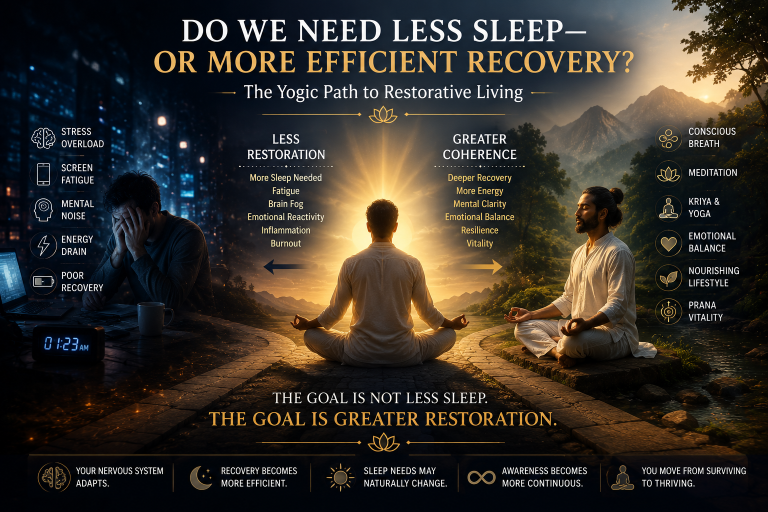
The Goal Is Not Less Sleep
This distinction is critical.
The goal of yoga is not sleep deprivation.
The goal is coherence.
The goal is vitality.
The goal is awareness.
The goal is restoration.
Far too many people hear stories of advanced practitioners sleeping four or five hours and assume that is the objective.
It is not.
The reduction in sleep is a consequence.
Not a technique.
A tree does not produce fruit because it is trying to.
Fruit appears naturally when the roots are healthy.
Similarly, some practitioners may discover they need less sleep after years of cultivating profound nervous system regulation.
That does not mean everyone should attempt to sleep less.
What Modern Science Can Measure
Science has become extraordinarily skilled at measuring sleep.
Researchers can evaluate:
- Brain waves
- Sleep stages
- Hormones
- Heart rate variability
- Cognitive performance
- Memory consolidation
These are valuable tools.
Yet there are still aspects of human experience that remain difficult to quantify.
Science can measure sleep duration.
But can it fully measure:
- Inner stillness?
- Pranic vitality?
- Meditative absorption?
- Energetic coherence?
- Spiritual restoration?
Perhaps one day it will.
For now, these dimensions remain largely outside conventional measurement.
This does not mean they do not exist.
It simply means our instruments may not yet be sophisticated enough to capture them fully.
Recovery Happens Beyond Sleep
Think about the moments in life when you feel most restored.
Is it always after sleeping?
Not necessarily.
Sometimes recovery arrives through:
- Deep meditation
- Prayer
- Breathwork
- Nature
- Silence
- Loving connection
- Sat Nam Rasayan
- Genuine relaxation
There are moments when ten minutes of profound stillness can restore more energy than an hour of restless activity.
Most people have experienced this.
The body clearly possesses multiple pathways to restoration.
Sleep is one.
Meditation may be another.
The Future of Human Potential
Perhaps the future conversation should not be:
“How can I survive on less sleep?”
That question is driven by productivity culture.
A better question is:
“How can I become so deeply regulated that recovery occurs more efficiently?”
That is a very different pursuit.
One seeks more output.
The other seeks greater harmony.
The first is rooted in doing.
The second is rooted in being.
This is where the wisdom of Kundalini Yoga becomes relevant.
The practices are not merely exercises.
They are technologies for refining the human system.
As the breath becomes balanced, the mind becomes quieter.
As the mind becomes quieter, the nervous system becomes more efficient.
As the nervous system becomes more efficient, recovery improves.
And perhaps, over time, the amount of sleep required begins to change naturally.
Not through force.
Not through discipline.
Not through deprivation.
But through transformation.
The Real Question
So do we need less sleep?
Perhaps.
Some people may.
Some may not.
The more interesting question is this:
If your nervous system became profoundly balanced…
If your mind became deeply peaceful…
If your emotions became integrated…
If your breath became efficient…
If your energy became abundant…
How much recovery would you truly require?
The yogis spent thousands of years exploring that question.
Perhaps it is time we began exploring it again.
Not with dogma.
Not with ideology.
But with curiosity, observation, and direct experience.
Because sleep may not be the ultimate goal.
Restoration is.
And the more skillful we become at restoring ourselves, the more vibrant, awake, and fully alive we can be.