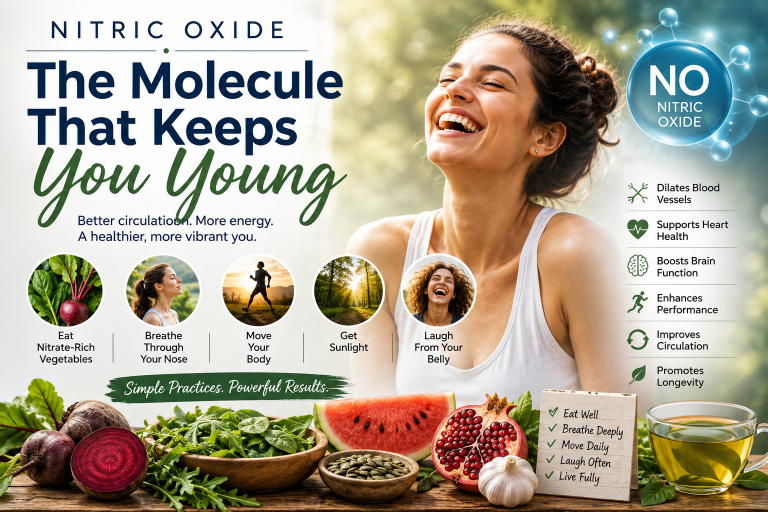
Nitric Oxide: The Molecule That Keeps You Young
Better Circulation, More Energy, and a Healthier, More Vibrant You
We usually think of health in terms of organs.
The heart.
The brain.
The lungs.
The muscles.
The immune system.
But beneath every organ is a more fundamental requirement:
Flow.
Blood must flow.
Oxygen must reach the tissues.
Nutrients must arrive.
Metabolic waste must leave.
The smallest blood vessels must open and close intelligently according to the needs of the body.
At the center of this extraordinary orchestration is a molecule most people rarely hear about.
Nitric oxide.
Nitric oxide, abbreviated as NO, is a gas naturally produced inside the body. Although it survives for only a short time, it acts as a powerful signaling molecule, allowing cells to communicate and blood vessels to respond rapidly to changing conditions.
It tells the muscles surrounding blood vessels to relax.
The vessels widen.
Circulation improves.
Oxygen and nutrients travel more easily.
The heart does not have to push against as much resistance.
The brain, muscles, skin, digestive organs, and reproductive tissues receive the blood supply they need.
Nitric oxide is not a vitamin, hormone, or mineral.
It is a brief biological message.
Yet that message can influence nearly every system in the body.
The discovery of nitric oxide as a signaling molecule in the cardiovascular system was considered so important that it earned the 1998 Nobel Prize in Physiology or Medicine.
Scientists had discovered something remarkable:
The body uses a gas to regulate life.
Health Is More Than Chemistry—It Is Circulation
Imagine a beautiful garden with rich soil, sunlight, seeds, and water.
Now imagine that the irrigation channels are blocked.
It does not matter how many nutrients exist in the soil if water cannot reach the roots.
The human body works in a similar way.
We can consume nutritious foods, herbs, minerals, and supplements, but they must still be transported through the bloodstream and delivered to the cells.
Circulation is the distribution system of life.
When the blood vessels respond properly, the body can direct blood toward the places where it is most urgently needed.
During exercise, more blood flows toward the muscles.
After eating, circulation supports the digestive system.
During mental work, the brain requires a continuous supply of oxygen and glucose.
During sexual arousal, nitric oxide helps produce the vascular changes necessary for healthy erectile and genital responses.
During healing, blood flow carries immune cells, oxygen, amino acids, and repair materials into injured tissue.
Nitric oxide helps regulate this continuous redistribution.
It is one of the reasons healthy circulation influences so many seemingly unrelated aspects of well-being.
What Nitric Oxide Does in the Body
Nitric oxide is best known for relaxing blood vessels, but its role extends far beyond simple vasodilation.
It Helps Blood Vessels Expand
The inner lining of the blood vessels is called the endothelium.
A healthy endothelium releases nitric oxide in response to blood flow and other signals. Nitric oxide then communicates with the smooth muscle surrounding the vessel, telling it to relax.
As the vessel widens, resistance decreases and blood can move more freely.
This mechanism supports healthy blood pressure and reduces unnecessary strain on the cardiovascular system.
It Supports the Heart
The heart is a pump, but it is also a muscle requiring its own oxygen supply.
Healthy nitric oxide signaling supports coronary circulation, vascular flexibility, and the heart’s ability to respond to changing physical demands.
When arteries become stiff or endothelial function deteriorates, the heart must work harder to circulate blood.
It Supports the Brain
The brain represents only a small portion of total body weight, yet it uses a considerable amount of the body’s oxygen and energy.
Nitric oxide participates in the regulation of cerebral blood flow and also functions as a signaling molecule within the nervous system.
Healthy circulation does not guarantee perfect cognition, but the brain cannot function optimally without reliable blood flow.
It Supports Physical Performance
When muscles contract, their demand for oxygen and nutrients increases.
Exercise stimulates blood flow, and the resulting mechanical force against the inner vessel wall—known as shear stress—encourages the endothelium to produce nitric oxide.
The vessels widen to help supply the working muscles.
This relationship helps explain why regular movement supports both circulation and long-term vascular health.
It Supports Sexual Function
Nitric oxide is essential to the relaxation of smooth muscle in erectile tissue.
This is true not only for male erectile function but also for blood flow and responsiveness within female genital tissues.
Sexual vitality is influenced by hormones, emotions, relationships, neurological health, and psychological safety, but it is also profoundly vascular.
Where healthy blood flow is compromised, sexual response may be affected.
It Participates in Immune Defense
Certain immune cells can generate nitric oxide as part of the body’s defense response.
In this setting, nitric oxide may help the immune system respond to microorganisms and damaged cells.
However, nitric oxide biology is about balance.
Appropriate production is protective. Excessive production during severe inflammation may contribute to tissue injury.
Nitric oxide is not simply “good” or “bad.” Its effect depends on where it is produced, how much is produced, and what is happening in the surrounding tissue.
Nitric Oxide and the Biology of Aging
We often describe aging by looking at the outside of the body:
Wrinkles.
Gray hair.
Loss of muscle.
Reduced mobility.
But aging also occurs inside the blood vessels.
Over time, the endothelium may become less responsive. Oxidative stress may reduce nitric oxide availability, arteries may become less flexible, and the vascular system may have more difficulty adjusting to physical and metabolic demands.
This decline is not determined by age alone.
Smoking, inactivity, poor sleep, uncontrolled blood sugar, chronic stress, high blood pressure, inflammatory conditions, and nutritionally poor diets can all interfere with endothelial health.
Conversely, regular movement, restorative sleep, nutritious plant foods, stress regulation, and the avoidance of tobacco can help protect vascular function.
Nitric oxide does not literally stop aging.
No molecule can do that.
But preserving the pathways that produce and protect nitric oxide may help preserve one of the qualities we associate with youth:
The ability of the body to adapt, circulate, respond, and recover.
Youthfulness is not only the absence of wrinkles.
It is responsiveness.
It is flexibility.
It is the capacity to increase blood flow when blood flow is needed.
The Two Main Ways the Body Makes Nitric Oxide
The body has more than one pathway for producing nitric oxide.
Understanding these pathways helps us see why movement, vegetables, nasal breathing, and oral health may all matter.
The Arginine–Nitric Oxide Pathway
Cells lining the blood vessels use enzymes called nitric oxide synthases to produce nitric oxide from the amino acid L-arginine.
This is one of the body’s primary internal nitric oxide pathways.
Healthy endothelial cells respond to increased blood flow by producing more nitric oxide. This is one reason exercise is so valuable: movement repeatedly trains the blood vessels to respond.
This pathway also depends on a supportive biochemical environment. Oxidative stress, inflammation, smoking, metabolic dysfunction, and certain diseases can impair nitric oxide production or rapidly deactivate the nitric oxide that is produced.
The Nitrate–Nitrite–Nitric Oxide Pathway
The second pathway begins largely with food.
Certain vegetables naturally contain nitrate. After we eat them, nitrate is absorbed into the bloodstream. Some of it is concentrated in the saliva.
Beneficial bacteria living on the tongue convert nitrate into nitrite.
When the saliva is swallowed, nitrite can be converted into nitric oxide and related compounds, particularly in acidic or low-oxygen environments.
This creates a beautiful collaboration between:
The soil.
The vegetable.
The mouth.
The microbiome.
The digestive system.
The blood.
The tissues.
The body is not creating nitric oxide in isolation. It is working with the plant kingdom and with its own microbial ecosystem.
The Easiest Way to Support Nitric Oxide: Eat Your Greens
For most people, the simplest everyday strategy is not an exotic supplement.
It is eating more nitrate-rich vegetables.
Among the richest sources are:
- Arugula
- Spinach
- Beetroot
- Beet greens
- Lettuce
- Celery
- Bok choy
- Swiss chard
- Radish
- Mustard greens
- Chinese cabbage
- Watercress
Nitrate concentrations vary according to the vegetable, soil, season, farming conditions, storage, and preparation.
There is no need to obsess over exact numbers.
The practical principle is simple:
Eat a generous variety of leafy green vegetables regularly.
Is Beetroot the Best Source?
Beetroot has become famous because beet juice has been widely studied in relation to blood pressure and exercise performance.
It is convenient, naturally nitrate-rich, and easy to measure in clinical trials.
However, beetroot is not the only—or always the most concentrated—food source.
Leafy greens such as arugula can be exceptionally rich in nitrate.
This means you do not necessarily need a specialized beet supplement.
A bowl of leafy greens may be equally valuable as part of your daily diet.
A Simple Nitric Oxide Salad
A practical nitric oxide-supporting meal could include:
- Arugula
- Spinach
- Grated beetroot
- Celery
- Pomegranate seeds
- Lemon juice
- Garlic
- Walnuts or pumpkin seeds
- Extra-virgin olive oil
This meal supplies nitrate-rich vegetables while also providing antioxidants, minerals, healthy fats, and plant compounds that support overall cardiovascular health.
Vitamin C and polyphenol-rich foods may also help support favorable chemistry within the nitrate–nitrite pathway.
The goal is not to isolate one miracle molecule.
The goal is to create a biological environment in which the body can function well.
Do Not Sterilize the Mouth Without a Reason
One of the most fascinating parts of the dietary nitrate pathway occurs on the tongue.
Oral bacteria help convert nitrate into nitrite.
This does not mean oral hygiene is harmful. Brushing, flossing, dental care, and maintaining healthy gums remain essential.
It does mean that indiscriminate use of strong antiseptic mouthwash may not always be beneficial.
A mouth is not meant to be sterile.
It is meant to have a healthy microbial ecology.
Some studies have found that frequent use of antibacterial mouthwash can disrupt nitrate-reducing bacteria and may interfere with the nitrate–nitrite–nitric oxide pathway.
This does not mean that medically prescribed mouthwash should be abandoned. A dentist may recommend antimicrobial products for specific conditions or limited periods.
The wiser message is:
Do not treat all bacteria as enemies.
Oral health depends upon balance, not total eradication.
Nasal Breathing: The Nitric Oxide Pathway in the Sinuses
The nasal passages and paranasal sinuses produce nitric oxide.
When we inhale through the nose, some of this locally produced nitric oxide is carried into the respiratory tract.
This is one reason nasal breathing is biologically different from mouth breathing.
The nose does far more than provide an alternative opening for air.
It warms the breath.
It humidifies the air.
It filters particles.
It regulates airflow.
And it contributes nitric oxide to the inhaled breath.
Studies have found that nasal breathing can influence oxygenation and pulmonary circulation under particular conditions. However, this should not be transformed into the simplistic claim that nasal breathing always dramatically raises nitric oxide throughout the entire body.
The strongest statement is more precise:
Nasal breathing allows us to inhale nitric oxide produced within the nasal and sinus cavities, while mouth-only breathing largely bypasses this route.
A Simple Nasal-Breathing Practice
Sit comfortably with the spine tall but not rigid.
Close the mouth gently.
Allow the tongue to rest naturally.
Inhale slowly through the nose.
Exhale slowly through the nose.
Do not force the breath.
Let the respiratory rate gradually become quieter and smoother.
Practice for three to five minutes.
The purpose is not to inhale the largest possible amount of air. It is to restore a calm, efficient relationship with breathing.
People with severe nasal obstruction, respiratory illness, or difficulty breathing should seek appropriate medical care rather than forcing nasal breathing.
Humming: A Powerful Way to Increase Nasal Nitric Oxide
Humming creates vibration and oscillating airflow within the nasal passages and sinuses.
Research has shown that humming can temporarily produce a striking increase in measured nasal nitric oxide compared with quiet exhalation.
This may occur because humming improves the movement of air between the sinuses and the nasal cavity, helping release nitric oxide that has accumulated within the sinus spaces.
This does not necessarily mean that humming raises whole-body nitric oxide fifteenfold or produces dramatic cardiovascular changes.
The increase measured in research is primarily local nasal nitric oxide during the humming breath.
That distinction matters.
Still, humming remains a simple and beautiful practice.
Bhramari: The Humming Bee Breath
Bhramari Pranayama is traditionally practiced by inhaling through the nose and exhaling with a steady humming sound.
Sit comfortably.
Inhale gently through the nose.
With the mouth closed, exhale with a smooth “mmm” sound.
Feel the vibration in the face, skull, throat, and chest.
Repeat five to ten rounds without strain.
The vibration may feel calming, grounding, and mentally organizing.
From a modern physiological perspective, humming changes airflow and increases measured nitric oxide within the nasal passages.
From the yogic perspective, sound organizes prana.
Both descriptions may be observing different dimensions of the same practice.
Belly Laughter: When Joy Opens the Blood Vessels
There may be no more enjoyable circulatory practice than genuine belly laughter.
Not a forced smile.
Not social politeness.
Not typing “LOL” without moving a single facial muscle.
Real laughter.
The kind that moves the diaphragm.
The kind that interrupts the breath.
The kind that softens the abdomen and temporarily removes the burden of self-consciousness.
Studies of mirthful laughter have found favorable short-term changes in vascular function, including improved arterial compliance and endothelial-dependent dilation.
Nitric oxide is believed to participate in these vascular effects, although laughter studies have not always measured nitric oxide directly.
Therefore, it is more accurate to say:
Deep laughter may support nitric oxide-mediated endothelial function and healthy circulation.
It is too strong to declare that every episode of laughter directly floods the body with a precisely measured quantity of nitric oxide.
But the vascular effect itself is meaningful.
Why Belly Laughter May Help
During a deep laugh:
- The diaphragm contracts rhythmically.
- Breathing patterns change.
- Heart rate and circulation temporarily increase.
- Muscles contract and release.
- The stress response is activated briefly and then settles.
- Emotional tension may soften.
- Blood flow against the vessel wall may encourage endothelial signaling.
Laughter is almost like a miniature interval exercise followed by relaxation.
The body becomes activated—but within the context of pleasure rather than danger.
Joy Is a Physiological State
Joy is often treated as a reward we receive only after every problem is solved.
But joy is also biological information.
A nervous system that can laugh is, at least for that moment, receiving the message that it is safe enough to expand.
Laughter does not cure every disease.
It does not replace medicine.
It does not invalidate grief, trauma, or pain.
It simply reminds the body that contraction is not the only available state.
Sometimes joy is not the result of healing.
Sometimes joy participates in healing.
Does Dog Breath Increase Nitric Oxide?
Dog Breath is a rapid, tongue-out panting practice used in some yogic traditions.
Because the tongue is extended and the breathing occurs through the mouth, this practice bypasses much of the nasal nitric oxide pathway.
Therefore, Dog Breath should not be presented as one of the most direct ways to inhale nasal nitric oxide.
It may still create other physiological effects.
The rapid movement of the diaphragm may alter circulation.
The practice may stimulate, warm, energize, or change autonomic state.
The increased movement of blood could theoretically support endothelial nitric oxide production through shear stress, much as other forms of physical activity do.
However, direct research demonstrating that tongue-out Dog Breath significantly increases systemic nitric oxide is limited.
The accurate conclusion is:
Dog Breath may stimulate circulation, but nasal breathing and humming have a clearer connection to nasal nitric oxide.
If Dog Breath is practiced, it can be followed with slow nasal breathing or gentle humming to restore calm and engage the nasal pathway.
People who become dizzy, breathless, numb, anxious, or uncomfortable should stop and return to normal breathing.
Breathwork is not improved by forcing it.
Exercise: Teaching the Blood Vessels to Stay Young
The endothelium responds to movement.
When exercise increases blood flow, the blood creates greater frictional force along the vessel lining.
This shear stress signals the endothelial cells to produce nitric oxide.
Over time, regular exercise can improve nitric oxide-dependent vasodilation and vascular responsiveness.
This is one reason sedentary living is so damaging.
The cardiovascular system is designed to experience changing demand.
It is meant to dilate.
It is meant to increase blood flow.
It is meant to respond to muscles requesting more oxygen.
Without regular movement, the signaling relationship between blood flow and the endothelium may become less robust.
What Kind of Exercise Is Best?
You do not need to become an elite athlete.
Helpful forms of movement include:
- Brisk walking
- Cycling
- Swimming
- Dancing
- Yoga
- Strength training
- Hiking
- Body-weight exercises
- Moderate interval training
- Active household work
Consistency is more important than chasing extreme intensity.
Even short movement breaks throughout the day may help interrupt the vascular stagnation of prolonged sitting.
Sunlight and Nitric Oxide Stored in the Skin
The skin contains compounds related to nitric oxide storage.
Research suggests that ultraviolet exposure can mobilize nitric oxide-related compounds from the skin into the circulation, potentially influencing blood vessel dilation and blood pressure.
This is an intriguing pathway, but it does not mean that unlimited sun exposure is healthy.
Excessive ultraviolet exposure increases the risk of skin damage, premature skin aging, and skin cancer.
The body often benefits from moderation rather than extremes.
Safe sun habits depend on skin type, geographic location, time of day, season, medical history, and medications.
Sunlight may participate in cardiovascular biology, but it should be approached intelligently rather than worshiped as harmless medicine.
Watermelon and the Citrulline Pathway
Watermelon contains an amino acid called citrulline.
The body can convert citrulline into arginine, which can then be used in the nitric oxide synthase pathway.
This is why citrulline-rich foods and supplements are often discussed in relation to circulation and exercise performance.
Whole watermelon also provides water, potassium, carotenoids, and other beneficial plant compounds.
Again, the best strategy is not to isolate one food and consume it obsessively.
A diverse plant-based diet gives the body multiple ways to support vascular health.
Other Foods That Support Healthy Nitric Oxide Biology
Nitric oxide production depends not only on nitrate intake but also on the health of the endothelium and the degree of oxidative stress in the body.
Helpful foods may include:
Pomegranate
Pomegranate is rich in polyphenols that may support vascular health and help protect nitric oxide from oxidative destruction.
Garlic
Garlic contains sulfur compounds associated with cardiovascular benefits and may support signaling pathways related to vascular relaxation.
Citrus Fruits
Vitamin C and citrus polyphenols may support endothelial health and favorable nitric oxide chemistry.
Nuts and Seeds
Walnuts, pumpkin seeds, sesame seeds, and other nuts and seeds provide arginine, minerals, and healthy fats.
Cacao
Unsweetened cacao and dark chocolate rich in cocoa flavanols have been studied for their effects on endothelial function.
This is not permission to treat heavily sweetened chocolate as medicine.
The benefit comes from the plant compounds, not from excessive sugar.
Legumes and Whole Grains
These foods support metabolic health, gut health, and overall cardiovascular function, all of which influence the environment in which nitric oxide is produced and preserved.
What Reduces Nitric Oxide Availability?
Supporting nitric oxide is not only about adding helpful practices.
It is also about reducing the forces that damage endothelial function.
Major threats include:
- Smoking
- Vaping
- Physical inactivity
- Poorly controlled blood pressure
- Chronic high blood sugar
- Persistent sleep deprivation
- Excessive ultra-processed food intake
- Severe oxidative stress
- Chronic inflammation
- Excessive alcohol consumption
- Long periods of uninterrupted sitting
Smoking is particularly harmful because it damages the endothelium and reduces nitric oxide availability.
No quantity of beetroot juice can neutralize a habit that repeatedly injures the blood vessels.
The foundations still matter.
The Problem with “Nitric Oxide Booster” Marketing
Nitric oxide cannot simply be swallowed and stored like a vitamin.
It is highly reactive and short-lived.
Most products marketed as nitric oxide supplements contain ingredients intended to support one of the body’s nitric oxide pathways, such as:
- Beetroot nitrate
- L-citrulline
- L-arginine
- Plant extracts
- Antioxidants
Some of these ingredients may be helpful in specific settings.
But supplements are not automatically superior to food, movement, breathing, sleep, and cardiovascular care.
They may also interact with medications or lower blood pressure more than intended.
People taking nitrates for chest pain, blood-pressure medication, erectile-dysfunction medication, or drugs that affect circulation should speak with a qualified clinician before using concentrated nitric oxide products.
More is not always better.
Biology depends on balance.
A Simple Daily Nitric Oxide Ritual
A sustainable routine can be remarkably uncomplicated.
In the Morning
Begin with a few minutes of gentle nasal breathing.
Hum softly for five to ten breaths.
Step outside for natural morning light.
Move the body through walking, stretching, yoga, or a short exercise practice.
During the Day
Eat a generous serving of nitrate-rich leafy greens.
Include beetroot, celery, radish, or other colorful vegetables.
Use garlic, lemon, herbs, nuts, and seeds to make the meal satisfying.
Stand and move regularly if your work requires prolonged sitting.
Drink adequate water.
In the Evening
Choose connection over constant stimulation.
Laugh with someone.
Watch something genuinely funny.
Practice laughter yoga or intentional laughter if it feels authentic and comfortable.
Finish with slow breathing through the nose.
Allow the nervous system to settle before sleep.
Throughout Life
Protect the mouth’s microbial ecosystem without neglecting oral hygiene.
Avoid smoking and vaping.
Build muscle.
Walk often.
Sleep deeply.
Manage blood pressure, glucose, and cardiovascular risk with appropriate professional guidance.
Eat plants in their natural colors.
And do not postpone joy indefinitely.
Nitric Oxide Through the Yogic Lens
Yoga speaks of prana moving through channels.
Modern physiology speaks of oxygen, circulation, nerve signals, vascular tone, and cellular communication.
These languages are not identical, and we should not force them to become identical.
Prana cannot simply be reduced to nitric oxide.
Nor should nitric oxide be treated as laboratory proof of every ancient yogic teaching.
Yet there is a meaningful resonance between them.
Both traditions recognize that life depends upon movement.
When the breath becomes restricted, consciousness changes.
When the blood vessels constrict, physiology changes.
When the diaphragm becomes rigid, the emotional state changes.
When circulation improves, warmth and sensation return.
When the nervous system feels safe, the body becomes more capable of expansion.
Yoga has always understood that vitality is not only about possessing energy.
It is about the ability of energy to move.
The Deeper Meaning of Flow
Nitric oxide teaches us a beautiful biological lesson.
Power does not always come from hardness.
Strength does not always come from contraction.
Health requires the ability to soften.
An artery must be strong enough to contain blood, but flexible enough to expand.
A heart must generate pressure, but it must also relax between beats.
A diaphragm must contract, but it must also release.
A nervous system must protect us from danger, but it must also recognize safety.
A human being must be capable of discipline, but also joy.
Nitric oxide is part of the body’s language of expansion.
It allows blood vessels to release unnecessary tension so that life can reach more of us.
Perhaps that is why so many nitric oxide-supporting practices feel fundamentally life-giving:
Eating green leaves.
Walking.
Breathing through the nose.
Humming.
Moving the body.
Feeling sunlight.
Laughing from the belly.
These practices do not require us to conquer the body.
They invite us to cooperate with it.
The Molecule That Keeps You Young
Nitric oxide is sometimes called the molecule that keeps us young.
Not because it grants immortality.
Not because it can reverse every disease.
And not because one supplement can restore everything that has been lost.
It keeps us young because it supports responsiveness.
Blood vessels that can open.
Muscles that can receive oxygen.
A brain that can be nourished.
A heart that does not have to fight unnecessary resistance.
A body that can adapt to movement, rest, intimacy, food, temperature, stress, and recovery.
The easiest way to support nitric oxide is not one isolated technique.
It is a way of living that protects flow.
Eat the greens.
Move every day.
Breathe through the nose when appropriate.
Hum.
Care for the mouth.
Spend time outside safely.
Protect your sleep.
Avoid smoking.
And laugh from the belly.
Because sometimes the medicine that helps life move through us does not arrive as a pill.
Sometimes it arrives as a leaf.
A breath.
A vibration.
A walk.
Or a moment of joy so complete that the whole body finally lets go.