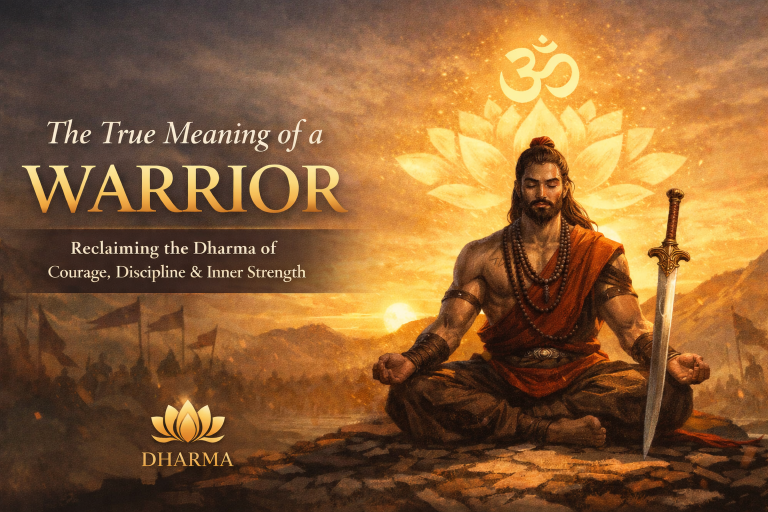
Reclaiming the Dharma of Courage, Discipline, and Inner Strength
In modern conversations, the word “warrior” often creates discomfort.
Some people hear the word and immediately imagine aggression, violence, domination, or conflict.
Others associate it with war, conquest, and destruction.
So when someone uses a phrase like “peaceful warrior,” confusion arises.
“How can someone be both peaceful and a warrior?”
“Isn’t that a contradiction?”
The discomfort does not come from the word itself.
It comes from how far we have drifted from the original meaning of the warrior archetype.
Because in the deeper traditions of human civilization — particularly in Sanatan Dharma — a warrior was never simply someone who fought battles.
A warrior was someone who embodied discipline, clarity, responsibility, and courage.
The true warrior was not defined by violence.
The warrior was defined by consciousness.
The Etymology of the Word “Warrior”
The English word warrior traces back to the Old North French word werreier, meaning:
“One who wages war.”
But even deeper roots point toward something more meaningful.
The word war itself comes from the Proto-Germanic werra, meaning confusion, struggle, or disorder.
In this sense, a warrior was originally someone who confronts chaos.
Someone who steps forward when life becomes unstable, uncertain, or threatened.
A warrior was not merely someone who fought others.
A warrior was someone who had the capacity to face disorder without collapsing.
This definition already begins to shift the perspective.
Because suddenly the warrior is not just a soldier.
The warrior is a stabilizing force in the world.
The Warrior Tradition in Sanatan Dharma
In Sanatan Dharma, the warrior ideal was deeply embedded within society.
But this concept was much broader than modern interpretations of the Kshatriya archetype.
Yes, the Kshatriya class was responsible for protection and governance.
But the qualities of the warrior were cultivated in everyone.
Men and women alike were taught to develop the inner architecture of strength.
A true warrior was trained in:
-
Discipline
-
Self-control
-
Courage
-
Clarity of mind
-
Emotional steadiness
-
Physical capability
-
Spiritual responsibility
This training was not about creating aggressive individuals.
It was about creating stable human beings capable of protecting Dharma.
Because Dharma — the natural order of life — cannot survive if people are weak in character.
The Warrior Beyond Weapons
When people hear the word warrior, they often imagine weapons.
Swords. Bows. Armies.
But the deeper warrior training went far beyond combat.
The real battlefield was internal.
Every person was expected to cultivate mastery over:
-
Fear
-
Anger
-
Desire
-
Attachment
-
Laziness
-
Self-doubt
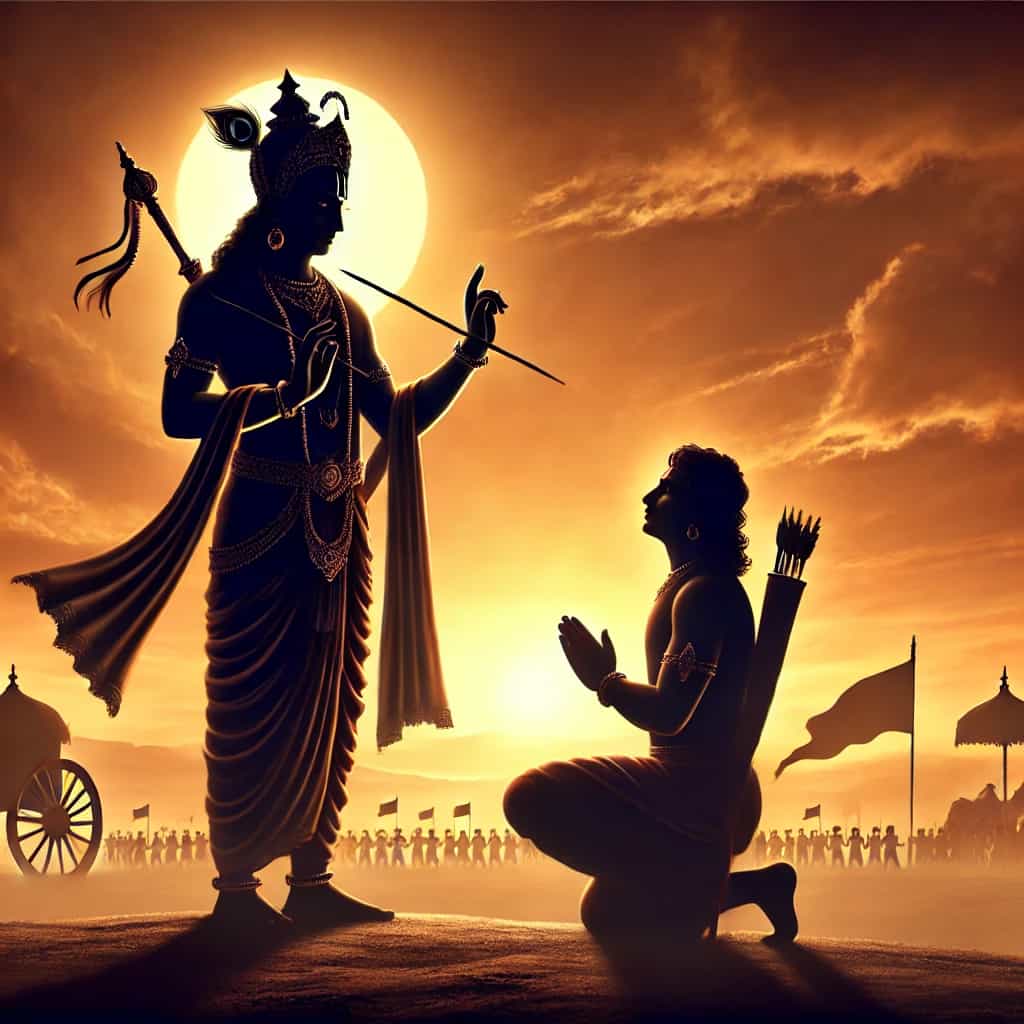
This is why the teachings of the Bhagavad Gita take place on a battlefield.
The battlefield is symbolic of life itself.
Arjuna’s hesitation before the war represents the universal human struggle between comfort and responsibility.
And the guidance of Krishna reminds him of something profound:
Avoiding your duty does not create peace.
It creates inner fragmentation.
A warrior is not someone who seeks conflict.
A warrior is someone who does not run away from responsibility.
The Peaceful Warrior
This is why the phrase peaceful warrior is not contradictory.
In fact, it describes the highest form of warrior.
A peaceful warrior is someone who:
-
does not seek domination
-
does not create unnecessary conflict
-
does not live in aggression
But when Dharma is threatened,
when truth is distorted,
when injustice appears,
they do not remain silent out of fear.
A peaceful warrior protects harmony.
Not through chaos.
But through clarity and strength.
Peace without strength is fragile.
Strength without wisdom becomes destructive.
The peaceful warrior integrates both.
Training the Warrior Mind
Traditional Dharma education did not only teach scriptures.
It trained character.
Students learned:
-
martial disciplines
-
philosophy
-
meditation
-
breath control
-
ethics
-
responsibility toward society
Even spiritual seekers were expected to develop mental resilience.
Because awakening without strength leads to confusion.
Knowledge without discipline becomes arrogance.
And spirituality without courage becomes escapism.
The warrior path ensured that a human being remained grounded in reality.
The Warrior in Modern Life
Today, most people will never enter a physical battlefield.
But the need for warriors has not disappeared.
In many ways, the modern world requires them more than ever.
Because the battles have simply changed form.
Today the warrior faces:
-
mental overwhelm
-
emotional instability
-
social pressure
-
ideological confusion
-
technological distraction
-
loss of meaning
The modern battlefield is the human mind.
And the modern warrior is someone who develops the ability to:
-
remain calm under pressure
-
think clearly when others panic
-
stand for truth even when unpopular
-
protect their integrity
-
support their family and community
These are not small things.
They require training.
The Courage to Stand Alone
One of the defining qualities of the warrior is the ability to stand alone.
History shows us that many great transformations began with individuals who refused to abandon Dharma simply because it was inconvenient.
A warrior does not measure truth by popularity.
A warrior measures truth by alignment with Dharma.
This often requires courage.
Because sometimes the path of Dharma is not the easiest path.
But it is the path that preserves integrity.
The Inner Question
At some point in life, every person must face an important question.
Not about success.
Not about status.
But about responsibility.
The question is simple.
Are you willing to live aligned with your Dharma?
Because embracing Dharma means accepting the discipline required to live with integrity.
It means:
-
facing your fears
-
taking responsibility for your life
-
protecting what is sacred
-
acting with clarity even when it is uncomfortable
This is the essence of the warrior path.
Are You Ready to Embrace Your Dharma?
The warrior path does not belong to ancient history.
It belongs to anyone who chooses to live consciously.
It belongs to anyone who refuses to be ruled by fear.
It belongs to anyone who chooses responsibility over comfort.
The true warrior is not defined by the battles they fight.
The true warrior is defined by the integrity they embody.
In the end, Dharma is not protected by weapons.
It is protected by human beings with courage, clarity, and discipline.
And the invitation remains open to all of us.
Not to become warriors of violence.
But to become warriors of consciousness.
So the real question is not whether warriors still exist.
The real question is:
Are you ready to embrace your Dharma?