You can have wealth.
You can have status.
You can have a successful career, a beautiful home, a loving family, and still wake up every morning with an inexplicable feeling that something is missing.
Likewise, you may know someone who has very little by worldly standards, yet they radiate peace. They laugh easily. They sleep deeply. They feel grateful for ordinary moments.
Why?
According to Vedic Astrology (Jyotiṣa), happiness is not measured by your possessions. It is experienced through your mind.
And the primary significator of the mind is the Moon (Chandra).
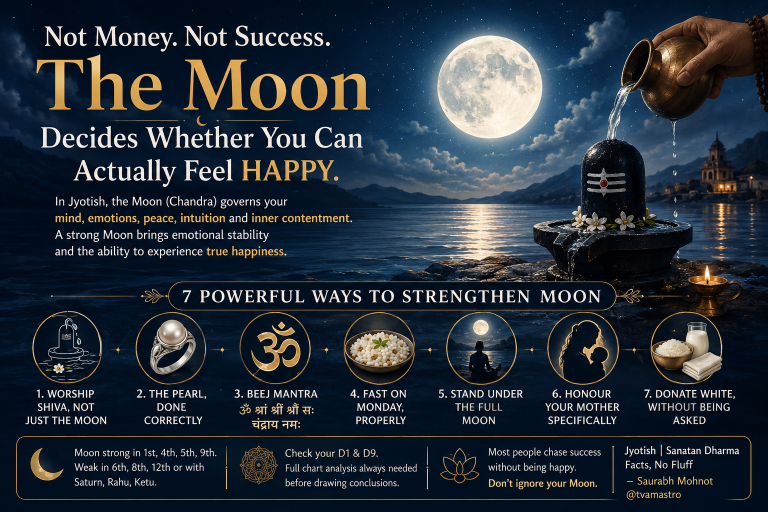
The Moon governs your emotional body, your ability to receive love, your sense of safety, your intuition, your imagination, your memory, your capacity to nurture, and perhaps most importantly, your ability to experience inner contentment.
A powerful Sun may make someone successful.
A strong Mars may make them courageous.
Mercury may make them intelligent.
Jupiter may make them wise.
Venus may make them charming.
But if the Moon is deeply disturbed, all of those achievements can still leave the person emotionally dissatisfied.
That is why so many accomplished people quietly struggle with anxiety, loneliness, emotional instability, or the feeling that nothing is ever enough.
Understanding the Moon in Jyotiṣa
The Moon changes signs every two and a quarter days.
It waxes and wanes.
It reflects rather than generates light.
Its nature reminds us that the human mind is naturally fluid. Thoughts change. Emotions rise and fall. Memories appear and disappear.
A healthy Moon does not eliminate emotion.
It creates emotional resilience.
Instead of being overwhelmed by every experience, a strong Moon allows you to process life with calmness and clarity.
This is why classical texts give tremendous importance to strengthening Chandra—not simply to improve emotions, but to stabilize the very instrument through which life is experienced.
1. Worship Lord Shiva
Perhaps the most beautiful symbol in Hindu iconography is the crescent Moon resting upon Lord Shiva’s head.
Shiva is consciousness itself.
The Moon represents the mind.
The symbolism teaches that the mind finds peace when it rests in higher awareness.
For this reason, many traditional teachers recommend worshipping Lord Shiva rather than only performing remedies directly for the Moon.
Every Monday morning:
- Offer clean water to a Shiva Lingam.
- Chant “Om Namah Shivaya.”
- Sit quietly for a few minutes after your prayers.
This practice is not merely ritual.
It is a reminder to allow awareness—not emotion—to guide your life.
2. Wear Pearl—But Only If It Is Appropriate
Among the classical gemstones, Pearl is associated with the Moon.
Ancient texts describe Pearl as strengthening lunar qualities such as emotional stability, compassion, intuition, softness, and peace.
Traditionally it is worn:
• Set in silver
• On the little finger
• On a Monday morning
• Preferably during Moon Hora after proper purification and energizing.
However, gemstones are never universal remedies.
Strengthening a planet that is functionally challenging in an individual’s horoscope may produce unwanted effects.
A complete chart analysis should always precede the decision to wear any gemstone.
3. Chant the Chandra Beej Mantra
Sound has always been considered medicine in the Vedic tradition.
The Moon’s Beej Mantra is:
ॐ श्रां श्रीं श्रौं सः चंद्राय नमः
Om Shraam Shreem Shraum Sah Chandraya Namah
Rather than repeating it occasionally, tradition recommends consistent daily practice.
Many practitioners chant:
- 108 repetitions daily
- Monday morning practice
- During Moon Hora
- Facing east while maintaining a calm mind
Over time, mantra becomes less about changing the heavens and more about refining the quality of your own consciousness.
4. Observe Monday Fasting
Monday (Somavara) has long been dedicated to Chandra.
Traditional fasting is not merely about abstaining from food.
It is an exercise in cultivating simplicity and discipline.
Many people choose to:
- Eat only once during the day.
- Favor light, nourishing foods.
- Reduce or avoid salt when appropriate.
- Spend more time in prayer, meditation, or quiet reflection.
The intention is to calm excess stimulation so the mind becomes more sattvic—clear, balanced, and peaceful.
5. Spend Time Under the Full Moon
Nature itself has always been regarded as one of the greatest healers.
On Purnima (Full Moon), many traditions encourage spending quiet time outdoors under the moonlight.
Rather than treating this as a mystical requirement, think of it as an opportunity to reconnect with natural rhythms.
Leave your phone behind.
Walk slowly.
Sit in silence.
Observe your breath.
Allow yourself to experience stillness.
Whether one interprets this spiritually, psychologically, or symbolically, many people find that these moments of quiet reflection help settle an overstimulated mind.
6. Honor Your Mother
The Moon is traditionally the karaka—the primary significator—of the mother in Jyotiṣa.
This does not mean every relationship with one’s mother is simple or healthy. Some people have experienced neglect, abuse, estrangement, or loss. Honoring the Moon does not require ignoring those realities or remaining in harmful situations.
Where possible, it can mean cultivating respect, gratitude for the gift of life, healing unresolved emotions, or working toward inner reconciliation—even if that process happens through therapy, spiritual practice, or private forgiveness rather than direct contact.
Many teachers suggest that healing this relationship, in whatever form is appropriate and safe, can support emotional peace because it addresses one of the deepest emotional patterns represented by the Moon.
7. Give Without Being Asked
The Moon represents nourishment.
One beautiful way to strengthen its qualities is through quiet generosity.
Traditional Monday donations often include:
- Milk
- White rice
- White clothing
- Sugar
- Other simple white foods
The deeper principle is not the color itself.
It is giving nourishment without expecting recognition.
Every act of quiet generosity softens the heart.
A softer heart often becomes a calmer mind.
When Should You Pay Extra Attention to Moon Remedies?
In classical Jyotiṣa, astrologers evaluate many factors before judging the Moon, including its sign, house, strength, aspects, dignity, phase, divisional charts, and planetary periods (daśās). No single placement tells the whole story.
Some combinations may prompt closer examination, such as a Moon placed in the 6th, 8th, or 12th houses, or one closely associated with planets like Saturn, Rahu, or Ketu. These can indicate areas where emotional resilience may require greater conscious cultivation, but they are not automatic indicators of an unhappy life.
This is why a complete reading of the D1 (Rāśi) chart and supporting divisional charts such as the D9 (Navāṁśa) is important before drawing conclusions.
Success Means Little Without Peace
Modern culture teaches us to strengthen our résumé.
Ancient wisdom teaches us to strengthen our mind.
Because what is the purpose of wealth if you cannot enjoy it?
What is the value of recognition if you remain restless?
What good is success if your heart never feels at home?
The Moon reminds us that happiness is not something we chase in the outer world.
It is the quality of consciousness through which we experience that world.
When the Moon is steady, ordinary moments become extraordinary.
A meal tastes better.
Relationships become warmer.
Sleep becomes deeper.
Meditation becomes easier.
Gratitude arises naturally.
And life begins to feel complete—not because everything is perfect, but because your mind has learned to rest in peace.
This article is intended for educational purposes based on the traditional principles of Jyotiṣa. Astrological remedies should be considered within the context of a complete birth chart interpreted by a qualified practitioner rather than from a single planetary placement alone.