Mahashivaratri is not a symbolic celebration.
It is a functional night.
A night where the body, breath, mind, and subtle field are more receptive to purification and upward movement of prana.
This guide is written so you can follow it directly — whether at home, in a temple, or in community.
You do not need perfection.
You need sincerity and structure.
PART 1 — Preparation (Before Sunset)
1️⃣ Clean the Space
-
Physically clean the room where you will practice.
-
Bathe or shower before beginning.
-
Wear clean, light-colored or white clothing if possible.
-
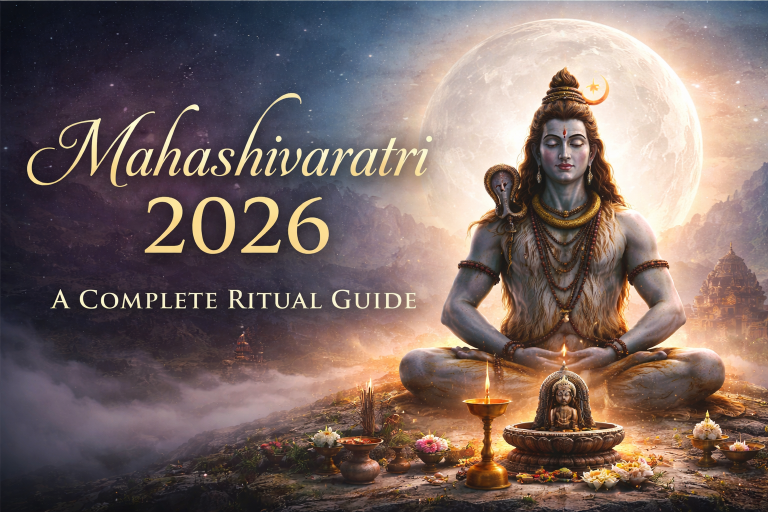
Create a simple altar:
-
Image or murti of Shiva
-
Shivling if you have one
-
Small lamp (ghee or sesame oil)
-
Incense
-
Water in a copper or clean vessel
-
Bilva leaves if available
-
Flowers
-
Small bowl for offerings
-
Keep the altar simple. Avoid clutter.
2️⃣ Materials You May Need
Not everything is mandatory. Do what is possible.
For Abhishekam:
-
Water
-
Milk
-
Yogurt
-
Honey
-
Ghee
-
Sugar (for Panchamrut)
-
Sandalwood paste (optional)
-
Rose water (optional)
-
Coconut water (optional)
-
Turmeric water (optional)
-
Holy ash (vibhuti if available)
For Offerings:
-
Bilva leaves – you can also use Neem Leaves here
-
Unbroken rice
-
Black sesame seeds
-
Barley
-
Wheat
-
Lentils (black gram / green gram)
-
Fruits (pomegranate, citron, coconut)
-
Flowers
For Aarti:
-
Camphor
-
Incense sticks or dhoop
If you do not have these — water, a lamp, and mantra are sufficient.
PART 2 — Sankalpa (Intention Setting)
Before sunset or at the beginning of the first Prahar:
Sit quietly.
Place your right hand over your heart.
Speak clearly:
“I undertake the observance of Mahashivaratri with sincerity and devotion. May this practice purify my mind, stabilize my prana, and align me with Shiva Tattva. May obstacles dissolve.”
Pause.
Feel it.
Without sankalpa, ritual is mechanical. With sankalpa, it becomes transformative.
PART 3 — Fasting Guidelines
Choose based on your health:
-
Full fast (water only)
-
Fruit + milk fast
-
One light sattvic meal before sunset
-
Or partial fast during the night only
If you have medical conditions, modify accordingly.
The purpose is not self-punishment.
The purpose is upward movement of prana.
Avoid:
-
Heavy food
-
Fried food before night
-
Alcohol
-
Overstimulation
Hydrate well if doing water fast.
PART 4 — Structure of the Night: The Four Prahars
Each Prahar lasts approximately 3 hours from sunset to sunrise.
You may set alarms.
Remain awake if possible — especially during the third Prahar (midnight window).
🌑 FIRST PRAHAR
(Gross Body Purification)
Step 1: Light the Lamp
Light a ghee or sesame oil lamp.
This represents awakening awareness.
Step 2: Chant Aum Namah Shivaya
Chant 108 or 1008 times.
Use a mala if available.
Chant steadily — not fast.
Let the sound align with breath.
Inhale naturally.
Exhale with the mantra.
Step 3: Rudrabhishekam (If You Have Shivling)
Pour slowly over the Shivling:
-
Water
-
Milk
-
Yogurt
-
Honey
-
Ghee
-
Sugar water
Then rinse gently with water.
While pouring, chant:
Aum Namah Shivaya
Move slowly. Do not rush.
Step 4: Offerings
Offer:
-
Panchamrut
-
Sandalwood paste
-
Unbroken rice
-
Black sesame
-
Bilva leaves
Place each offering consciously.
Step 5: Incense + Camphor Aarti
Circle camphor clockwise in front of Shiva 3 or 7 times.
Step 6: Sit in Silence (5–10 Minutes)
Allow energy to settle.
🌒 SECOND PRAHAR
(Emotional & Mental Stabilization)
Repeat the structure:
-
Light lamp (if needed)
-
Chant double the original count (if 108 → chant 216)
-
Perform abhishekam again (water + milk sufficient)
-
Offer barley, lotus (if available), bilva leaves, fruits
Remain steady.
Do not allow distraction.
After ritual, sit in meditation for 10–15 minutes.
Observe breath without control.
🌑 THIRD PRAHAR (MIDNIGHT WINDOW)
(Karmic Dissolution)
This is the most important segment.
Even if you sleep earlier, wake for this.
Step 1: Light Lamp
Step 2: Chant Triple Count
If you started with 108 → chant 324.
Slow. Deep. Focused.
This is not about speed. It is about absorption.
Step 3: Abhishekam
Offer water with full awareness.
You may visualize all accumulated emotional toxins being washed.
Step 4: Meditation (Minimum 20 Minutes)
Spine upright.
Hands in chin mudra.
Allow breath to lengthen naturally.
Do not force.
Observe the space between thoughts.
This Prahar is where deep internal shifts occur.
🌘 FOURTH PRAHAR (Pre-Dawn)
This Prahar represents rebirth.
Step 1: Light Lamp
Step 2: Chant Four Times Original Count
If starting at 108 → chant 432.
Your mind will feel different now.
Clearer. Quieter.
Step 3: Final Abhishekam
Offer water and bilva leaves.
Offer gratitude.
Step 4: Aarti + Gratitude
Offer camphor.
Bow.
Thank the Divine for allowing you to complete the observance.
PART 5 — The Panchakshari Mantra
Throughout the night you may also chant:
Aum Hrim Namah Shivaya
Chant 5 times with full awareness at minimum.
This invokes the Shakti dimension of Shiva.
PART 6 — The Eight Names of Shiva
Offer flowers while chanting:
Aum Ishanaya Namah
Aum Mahadevaya Namah
Aum Rudraya Namah
Aum Sharvaya Namah
Aum Bhimaya Namah
Aum Bhavaya Namah
Aum Ugraya Namah
Aum Pashupataye Namah
Pause briefly after each name.
PART 7 — Donation & Closing
At sunrise:
Break your fast gently.
Offer gratitude.
Donate food or money to someone in genuine need.
Integration matters.
Practical Notes for Students
-
If you cannot complete all four Prahars, prioritize the third.
-
If you cannot perform abhishekam, chant sincerely.
-
If you cannot stay awake all night, meditate deeply at midnight.
-
Do not compare your practice with others.
-
Do not perform ritual mechanically.
-
Do not overstrain your body.
This is alignment — not performance.
Final Teaching
On Mahashivaratri, you are not trying to impress Shiva.
You are reorganizing your own nervous system around stillness.
You are letting accumulated internal turbulence settle.
You are allowing the upward current of consciousness to move.
Shiva is not outside you.
Shiva is the dimension of you that is untouched by history.
Observe the night with sincerity.
Aum Namah Shivaya.