
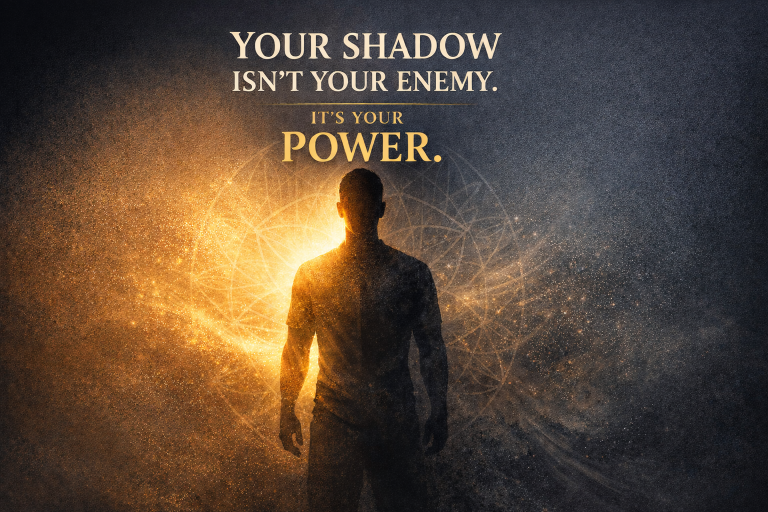
There is a version of you that learned very early how to survive.
A version that understood, without anyone saying it directly:
-
“Don’t be too loud.”
-
“Don’t be too emotional.”
-
“Don’t be too ambitious.”
-
“Don’t be too sexual.”
-
“Don’t be too needy.”
-
“Don’t be too much.”
So you adjusted.
You edited yourself.
Softened yourself.
Silenced yourself.
Fragmented yourself.
And you called it maturity.
You called it growth.
You called it becoming a “good person.”
But what you were really doing was creating a split.
And that split has a name:
The Shadow.
What the Shadow Really Is
The concept of the shadow was first articulated by Swiss psychologist Carl Jung, who described it as the unconscious part of the personality that contains everything we disown about ourselves.
The shadow is not evil.
It is simply everything you had to exile in order to belong.
It holds:
-
The anger you were punished for.
-
The ambition that threatened others.
-
The sexuality that brought shame.
-
The vulnerability that felt unsafe.
-
The wildness that didn’t fit your family system.
-
The power that made people uncomfortable.
These parts were not rejected because they were wrong.
They were rejected because they threatened your belonging.
And as a child, belonging equals survival.
So you chose survival.
The Parts You Buried Didn’t Disappear
They went underground.
And anything pushed underground does not dissolve.
It intensifies.
The shadow does not vanish.
It leaks.
It erupts.
It sabotages.
Not because it wants to hurt you—
but because it wants to be seen.
How the Shadow Sabotages Your Life
1. Disproportionate Reactivity
Someone makes a small comment.
You explode.
Why?
Because the anger you suppressed for twenty years found an opening.
This is not about the moment.
It is about the backlog.
Shadow energy accumulates.
When it finally surfaces, it comes out amplified.
2. You Attract What You Reject
What you refuse to own internally, you meet externally.
-
Reject your anger → attract angry people.
-
Reject your power → attract dominating personalities.
-
Reject your neediness → attract partners who cling.
-
Reject your ambition → feel resentful of successful people.
Life keeps presenting you with the very energy you disowned.
Not as punishment.
But as invitation.
Integration always returns.
3. It Drains Your Life Force
Suppression is exhausting.
You are constantly:
-
Monitoring your tone.
-
Controlling your impulses.
-
Editing your desires.
-
Shrinking your presence.
All that effort?
That is creative life force being diverted into containment.
When you integrate your shadow, that energy returns to you.
And when it returns, it becomes power.
4. It Keeps You Fragmented
When parts of you are exiled, you are divided into:
-
The acceptable self.
-
The hidden self.
You become half-visible.
Half-expressed.
Half-alive.
And you can never feel whole while at war with yourself.
The Truth About Your Shadow
Your shadow is not broken.
It is your power in exile.
-
Suppressed anger → boundary power.
-
Rejected ambition → creative fire.
-
Denied neediness → capacity for intimacy.
-
Hidden sexuality → life force.
-
Tamed wildness → authenticity.
-
Feared power → leadership.
The energy itself is never the problem.
It is unconscious expression that causes destruction.
Conscious integration creates sovereignty.
The Nervous System and the Shadow
From a nervous system perspective, shadow parts are survival strategies.
If expressing anger once got you punished, your system learned:
“Anger is dangerous.”
So it shut it down.
But the energy of anger doesn’t disappear.
It remains stored in the body.
This is why shadow work must be embodied.
It is not enough to understand your shadow.
You must feel it.
Move it.
Give it safe expression.
Otherwise, insight stays intellectual and the pattern continues.
How to Begin Shadow Integration
Shadow work is not about fixing yourself.
It is about welcoming yourself.
Step 1: Identify What Was Rejected
Ask yourself:
-
What traits were unacceptable in my family?
-
What emotions were discouraged?
-
What behaviors were shamed?
-
What parts of me feel “too much”?
Your shadow is often the trait that triggered disapproval.
Step 2: Notice Where It Leaks
Shadow reveals itself through:
-
Overreactions.
-
Chronic patterns in relationships.
-
Strong judgments of others.
-
Compulsions.
-
Emotional triggers that feel outsized.
Instead of saying:
“What’s wrong with me?”
Ask:
“What part of me wants attention?”
Step 3: Meet It With Curiosity
When anger arises, instead of suppressing it, ask:
“What are you protecting?”
When jealousy appears:
“What do you actually want?”
When ambition flares:
“What vision are you trying to bring to life?”
Shadow parts are rarely destructive at their core.
They are protective.
Step 4: Give It Safe Expression
Shadow needs movement.
Not indulgence.
Not repression.
Expression.
For anger:
-
Hit a pillow.
-
Move your body intensely.
-
Speak the truth privately.
For grief:
-
Cry fully.
-
Write what you never said.
-
Ritualize release.
For power:
-
Practice taking up space.
-
Speak clearly without apology.
-
Set a firm boundary.
The goal is integration—not performance.
Step 5: Integrate the Gift
Once felt, ask:
“How can I use this energy constructively?”
Anger becomes:
Clear boundaries.
Ambition becomes:
Creative leadership.
Neediness becomes:
Authentic vulnerability.
Wildness becomes:
Aliveness.
Power becomes:
Presence.
A 15-Minute Shadow Integration Practice
1. Create Container (2 min)
Private space. Journal ready.
Intention: “I welcome what wants to be known.”
2. Body Awareness (3 min)
Close eyes. Breathe slowly.
Notice where tension lives.
3. Dialogue (5 min)
Write: “What are you trying to tell me?”
Let the part answer uncensored.
4. Expression (3 min)
Use voice, movement, or writing.
Let the energy move through.
5. Integration (2 min)
Ask: “What gift do you hold?”
Commit to one conscious action.
What Happens When You Integrate Your Shadow
Weeks 1–2:
-
Increased awareness.
-
Reduced reactivity.
-
Less self-judgment.
Weeks 3–4:
-
Emotional stability.
-
Access to suppressed creativity.
-
More grounded expression.
Months 2–3:
-
Dramatic energy increase.
-
More authentic relationships.
-
Clearer boundaries.
Month 3+:
-
Wholeness.
-
No internal split.
-
Power without aggression.
-
Vulnerability without collapse.
-
Confidence without domination.
You stop fighting yourself.
And when you stop fighting yourself,
your nervous system relaxes.
When your nervous system relaxes,
your power stabilizes.
The Ultimate Truth
You were never broken.
You were adapting.
You rejected parts of yourself to survive.
But survival is not the same as wholeness.
And you are no longer that child who needed to fragment to belong.
You are ready to reclaim what was exiled.
Your shadow is not your enemy.
It is your power waiting to come home.
Bring it home.
Integrate it.
Stand fully expressed.
Live in frequency.
— Prakash Chegu