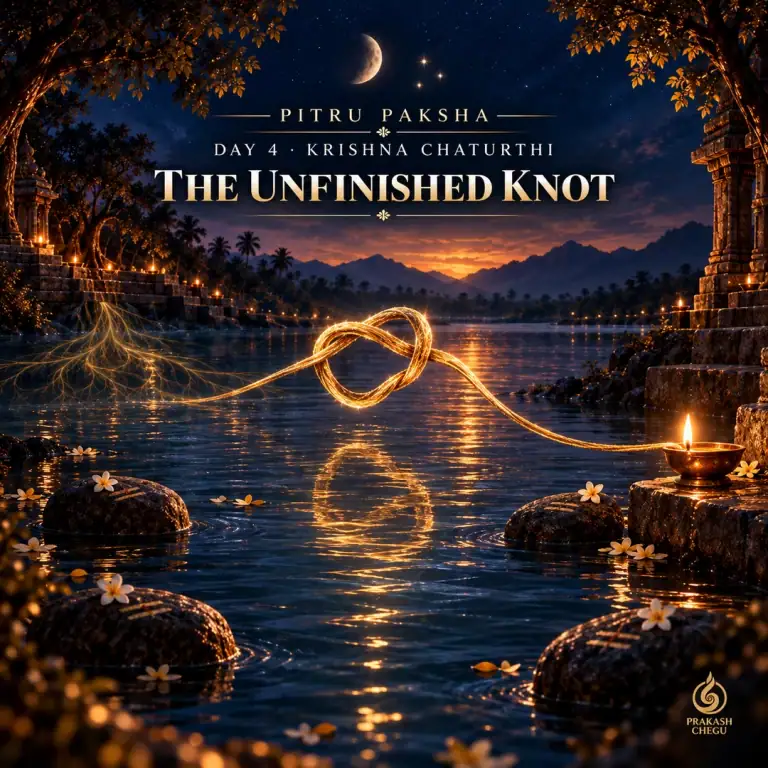
Pitru Paksha 2026 online · Day 4 of 16 · Wednesday, September 30, 2026 · live at 7:00 AM CET, recording included.
Some inheritances arrive as blessings.
Others arrive as unfinished instructions.
By Day 4, the ancestral field has become more visible.
We have begun the water offering. We have honoured the maternal and paternal rivers. We have looked through three generations and recognised the difference between responsibility and guilt.
Now we meet what has not yet found completion.
Every lineage contains unfinished matters: promises that were never fulfilled, grief that was never spoken, responsibilities abandoned, names excluded, property disputed, relationships severed, knowledge lost, care withheld or duties passed silently from one generation to the next.
These do not always appear as dramatic family secrets.
Sometimes the knot is a sentence repeated for decades. A sibling no one mentions. A debt nobody understands. A role one person is expected to perform forever. A fear that controls decisions long after the original danger has passed.
The Unfinished Knot is not an invitation to take responsibility for the entire past.
It is a practice of discernment.
What can be completed through action? What can only be acknowledged? What requires a boundary? What belongs to grief? And what must be returned to the ancestors, to time and to Dharma because it was never ours to solve?
This event may be attended individually or as part of Pitru Paksha: The River Behind You, the complete journey from Bhadrapada Purnima to Sarva Pitru Amavasya.
Global Session Times
Live session at 7:00 AM Central European Time (CET)
- Central Europe (Berlin · Paris · Budapest) — 7:00 AM
- London — 6:00 AM
- Tallinn · Helsinki · Athens — 8:00 AM
- India (IST) — 10:30 AM
- New York (EDT) — 1:00 AM
- Tulum (Quintana Roo) — 12:00 AM (midnight)
- Mexico City — 11:00 PM the previous evening
- California (PDT) — 10:00 PM the previous evening
A recording is included for every session if the live time does not suit your location.
The Meaning of Chaturthi
Chaturthi is the fourth lunar day.
Four suggests structure: four directions, four corners, four legs that allow a table to stand. After Tritiya reveals a pattern across generations, Chaturthi asks whether that pattern has been given a conscious structure—or whether it continues to hold the family through an invisible knot.
A knot is not inherently negative.
A knot can bind what must remain connected. It can hold a vessel, secure a load or preserve a promise. But a knot tied through fear, secrecy or compulsion can tighten with every attempt to ignore it.
Day 4 asks us to distinguish:
- A sacred commitment from an inherited compulsion
- Responsibility from over-responsibility
- Repair from self-punishment
- Loyalty from silence
- Completion from forced reconciliation
- Acceptance from approval
- A boundary from rejection
The aim is not to untie every knot during one ceremony.
The aim is to stop tightening it unconsciously.
An unfinished story does not always need a new ending. Sometimes it needs a truthful place in the larger story.
Who Is Traditionally Honoured on Chaturthi?
Chaturthi Shraddha—also known as Chauth Shraddha—is traditionally observed for departed family members whose death occurred on Chaturthi tithi, whether in Shukla Paksha or Krishna Paksha.
A formal observance may include Shraddha, Pinda Dāna, Tarpanam, food offerings, feeding and charity according to family and regional tradition. The appropriate ritual period is calculated locally, commonly through Kutup, Rohina and Aparahna timings.
The Unfinished Knot is the contemplative architecture created for this Day 4 event. It should not be presented as a universal scriptural designation of Chaturthi Shraddha.
Participants who have a formal Chaturthi observance should follow the instructions of their family priest, Vedic tradition or sampradaya. The guided ritual offered here is an accessible household remembrance and a process of ethical reflection; it does not replace formal ancestral rites.
What Makes a Family Matter “Unfinished”?
Not every painful event is unfinished, and not every unfinished matter can—or should—be repaired by a descendant.
An unfinished matter is something whose effects continue to organise the living family even though the original people, conditions or agreements have changed.
It may appear as:
- A deceased person whose existence is deliberately omitted from the family story
- An apology that was never made
- A promise of care that later generations are still expected to fulfil
- Land, money or property conflict that has become more important than relationship
- A migration or displacement that was survived but never grieved
- A spiritual, artistic or healing tradition that disappeared because it was devalued
- A pattern of rescuing one family member at the expense of everyone else
- A role inherited by the eldest child, daughter, son or most capable person without consent
- Secrecy around adoption, parentage, illness, addiction, violence or loss
- Ritual duties neglected through ignorance, conflict, distance or lack of access
- Love that could never be publicly acknowledged
- A family division preserved long after anyone remembers its true origin
The continuing effect matters more than the drama of the original story.
If a family adapts, grieves and moves forward, a difficult event may be complete. If everyone organises life around what cannot be named, even a small event can become a powerful knot.
Four Ways an Unfinished Matter Can Be Met
Day 4 introduces a fourfold discernment. Every knot does not require the same response.
1. Complete
Some matters can be addressed through a practical action: recording a name, paying a legitimate debt, returning an object, fulfilling a safe promise, organising documents or completing a neglected act of remembrance.
2. Repair
Some matters require truthful communication, restitution, changed behaviour or a sincere apology. Repair is more than emotional intention; it includes impact and appropriate action.
3. Set a Boundary
Some patterns require a boundary rather than renewed contact. Completion may mean refusing further harm, ending secrecy, declining an inherited role or allowing a relationship to remain distant.
4. Release
Some matters cannot be resolved by us. The people involved may have died. Facts may never be known. Reconciliation may be unsafe or impossible. Here the task is acknowledgement, grief and release—not control.
These four movements protect ancestral practice from spiritual overreach.
We do not contact someone merely because a ritual stirred emotion. We do not confess another person’s secret publicly. We do not reopen legal, financial or relational conflict without wisdom. We do not promise what cannot be carried responsibly.
The sacred question is not, How can I make this disappear?
It is, What is the next truthful and proportionate response?
What We Will Explore
- The traditional purpose of Chaturthi Shraddha
- Who is remembered when an ancestor departed on Chaturthi tithi
- The distinction between formal Shraddha and an accessible household remembrance
- Why unfinished ancestral matters should not automatically be called curses or doshas
- How unresolved events continue through roles, silence, fear and repetition
- The difference between fact, family story, intuition and speculation
- How to work respectfully when the full history is unknown
- Four possible responses: complete, repair, set a boundary and release
- Why forgiveness is not the same as reconciliation
- Why a boundary can be an honourable form of completion
- How to acknowledge harm without condemning an entire lineage
- How to make Tarpanam for ancestors connected with an unfinished matter
- How to use a simple thread and knot without treating it as magical control
- How to choose one practical completion step among the living
- When professional, legal, therapeutic or priestly support may be more appropriate than solitary ritual
The class includes sufficient Tarpanam foundations for a first-time participant while allowing those continuing from Days 1–3 to deepen the established practice.
The Day 4 Ritual
The Knot of Right Responsibility
This ceremony combines water, written discernment and a single knotted thread.
The knot is not used to bind another person, remove karma magically or declare a complex history resolved. It represents the place where attention has become entangled. We hold it consciously until the concluding Amavasya ceremony, allowing time for truth and proportion to emerge.
The guided practice will include:
1. Preparing the Space
Create a clean altar with a lamp or flower, a pouring vessel and a bowl to receive the offered water.
Place one length of plain natural thread nearby. It may be white, unbleached cotton or another simple biodegradable fibre. Avoid using a sacred thread, mālā or valued family textile for this exercise.
2. Choosing One Knot
Do not attempt to work with the entire lineage at once.
Choose one unfinished matter whose effects are visible in your present life. It may be a duty, silence, repeated role, unresolved grief or relationship pattern.
If the matter involves trauma, abuse, active legal conflict or danger, choose only the part that belongs safely within personal reflection. The ritual does not require confrontation, disclosure or contact.
3. Separating Fact from Story
Divide a page into four lines:
- What I know happened
- What I was told or came to believe
- How this affects the living family now
- What response may actually be mine
This prevents intuition from becoming accusation and family mythology from being mistaken for verified history.
Unknown details may remain unknown.
4. Tying the Witness Knot
Tie one loose, simple knot in the centre of the thread.
As you tie it, say:
I acknowledge that this matter has remained active. I will neither deny it nor make it larger than what is true.
The knot should remain loose enough to be untied later. We are creating a witness, not another binding.
5. Establishing Sankalpa
Hold the thread between open palms and state:
I offer this practice for the ancestors connected with this unfinished matter, known and unknown. May truth become clearer. May responsibility be placed correctly. May the living be guided toward wise action, and may unnecessary burden return to rest.
6. Preparing the Tarpanam
Prepare clean water in a suitable vessel. Black sesame and darbha may be added according to family practice and availability.
First-time participants will receive concise guidance on direction, posture, Pitru Tirtha and respectful disposal of the water. Those with formal family instructions should observe those procedures instead.
7. The Offering of Acknowledgement
Offer the first stream of water for the ancestors connected with the matter.
No blame is assigned. No story is embellished.
To those who lived within this story: I acknowledge that this occurred and that its effects continued. May this offering bring remembrance, truth and peace.
8. The Offering of Right Placement
Offer the second stream while distinguishing responsibility:
What belongs to me, may I meet with courage. What belongs to another, may I stop carrying in confusion. What belongs to the past, may I honour without repeating.
Allow the water to move without forcing an emotional release.
9. The Fourfold Choice
Return to the four possible responses:
- Complete: What specific task can be finished?
- Repair: What impact requires acknowledgement or restitution?
- Set a boundary: What limit protects life and dignity?
- Release: What cannot be controlled and must be entrusted to time, prayer or Dharma?
Choose only one primary movement for this knot. A complicated situation may eventually require more than one, but the ritual needs a clear next step.
10. The Offering for Chaturthi Ancestors
Make the universal ancestral offering for all departed family members appropriately remembered on Chaturthi, including those known and unknown.
ॐ पितृभ्यः स्वधा नमः
Om Pitṛbhyaḥ Svadhā Namaḥ
Reverence to the ancestral beings; may this offering be received through Svadhā.
11. Placing the Knot Beneath the Altar
Wrap the written reflection once around the loose knot without tightening it. Place both beneath or beside the ancestral altar.
The knot remains there until Sarva Pitru Amavasya.
During the remaining days, insight or information may emerge. The purpose is not to obsess over it, but to let the matter rest inside a conscious ritual container.
12. Choosing a Living Action
Name one proportionate action that can be taken safely after the ceremony.
Examples include:
- Recording an ancestor’s correct name
- Asking an elder a respectful question
- Organising a neglected document
- Making a charitable offering connected with the ancestor’s values
- Ending participation in harmful gossip or secrecy
- Beginning a needed conversation with professional support
- Establishing a clear boundary
- Performing a family rite through an appropriate priest
- Accepting that no external action is presently wise
An action should be specific, ethical and small enough to complete. It should never place the participant or another person at risk.
13. Completion
Close with gratitude and grounding. Return the offered water respectfully to clean earth, the base of a suitable plant or another place consistent with family tradition and local conditions.
Do not cut, burn or dramatically untie the thread today. The Amavasya ceremony will provide the larger context for deciding whether the knot is completed, transformed, retained as a vow or released.
The Mantra of Right Responsibility
ॐ पितृभ्यः स्वधा नमः
Om Pitṛbhyaḥ Svadhā Namaḥ
Reverence to the ancestral beings; may this offering be received through Svadhā.
The accompanying spoken prayer is:
May what is mine become clear. May what is not mine become light. May truth guide the next action.
Participants who have received specific Chaturthi, lineage or Shraddha mantras may use them according to their tradition. No one needs to invent names, gotra or Sanskrit formulas that are not known.
The Deeper Teaching: Completion Is Not Control
An unfinished matter often produces the fantasy that if we understand enough, pray correctly enough or sacrifice enough, we can repair the entire past.
But completion is not the same as control.
We cannot make a deceased person offer the apology they never gave. We cannot recover every lost fact. We cannot force living relatives to acknowledge what they deny. We cannot guarantee that a sincere conversation will create reconciliation.
What we can do is place ourselves in right relationship with what remains.
We can tell the truth without turning truth into a weapon.
We can fulfil a duty without surrendering our entire life to it.
We can make restitution where we caused harm.
We can refuse to continue a destructive pattern.
We can grieve what will never be repaired.
We can honour an ancestor without inheriting their unfinished argument.
This is not a lesser completion.
It is the completion available to the living.
The knot loosens when responsibility returns to its rightful place.
When the Knot Involves Harm
Ancestral practice must never be used to pressure someone into unsafe contact, premature forgiveness or silence about abuse.
If the unfinished matter includes violence, coercion, addiction, exploitation, severe family conflict or traumatic loss, ritual may support reflection—but it may not be sufficient by itself.
Appropriate support can include:
- A qualified mental-health professional
- Legal or financial counsel
- A trusted elder who is not invested in preserving secrecy
- A mediator trained in family conflict
- A knowledgeable family priest or ritual specialist
- A domestic-violence or crisis service where safety is at risk
Seeking skilled support is not a failure of spiritual practice. It is one way responsibility becomes real.
Your Reflection for Day 4
What belongs to my responsibility, and what does not belong to my burden?
You may also contemplate:
- What family matter continues to organise behaviour even though it is rarely named?
- Which part of the story is verified fact?
- Which part is interpretation, assumption or inherited mythology?
- Who has been expected to carry the consequences?
- Is there a practical action that would create genuine completion?
- Would contact create repair, or would a boundary be wiser?
- What am I afraid will happen if I stop carrying this role?
- What apology, restitution or acknowledgement is actually mine to offer?
- What must remain unresolved without becoming my identity?
- What would right proportion look like?
What to Bring
Please prepare:
- A clean vessel for pouring water
- A bowl, plate or vessel to receive the offering
- Clean water
- Black sesame seeds, if available
- Darbha or kusha grass, if available and appropriate to your practice
- One length of plain natural thread
- One small piece of plain paper
- A notebook and pen
- A lamp or flower for the altar
- Known names or photographs of departed ancestors, optional
- A clean altar cloth
Please do not bring a sacred thread, mālā or irreplaceable family textile for the knot practice.
The Event Experience
The gathering will move through six stages:
- Chaturthi teaching — structure, binding and the fourth tithi
- Ancestral inquiry — identifying one unfinished matter
- Discernment — separating fact, story, effect and responsibility
- Practical preparation — water, sankalpa and offering method
- Guided ritual — the witness knot and Tarpanam of right placement
- Integration — choosing one safe and proportionate living action
No previous experience with Tarpanam, Sanskrit or ancestral ritual is required.
This Event Is for You If…
- You sense that an unfinished family matter still shapes the present
- You carry a duty or role whose origin is unclear
- You want to distinguish genuine responsibility from inherited guilt
- You are seeking completion without forced reconciliation
- You need a spiritual practice that honours boundaries and practical action
- You have an ancestor whose death tithi was Chaturthi
- You want a grounded way to remember ancestors connected with rupture or silence
- You are entering the Pitru Paksha journey for the first time on Day 4
Can This Event Be Attended Individually?
Yes.
Day 4 is a complete standalone event. You will receive the traditional context, essential Tarpanam guidance, the fourfold discernment process, the full knot ritual and the recording.
Participants continuing from the previous days will recognise a natural progression: the lineage has been named, its patterns have been observed, and now one unfinished movement can be placed into conscious relationship.
Continue into the Complete Journey
Day 4 identifies an unfinished knot without rushing to sever it. Day 5 turns toward lives that did not follow the expected path—especially departed unmarried relatives—and restores belonging beyond conventional ideas of completion.
The complete journey includes:
- Sixteen tithi-based teachings from Purnima to Amavasya
- A distinct ritual and reflection for every day
- Practical Tarpanam instruction
- Maternal, paternal, known, unknown and excluded ancestral remembrance
- Space for gifts, grief, unfinished duties and conscious release
- Live ceremonies and recordings
- The concluding Sarva Pitru Amavasya offering
Respecting Family and Vedic Traditions
Shraddha and Tarpanam vary according to Veda, śākhā, sutra, sampradaya, region and family custom. Formal rites may prescribe exact eligibility, names, gotra, mantras, sacred-thread positions, directions, pindas, food offerings and recipients.
Where you have inherited or received those instructions, they take precedence.
This class offers education, guided reflection and an accessible household practice. It does not replace annual Shraddha, first-year rites, priest-led Pinda Dāna or formal Chaturthi Shraddha.
Those for whom formal Pitru Tarpanam is restricted may complete the reflection, offer a lamp or flower, chant a known divine name, read sacred text, feed another being or make charity in the ancestors’ memory.
Do Not Tighten What You Came to Understand
The unfinished knot may have travelled through many hands before reaching yours.
You do not honour the ancestors by pulling it tighter.
You honour them by meeting it with truth, proportion and care.
Some knots become promises consciously renewed. Some become boundaries. Some loosen through repair. Some are finally allowed to remain with the past.
Day 4 does not demand that you know which one immediately.
It asks you to stop carrying the knot without awareness.
May what is mine become clear.
May what is not mine become light.
May the next action serve life.
Join Day 4
Krishna Chaturthi: The Unfinished Knot
Wednesday, September 30, 2026 — India Reference Calendar
Live Online · Time to Be Announced · Recording Included
Series Navigation
Previous: Day 3 · Krishna Tritiya — Three Generations · Maha Bharani
View the Complete Pitru Paksha Calendar
Next: Day 5 · Krishna Panchami — Lives Beyond the Expected Path