Pitru Paksha 2026 online · Day 3 of 16 · Tuesday, September 29, 2026 · live at 7:00 AM CET, recording included.
Behind every name stands another name.
Behind every story stands a life we may never fully know.
Day 1 taught us how to make the first offering. Day 2 revealed the maternal and paternal rivers. Day 3 turns our attention backward through depth: the generations immediately before us, those behind them, and those whose lives formed the foundations beneath the visible family story.
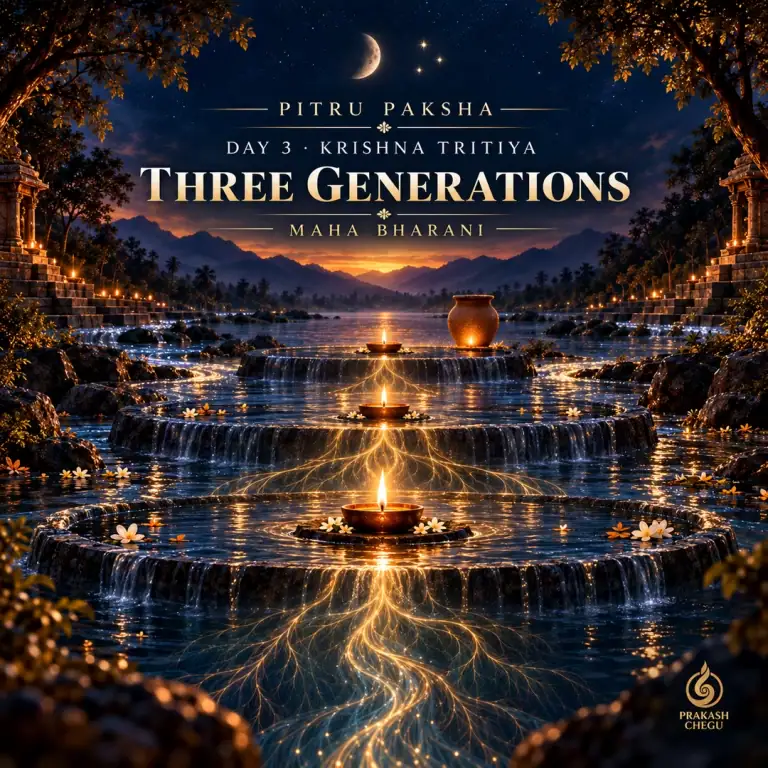
On Krishna Tritiya, we work with three generations.
We remember the departed among the generation closest to us. We honour grandparents and their contemporaries. We extend the offering toward great-grandparents and the generation whose names may already be fading from memory.
In the 2026 India reference calendar, Tritiya coincides with Maha Bharani, an important Pitru Paksha observance connected with Bharani Nakshatra and Yama—the guardian of mortality, restraint, consequence and dharmic order.
This makes Day 3 more than an exercise in genealogy.
It becomes a threshold of responsibility.
What did these generations carry? What did they preserve? What remained unfinished? And what has now arrived in our hands—not so that we can carry everything, but so that we can respond consciously?
This event may be attended individually or as part of Pitru Paksha: The River Behind You, the complete journey from Bhadrapada Purnima to Sarva Pitru Amavasya.
Global Session Times
Live session at 7:00 AM Central European Time (CET)
- Central Europe (Berlin · Paris · Budapest) — 7:00 AM
- London — 6:00 AM
- Tallinn · Helsinki · Athens — 8:00 AM
- India (IST) — 10:30 AM
- New York (EDT) — 1:00 AM
- Tulum (Quintana Roo) — 12:00 AM (midnight)
- Mexico City — 11:00 PM the previous evening
- California (PDT) — 10:00 PM the previous evening
A recording is included for every session if the live time does not suit your location.
The Meaning of Tritiya
Tritiya means the third lunar day.
One establishes presence. Two reveals relationship. Three creates continuity.
With the third point, a pattern becomes visible. A single event may appear accidental. When a similar movement appears across parents, grandparents and great-grandparents, we begin to perceive inheritance.
The pattern may be a gift:
- Devotion carried through daily prayer
- Skill with land, food, healing, music or craft
- Courage during displacement or difficulty
- Commitment to education, service or family
- Humour, hospitality or generosity
It may also be a pattern that asks for transformation:
- Repeated estrangement or abandonment
- Silence around grief, addiction, money or violence
- Chronic self-sacrifice mistaken for love
- Fear of visibility, prosperity or intimacy
- Family roles that leave no room for individual truth
Tritiya does not ask us to diagnose the dead.
It asks us to observe what repeats.
A pattern becomes an inheritance when it passes unconsciously. It becomes wisdom when it is finally seen.
Who Is Traditionally Honoured on Tritiya?
Tritiya Shraddha—also called Teej Shraddha—is traditionally observed for departed family members whose death occurred on Tritiya tithi, whether during Shukla Paksha or Krishna Paksha.
Formal Shraddha may include Pinda Dāna, Tarpanam, food offerings, mantra, feeding and charity according to family and regional tradition. It is generally performed during locally calculated Kutup, Rohina or Aparahna periods, with Tarpanam offered at the conclusion of the formal rite.
The Three Generations framework is the contemplative architecture of this event. Many Shraddha traditions give ritual attention to three immediately preceding ancestral generations, but the exact order, eligibility, names, gotra, mantras and inclusion of maternal or paternal relatives are governed by the practitioner’s family tradition.
This event will not replace that formal structure with a universal invented procedure.
Instead, it offers two clearly distinguished layers:
- Traditional understanding — who is formally honoured on Tritiya and how three-generation remembrance appears within ancestral rites.
- Accessible household practice — a guided remembrance of three generational layers, suitable for reflection and simple water offering without claiming to be a complete priest-led Shraddha.
Why Three Generations Matter
Three generations provide a powerful human scale for ancestral remembrance.
The first preceding generation may still be held through direct memory. We may remember a voice, a touch, a conflict, a teaching or the shape of a daily routine.
The second often arrives through both memory and family story. Grandparents may have shaped the home directly, or they may be known through fragments: a photograph, a recipe, a migration, a profession, a phrase repeated by their children.
By the third preceding generation, names often begin to disappear. Great-grandparents may be reduced to a village, a surname, a religious practice, a family object or a story whose details have changed with every telling.
Yet their choices may still live in the family.
Where people settled. Which language survived. Who was educated. What food was preserved. Which relationships were permitted. What was feared. What was never discussed. What counted as honour. What had to be endured.
The farther we look back, the less certainty we may have.
Day 3 teaches that reverence does not require invented certainty. We name what we know, acknowledge what we do not know, and leave sacred space for the unrecorded.
The Special Threshold of Maha Bharani
Maha Bharani is a nakshatra-based ancestral observance. It occurs when Bharani Nakshatra holds the relevant ritual period during Pitru Paksha; it is not permanently attached to Tritiya or any single tithi.
In 2026, the India reference calendar places Maha Bharani on the same civil date as Tritiya Shraddha: Tuesday, September 29.
Bharani is governed by Yama. Yama is not approached here as a figure of fear, but as the principle that reminds us that life has boundaries, actions have consequences, and every embodied journey passes through mortality.
The name Bharani carries the sense of bearing, holding or carrying. Its symbolism invites us to consider the vessel capable of holding life, pressure, transition and consequence.
For ancestral work, this raises a profound question:
What is mine to carry with integrity, and what must no longer be carried unconsciously?
Traditional sources treat Maha Bharani as a highly significant opportunity for Shraddha. Some descriptions compare its merit with Gaya Shraddha and note differing customs regarding whether Bharani Shraddha is performed once after a death or observed annually.
Because these are formal ritual questions, participants wishing to undertake Maha Bharani Shraddha in its complete traditional form should consult their family priest or a qualified practitioner. Our guided ceremony honours the symbolism of the day without claiming to reproduce every regional or scriptural procedure.
Yama: Mortality, Measure and Dharma
Yama brings measure to life.
Without boundary, nothing has form. Without consequence, responsibility has no meaning. Without mortality, we might never recognise the preciousness of time.
When we remember three generations under Bharani, we are invited to move beyond sentimentality.
Our ancestors were human. They acted from wisdom and limitation, courage and fear, generosity and conditioning. Their choices created consequences—some visible, some hidden, some still unfolding.
To honour them does not mean calling every choice righteous.
To honour them means becoming more conscious of what has reached us.
Yama’s presence asks:
- What boundary was missing in the lineage?
- What responsibility was avoided?
- What promise was kept even when it was difficult?
- What consequence did later generations have to carry?
- Where must truth become stronger than image?
- What can I complete through dharmic action rather than inherited guilt?
This is remembrance with moral clarity.
What We Will Explore
- The traditional purpose of Tritiya Shraddha
- Who is remembered when an ancestor departed on Tritiya tithi
- Why tithi and nakshatra observances must not be confused
- The meaning and timing of Maha Bharani within Pitru Paksha
- Bharani’s connection with Yama, mortality, restraint and consequence
- Why three ancestral generations form an important ritual and psychological field
- How to distinguish direct memory, inherited story and ancestral mystery
- How name, relationship and gotra give specificity to formal offerings
- How to proceed when names or gotra are unknown
- How paternal and maternal lineages may be mapped without collapsing their ritual distinctions
- How to identify one repeated blessing and one repeated burden
- The difference between responsibility and inherited guilt
- How to create a three-level lineage map
- How to make three simple water offerings followed by an offering to the wider ancestral field
- How to close the practice without leaving the participant emotionally overwhelmed
No previous class is required. Participants who attended Days 1 and 2 will deepen the existing Tarpanam sequence; first-time participants will receive the practical foundations needed for this ceremony.
The Day 3 Ritual
Three Streams and the Bharani Vessel
The Day 3 practice has two movements.
First, we offer three streams of water for three generational layers. Then we work with a simple Bharani vessel—a contained space in which responsibility can be named without becoming burden.
This is a contemplative household ceremony. Those performing a formal Tritiya or Maha Bharani Shraddha should follow their inherited instructions.
The guided practice will include:
1. Preparing the Altar
Place three flowers, leaves, stones or small mounds of uncooked rice in a line moving away from you.
- The nearest represents the preceding generation
- The middle represents the grandparents’ generation
- The farthest represents the great-grandparents’ generation
Place a small empty bowl or clay vessel beyond them. This is the Bharani vessel: a symbol of what can be witnessed, contained and placed into right relationship.
2. Creating the Three-Generation Map
Divide a page into three horizontal levels. Add the names of departed relatives you know from both maternal and paternal streams.
Names should be placed according to actual relationship—not according to affection, status or whether the family spoke well of them.
Where a name is unknown, write the relationship if known: mother’s maternal grandfather, father’s grandmother, an unknown great-grandparent. Where even the relationship is uncertain, leave an open space.
3. Establishing Sankalpa
We enter with a clear intention:
I remember the generations through whom this life became possible. I offer with gratitude for what nourished life, honesty about what caused suffering, and discernment regarding what is mine to carry forward.
4. Preparing the Water
Prepare clean water in a suitable vessel. Black sesame and darbha may be included according to availability and family practice.
Participants will receive concise guidance on posture, direction, Pitru Tirtha and the use of the universal ancestral mantra. Those who have formal family instructions should follow them instead.
5. First Stream: The Nearest Generation
We begin with departed ancestors and relatives of the generation immediately before us—the layer most likely to be held through living memory.
Speak known names and relationships. Offer water slowly.
Then recognise:
- One direct memory or truth
- One gift received
- One matter that requires a healthier response among the living
The aim is not to retell the entire relationship. One honest recognition is enough.
6. Second Stream: The Grandparents’ Generation
We move to the generation behind the first.
Offer water to known and unknown grandparents and their generational field according to the accessible practice taught in the class.
Recognise:
- One family story that has survived
- One quality or practice this generation preserved
- One pattern that crossed from their lives into later generations
7. Third Stream: The Great-Grandparents’ Generation
We extend the offering to the generation whose names and details may be less complete.
Here the practice shifts from certainty to humility.
We offer for those whose labour, choices, displacement, prayer or endurance helped form the family conditions we inherited—even when we cannot reconstruct their individual stories.
Recognise:
- One inherited cultural or spiritual thread
- One question whose answer may be lost
- One expression of gratitude that does not require complete knowledge
8. The Generations Behind Them
After the three specific streams, one additional offering is made to the ancestors beyond remembered genealogy.
To those whose names and stories have passed beyond our records: you are included in this remembrance. May this offering reach the wider ancestral field in peace.
This fourth offering is not counted as a fourth mapped generation. It acknowledges that the visible family tree stands within a much older forest.
9. The Bharani Inquiry
Bring attention to the empty bowl beyond the three symbols.
On one small piece of paper, write a quality from the lineage that you are willing to carry responsibly: devotion, honesty, courage, protection, learning, service or another genuine inheritance.
On a second piece, write a pattern you refuse to carry unconsciously: silence, rivalry, abandonment, self-erasure, cruelty, fear or another repeated movement.
Fold both papers separately and place them beside—not inside—the bowl. The vessel remains empty, reminding us that awareness can contain experience without becoming filled or defined by it.
10. The Prayer of Right Carrying
Place both hands around the Bharani vessel without lifting it.
May I carry forward what serves life. May I meet consequence with maturity. May I establish the boundaries that were missing. May what is not mine return to the care of Dharma. May memory become wisdom rather than weight.
The paper naming the gift may remain on the altar through Pitru Paksha. The paper naming the repeated pattern may be kept beneath the altar for conscious review and released during the closing Amavasya ceremony. It should not be burned impulsively during this class.
11. Maha Bharani Remembrance
We offer a final stream of water with reverence for all ancestors appropriately remembered on this day and hold a moment of silence in recognition of mortality.
There is no attempt to imitate a complete Maha Bharani Shraddha. The observance is honoured through awareness, Tarpanam and commitment to dharmic action.
12. Completion
We close with gratitude, prayer and grounding. The offered water is returned respectfully to clean earth, a suitable plant or another place consistent with family custom and local conditions.
Participants are encouraged to eat simply, rest briefly and avoid turning the class immediately into intellectual analysis.
The Mantra of Three Generations
ॐ पितृभ्यः स्वधा नमः
Om Pitṛbhyaḥ Svadhā Namaḥ
Reverence to the ancestral beings; may this offering be received through Svadhā.
The universal ancestral mantra may be repeated for each generational stream. Specific names, gotra and lineage mantras should be used only when known or received through an appropriate tradition.
For the Bharani reflection, the central spoken prayer is:
May memory become wisdom. May responsibility become Dharma. May unnecessary burden come to rest.
The Deeper Teaching: Responsibility Is Not Guilt
When a repeated family pattern becomes visible, people often move toward one of two extremes.
The first is denial: This has nothing to do with me.
The second is over-identification: It is my responsibility to heal everything that happened before me.
Neither creates freedom.
We are not responsible for actions taken before our birth. But we are responsible for what we do with the patterns that have become visible in our lives.
We may not have created the family silence, but we can choose whether to continue it.
We may not have created the fear around money, but we can bring honesty and stewardship to it.
We may not have caused estrangement between lineages, but we can refuse to recruit the next generation into inherited hostility.
This is the mature threshold of Maha Bharani:
I do not accept guilt for what I did not do. I accept responsibility for what I now know.
Yama represents the clarity of measure. A boundary is not punishment. Consequence is not condemnation. Mortality is not a failure.
Right relationship begins when everything is placed in its proper measure.
Your Reflection for Day 3
What pattern has repeated across at least three generations? What gift has repeated with it?
You may also contemplate:
- Which ancestors do I remember directly?
- Which relatives are known only through stories?
- At what generation do the names begin to disappear?
- What profession, prayer, food, place or value survived across generations?
- What family pattern has been treated as inevitable?
- What consequence did one generation leave for another to carry?
- Where does my family confuse guilt with responsibility?
- What boundary would protect life now?
- What blessing am I willing to steward consciously?
- What do I want the generation after me to inherit differently?
What to Bring
Please prepare:
- A clean vessel for pouring water
- A bowl, plate or vessel to receive the offering
- Clean water
- Black sesame seeds, if available
- Darbha or kusha grass, if available and appropriate to your practice
- Three flowers, leaves, stones or small portions of uncooked rice
- One small empty bowl or clay vessel for the Bharani reflection
- Two small pieces of plain paper
- A pen and notebook
- Known names or photographs of departed relatives, optional
- A clean altar cloth
- A lamp or candle, if safe and desired
Do not postpone participation because every item is not available. Simple symbolic alternatives will be explained.
The Event Experience
The gathering will move through six stages:
- Tritiya teaching — the third tithi, continuity and pattern
- Maha Bharani teaching — Yama, mortality, consequence and right measure
- Lineage mapping — three generational layers across maternal and paternal streams
- Practical preparation — water, sankalpa, direction and offering method
- Guided ritual — three streams, the wider ancestral field and the Bharani vessel
- Integration — responsibility, boundary and conscious inheritance
No previous knowledge of Tarpanam, Sanskrit or genealogy is required.
This Event Is for You If…
- You want to understand how family patterns move through generations
- You know only fragments of your ancestry and want a respectful way to begin
- You feel burdened by the idea that you must heal the entire lineage
- You want to distinguish ancestral responsibility from inherited guilt
- You are drawn to the deeper meaning of Bharani and Yama
- You want practical Tarpanam guidance within a thoughtful spiritual container
- You have an ancestor whose death tithi was Tritiya
- You are joining the Pitru Paksha journey for the first time on Day 3
Can This Event Be Attended Individually?
Yes.
Day 3 is a complete standalone event. You will receive the necessary background, the three-generation mapping process, practical water-offering guidance, the full guided ceremony and the recording.
Participants continuing from Days 1 and 2 will experience a natural deepening: from the first stream, to two lineages, to three generational layers. New participants will be given enough structure to enter without needing the earlier recordings first.
Continue into the Complete Journey
Day 3 reveals the patterns carried through visible generations. Day 4 turns toward The Unfinished Knot—responsibilities, ruptures and burdens that remain active because they were never brought into conscious relationship.
The complete journey includes:
- Sixteen tithi-based teachings from Purnima to Amavasya
- A distinct ritual and reflection for every day
- Practical Tarpanam instruction
- Maternal, paternal, known, unknown and excluded ancestral remembrance
- Special observances including Maha Bharani, Matri Navami and Magha Shraddha
- Live ceremonies and recordings
- The concluding Sarva Pitru Amavasya offering
Respecting Family and Vedic Traditions
Shraddha and Tarpanam procedures vary according to Veda, śākhā, sutra, sampradaya, region and family custom. Formal three-generation rites can carry precise rules concerning lineage, eligibility, gotra, sacred-thread position, direction, mantras, pindas and ritual recipients.
Where you have received those instructions, they take precedence.
This class offers education and an accessible household practice. It does not replace annual Shraddha, first-year death rites, priest-led Pinda Dāna, Gaya Shraddha or a formal Maha Bharani ceremony.
Participants for whom formal Pitru Tarpanam is restricted may complete the lineage map, offer a lamp or flower, chant a known divine name, read sacred text, feed another being or give charity in the ancestors’ memory.
Stand at the Threshold
Three generations stand behind you.
Some are remembered clearly. Some survive through a single story. Some have already passed beyond the reach of family memory.
You do not need to reconstruct every life.
You need only to stand honestly before what has reached you.
Under the threshold of Maha Bharani, remembrance becomes responsibility:
May I preserve what gave life.
May I stop repeating what diminishes life.
May what I carry become worthy of those who come after me.
Join Day 3
Krishna Tritiya: Three Generations
Special Observance: Maha Bharani
Tuesday, September 29, 2026 — India Reference Calendar
Live Online · Time to Be Announced · Recording Included
Series Navigation
Previous: Day 2 · Krishna Dwitiya — The Two Rivers
View the Complete Pitru Paksha Calendar
Next: Day 4 · Krishna Chaturthi — The Unfinished Knot