Pitru Paksha 2026 online · Day 14 of 16 · Friday, October 9, 2026 · live at 7:00 AM CET, recording included.
The death may have shattered the story.
It does not possess the whole life.
Some deaths arrive with a force that continues long after the event.
An accident. An act of violence. A war. A disaster. A death by suicide. A disappearance followed by devastating news. A medical crisis that moved too quickly. A life ended through the actions of another person.
The manner of death can become so large that it covers everything that came before it.
The person becomes the accident.
The murder.
The suicide.
The one who died in the fire.
The one we could not save.
The one whose final moments we cannot stop imagining.
But no human life begins at its death.
Before the final event there was a body that moved through ordinary mornings. There were preferences, relationships, mistakes, work, laughter, contradictions, irritations, loyalties, meals, places, private thoughts and moments no one else witnessed.
There was a whole person.
Day 14 is dedicated to remembering that wholeness.
Krishna Chaturdashi — The Difficult Departures enters the traditional field of Ghata or Ghayala Chaturdashi: the Pitru Paksha observance especially associated with those who died through weapons, accident, violence, suicide or other unnatural circumstances.
The word unnatural describes a ritual category. It does not make the person impure, spiritually inferior or responsible for what happened.
Through a trauma-sensitive sesame-water offering, a protected flame, fourteen witnesses to the whole life and spacious silence, we honour the departed without requiring anyone to relive the event or explain its karma.
No participant will be asked to disclose the cause of death, provide graphic detail, name a perpetrator, describe a suicide method, revisit a body, forgive anyone or demonstrate grief.
The purpose is not to overpower trauma with ceremony.
The purpose is to place the final event back inside the larger life.
This event may be attended individually or as part of Pitru Paksha: The River Behind You, the complete journey from Bhadrapada Purnima to Sarva Pitru Amavasya.
Global Session Times
Live session at 7:00 AM Central European Time (CET)
- Central Europe (Berlin · Paris · Budapest) — 7:00 AM
- London — 6:00 AM
- Tallinn · Helsinki · Athens — 8:00 AM
- India (IST) — 10:30 AM
- New York (EDT) — 1:00 AM
- Tulum (Quintana Roo) — 12:00 AM (midnight)
- Mexico City — 11:00 PM the previous evening
- California (PDT) — 10:00 PM the previous evening
A recording is included for every session if the live time does not suit your location.
The Meaning of Chaturdashi
Chaturdashi is the fourteenth lunar day.
During Pitru Paksha, Krishna Chaturdashi holds a specialised ancestral function. It is commonly known as Ghata Chaturdashi, Ghayala Chaturdashi or Chaudas Shraddha and is associated with people whose deaths involved violence, weapons, accident, combat, suicide or other sudden and traumatic circumstances.
Customs are not identical across India.
Some ritual authorities describe Chaturdashi Shraddha as the observance for those who died on Chaturdashi tithi as well as those who suffered an unnatural death. Other traditions reserve this day specifically for difficult departures, even when the death occurred on another tithi, and direct an ancestor who died naturally on Chaturdashi toward Sarva Pitru Amavasya instead.
Where a family has an established procedure, it should be followed.
This event does not attempt to settle regional differences with one universal rule. It clearly teaches the day’s widely recognised special field and provides an accessible form of remembrance that does not replace formal Shraddha.
Chaturdashi does not judge the departed. It gives ritual attention to a death that may have left the family without an ordinary sense of ending.
Who Is Traditionally Remembered?
The special Chaturdashi field may include those who died through:
- Accident or catastrophic injury
- Weapons, combat or war
- Homicide or another person’s violence
- Suicide
- Fire, drowning, disaster or exposure
- Animal attack or other sudden external cause
- Occupational or public-service danger
- Collective tragedy, displacement or conflict
- Another sudden or traumatic circumstance recognised by the family’s tradition
Some families also include a person who died after an injury or violent event rather than at the scene itself. Others follow the recorded death tithi without expanding the category. Formal decisions belong with the relevant family and ritual tradition.
Not every sudden death is ritually classified in the same way. A rapid illness, for example, may feel traumatic to a family without being categorised as an unnatural death within its formal procedure.
The accessible event can still hold the family’s experience through prayer and the protected-flame practice, while formal Tarpanam follows the appropriate guidance.
People who are missing and not legally or ritually regarded as deceased should not be declared dead through this event. Ambiguous loss receives a separate living prayer rather than ancestral Tarpanam.
A Difficult Death Is Not a Difficult Person
The manner of death can change the way a person is remembered.
Families may conceal a suicide. A homicide may turn the deceased into evidence in a public story. An accident may lead everyone to repeat the same final details. A death in war may become a symbol used by people who never knew the individual. A person who died while struggling with addiction may be reduced to the substance involved. A victim of violence may be remembered only through the perpetrator.
These reductions are understandable. The mind returns to rupture because rupture has not yet found a place within the story.
But the person is more than the rupture.
They may also have been difficult, loving, funny, inconsistent, generous, secretive, brilliant, ordinary, frightened or flawed. Wholeness does not require idealisation.
To remember the whole life is not to turn the deceased into a saint.
It is to refuse to let the final event consume every other truth.
Day 14 asks:
- What existed before the death?
- Which relationships belonged to this person?
- What qualities, contradictions and unfinished matters remain?
- What did the public story omit?
- What detail of ordinary life restores human scale?
- Can the death be named without allowing it to become the only name?
The answer may be very small.
He always overwatered the plants.
She sang while cooking.
They were complicated, and they mattered.
I do not have a warm memory, but I acknowledge the life.
Even this is enough to begin returning the person to the human story.
Trauma Remembers Differently
Ordinary memory tends to move.
Traumatic memory may repeat.
An image, sound, smell, date, telephone call or fragment of information can return with the immediacy of the original event. The body may react before the thinking mind understands why. A person may become numb, vigilant, restless, flooded, detached or unable to approach any ritual associated with the death.
This is not a failure of devotion.
The nervous system may be attempting to protect life after encountering something it could not integrate at the time.
For that reason, Day 14 does not use detailed visualisation. Participants are not guided into the scene of death, asked to imagine the departed’s final experience or encouraged to search for a supernatural message.
The practice repeatedly returns attention to the present:
- The floor beneath the feet
- The support beneath the body
- The temperature of the water
- The visible boundary of the room
- The protected flame
- The sound of the facilitator’s voice
- The freedom to stop
Ritual can offer structure and meaning. It cannot guarantee that trauma will resolve, and it does not replace qualified trauma care.
The practice follows the body’s capacity. The body is not forced to follow the ritual.
Fourteen Witnesses to the Whole Life
The fourteen witnesses below form this event’s contemplative framework. They are not scriptural correspondences assigned to Chaturdashi.
1. Existence
Before any story about the death, there was a life. The first witness says simply: You existed.
2. Name
A name may be spoken, written, protected or withheld. The person’s dignity does not depend upon public disclosure.
3. Body
The body was more than the place where injury occurred. It breathed, moved, rested, worked, sensed and carried a person through the world.
4. Place
There were rooms, roads, landscapes, homes, workplaces and ordinary locations that belonged to the life before the final place took over memory.
5. Relationship
The person was held in many relationships: child, parent, sibling, partner, friend, colleague, neighbour, student, teacher—or in relationships that were strained, hidden or unresolved.
6. Voice
There were words, silences, gestures, opinions, questions or ways of speaking that belonged uniquely to them.
7. Work
Every life participates in the world: through paid work, care, study, survival, creativity, service or small repeated tasks.
8. Pleasure
There may have been music, food, humour, movement, animals, games, weather, colours or other moments in which life was enjoyed.
9. Struggle
Wholeness includes suffering, conflict, illness, addiction, isolation, fear and contradiction. We do not need to erase difficulty to resist reduction.
10. Choice
Some choices were free. Others were made under pressure, illness, coercion, danger or limited capacity. We resist simple moral verdicts about complex lives.
11. Effect
The life changed other lives, sometimes knowingly and sometimes without recognition.
12. Mystery
There are things the family may never know: motives, final thoughts, hidden pain, unanswered questions and parts of the person that belonged only to them.
13. Death
The manner of death is acknowledged. It is not denied, beautified or spiritually explained. It is one witness among fourteen.
14. Continuing Influence
What follows may include memory, changed behaviour, advocacy, caution, grief, love, justice, service or the decision that a harmful pattern will not continue.
The final event is present. It is no longer alone.
What We Will Explore
- The traditional purpose of Ghata or Ghayala Chaturdashi
- Why Chaturdashi is especially associated with violent, accidental and traumatic deaths
- The difference between a difficult-death category and the person’s spiritual worth
- Tradition-dependent rules for a natural death occurring on Chaturdashi tithi
- Why Sarva Pitru Amavasya may be used for ordinary-cause Chaturdashi deaths in some lineages
- How traumatic memory can make the final event eclipse the whole life
- How to speak of suicide, homicide, accident and war without blame or sensationalism
- Why the event does not use graphic disclosure, death-scene visualisation or mediumship
- The fourteen witnesses to the whole life
- How to prepare a protected flame and a grounding ritual space
- How to perform a quiet sesame-water offering where appropriate
- How to honour the living without directing ancestral rites toward them
- Why justice, boundaries and remembrance can coexist
- How to include ambiguous loss without declaring a missing person dead
- How remembrance can become prevention, safeguarding, service or support
- How to close the practice with deliberate aftercare
No previous class is required. First-time participants will receive essential Tarpanam guidance, while those continuing through the series will deepen the daily sequence.
The Day 14 Ritual
The Protected Flame
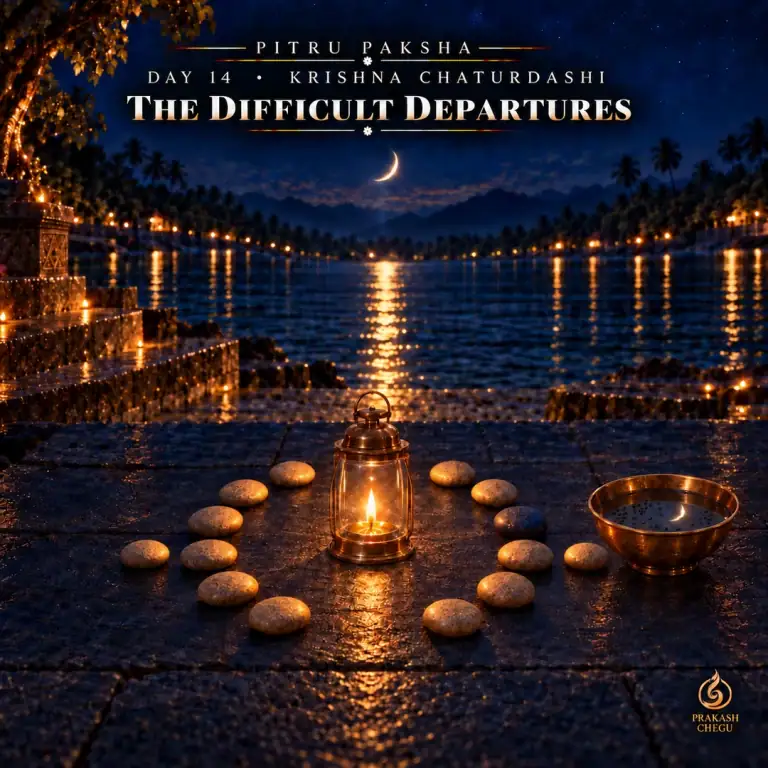
The ritual centre contains a small lamp or candle placed within a safe glass holder or lantern, a bowl of clean water, black sesame and fourteen stones, petals or paper markers.
The flame does not represent the manner of death. It represents the life that cannot be reduced to the rupture.
The protection around it represents containment: a boundary strong enough for remembrance to occur without flooding the whole space.
No weapon, accident image, news article, death certificate or object from the scene is required. Do not use such material during the group practice.
The guided practice will include:
1. Choosing a Level of Participation
Before lighting the flame, choose one level:
- Full practice — grounding, Tarpanam, fourteen-witness ritual and closing
- Simple remembrance — protected flame, one flower or stone and silence
- Witnessing — remain present without making a personal offering
- Rest — step away and return only if desired
Keep water nearby. Sit where you can move freely. Cameras may remain off.
If the death is recent, the legal process is active or the memory is destabilising, the simplest form may be the most respectful choice.
2. Orienting to the Present
Keep the eyes open.
Notice:
- Five things you can see
- Four points of physical support
- Three sounds in the present room
- Two places where the body can soften without being forced
- One clear way to leave or pause the practice
State the current date and location silently.
I am here. The event being remembered is not happening in this room now.
If that sentence does not feel true because danger is current, leave the ritual and seek immediate practical support.
3. Lighting the Protected Flame
Place the lamp in a stable, fire-safe holder, away from cloth, children, animals and moving air.
If flame is unsafe or activating, use an unlit lamp, a flower or a warm electric light.
Say:
This light represents the life beyond the final event. The boundary around it protects the space in which I remember.
4. Establishing the Sankalpa
Prepare for the ancestral offering and say:
For the departed of my maternal and paternal lineages whose deaths came through accident, violence, weapon, suicide, disaster or another difficult circumstance, I offer remembrance according to Chaturdashi tradition. I honour the whole life without entering the scene of death. May truth remain possible, may blame not be placed upon the vulnerable, and may remembrance support peace, justice and protection among the living.
Those with a family-given sankalpa should use their received wording.
5. Preparing the Sesame Water
Prepare clean water in a suitable vessel. Add black sesame where it belongs within your family practice. Darbha may also be used if available and appropriate.
Participants will receive concise guidance on posture, direction, Pitru Tirtha and respectful handling of the water.
Do not add ash, blood, soil from a death scene, medication, alcohol, weapons or personal evidence to the ritual water.
6. The First Offering · For Chaturdashi’s Special Field
Offer the first stream silently for departed relatives whose deaths fall within the family’s Chaturdashi practice.
Then say:
ॐ पितृभ्यः स्वधा नमः
Om Pitṛbhyaḥ Svadhā Namaḥ
For those remembered through this Chaturdashi, I offer water with reverence. I do not enter the final scene. I remember the life.
7. The Second Offering · For Those Reduced to the Death
Offer a second stream for those whose names have been eclipsed by headlines, secrecy, stigma, public conflict or the actions of another person.
May the manner of death no longer be the only story. May dignity return to the name. May the person be remembered without spectacle.
This does not ask a family to make private information public. Dignity and confidentiality can coexist.
8. The Third Offering · For the Unmourned and Unrecovered
Offer a third stream for people whose bodies were not recovered, whose identities remain unknown, whose death was denied or whose families could not perform customary rites.
For those without witness, recovery or recognised mourning, I offer reverence. May the absence of certainty not become the absence of care.
Do not include a specific missing person as deceased unless their status is known. Hold uncertain cases through the separate living-and-unknown prayer below.
9. Fourteen Markers Around the Flame
Place fourteen stones, petals or paper markers around the protected flame.
Name the witnesses slowly:
Existence. Name. Body. Place. Relationship. Voice. Work. Pleasure. Struggle. Choice. Effect. Mystery. Death. Continuing influence.
Place the marker for Death among the others—not at the centre.
Notice what changes when the final event remains present but no longer occupies the whole field.
If you know little about the person, do not invent details. The markers can acknowledge dimensions that once existed even when their contents are unknown.
10. One Ordinary Memory
Choose one memory or fact that does not describe the death.
It may be:
- A food they liked
- A phrase they used
- A place they lived
- Work they performed
- A habit that annoyed or amused others
- A kindness they offered
- A contradiction that made them human
- A simple physical detail, such as handwriting or the sound of a laugh
- The honest statement, I did not know them well
Write one sentence.
No positive memory is required. If the relationship was harmful, wholeness may mean acknowledging the life without manufacturing affection.
11. The Living-and-Unknown Prayer
Place a separate bowl of clean water outside the ancestral arrangement.
This bowl is for living people affected by the death and for cases in which life or death remains uncertain. It is not offered through Pitru Tirtha.
Say:
For survivors, witnesses, families, responders and those who live without an answer, may there be safety, truthful information, competent care and sustaining support. Where justice is needed, may remembrance never be used to silence it.
12. Silence Without Visualisation
Sit for up to fourteen natural breaths.
Keep attention upon the flame, the floor or an ordinary object in the room. Do not imagine the death, reconstruct final moments or ask the departed to appear.
If an intrusive image arises, say internally:
That is a memory or image. I am in the present room.
Then return to the visible boundary around the flame.
Counting is optional. Stop before fourteen if needed.
13. The Living Act of Protection
Choose one action through which remembrance supports life:
- Donate to a trusted trauma, bereavement or survivor-support organisation
- Support suicide-prevention or mental-health access without using the deceased’s story publicly
- Contribute to road, water, workplace or fire safety
- Support people displaced by war or disaster
- Learn basic first aid or crisis-response skills
- Improve safe storage of medicines, weapons or hazardous materials where relevant and lawful
- Establish a family emergency contact plan
- Support survivors of domestic or community violence
- Help with practical tasks following a traumatic death
- Preserve accurate family information without graphic detail
- Challenge stigma that keeps people from seeking help
- Cooperate with a lawful investigation or safeguarding process
The action is not payment for the death and does not guarantee prevention. It allows grief to participate in protection without turning the departed into a campaign symbol against the family’s wishes.
14. Contained Completion and Aftercare
Close the ancestral practice with the Pitru mantra and gratitude.
Return the Tarpanam water respectfully to clean earth, a suitable plant or another place consistent with family tradition and local conditions.
Extinguish the lamp safely or leave it only under continuous supervision. Do not interpret flickering, smoke, sound or accidental extinguishing as a message from the departed.
Move the fourteen markers into a small cloth or container. The death marker goes with the others; it is neither discarded nor placed above them.
Drink water. Eat something simple if appropriate. Wash the hands, look at the horizon, walk gently or contact a trusted person.
Do not drive or undertake demanding work immediately if you feel dissociated, flooded or physically unsteady.
The ritual has ended. The present room remains.
The Mantra and the Prayer
For the Ancestral Offering
ॐ पितृभ्यः स्वधा नमः
Om Pitṛbhyaḥ Svadhā Namaḥ
Reverence to the ancestral beings; may this offering be received through Svadhā.
For the Protected Flame
I honour the life. I acknowledge the death. I do not allow the final event to possess the whole story.
Participants with family-specific Chaturdashi mantras should follow their tradition.
Silence is sufficient. No special mantra is required in order to hold a traumatic death with dignity.
When the Death Was Suicide
Use the phrase died by suicide unless a bereaved family prefers another form. Language that treats suicide as a crime or moral failure can intensify stigma and isolation.
A death by suicide may leave unbearable questions:
Why did this happen?
What did I miss?
Could I have stopped it?
Were they thinking of us?
Did they know they were loved?
The ritual does not answer these questions.
It also does not claim that the departed is trapped, condemned, spiritually polluted or destined to remain near the place of death. Such statements cannot be verified and may deepen fear.
Suicide is complex. It may involve mental illness, trauma, pain, isolation, substance use, social conditions, crisis and impaired capacity. No single explanation should be imposed upon a particular person.
Bereaved relatives are not collectively responsible for foreseeing or preventing every death. Where there are real questions of care, neglect or accountability, they deserve careful support rather than ritualised blame.
Do not discuss methods or display death-scene material in the gathering.
If you are currently thinking about suicide or fear that you may act, this event is not sufficient support. Pause the ritual, move toward another person and contact local emergency services, a crisis service or a qualified healthcare professional now. If someone may be in immediate danger, do not leave them alone while arranging appropriate help.
When Violence Was Done by Another Person
Remembrance does not require forgiveness of a perpetrator.
Peace for the departed and justice among the living are not opposites.
A family may need truth, investigation, protection, legal action, financial support and freedom from public intrusion. Spiritual language should never pressure survivors to reconcile, withdraw a complaint or interpret violence as shared karma.
The deceased should not be blamed for failing to avoid violence.
Survivors should not be blamed for remaining, leaving, reporting, not reporting, freezing, fighting, complying or responding imperfectly under threat.
Day 14 keeps the ritual focus upon the departed and the living need for dignity, safety and truth.
It does not attempt to conduct a ritual judgement of the perpetrator.
Where the person who caused harm is also an ancestor, participants may establish firm boundaries. Acknowledging someone’s place in the family line does not require praise, intimacy, absolution or permission for the pattern to continue.
When War, Disaster or Public Tragedy Is Involved
Collective deaths can become symbols very quickly.
Governments, movements, media and communities may use the dead to justify competing narratives. Families may lose control of names and images. Graphic material can circulate long after it serves any legitimate public purpose.
This event does not ask participants to reproduce such material.
When remembering a public tragedy:
- Use verified names only when public remembrance is appropriate
- Avoid sharing photographs of bodies or final moments
- Do not assume the religion, beliefs or ritual wishes of every person affected
- Do not use another community’s dead to prove a spiritual theory
- Let material support accompany prayer where possible
- Respect requests from families and communities concerning privacy
- Make room for responders, survivors and displaced people who continue to live with the event
Collective prayer can widen compassion. It should not erase the particular human beings or practical responsibilities involved.
When There Was No Goodbye
Sudden death often removes the expected gestures of ending.
There may have been no final conversation, no bedside presence, no customary funeral, no recovered body or no opportunity to see what happened clearly. Travel, conflict, legal restriction, family division or pandemic conditions may have prevented participation in rites.
The absence of a goodbye can produce endless internal revisions:
If only I had called.
If only I had gone.
If only our last words had been different.
Day 14 does not create a fictional final conversation.
It offers a truthful present-tense statement:
I cannot change the last moment. I can choose the quality of this moment of remembrance.
You may speak one sentence that was never said, but you are not asked to imagine a reply.
The practice remains anchored in your action now—not in a claim of communication with the dead.
Guilt, Responsibility and the Limits of Control
After a traumatic death, the mind often searches for the point at which the outcome might have changed.
Some guilt is an expression of love confronting helplessness.
Some points toward a real action, omission or systemic failure that requires accountability.
The two should not be confused.
Ritual cannot decide legal or moral responsibility. It can create enough steadiness to ask better questions:
- What did I genuinely know at the time?
- What was within my actual control?
- What became visible only afterwards?
- Is there a repair I can make among the living?
- Is there an investigation or safeguarding step that remains necessary?
- Am I taking responsibility for another person’s choices because uncertainty feels intolerable?
- What support do I need before approaching these questions further?
Self-forgiveness should not be demanded as a ritual outcome.
Accountability should not become lifelong self-destruction.
Where there is something to repair, repair it honestly.
Where control never existed, allow support to help the body learn that truth gradually.
Your Reflection for Day 14
Can I honour the person without allowing the final event to become their entire identity?
You may also contemplate:
- What ordinary memory returns this person to human scale?
- Which words have replaced their name?
- What part of the life existed before the public or family story of the death?
- What do I know, and what remains unknown?
- Which details belong in private rather than in the ritual?
- Have I mistaken unanswered questions for personal guilt?
- Is there a real responsibility that still requires action?
- What explanation has been imposed through karma, fate or blame?
- What boundary is necessary around the memory?
- Can justice and prayer exist together?
- Who among the living still needs support?
- What danger, stigma or silence could be reduced through one practical action?
- What does the body need after approaching this memory?
- Which of the fourteen witnesses feels most absent from the current story?
- What would it mean to place the death among the facts of the life rather than at its centre?
What to Bring
Please prepare:
- A clean vessel for pouring water
- A bowl, plate or vessel to receive the ancestral offering
- Clean water
- Black sesame seeds, if available and appropriate
- Darbha or kusha grass, if available and appropriate
- A small lamp or candle in a stable glass holder or lantern
- A flame-free light, flower or reflective object if fire is unsafe
- Fourteen stones, petals, leaves or paper markers
- A separate bowl of clean water for the living-and-unknown prayer
- A notebook and pen
- A name or photograph of the departed, entirely optional
- Drinking water and a simple grounding snack
- Contact details for a trusted person if you may want support afterwards
Please do not bring or display weapons, graphic images, news footage, death-scene objects, suicide notes, medical evidence or material connected to an active investigation.
One bowl of water and one steady point of light are enough for the accessible practice.
Trauma-Sensitive Participation Agreements
To protect the gathering:
- No participant will be required to identify the cause of death
- No graphic details, images or method descriptions will be shared
- Cameras may remain off
- Participants may leave and return without explanation
- No one will interpret a death through karma, astrology, curse, possession or divine punishment
- No mediumship or attempts to summon the deceased will be used
- No participant will be asked to forgive a perpetrator or themselves
- Advice is not offered unless requested
- Details heard in the gathering remain confidential
- Active safety, legal and safeguarding needs take precedence over ritual
- The facilitator may interrupt graphic or unsafe disclosure to protect the group
This is a spiritual-educational gathering, not trauma therapy, crisis care, legal advice or an investigative forum.
The Event Experience
The gathering will move through fourteen contained stages:
- Arrival and choice — selecting a safe level of participation
- Present-time orientation — grounding without forced breath control
- Chaturdashi teaching — Ghata, Ghayala and Chaudas traditions
- Ritual boundaries — difficult departures and ordinary-cause Chaturdashi deaths
- The protected flame — containment without suppression
- Practical preparation — sesame water, posture, direction and offering method
- Silent Tarpanam — offerings for Chaturdashi’s special field
- Restoring the name — remembrance without spectacle or stigma
- Fourteen witnesses — placing the death among the dimensions of the life
- One ordinary memory — returning the person to human scale
- The living-and-unknown bowl — support for survivors and uncertain loss
- Silence without visualisation — fourteen optional breaths in the present room
- The living act of protection — service, safety, justice or support
- Contained completion — closing and deliberate aftercare
No previous knowledge of Tarpanam, Sanskrit or trauma-sensitive ritual is required.
This Event Is for You If…
- Your family remembers someone who died through accident, violence, suicide, war, disaster or another traumatic circumstance
- You want to understand the traditional purpose of Ghata Chaturdashi
- The manner of death has overshadowed every other memory of the person
- A relative’s death carries secrecy, stigma, public attention or unanswered questions
- You want a private ritual that does not require disclosure
- You are seeking spiritual remembrance without karmic blame, mediumship or forced forgiveness
- You want practical sesame-water Tarpanam with a simple alternative
- You need a way to acknowledge both grief and justice
- You are supporting someone affected by traumatic bereavement
- You want remembrance to become safety, advocacy, safeguarding or service
- You need permission to stop a ritual when the body reaches capacity
- You are entering the Pitru Paksha journey for the first time on Day 14
You may also attend as a respectful witness without naming a particular person.
Can This Event Be Attended Individually?
Yes.
Day 14 is a complete standalone event. You will receive the traditional Chaturdashi context, clear distinctions concerning difficult deaths and ordinary-cause Chaturdashi deaths, essential Tarpanam guidance, the complete Protected Flame ritual, reflection prompts, trauma-sensitive participation options and the recording.
You do not need to have attended Days 0–13. You do not need to disclose a cause of death or complete every ritual movement.
Those continuing through the series will experience a natural progression: Day 13 offered tenderness where a life ended young; Day 14 turns toward deaths whose manner can overwhelm the memory of everything else. The following day gathers all ancestors into the great collective completion.
Continue into the Complete Journey
Day 14 gives difficult departures a protected place without allowing violence, accident or trauma to possess the whole story. Day 15 enters Sarva Pitru Amavasya — The Great Completion, gathering known, unknown, forgotten and excluded ancestors into one final offering.
The complete journey includes:
- Sixteen tithi-based teachings from Purnima to Amavasya
- A distinct ritual and reflection for every day
- Practical Tarpanam instruction
- Maternal, paternal, known, unknown and specially remembered ancestors
- Trauma-aware space for accident, violence, suicide, difficult grief and unanswered questions
- Live ceremonies and recordings
- The concluding Sarva Pitru Amavasya offering
Respecting Family and Vedic Traditions
Shraddha and Tarpanam procedures vary according to Veda, śākhā, sutra, sampradaya, region, family custom, death tithi and manner of death.
Formal traditions may differ on whether Chaturdashi includes every person whose death tithi was Chaturdashi or is reserved specifically for accidental, violent and otherwise unnatural deaths. Some direct ordinary-cause Chaturdashi deaths to Sarva Pitru Amavasya.
Where you have inherited or received instructions, they take precedence.
Special rites may be advised after suicide, homicide, accident, an unrecovered body or another difficult circumstance. These should not be improvised from a general online event. Consult an appropriately qualified family priest, Vedic practitioner or lineage authority where formal rites are desired.
This class offers education, guided reflection and an accessible household practice. It does not replace formal Chaturdashi Shraddha, annual Shraddha, first-year death rites, priest-led Pinda Dāna or specialised rites.
Participants for whom formal Pitru Tarpanam is restricted—or for whom it is inappropriate—may offer a flower, protected light, prayer, feeding or charity in remembrance.
Do not promise liberation, removal of Pitru Dosha, release of a supposedly trapped spirit, communication with the deceased, resolution of trauma or any guaranteed outcome.
The Life Is Larger
There was a final day.
There was also a first day.
Between them were thousands of moments that did not know they would one day become memory.
A door opened.
A meal was prepared.
A joke was repeated too many times.
A mistake was made.
A hand rested upon a table.
Someone waited for a message.
Someone was disappointed.
Someone tried again.
The violent moment may be loud.
The life is still larger.
Place the death stone among the others.
Do not throw it away. Do not place it at the centre.
Light the protected flame.
Offer the sesame water.
Say the name if it is yours to say.
Keep the details private if privacy protects dignity.
Let justice remain possible.
Let unanswered questions remain unanswered for now.
Let the ordinary memory return.
The final event happened.
It matters.
It is not the only thing that matters.
May the dead be remembered without spectacle.
May the living receive protection and truthful support.
May the whole life become visible again.
Join Day 14
Krishna Chaturdashi: The Difficult Departures
Friday, October 9, 2026 — India Reference Calendar
Special Remembrance: Sudden, Violent and Traumatic Deaths
Live Online · Time to Be Announced · Recording Included
Series Navigation
Previous: Day 13 · Krishna Trayodashi — The Tenderly Remembered
View the Complete Pitru Paksha Calendar
Next: Day 15 · Sarva Pitru Amavasya — The Great Completion