
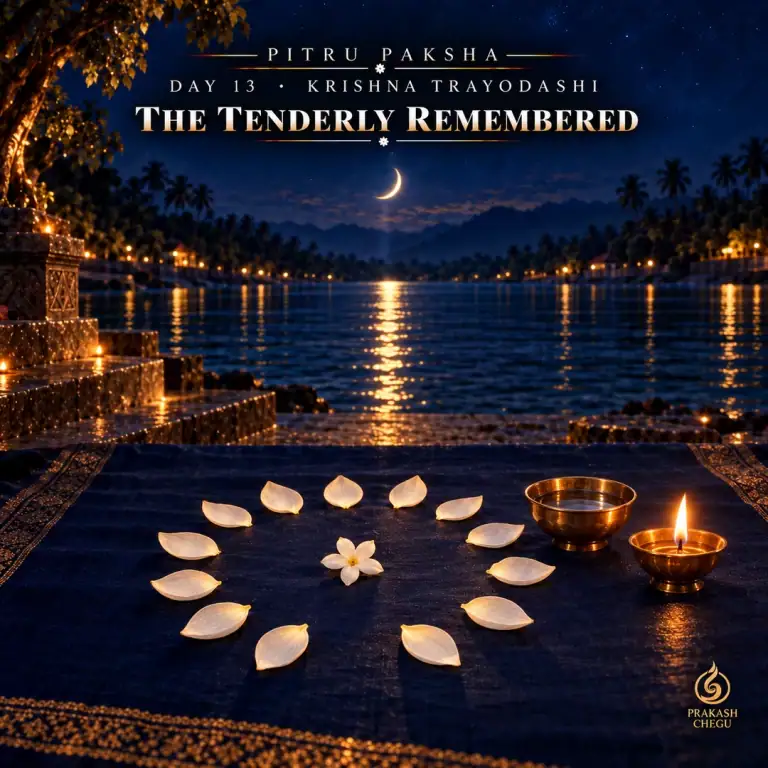
Pitru Paksha 2026 online · Day 13 of 16 · Thursday, October 8, 2026 · live at 7:00 AM CET, recording included.
Some lives are held for decades.
Some are held for days, hours or only in hope.
Love does not measure their meaning by duration.
There are names a family says easily.
There are names that change the atmosphere of the room.
There are names remembered only by one person. Names never formally given. Lives known through a photograph, a hospital bracelet, an empty room, a family story, a letter, a date—or the shape of a future that did not arrive.
When a child or young person dies, language often rushes toward explanation.
People say it was destiny. Karma. God’s will. A lesson. A soul completing its work. A reason that will become clear one day.
Sometimes these words are offered with love.
But love does not always require an explanation.
Sometimes love requires a place where nothing is solved, justified or made spiritually convenient.
Day 13 is that place.
Krishna Trayodashi — The Tenderly Remembered honours departed family members whose death tithi was Trayodashi and, in traditions that make this special association, children and those who died young.
Through a gentle Tarpanam, white flowers, fruit or a simple sweet, thirteen permissions for remembrance and an extended period of silence, we make an offering without demanding that grief become wisdom before it is ready.
The ritual is deliberately simple. No participant will be asked to tell the story, display a photograph, speak a name aloud, explain a pregnancy, disclose the circumstances of a death or demonstrate emotion.
This is not a ceremony for closing the bond.
It is a ceremony for allowing love to remain present without being forced into an answer.
This event may be attended individually or as part of Pitru Paksha: The River Behind You, the complete journey from Bhadrapada Purnima to Sarva Pitru Amavasya.
Global Session Times
Live session at 7:00 AM Central European Time (CET)
- Central Europe (Berlin · Paris · Budapest) — 7:00 AM
- London — 6:00 AM
- Tallinn · Helsinki · Athens — 8:00 AM
- India (IST) — 10:30 AM
- New York (EDT) — 1:00 AM
- Tulum (Quintana Roo) — 12:00 AM (midnight)
- Mexico City — 11:00 PM the previous evening
- California (PDT) — 10:00 PM the previous evening
A recording is included for every session if the live time does not suit your location.
The Meaning of Trayodashi
Trayodashi is the thirteenth lunar day.
Pitru Paksha Trayodashi Shraddha—also called Teras Shraddha in some regions—is traditionally performed for departed family members whose death occurred on Trayodashi tithi in either Shukla Paksha or Krishna Paksha.
Several contemporary ritual calendars also identify this tithi as suitable for remembering children who died young. In Gujarat, the observance may be called Balabholani Teras. Terminology and procedure vary, and not every family or region assigns the same special categories to the same day.
The stable foundation remains the death tithi: a person whose death occurred on Trayodashi may be formally remembered on Trayodashi Shraddha.
The wider remembrance of young lives creates a compassionate field around that foundation. It does not erase family rules concerning age, samskaras, initiation, funeral rites or eligibility for particular forms of Shraddha.
Some traditions distinguish the rites of an infant, a child who had not received particular samskaras, an initiated young person and an adult. Families with inherited procedure should follow it.
This event offers an accessible act of water, flower, food, silence and charity. It does not attempt to replace those distinctions.
Tenderness is the shared field. Formal ritual follows the lineage.
Who Is Remembered on Day 13?
The formal Trayodashi offering may honour known and unknown ancestors whose death tithi was Trayodashi.
The day’s special contemplative remembrance may also hold:
- Babies who died before or shortly after birth
- Children who died in infancy or childhood
- Adolescents and young adults whose lives ended early
- Sons, daughters, siblings, cousins, nieces, nephews and grandchildren
- Young friends, students, classmates or community members
- Children known through adoption, fostering, guardianship or chosen family
- Pregnancies remembered after miscarriage, ectopic pregnancy, stillbirth or termination
- A twin or sibling whose life was known only briefly
- Young people whose death was never spoken of openly
- Children whose names, dates or circumstances have been lost from the family record
- Young lives affected by illness, accident, violence, suicide, conflict, displacement, neglect or other circumstances
- The hopes, relationships and futures carried around these lives
Not every category above receives the same formal rite in every tradition. Inclusion in the event’s field of tenderness is not a claim that all are ritually identical.
Participants may direct formal Tarpanam only where it is appropriate and use a flower, lamp, prayer or silent remembrance for all others.
No one must decide publicly which category applies.
A Life Is Not Incomplete Because It Was Short
Adults often describe a young death as an unfinished life.
The phrase is understandable. So much appeared possible. There were birthdays that did not happen, questions never answered, journeys never taken, work never begun, relationships never formed and versions of the family that vanished with the death.
Yet the person is not a failed version of someone who should have lived longer.
A short life may contain relationship, presence, touch, longing, disruption, beauty and immeasurable consequence. Even a pregnancy held privately can reorganise the inner world of the person who carried it.
The future may feel unfinished.
Love is not.
Day 13 does not ask us to declare that everything happened as it should.
It asks whether remembrance can be complete even when the life felt incomplete.
Complete remembrance means that the person does not have to be reduced to the moment of death. It also means that the mourner does not have to manufacture memories that do not exist.
Some will remember a laugh, a favourite food or a particular stubbornness.
Some will remember only a medical room, a small movement, a name considered but never used, or the day hope changed form.
Both are enough.
The Grief That Families Hide
Young death can become the silent centre of a family.
A photograph disappears from the wall. A name is not given to a later child because it carries too much pain. Siblings learn not to ask. A parent is told to be strong. A mother’s grief is recognised while a father’s is ignored—or the reverse. Grandparents carry sorrow while trying not to add to their child’s burden.
Pregnancy loss may be treated as if nothing happened. A termination may be surrounded by secrecy, judgement or conflicting emotions. A stillbirth may leave parents with memories that the wider family does not know how to hold. A child who lived only briefly may be absent from official family narratives.
The family may speak only about how someone died and forget to speak about how they lived.
Or the family may speak only of beautiful memories and leave no room for anger, guilt, trauma or relief.
Silence can protect privacy.
It can also isolate grief.
Day 13 does not demand disclosure. It offers a different possibility: a private truth can be acknowledged without becoming public property.
You may write a name and keep the paper folded.
You may place a flower without naming anyone.
You may participate for another family without claiming to understand their loss.
You may simply sit beside the ritual and allow your presence to say, This life is not excluded from remembrance.
No Spiritual Explanation Is Required
Grief often attracts certainty from people standing outside it.
They may say:
- The child chose the parents
- The soul needed only a short incarnation
- A karmic debt was completed
- The death prevented a worse future
- God needed another angel
- The family is being spiritually tested
- A ritual failure, ancestral fault or astrological condition caused the death
- The parents must forgive themselves or become grateful in order to heal
This event will not make these claims.
No one can use a spiritual system responsibly to declare why a particular child died or what the death was meant to teach another person.
Karma is not a licence for blame.
Ritual is not proof that grief should now be finished.
Faith may give a mourner language, companionship and meaning. It may hold hope concerning continuity, rebirth, divine presence or the journey of the soul. Such beliefs can be deeply sustaining when they arise from the person’s own tradition and heart.
They become harmful when imposed as an explanation, used to silence pain or presented as certainty about another person’s loss.
The only statement required on Day 13 is simple:
You were here. You matter. You are remembered with tenderness.
Thirteen Permissions for Remembrance
The thirteen permissions below form the event’s contemplative framework. They are not presented as scriptural correspondences for Trayodashi.
1. Permission to Use the Name
If there is a name and you wish to say it, the name belongs in the family’s field of remembrance.
2. Permission to Keep the Name Private
Sacred does not have to mean public. A name may remain written, whispered or known only within the heart.
3. Permission to Have No Name
The absence of a name does not mean the absence of relationship.
4. Permission to Remember What Happened
You do not need to erase the difficult circumstances in order to create a beautiful memorial.
5. Permission to Remember More Than the Death
A person is larger than the illness, accident, violence or final event through which they died.
6. Permission to Feel What Is Present
Tears are welcome but not required. Numbness, anger, quiet, gratitude, relief, confusion and even moments of laughter may coexist with love.
7. Permission Not to Explain
You do not owe the group, the family or the ritual a theory of why the death occurred.
8. Permission to Grieve Differently
Two parents, siblings or relatives may love the same person and grieve in entirely different ways.
9. Permission to Protect the Memory
You may set boundaries around photographs, belongings, anniversaries, questions and public storytelling.
10. Permission to Experience Joy
Joy is not betrayal. A continuing life does not erase the one who died.
11. Permission to Seek Support
Spiritual practice and professional grief care can stand beside each other. Asking for help does not diminish faith.
12. Permission to Let the Bond Change
Continuing love may become prayer, service, advocacy, art, a family tradition or quiet inner companionship.
13. Permission to Leave the Ritual Unfinished
If the practice becomes too intense, you may stop. You can close with one breath, one flower or no further action. The worth of the remembrance is not measured by completion.
Tenderness never uses devotion to override the nervous system.
What We Will Explore
- The traditional purpose of Trayodashi Shraddha and Teras Shraddha
- Who is formally remembered when a person died on Trayodashi tithi
- The tradition-dependent association between Trayodashi and children who died young
- Why rites may differ according to age, samskaras, family and region
- How to remember young lives without assigning a spiritual cause to their death
- Why a short life is not a lesser life
- The grief carried by parents, siblings, grandparents, teachers and communities
- The silence surrounding miscarriage, stillbirth, neonatal death and pregnancy termination
- How to include unnamed or privately remembered lives without forced disclosure
- The thirteen permissions for remembrance
- How to perform a gentle Trayodashi Tarpanam where appropriate
- When to use a flower, lamp or prayer instead of a formal ancestral offering
- Why fruit or a simple sweet can be offered without romanticising childhood
- How to honour a whole life without allowing the final event to become its only identity
- How remembrance can become care for living children and grieving families
- How to leave the ritual safely if the emotional intensity becomes too high
No previous class is required. First-time participants will receive essential Tarpanam guidance, while those continuing through the series will deepen the daily sequence.
The Day 13 Ritual
The Offering Without Explanation
The ritual centre is deliberately uncluttered: clean water, one white cloth, white flowers or petals, fruit or a simple sweet and a small lamp if safe.
Thirteen petals form an open circle.
The small opening is not a sign that the person or ritual is incomplete. It is space for what cannot be known, resolved or spoken.
No image of a child is required. No object associated with a deceased person should be used without the consent of the person responsible for it.
The guided practice will include:
1. Establishing Choice
Before beginning, decide which level of participation feels right:
- Full practice — water, flower, food offering, silence and closing
- Simple remembrance — flower, lamp and silence only
- Witnessing — remain present without making a personal offering
- Rest — step away and return only if desired
Keep drinking water nearby. Sit where you can move easily. Keep the camera off if privacy supports you.
Participation is never proved by emotional intensity.
2. Preparing the White Cloth
Place a clean white or neutral cloth at the centre.
White is used here for simplicity, quiet and tenderness. It is not a claim that grief, the child or the circumstances of death were pure, impure, innocent or karmically resolved.
Place the Tarpanam vessel and receiving bowl to one side. Keep the fruit or sweet separate from the ritual water.
3. Forming the Open Circle
Arrange thirteen white flowers, petals, leaves, grains or paper markers in a circle with a small opening.
As you place them, allow each one to carry a permission:
Name. Privacy. Namelessness. Truth. Wholeness. Feeling. Mystery. Difference. Boundary. Joy. Support. Continuing bond. Pause.
You do not need to remember the list perfectly. The circle is a support, not a test.
4. Naming—or Not Naming
If you wish, write the name of the person being remembered.
You may also write:
- The child held in our family’s silence
- The young ones whose names I do not know
- The life I carried and remember privately
- The student, friend, sibling or relative I remember today
- Nothing at all
Fold the paper if you want the words to remain private. No one will be asked to read it aloud.
5. Establishing the Sankalpa
For formal Trayodashi remembrance, say:
For the departed ancestors of my maternal and paternal lineages, and especially those whose death tithi was Trayodashi, I offer remembrance. I also hold with tenderness the children and young people whose lives remain within our families and communities. May this offering ask for no explanation and impose no burden upon grief.
Those with family-given sankalpa wording should follow it.
6. Preparing the Tarpanam
Prepare clean water in a suitable vessel. Black sesame and darbha may be included according to family custom and availability.
Participants will receive concise guidance on posture, direction, Pitru Tirtha and respectful handling of the offered water.
Where family tradition gives different rites for a baby, child, pregnancy loss or young unmarried person, do not replace those instructions with the general practice offered here. Use the formal Tarpanam for appropriate Trayodashi ancestors and the flower practice for the young life being remembered.
7. The First Offering · For Trayodashi Ancestors
Offer the first stream of water for known and unknown ancestors whose death tithi was Trayodashi.
ॐ पितृभ्यः स्वधा नमः
Om Pitṛbhyaḥ Svadhā Namaḥ
For the ancestors remembered on Trayodashi, I offer this water with reverence. May it be received in peace.
8. The Second Offering · For Young Lives
Where appropriate within your practice, offer a second stream for departed children and young people.
Otherwise, pour this water onto clean earth or into the receiving bowl as a general prayer rather than a formal named Tarpanam.
For the young lives held within our families, friendships and communities, I offer tenderness. I do not reduce you to the length of your life or the manner of your death.
9. The Third Offering · For the Unnamed and Unacknowledged
Offer a third stream for the lives whose names, stories or place in the family were never publicly recognised.
For those remembered without a name, for grief carried without witnesses and for love that had no recognised place, may there be dignity. Nothing must be disclosed in order to belong.
10. The White Flower
Place one white flower or petal inside the open circle.
Say only what is true for you.
Possible words include:
- You are remembered.
- Your life belongs in our story.
- I do not know why.
- I am grateful for what I knew of you.
- I release the explanations that have caused harm.
- There are no words today.
Silence is a complete offering.
11. The Fruit or Sweet
Place a piece of fruit or a simple sweet on a clean dish.
The offering is not meant to sentimentalise the person or assume every child loved sweets. It represents nourishment, gentleness and the living family’s willingness to feed rather than avoid remembrance.
After the ritual, handle the offering according to family practice. Where suitable, prepare fresh food for donation rather than distributing ritual food in a way inconsistent with your tradition.
12. Thirteen Breaths of Silence
Rest one hand upon the heart or place both hands comfortably in the lap.
Take thirteen unforced breaths.
There is no visualisation of the deceased, no attempt to call them into the room and no demand for a sign or message.
If counting increases tension, release the count. Feel the support beneath the body and notice the room around you.
If emotion becomes overwhelming, open the eyes, name five things you can see, place both feet on the floor, drink water or step away.
13. The Living Act of Tenderness
Choose one action that allows remembrance to protect or nourish life:
- Donate age-appropriate books, clothing or school supplies requested by a local organisation
- Support a children’s hospital, hospice, grief programme or bereavement charity
- Fund a meal, scholarship, vaccination, medical need or safe transport through a trusted organisation
- Offer practical help to grieving parents without asking them to make you comfortable
- Learn how to speak more sensitively about miscarriage, stillbirth, termination or child death
- Record the name and dates of a young relative so the person is not erased from family history
- Include siblings and grandparents in appropriate grief support
- Create a small annual act of service in the person’s memory
- Protect a living child through attention, advocacy, education or safeguarding
- Ask a grieving person what is useful instead of assuming
The act should not use another child as a symbolic replacement for the person who died. Give because a living need exists, not to make grief disappear.
Completion
Close with the Pitru mantra if you used the ancestral offering.
Return the Tarpanam water respectfully to clean earth, a suitable plant or another place consistent with family tradition and local conditions.
The thirteen petals may remain until the lamp is extinguished. Afterwards, return natural petals to earth where appropriate or wrap and dispose of them respectfully.
The folded name may be kept, placed in a journal, offered privately according to tradition or destroyed later. No single choice represents greater love.
Leave the circle open.
The ritual does not close the relationship. It simply closes this period of practice.
The Mantra and the Silence
For the Ancestral Offering
ॐ पितृभ्यः स्वधा नमः
Om Pitṛbhyaḥ Svadhā Namaḥ
Reverence to the ancestral beings; may this offering be received through Svadhā.
For the Flower Offering
No mantra is required.
You may say:
Your life is not measured only by time. Your place in love does not require explanation. You are tenderly remembered.
Participants with family-specific mantras or prayers may follow their tradition.
Fewer words are intentional on Day 13.
The Deeper Teaching: Love Without Resolution
Modern culture often imagines grief as a task.
Process it. Heal it. Release it. Find the meaning. Reach closure. Return to normal.
These verbs can become another burden.
Grief changes, but it does not obey a schedule. It may become quieter and then return at a birthday, a family celebration, a school year, a pregnancy, a song, a hospital corridor or the sight of someone who would now be the same age.
Continuing love is not the same as refusing to live.
We can remain related to the person through memory while building a life that contains pleasure, purpose and new attachment. The bond may move from daily agony to an inner presence, a family story, a private prayer or an act of service.
There is no betrayal in this movement.
Nor is there failure if the grief remains difficult.
The aim of ritual is not to produce a particular emotional result. Ritual gives form to attention. It offers the body a beginning and an ending, the heart a symbol and the family a language that may have been missing.
Sometimes that form brings relief.
Sometimes it brings tears.
Sometimes it brings nothing immediately perceptible.
All three responses are valid.
The offering has integrity when it is truthful—not when it creates a dramatic experience.
Grief Does Not Belong Only to Parents
The death of a child or young person moves through an entire relational field.
Siblings may grieve while also feeling overlooked, guilty, frightened or responsible for protecting their parents. A later-born child may grow beneath the memory of someone they never met. Grandparents may carry both their own grief and anguish for their child. Cousins and friends may lose the person with whom they imagined growing older.
Teachers may return to a classroom containing an empty desk.
Healthcare workers, caregivers and first responders may carry images they cannot easily discuss.
Community members may feel they have no right to grieve because they were not immediate family.
Day 13 allows these circles of grief to exist without competition.
The parents’ experience remains unique. It does not need to be displaced in order to recognise that others were also changed.
If you are supporting a grieving family, presence may be more useful than interpretation. Use the person’s name if the family does. Remember important dates. Offer specific practical help. Accept that there may be no comforting sentence.
Do not compare losses.
Do not demand details.
Do not turn someone else’s grief into a demonstration of your spiritual understanding.
Pregnancy Loss and Private Grief
A pregnancy may be deeply significant even when it was brief, medically complex, unplanned, private or ended through a decision others would judge.
People may feel sorrow, relief, love, guilt, anger, numbness or several of these at once. Partners may respond differently. Some people use the word baby; others use pregnancy, embryo or foetus. Respect the language chosen by the person whose experience it is.
No participant will be asked why a pregnancy ended.
The event does not assign sin, punishment, spiritual superiority or karmic cause to miscarriage, infertility, ectopic pregnancy, stillbirth or termination.
Formal ritual rules vary. If you do not know what your tradition prescribes, a private flower, lamp, prayer or act of charity is sufficient for this event.
The purpose is not to decide publicly what metaphysical category applies.
The purpose is to give tenderness a place.
When the Death Was Traumatic
If the young person died through accident, violence, suicide, abuse, medical crisis, war or another traumatic circumstance, the mind may repeatedly return to the final event.
You do not need to recount it during this gathering.
Day 13 honours the whole life. Day 14 will address difficult and violent departures more directly through a trauma-aware Chaturdashi framework.
For this event, choose an image, object or sentence connected with life rather than the circumstances of death—if such a memory is available. If it is not, the white flower can carry simple presence without narrative.
Ritual can support meaning and remembrance, but it does not replace medical or psychological care, grief counselling, trauma treatment, safeguarding or legal support.
If remembrance brings an immediate risk of harm to yourself or someone else, pause the ritual and contact local emergency or crisis support.
Your Reflection for Day 13
Can remembrance be complete even when a life felt incomplete?
You may also contemplate:
- Whose name became difficult for the family to say?
- Is there a young life missing from our family story?
- What do I remember beyond the circumstances of death?
- What did this person love, notice, resist or make possible?
- If there are few memories, what honest fragment can I hold?
- Which explanations have comforted me?
- Which explanations caused harm or blame?
- What would it mean to allow the question to remain unanswered?
- How did different family members grieve differently?
- Who became invisible while everyone focused upon one mourner?
- What boundary protects this memory?
- What joy have I mistakenly treated as betrayal?
- What support would be useful now?
- What living act could carry tenderness without trying to replace the person?
- Can I let love continue without demanding closure?
What to Bring
Please prepare:
- A clean vessel for pouring water
- A bowl, plate or vessel to receive the ancestral offering
- Clean water
- Black sesame seeds, if available and appropriate to your practice
- Darbha or kusha grass, if available and appropriate
- A clean white or neutral cloth
- Thirteen white flowers, petals, leaves, grains or paper markers
- One piece of fruit or a simple sweet on a clean dish
- A small lamp or candle, if safe and desired
- A notebook and pen
- A name, photograph or small remembrance object, entirely optional
- Drinking water and anything that helps you remain physically grounded
- A private, comfortable place from which you can step away if needed
Please do not postpone participation if every traditional material is unavailable. One flower and a bowl of water are enough for the accessible practice.
Do not use an object, image or story that belongs to another grieving person without permission.
Gentle Participation Agreements
To protect the gathering:
- No participant will be required to share a name or story
- Cameras may remain off
- Tears, silence and the absence of tears are equally welcome
- No one will interpret another person’s loss through karma, astrology, mediumship or divine intention
- No participant will be asked to forgive, release, find gratitude or accept closure
- Advice is not offered unless requested
- Stories heard in the gathering remain confidential
- Participants may leave and return without explanation
- Parents and immediate family determine the language used for the person being remembered
- Ritual guidance remains subordinate to health, safety and inherited family practice
This is a spiritual-educational gathering, not group therapy. It may stand beside qualified grief support but does not replace it.
The Event Experience
The gathering will move through thirteen gentle movements:
- Arrival and choice — selecting a level of participation
- Trayodashi teaching — the thirteenth tithi and its Shraddha context
- Tradition boundaries — death tithi, young lives and differing family rites
- The open circle — thirteen permissions for remembrance
- Naming or privacy — choosing what remains spoken, folded or silent
- Practical preparation — water, posture, direction and offering method
- Trayodashi Tarpanam — remembrance for the tithi ancestors
- The young lives — a water or flower offering according to tradition
- The unacknowledged — remembrance without disclosure
- White flower and food — tenderness and nourishment without explanation
- Thirteen breaths — silence without visualisation or summoning
- Living care — charity, advocacy or practical support
- Open-circle closing — ending the practice without ending the bond
No previous knowledge of Tarpanam, Sanskrit or grief ritual is required.
This Event Is for You If…
- You want to honour an ancestor whose death tithi was Trayodashi
- A baby, child, adolescent or young adult belongs in your field of remembrance
- Your family carries a young death that is rarely acknowledged
- You are a parent, sibling, grandparent, relative, friend, teacher or caregiver affected by a young loss
- You want a private ritual for pregnancy loss without moral or spiritual judgement
- You have few memories but still feel a meaningful bond
- You want spiritual remembrance without karmic explanations or forced closure
- You need permission to participate silently
- You want practical Tarpanam guidance with a gentler alternative where formal rites differ
- You want remembrance to become service to living children or grieving families
- You are entering the Pitru Paksha journey for the first time on Day 13
You may also attend without a specific personal loss, holding respectful space for the young lives within the wider human family.
Can This Event Be Attended Individually?
Yes.
Day 13 is a complete standalone event. You will receive the traditional Trayodashi context, the tradition-dependent remembrance of children and young people, essential Tarpanam guidance, the complete Offering Without Explanation ritual, reflection prompts, gentle participation options and the recording.
You do not need to have attended Days 0–12. You do not need to speak a name, share a story or perform formal Tarpanam.
Those continuing through the series will experience a natural progression: Day 12 examined the authority and responsibility carried through lineage; Day 13 turns toward the lives over whom families imagined protection, asking us to meet what could not be protected without blame, explanation or spiritual performance.
Continue into the Complete Journey
Day 13 creates a gentle field for children and those who died young. Day 14 enters Krishna Chaturdashi — The Difficult Departures, offering trauma-sensitive remembrance for those who died through accident, violence, suicide or other sudden and unnatural circumstances.
The complete journey includes:
- Sixteen tithi-based teachings from Purnima to Amavasya
- A distinct ritual and reflection for every day
- Practical Tarpanam instruction
- Maternal, paternal, known, unknown and specially remembered ancestors
- Space for young loss, difficult death, silence, tenderness and continuing love
- Live ceremonies and recordings
- The concluding Sarva Pitru Amavasya offering
Respecting Family and Vedic Traditions
Shraddha, Tarpanam and memorial procedures vary according to Veda, śākhā, sutra, sampradaya, region, family custom, age, samskaras and the circumstances of death.
Formal practices may include specific rules concerning eligibility, sacred-thread position, direction, materials, mantras, Pinda Dāna, food offerings and who is named as a ritual recipient. Rites for miscarriage, stillbirth, infants, children and young unmarried people may differ significantly.
Where you have inherited or received such instructions, they take precedence.
This class offers education, guided reflection and an accessible household practice. It does not replace formal Trayodashi Shraddha, annual Shraddha, first-year death rites, priest-led Pinda Dāna or specialised rites advised by a qualified family or lineage practitioner.
Participants for whom formal Pitru Tarpanam is restricted—or for whom it does not feel appropriate—may offer a flower, lamp, prayer, food, feeding or charity in remembrance.
Do not pressure a grieving person to participate. Do not disclose a pregnancy, name, cause of death or family story without consent. Do not promise liberation, closure, removal of Pitru Dosha, contact with the deceased or guaranteed emotional healing.
Let the Flower Be Enough
We often reach for many words when no words can change what happened.
We explain because helplessness is difficult.
We advise because silence asks us to remain beside pain we cannot repair.
We search for meaning because the unanswered question feels unbearable.
Trayodashi offers another form of courage.
Place the flower.
Let it be white, or any colour that carries the person honestly.
Offer the water.
Set down the fruit.
Say the name—or protect it in silence.
Remember the laugh if there was time for one.
Remember the hope if hope was all there was.
Remember the life without reducing it to its final moment.
You do not have to declare that the loss made you stronger.
You do not have to understand why.
You do not have to finish grieving in order to bow.
Let the circle remain open.
Let the question remain a question.
Let love be the part that does not need to defend its existence.
May every young life have a place in remembrance.
May every hidden grief be met without judgement.
May tenderness ask for nothing in return.
Join Day 13
Krishna Trayodashi: The Tenderly Remembered
Thursday, October 8, 2026 — India Reference Calendar
Special Remembrance: Children and Those Who Died Young
Live Online · Time to Be Announced · Recording Included
Series Navigation
Previous: Day 12 · Krishna Dwadashi & Magha Shraddha — The Ancestral Throne
View the Complete Pitru Paksha Calendar
Next: Day 14 · Krishna Chaturdashi — The Difficult Departures