Modern wellness has become obsessed with what we eat, what supplements we take, and how we exercise. Yet Ayurveda, the world’s oldest holistic healing system, has always viewed healing as something far more intimate. According to the classical Ayurvedic tradition, the body is influenced not only by food and herbs but also by sound, fragrance, touch, colors, metals, and even the clothing that rests against our skin.
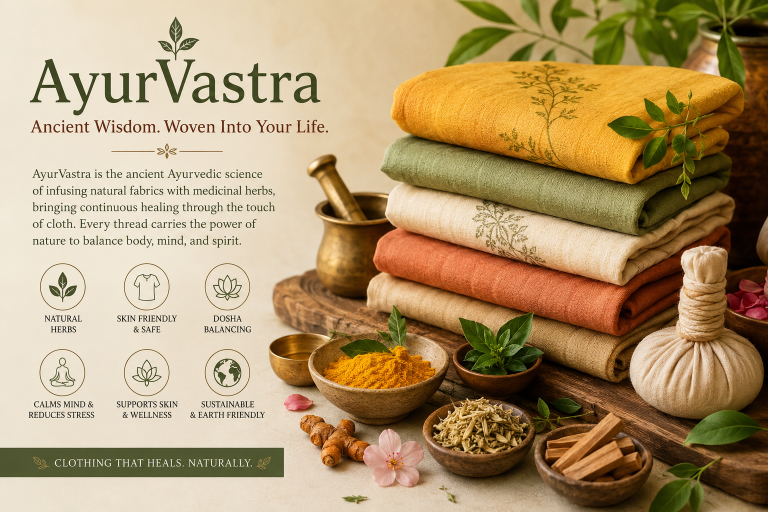
Among these lesser-known traditions lies a fascinating branch called AyurVastra—literally meaning Ayurvedic cloth.
It is the ancient practice of infusing natural fabrics with medicinal herbs so that healing may occur continuously through contact with the skin.
Long before pharmaceutical patches and transdermal drug delivery systems, Indian sages and physicians understood something profound:
The skin is not merely a covering. It is an organ of absorption and communication.
Clothing as Medicine
In Sanskrit:
- Ayur means life.
- Vastra means cloth or garment.
AyurVastra refers to garments dyed and processed with combinations of medicinal plants according to Ayurvedic principles.
These are not ordinary dyed fabrics.
Traditional AyurVastra is made from:
- Organic cotton
- Silk
- Linen
- Wool
And treated with decoctions prepared from herbs, roots, bark, flowers, and minerals.
The intention was simple:
To transform something we wear every day into a subtle form of medicine.
The body receives healing continuously—not by swallowing pills, but through prolonged contact.
The Skin: A Forgotten Organ of Absorption
Ayurveda considers the skin (Twak) one of the most important sensory organs.
Modern science agrees that the skin is highly active.
It:
- absorbs certain compounds,
- regulates temperature,
- houses billions of microbes,
- communicates with the nervous system,
- and serves as a neurochemical interface between the body and environment.
We already accept:
- nicotine patches,
- estrogen patches,
- pain-relief creams,
- magnesium oils,
- essential oil therapies.
AyurVastra operates on the same principle:
Healing substances can enter the body through the skin.
Although the quantities absorbed are likely very small, Ayurveda emphasizes that repeated, gentle exposure over time can influence the organism in subtle ways.
A Tradition Over 5,000 Years Old
AyurVastra finds its roots in the classical Ayurvedic texts and traditional textile practices of South India, especially Kerala.
Ancient physicians recognized that different herbs possessed:
- cooling qualities,
- warming qualities,
- calming properties,
- stimulating actions,
- doshic balancing effects.
Instead of applying these herbs only internally, they developed ways to impregnate fabrics with medicinal energies.
Historically, AyurVastra garments were prescribed for:
Skin disorders
Such as:
- eczema,
- psoriasis,
- dermatitis,
- itching,
- fungal conditions.
Joint and muscle pain
Through warming herbs that support circulation.
Diabetes
Specialized garments were believed to support metabolic balance.
Sleep disturbances
Cooling herbs and calming fragrances were used to pacify the mind.
Hypertension
Certain herbal combinations were chosen to soothe excess Pitta and stress.
Stress and anxiety
Garments infused with nervine herbs were believed to calm the nervous system.
The Importance of Natural Dyes
Conventional textile manufacturing introduces hundreds of synthetic chemicals into fabrics.
Many modern dyes contain:
- azo compounds,
- heavy metals,
- formaldehyde,
- petroleum derivatives.
Studies increasingly suggest that prolonged exposure to some textile chemicals may contribute to:
- skin irritation,
- allergies,
- endocrine disruption,
- environmental toxicity.
AyurVastra represents the opposite philosophy.
Instead of chemical dyes, fabrics are colored using herbs such as:
Turmeric
One of Ayurveda’s greatest anti-inflammatory herbs.
Associated with:
- purification,
- immune support,
- skin healing.
Golden-yellow shades arise naturally from turmeric.
Neem
Known as “the village pharmacy.”
Traditionally used for:
- skin diseases,
- inflammation,
- infections,
- blood purification.
Sandalwood
Cooling and calming.
Associated with:
- reducing Pitta,
- soothing the mind,
- promoting spiritual tranquility.
Tulsi (Holy Basil)
Revered as a sacred plant.
Known for:
- stress reduction,
- immune support,
- respiratory health.
Vetiver
Deeply grounding and cooling.
Often used to calm excess heat and anxiety.
Aloe Vera
Associated with:
- hydration,
- tissue repair,
- skin rejuvenation.
Manjistha
An important Ayurvedic herb for:
- lymphatic health,
- blood purification,
- skin disorders.
Matching Fabrics to the Doshas
Ayurveda recognizes three constitutional energies:
Vata
Associated with:
- dryness,
- anxiety,
- insomnia,
- coldness.
Beneficial colors:
- warm earth tones,
- reds,
- oranges.
Herbs:
- Ashwagandha,
- Bala,
- sesame preparations.
Soft cotton and silk are preferred.
Pitta
Associated with:
- inflammation,
- irritability,
- heat.
Beneficial colors:
- blue,
- green,
- white.
Cooling herbs:
- sandalwood,
- vetiver,
- aloe vera,
- neem.
Kapha
Associated with:
- sluggishness,
- heaviness,
- congestion.
Stimulating colors:
- saffron,
- yellow,
- bright reds.
Herbs:
- ginger,
- cinnamon,
- tulsi.
The Kerala Revival
The state of Kerala has become the modern center of AyurVastra production.
Traditional artisans collaborate with Ayurvedic physicians to create:
- bedsheets,
- pajamas,
- meditation shawls,
- scarves,
- baby clothing,
- yoga garments,
- socks,
- eye pillows.
Many Ayurvedic hospitals incorporate these fabrics into therapeutic programs.
Some patients wear AyurVastra clothing continuously during Panchakarma treatments to support healing.
Healing Through Touch
Perhaps one of the deepest teachings hidden inside AyurVastra is philosophical.
Everything touching us influences us.
Our:
- environment,
- relationships,
- sounds,
- thoughts,
- fragrances,
- and even our clothing,
become part of our inner ecosystem.
The yogic sciences describe human beings as electromagnetic and vibrational beings.
Ancient traditions therefore paid careful attention to:
- the fibers they wore,
- the colors surrounding them,
- the plants touching their bodies,
- and the subtle impressions entering consciousness.
Clothing was never merely fashion.
It was medicine.
It was ritual.
It was energy management.
What Does Modern Science Say?
Scientific research on AyurVastra remains limited.
There is currently little evidence showing that significant amounts of medicinal compounds penetrate the skin from herbal fabrics.
Many of the therapeutic claims remain traditional rather than clinically established.
However, several aspects are scientifically plausible:
Reduced Chemical Exposure
Natural dyes eliminate many synthetic textile chemicals.
Aromatic Effects
Volatile compounds from herbs may influence mood and stress levels.
Skin Compatibility
Plant-based dyes often cause fewer allergic reactions.
Psychological Benefits
Color, ritual, and sensory experiences profoundly affect the nervous system.
Continuous Micro-Exposure
Though subtle, prolonged contact with herbal compounds may contribute to skin health and well-being.
Further research is needed to understand the mechanisms involved.
The Yogic Perspective
Yogis have long understood that the body is porous.
Not just physically.
Energetically.
Everything leaves an imprint.
The Sanskrit word Samskara refers to impressions that shape our inner state.
Perhaps AyurVastra emerged from the realization that healing does not happen only through what we consume.
Healing happens through what surrounds us.
Through touch.
Through beauty.
Through intention.
Through relationship with nature.
Returning to Sacred Simplicity
In a world filled with synthetic materials and endless stimulation, AyurVastra invites us to remember something ancient:
What if healing is not always something we have to do?
What if healing can simply be something we live inside?
A bed sheet infused with sandalwood.
A meditation shawl dyed with tulsi.
A cotton garment touched by turmeric and neem.
Not because the cloth itself is miraculous.
But because it reminds us of a forgotten truth:
Life itself can become medicine.
And perhaps true wellness begins when even the things closest to our skin are chosen with consciousness, reverence, and love.
“The skin is where the world meets the soul. What touches us, teaches us.”