
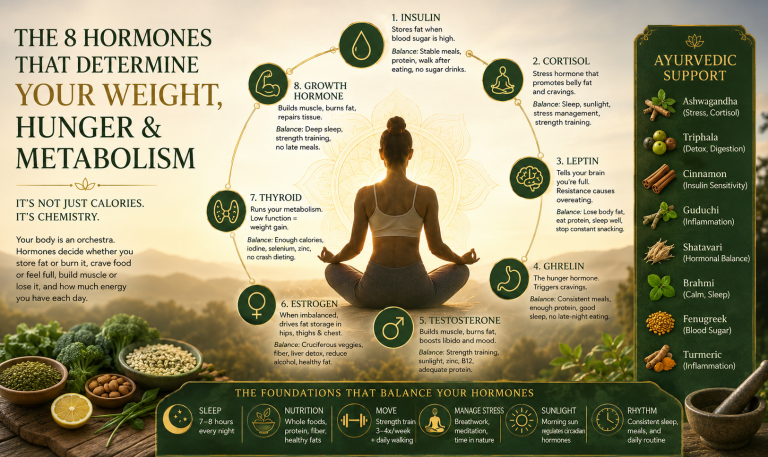
Most people have been taught that weight loss is simply a matter of eating less and moving more.
While calories matter, anyone who has struggled with stubborn belly fat, unexplained weight gain, intense cravings, or a slowing metabolism knows there is something more happening beneath the surface.
Your body is not a calculator.
It is an orchestra.
And the musicians of that orchestra are hormones.
Hormones determine:
- whether you feel hungry or satisfied,
- whether calories are burned or stored,
- whether you build muscle or lose it,
- whether you wake up energized or exhausted,
- and ultimately, whether your body feels safe enough to release excess fat.
The beautiful thing is that many of these hormones can be naturally supported through lifestyle, food, sleep, movement, and Ayurvedic wisdom.
1. Insulin: The Master Energy Storage Hormone
Insulin is one of the most powerful metabolic hormones in the body.
Its job is simple:
When blood sugar rises after eating, insulin moves glucose into the cells.
When insulin remains elevated all day long, the body receives fewer signals to access stored fat.
The problem is rarely insulin itself.
The problem is chronic insulin resistance.
Signs of Poor Insulin Sensitivity
- Belly fat
- Energy crashes
- Sugar cravings
- Brain fog
- Difficulty losing weight
Natural Ways to Support Healthy Insulin
- Eat protein with every meal.
- Avoid sugary drinks.
- Walk 10–20 minutes after meals.
- Reduce ultra-processed carbohydrates.
- Strength train regularly.
Ayurvedic Support
- Cinnamon
- Fenugreek
- Bitter melon
- Amla
- Triphala
2. Cortisol: The Stress Hormone
Cortisol is not the enemy.
Without cortisol, you would not wake up in the morning.
But modern life often traps people in a state of chronic stress.
High cortisol patterns are associated with:
- belly fat,
- sleep disturbances,
- sugar cravings,
- inflammation,
- anxiety,
- and muscle loss.
The body stores energy when it perceives danger.
In other words:
A stressed body often behaves like a starving body.
Natural Ways to Support Healthy Cortisol
- Morning sunlight.
- Walking daily.
- Regular sleep times.
- Meditation.
- Strength training.
- Reducing alcohol.
Ayurvedic Adaptogens
- Ashwagandha
- Tulsi
- Brahmi
- Shankhpushpi
3. Leptin: The Hormone That Says “I’m Full”
Leptin is produced by fat cells.
Its purpose is to tell the brain:
“We have enough energy.”
However, excess body fat can create leptin resistance.
The message becomes distorted.
The body has plenty of stored fuel, yet the brain acts as though famine is approaching.
This creates:
- constant hunger,
- overeating,
- cravings,
- and difficulty losing weight.
Supporting Leptin Sensitivity
- Improve sleep.
- Avoid constant snacking.
- Eat sufficient protein.
- Build muscle.
- Lose body fat gradually.
Ayurvedic Support
- Ginger
- Triphala
- Guduchi
- Trikatu
4. Ghrelin: The Hunger Hormone
Ghrelin rises before meals and stimulates appetite.
Poor sleep dramatically affects ghrelin and can make healthy eating feel almost impossible.
Sleep deprivation literally changes hunger.
This is why exhausted people often crave:
- sugar,
- caffeine,
- and highly processed foods.
Support Healthy Ghrelin Rhythms
- Sleep consistently.
- Eat meals at regular times.
- Avoid late-night eating.
- Prioritize protein.
Ayurvedic Support
- Fennel tea
- Cumin-coriander-fennel tea
- Triphala
- Warm cooked meals
5. Testosterone: Much More Than a Male Hormone
Testosterone affects:
- muscle mass,
- metabolism,
- libido,
- confidence,
- mood,
- and recovery.
Both men and women require healthy testosterone levels.
Contrary to popular belief, meat is not required to support testosterone.
Vegetarian Sources
- Lentils
- Paneer
- Tofu
- Tempeh
- Greek yogurt
- Pumpkin seeds
- Sesame seeds
Lifestyle Support
- Strength training
- Morning sunlight
- Adequate sleep
- Vitamin D
- Zinc
- B12
Ayurvedic Support
- Ashwagandha
- Shilajit
- Kapikacchu
- Safed Musli
6. Estrogen: A Hormone That Requires Balance, Not Fear
Estrogen has unfairly received a bad reputation.
Healthy estrogen is essential for:
- bones,
- cardiovascular health,
- brain function,
- fertility,
- and metabolism.
The issue is not estrogen.
The issue is imbalance.
Excess body fat, alcohol, and poor liver detoxification can create excessive estrogen activity.
Support Healthy Estrogen Balance
- Increase fiber.
- Eat cruciferous vegetables.
- Sweat regularly.
- Support bowel regularity.
- Reduce alcohol.
Ayurvedic Support
- Manjistha
- Turmeric
- Triphala
- Shatavari (especially for women)
7. Thyroid Hormones: The Metabolic Thermostat
The thyroid governs:
- energy production,
- body temperature,
- metabolism,
- mood,
- and vitality.
Crash dieting and chronic stress often suppress thyroid function.
A sluggish thyroid can produce:
- fatigue,
- weight gain,
- constipation,
- hair loss,
- brain fog,
- and cold intolerance.
Support Healthy Thyroid Function
- Eat enough calories.
- Avoid chronic dieting.
- Consume adequate protein.
- Ensure sufficient:
- iodine,
- selenium,
- zinc,
- iron,
- vitamin B12.
Ayurvedic Support
- Kanchanar Guggulu
- Ashwagandha
- Triphala
8. Growth Hormone: The Repair Hormone
Growth hormone is one of the body’s most powerful rejuvenation hormones.
It supports:
- muscle building,
- fat metabolism,
- collagen synthesis,
- tissue repair,
- and healthy aging.
Most growth hormone is released during deep sleep.
Which means:
Youthfulness is built at night.
Support Growth Hormone Naturally
- Strength training.
- Deep sleep.
- Finish eating 2–3 hours before bed.
- Maintain healthy blood sugar.
Ayurvedic Support
- Brahmi
- Jatamansi
- Warm milk with nutmeg
- Abhyanga (oil massage)
- Nasya
The Hormones Everyone Forgot
These hormones deserve equal attention.
Adiponectin
Adiponectin improves insulin sensitivity and encourages fat burning.
It rises with:
- exercise,
- muscle building,
- fiber-rich diets,
- and healthy weight loss.
GLP-1
One of the most fascinating hormones in metabolism.
GLP-1 helps:
- reduce appetite,
- slow stomach emptying,
- stabilize blood sugar,
- improve insulin sensitivity.
You can naturally stimulate GLP-1 by eating:
- protein,
- legumes,
- fermented foods,
- fiber-rich vegetables,
- bitter foods.
Melatonin
Melatonin is much more than a sleep hormone.
It influences:
- insulin sensitivity,
- mitochondrial repair,
- inflammation,
- growth hormone release,
- cellular regeneration.
Modern artificial light may be one of the greatest disruptors of metabolic health.
Progesterone
Particularly important for women.
Healthy progesterone supports:
- sleep,
- mood,
- fertility,
- fluid balance,
- estrogen balance.
Dopamine and Serotonin
These neurotransmitters influence:
- cravings,
- motivation,
- emotional eating,
- reward pathways,
- mood.
Many food addictions are not failures of willpower.
They are attempts by the nervous system to seek regulation.
Ayurveda Saw This Thousands of Years Ago
Ayurveda never separated weight from the whole person.
Excess weight was understood as a disturbance of:
- Agni (digestive fire),
- Kapha imbalance,
- Ama (toxicity),
- stress,
- poor sleep,
- emotional stagnation,
- and loss of natural rhythm.
The solution was never punishment.
The solution was restoring harmony.
Regular meals.
Sunlight.
Movement.
Breathing.
Good sleep.
Seasonal living.
Herbs.
Meditation.
And learning once again to live in rhythm with nature.
The Truth About Weight Loss
Weight loss is not simply a battle of willpower.
It is a conversation between:
- your hormones,
- your nervous system,
- your gut,
- your circadian rhythm,
- your muscles,
- your mitochondria,
- and your mind.
Your body is always listening.
And perhaps the most important question is not:
“How can I force my body to lose weight?”
But rather:
“How can I create the conditions in which my body finally feels safe enough to heal?”
Because health is not punishment.
Health is harmony.
And when harmony returns, the body often begins to release what it no longer needs.