
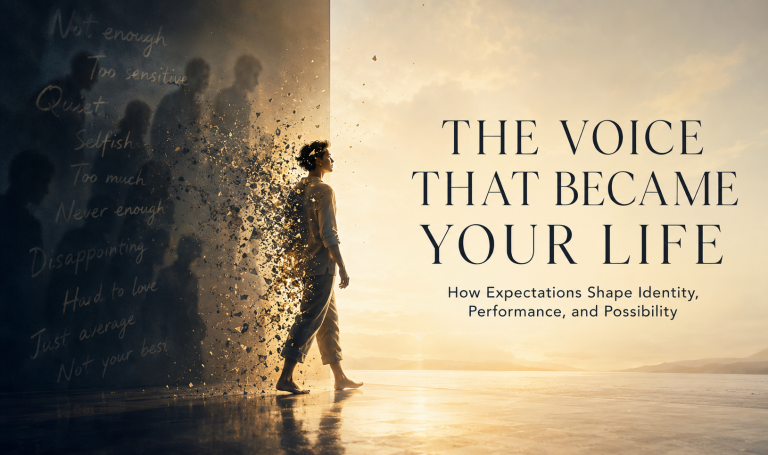
Have you noticed that some of the most transformative moments in your life happened immediately after you stopped believing someone else’s prediction about you?
Perhaps someone once told you that you were too sensitive.
Too difficult.
Not intelligent enough.
Not disciplined enough.
Too old to begin again.
Too wounded to love.
Too ordinary to create anything meaningful.
At first, these may have sounded like passing opinions. But when the same message was repeated by a parent, teacher, partner, authority figure, or culture, it could begin to feel less like an opinion and more like a description of reality.
Eventually, you may have stopped hearing the voice as theirs.
It became yours.
You began to organize your choices around it. You hesitated before opportunities. You interpreted ordinary mistakes as proof of inadequacy. You withdrew before anyone could reject you. You performed beneath your ability—not necessarily because you lacked talent, but because a hidden conclusion had already been reached:
People like me cannot do things like this.
This is where expectation becomes more than a thought.
It becomes a posture, a pattern of attention, a quality of breath, a willingness to try, a threshold for discomfort, and eventually, a life.
The prophecy does not need to be true when it is spoken.
It only needs to be believed long enough to influence behavior.
The Experiment That Changed How We Understand Expectations
In 1965, psychologist Robert Rosenthal and school principal Lenore Jacobson conducted what would become one of the most famous—and controversial—experiments in educational psychology.
At the beginning of the school year, students at a California elementary school were given an intelligence test. Teachers were then told that the test had identified certain children as “intellectual bloomers”—students who appeared ready to make an unusual leap in their cognitive development.
There was only one problem.
The test did not actually predict intellectual blooming.
The children identified as having exceptional potential had been selected randomly.
There was no scientific reason to believe that these students were more intelligent, gifted, or developmentally prepared than their classmates. The only meaningful difference was that their teachers now expected more from them.
When the researchers returned, some of the randomly designated “bloomers”—particularly younger children—showed greater gains on intelligence testing than other students.
The research was published in 1968 as Pygmalion in the Classroom, and the phenomenon became widely known as the Rosenthal effect or Pygmalion effect. Read the original published account.
The experiment did not prove that merely thinking someone is gifted instantly transforms their intelligence. Its methods and conclusions were debated, and later research found that expectancy effects vary considerably across situations.
But it raised an enduring and deeply important question:
What happens when another person’s expectations subtly change the environment in which we are trying to become ourselves?
Expectation Is Rarely Communicated Through Words Alone
The teachers in Rosenthal and Jacobson’s study did not stand in front of the supposedly gifted children every morning and declare:
“You are brilliant.”
The process was subtler.
When we expect someone to succeed, we often treat them differently without realizing it.
We may give them more time to answer.
We may explain something again when they do not immediately understand.
We may offer warmer eye contact.
We may give more detailed feedback.
We may interpret their confusion as temporary rather than permanent.
We may place more challenging opportunities before them.
Most importantly, we continue engaging with them because we believe there is something worth reaching.
When we expect someone to fail, the opposite can happen.
We interrupt sooner. We simplify excessively. We become less patient. We offer fewer meaningful opportunities. We interpret a temporary mistake as evidence of a permanent limitation.
The person on the receiving end notices these signals—even when nothing is spoken directly.
They sense whether the room is waiting for their intelligence or anticipating their failure.
Over time, this changes participation. Participation changes practice. Practice changes competence. Competence then appears to confirm the original expectation.
A belief has become a social environment.
The environment has shaped behavior.
The behavior has produced evidence.
And everyone walks away saying, “See? We were right about them.”
The Pygmalion Effect Is Not Magic
There is a temptation to turn this research into a mystical promise:
Believe you are extraordinary, and extraordinary results will immediately appear.
Reality is more nuanced.
Expectations do not eliminate the need for skill, preparation, opportunity, practice, supportive conditions, or honest feedback. Positive thinking does not make structural barriers disappear. A person cannot simply affirm their way out of every illness, financial hardship, injustice, or traumatic experience.
But expectation can influence how much of our existing capacity becomes available in a given moment.
It affects whether we begin.
It affects whether we persist after the first difficulty.
It affects whether the nervous system interprets a challenge as an invitation or a threat.
It affects whether we search for solutions or scan for proof that there are none.
It affects the meaning we give to discomfort.
Two people may encounter the same obstacle. One interprets it as evidence that they are incapable. The other interprets it as part of learning.
The obstacle is identical.
The future created from it may be completely different.
The Body Listens to Meaning
The influence of expectation is not confined to classrooms.
Research into placebo and nocebo effects has shown that expectations can shape pain, symptoms, perception, attention, emotional experience, and some physiological responses. These effects are not evidence that an illness is imaginary. They demonstrate that the brain and body respond not only to physical events, but also to the meaning assigned to those events.
In a well-known Stanford study, participants drank the same milkshake on two different occasions. Once, the shake was presented as indulgent and high in calories. On another occasion, it was presented as a sensible, low-calorie drink.
Although the nutritional contents were identical, the participants’ ghrelin responses differed depending on what they believed they had consumed. Their bodies did not respond only to the ingredients. They also responded to the story surrounding the ingredients. Stanford’s Mind & Body Lab summarizes the research here.
Similarly, studies of cognitive training indicate that participants’ expectations can contribute to perceived and sometimes measured improvement, although the size and reliability of these effects depend on the task and study design. A 2022 working-memory study discusses these expectancy effects.
Expectation is therefore not an imaginary force floating outside biology.
It can influence biology through attention, emotion, learning, motivation, stress regulation, behavior, and prior conditioning.
The body is always asking:
What does this experience mean?
Am I safe enough to engage?
Is effort likely to be rewarded?
Is this sensation dangerous?
Do I have the capacity to meet this moment?
The answer changes what becomes available.
The Darker Twin: The Nocebo Effect
If hopeful expectations can support performance and healing, negative expectations can work in the opposite direction.
This is often described as the nocebo effect.
When a person expects pain, failure, humiliation, rejection, or incapacity, the nervous system may begin preparing for that outcome before it occurs. Attention narrows. Muscles tighten. Breathing changes. Working memory becomes crowded by self-monitoring.
Instead of being fully engaged in the task, part of the mind is watching for collapse.
Am I failing yet?
Did they notice my mistake?
What if I cannot do this?
This always happens to me.
This does not mean every negative thought becomes reality. Nor does it mean people are responsible for every difficulty they experience. It means that persistent expectations can influence which signals we notice, how we interpret ambiguity, and how freely we use our abilities.
A person who believes, “I always fail under pressure,” may become hyperaware of every sign of nervousness. A slightly elevated heartbeat becomes evidence that failure has begun. Attention moves away from the task and toward the body’s alarm signals. Performance drops, and the result seems to prove the belief.
The belief did not predict the future.
It participated in creating it.
When a Label Becomes an Identity
Children are especially vulnerable to the expectations of adults because they do not yet have a stable inner reference point.
If a child repeatedly hears, “You are lazy,” they may not understand that they are struggling with attention, sleep, fear, an unsuitable learning environment, or a task that feels meaningless.
They simply learn:
I am lazy.
If they are called difficult, dramatic, weak, selfish, unintelligent, careless, or unlovable, they may begin to build an identity around the label.
Once a label becomes identity, the psyche naturally searches for evidence that supports it.
A forgotten appointment proves irresponsibility.
A failed relationship proves unlovability.
A tired afternoon proves laziness.
An anxious moment proves weakness.
Success, meanwhile, is dismissed as luck, timing, or an exception.
The mind has become a lawyer defending an old verdict.
This is one reason childhood messages can remain influential long after the original speaker is gone. The external authority has been internalized. No one needs to repeat the criticism anymore because the person now carries the critic within.
The prison no longer requires a guard.
“This Voice Is Not Mine”
There comes a moment in healing when we begin to ask a revolutionary question:
Whose voice is this?
Who first told me I was difficult?
Who taught me that rest was laziness?
Who decided I was not creative?
Who made me believe love had to be earned through usefulness?
Who taught me that visibility was dangerous?
Who convinced me that one failure revealed my permanent nature?
Not every thought spoken in your own voice belongs to your deepest self.
Some thoughts are inherited.
Some are absorbed from frightened parents.
Some come from teachers who did not know how to reach you.
Some come from partners who needed you to remain small.
Some come from cultures that benefit when certain people doubt their worth.
Some are conclusions formed by a younger version of you who was trying to survive an experience they did not yet understand.
Recognizing this does not require blaming everyone in your past. Most people pass on what they themselves were taught.
But inherited does not mean sacred.
Familiar does not mean true.
Repeated does not mean yours.
Self-Perception Changes the Instructions
Many people try to change their lives through motivation alone.
They make stricter schedules. They set larger goals. They force themselves to work harder. They repeat affirmations they do not believe.
But motivation is often downstream from identity.
If you consciously want success while unconsciously identifying as someone who always ruins opportunities, you will experience constant inner conflict. One part of you moves forward while another quietly searches for the familiar exit.
Lasting change often begins when the question shifts from:
“How do I force myself to do more?”
to:
“Who do I believe I am while I am doing this?”
Consider the difference between these two inner positions:
“I am a failure trying to become disciplined.”
and:
“I am learning how to create consistency.”
The first statement turns every imperfect day into confirmation of a fixed identity.
The second allows imperfection to belong to a process.
Or consider:
“I am terrible at relationships.”
compared with:
“I am learning to recognize and participate in healthier love.”
The first closes the future.
The second creates movement without denying the past.
A liberating self-perception does not need to be grandiose. It only needs to be believable enough that the nervous system does not reject it.
You do not have to tell yourself, “I am the most powerful person in the world.”
Perhaps the truer beginning is:
“I may be more capable than I have been taught to believe.”
That small opening can change everything.
Give the Body a Future It Can Enter
The nervous system responds poorly to fantasies that feel impossibly distant. If your current self-perception is deeply wounded, an extravagant declaration may create more internal resistance.
Instead, offer yourself a version of the future that feels both expansive and reachable.
Not:
“I will never feel fear again.”
But:
“I can feel fear without abandoning myself.”
Not:
“Everyone will recognize my worth.”
But:
“I am learning not to make my worth dependent on their recognition.”
Not:
“I will never fail.”
But:
“Failure no longer has the authority to define me.”
Not:
“My life will transform overnight.”
But:
“My life can change through the choices I repeat.”
The purpose is not to hypnotize yourself with false promises. It is to stop rehearsing a future built entirely from old wounds.
A Practice for Reclaiming Your Inner Voice
Take a blank page and divide it into three sections.
In the first section, write:
What I was taught to believe about myself
Write down the labels and predictions you have carried:
“I am too much.”
“I never finish anything.”
“I cannot be trusted.”
“I am not attractive.”
“I am bad with money.”
“I always choose the wrong people.”
In the second section, write:
How I have been confirming this belief
Look gently but honestly at the behaviors that keep the identity alive. Do you avoid opportunities, dismiss compliments, tolerate disrespect, procrastinate, overexplain, or leave before you can be seen?
This is not an exercise in self-blame. It is an exercise in recovering choice.
In the third section, write:
What may also be true
Allow a more complete identity to emerge:
“My sensitivity is also perception.”
“I have completed many things when I felt connected to their purpose.”
“I can learn financial steadiness.”
“I have chosen from wounds before, and I can now choose from clarity.”
“I do not need to shrink to make others comfortable.”
Read the final section slowly.
Do not perform it.
Let the body hear it.
Be Careful Whose Eyes You Live Beneath
We do not develop in isolation.
The people around us become mirrors. Some mirrors reveal possibility. Others repeatedly show us a distorted image until we forget that distortion is occurring.
This does not mean surrounding yourself only with people who praise everything you do. Empty flattery is not belief. Real belief can include correction, accountability, and truth.
The difference is in the underlying gaze.
A loving mentor can challenge your behavior without reducing your identity to the behavior.
A healthy partner can name a wound without weaponizing it.
A wise teacher can see your unfinished places while continuing to address the wholeness beneath them.
We all need people who can hold a vision of us that is slightly larger than our current self-concept—not because they are denying our limitations, but because they are not mistaking our present condition for our final form.
And we must learn to offer the same quality of vision to others.
Our expectations are never completely private. They enter our tone, patience, invitations, silences, and willingness to remain present.
Every relationship carries an unspoken question:
Who are you inviting this person to become in your presence?
You Are Not Obligated to Fulfill an Old Prediction
Perhaps someone misunderstood you at the very moment you were learning how to understand yourself.
Perhaps your survival strategy was mistaken for your personality.
Perhaps your silence was called weakness.
Perhaps your boundaries were called selfishness.
Perhaps your intensity was called instability.
Perhaps your difference was treated as deficiency.
Their interpretation may have shaped you.
It does not have to finish you.
The real invitation of the Rosenthal effect is not to pretend that thoughts possess unlimited magical power. It is to recognize that expectations create climates—and human beings grow differently in different climates.
You may not be able to rewrite every event that formed you.
But you can begin changing the climate within you.
You can question the voices that predict failure before you begin.
You can notice where you have confused conditioning with identity.
You can choose relationships that speak to your capacity without denying your humanity.
You can offer yourself a future that does not merely repeat your past.
And perhaps the most powerful sentence is not:
“I know I can do it.”
Perhaps it is simply:
“I no longer know that I cannot.”
That is how the old prophecy begins to break.
Not always through certainty.
Sometimes through one sacred moment of doubt—doubt directed not toward your potential, but toward every limiting story you once mistook for the truth.