A Sacred Day of Remembrance, Release and Ancestral Healing
There are certain days in the Vedic calendar when the veil between the visible and invisible worlds is believed to become especially thin.
Aadi Amavasya is one such day.
Observed on the New Moon during the Tamil month of Aadi, this sacred occasion invites us to turn toward our ancestors—not merely as names from the past, but as living currents within our bodies, minds, relationships and destinies.
In 2026, Aadi Amavasya falls on Wednesday, August 12. The Amavasya tithi begins at approximately 1:52 AM and ends at 11:06 PM IST, allowing the entire day to be observed for prayer, meditation, charity and ancestral offerings.
This year, Aadi Amavasya carries an additional intensity because it coincides with a solar eclipse. While the eclipse will not be visible everywhere, the symbolic convergence is still profound: the light of the Sun is temporarily obscured, the Moon becomes invisible, and we are invited to enter the unseen chambers of memory, lineage and consciousness.
Aadi Amavasya is not a day to fear the past.
It is a day to acknowledge the lives that made our life possible.
It is a sacred pause in which the living turn toward the dead—not to remain bound to them, but to offer gratitude, nourishment, forgiveness and release.
What Is Aadi Amavasya?
Amavasya is the lunar phase of complete darkness—the New Moon—when the Sun and Moon come together in the same region of the zodiac.
In the external sky, the Moon disappears from view. In the inner world, however, what has been hidden may become more perceptible.
The word Aadi refers to the fourth month of the Tamil solar calendar, usually falling between mid-July and mid-August. It is a spiritually charged month associated with the Divine Mother, the forces of nature, fertility, water, protection and the unseen movements of Shakti.
Aadi Amavasya is therefore not simply another monthly New Moon. It is considered one of the most significant days of the year for remembering one’s Pitrs—the ancestral beings and departed members of the family lineage.
Across Tamil Nadu and other parts of South India, people visit rivers, seashores, sacred water bodies and temples to perform Tarpanam, offer food, feed animals and the poor, and pray for the peace and onward journey of departed souls.
The day rests upon a simple but powerful recognition:
We did not begin with ourselves.
Our bodies were given to us through an unbroken chain of lives. Our blood, facial features, instincts, vulnerabilities, talents and emotional tendencies have all travelled through generations before reaching us.
We are individual souls, but we are also expressions of a lineage.
For another exploration of this sacred observance—its ancestral significance, karmic dimensions and invitation to inner renewal—you may also read:
Aadi Amavasya: A Day of Ancestral Reverence, Karmic Release & Inner Renewal
The Ancestors Are Not Only Behind Us
We often imagine ancestors as people who existed long ago and are now gone.
But ancestry is not only historical. It is biological, psychological, emotional and energetic.
The rhythm of your nervous system may carry adaptations that helped your grandparents survive. Your relationship with money may contain memories of famine, displacement, poverty or sudden loss. Your difficulty receiving love may echo emotional patterns that began long before you were born.
Even your gifts may be ancestral.
Your instinct for healing, your love of music, your spiritual hunger, your capacity to teach, your endurance, your intelligence, your devotion and your ability to rebuild after hardship may all have been cultivated through generations of lived experience.
The ancestors continue through us—not necessarily as ghosts or personalities hovering around our lives, but as inherited patterns seeking expression, completion or transformation.
Modern science speaks of genetics, intergenerational trauma, family conditioning and epigenetic influence. Vedic traditions speak of Pitru Rina, the ancestral debt, and Pitru Samskaras, the impressions carried through the lineage.
These languages are not identical, but they point toward a shared truth:
The past does not disappear merely because it is no longer visible.
Aadi Amavasya gives us a conscious way to meet that past.
Understanding Pitru Rina: The Debt to the Ancestors
The Sanskrit word rina means debt or obligation.
Pitru Rina is sometimes interpreted negatively, as though we are being punished for something our ancestors did. But ancestral debt can be understood more compassionately.
It is the recognition that our life was made possible through countless sacrifices.
Someone survived so that you could be born.
Someone endured hunger, travelled across lands, protected a child, preserved a tradition, carried a family through illness or continued living after devastating loss.
Not every ancestor was conscious. Not every action was wise. Families also transmit wounds, addictions, prejudices, silences and unresolved grief. Yet even an imperfect lineage carried life forward until it reached us.
Pitru Rina is therefore not blind obedience to the past. It is the responsibility to receive what was given, purify what was distorted and pass something more conscious to those who come after us.
We honour our ancestors not by repeating everything they did.
We honour them by allowing their journey to evolve through us.
Why Amavasya Is Connected With the Ancestors
In Jyotish, the Sun represents the essential Self, vitality, authority and the illuminating principle of consciousness. It is also associated with the father and the ancestral line.
The Moon represents the mind, memory, emotional nourishment, maternal inheritance and the inner world.
During Amavasya, the Sun and Moon come together. The reflected light of the Moon disappears, and the night becomes profoundly dark.
This darkness is not inherently negative.
It is gestational.
It is the darkness of the womb, the seed beneath the soil and the silent space before a new cycle begins. It is a time when outward activity naturally gives way to inward perception.
The New Moon asks us to listen without demanding immediate clarity.
Aadi Amavasya directs this listening toward the ancestral field.
What has our family been carrying?
What was never spoken?
What grief was never given permission to move?
What strength has been forgotten?
What pattern must stop with us?
And what blessing is ready to continue through us?
Aadi: The Month of Shakti
The Tamil month of Aadi marks a turning point in the seasonal cycle. Traditionally, the changing winds and monsoon movements were understood as signs of powerful transitions in nature.
Aadi is deeply associated with Amman, the Divine Mother in her many local and cosmic forms.
During this month, temples dedicated to Mariamman, Kali, Durga and other manifestations of Shakti become centres of intense devotion. The Mother is invoked for protection, rain, health, fertility and the purification of forces that disturb individual and collective harmony.
This connection with the Divine Mother gives Aadi Amavasya another layer of meaning.
The ancestors belong to the womb of time.
Just as our physical body was formed within the maternal womb, our individual life emerged from the greater womb of the lineage. Aadi Amavasya asks us to acknowledge that womb while also releasing ourselves from unconscious entanglement with it.
The Mother does not only give birth.
She also digests, transforms and renews.
The Special Significance of Aadi Amavasya in 2026
In 2026, Aadi Amavasya coincides with the total solar eclipse of August 12.
Astronomically, an eclipse occurs when the Moon passes between Earth and the Sun, obscuring the Sun’s light for those within the eclipse path.
Spiritually, eclipses have long been treated as periods of intensified inwardness. Normal patterns are interrupted. External certainty is temporarily withdrawn, and attention is redirected toward what usually remains hidden beneath the surface.
The convergence of Amavasya, ancestral remembrance and a solar eclipse makes this day particularly suitable for meditation, mantra, silence and sincere inner examination.
However, spiritual intensity does not mean we must become afraid or superstitious.
The purpose of such a day is not anxiety.
It is awareness.
The eclipse may amplify the symbolic themes already present within Aadi Amavasya: the obscuring of inherited authority, the revelation of unconscious family patterns, the healing of ancestral identity and the possibility of releasing something that has quietly controlled us.
You can read more about the eclipse and how to approach it consciously in my earlier guide:
Prepare for the August 12 Solar Eclipse: A Vedic Guide to Inner Transformation
What Is Tarpanam?
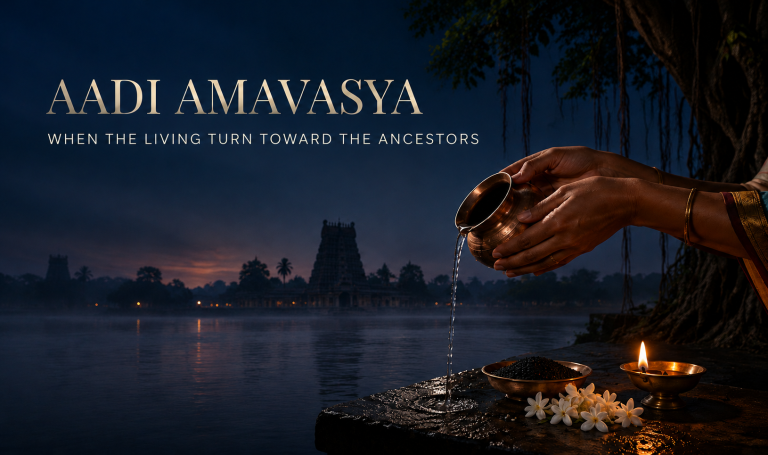
One of the central practices associated with Aadi Amavasya is Tarpanam, the offering of water to the ancestors.
The word is connected with the idea of satisfying, refreshing or bringing contentment. Water is offered with prayer, remembrance and gratitude, traditionally accompanied by specific mantras and ritual procedures.
Water is an especially meaningful offering because it carries memory, nourishes life and moves between worlds without resistance.
The ritual communicates:
I remember you.
I acknowledge what came through you.
May you be nourished.
May you be at peace.
May what remains unresolved find completion.
Formal Tarpanam is traditionally learned from a qualified priest or lineage holder, particularly when Vedic mantras and detailed ritual rules are involved. But those who do not know the formal procedure can still honour the day sincerely.
The essence of the practice is remembrance joined with offering.
A Simple Ancestral Practice at Home
If you are unable to visit a temple, river or sacred place, you can create a simple and respectful practice at home.
Begin by bathing and wearing clean clothing. Clean the area in which you will sit. If possible, keep the morning quiet and avoid unnecessary distraction.
You may place:
- A small lamp or candle
- A bowl or vessel of clean water
- Flowers
- Black sesame seeds
- A simple vegetarian food offering
- Photographs of departed family members, if this feels appropriate
Sit quietly and bring your ancestors to mind.
You do not need to remember every name. You may address the known and unknown members of both your maternal and paternal lineages.
You might say:
To all those whose lives made my life possible,
to those whose names I know and those whose names have been forgotten,
I offer my gratitude.
May you be at peace.
May you be free from hunger, grief, attachment and unrest.
May the wisdom of our lineage continue.
May its suffering find completion through consciousness.
May I carry forward what is true and release what no longer serves life.
Offer the water slowly, preferably to the earth or into a plant, with reverence. If you use sesame seeds, they may be added to the water before the offering.
The power is not in performing something elaborate.
The power is in becoming present.
Meaningful Ways to Observe the Day
1. Remember Your Ancestors by Name
Speak the names of departed parents, grandparents, teachers and family members. Tell younger members of the family something beautiful and truthful about those who came before them.
A person experiences a kind of second death when no one remembers their name.
Remembrance restores dignity to the lineage.
2. Offer Food
Prepare a simple sattvic vegetarian meal with care. Traditionally, food may be offered before being eaten or given to priests, the poor, cows, birds, animals or anyone genuinely in need.
Feeding another being in the name of an ancestor transforms memory into nourishment.
3. Give in Charity
Donate food, clothing, medicine or financial support without seeking recognition.
If an ancestor suffered from hunger, poverty, illness or lack of opportunity, an act of generosity can become a conscious way of transforming that inherited story.
4. Enter Silence
Reduce entertainment, arguments, excessive speech and social media.
Aadi Amavasya is not a day for constantly filling the mind. Its medicine is found in listening.
5. Meditate and Chant
You may chant a mantra connected with your Ishta Devata, Guru, Shiva, the Divine Mother or the ancestors.
Even the simple repetition of Om Namah Shivaya can support inner purification and surrender.
The Mahamrityunjaya Mantra may also be recited with the intention of peace, healing and liberation.
6. Ask for Forgiveness
Not every relationship with the departed was peaceful.
Some ancestors may have caused pain. Others may have died before reconciliation was possible. You may carry anger, confusion, abandonment or grief.
Honouring the ancestors does not require denying what happened.
You can acknowledge the truth while refusing to remain imprisoned by it.
Forgiveness is not the declaration that harm was acceptable. It is the decision that the harm will no longer govern your inner life.
7. Resolve Not to Continue a Harmful Pattern
Perhaps the greatest ancestral offering is transformation.
If addiction ran through the family, become the one who chooses clarity.
If silence protected abuse, become the one who speaks truth.
If affection was withheld, become the one who learns to express love.
If money was governed by fear, become the one who brings responsibility and generosity.
If spirituality was abandoned, become the one who lights the lamp again.
A ritual becomes truly powerful when it changes how we live.
What Should Be Avoided?
Traditionally, Amavasya is not considered ideal for beginning major worldly ventures, making impulsive commitments or creating unnecessary agitation.
Because the day is already inward and spiritually intense, it is helpful to avoid:
- Intoxication
- Non-vegetarian food
- Unnecessary conflict
- Harsh or disrespectful speech
- Excessive stimulation
- Major impulsive decisions
- Activities that disturb mental clarity
- Treating the observance as a transaction for obtaining material rewards
If you are observing the eclipse disciplines as well, you may choose to keep food light, spend more time in mantra and meditation, and avoid eating during the locally relevant eclipse period. These customs vary by tradition and location, particularly because the eclipse is not visible everywhere.
The most important discipline is inner cleanliness.
Ancestral Healing Is Not Ancestral Blame
The growing interest in ancestral healing has created a subtle danger: the temptation to blame everything on the family line.
“My relationships fail because of my ancestors.”
“My finances are blocked because of ancestral karma.”
“My illness belongs to my lineage.”
Inherited influences are real, but they do not remove personal responsibility.
The purpose of understanding the lineage is not to create a new explanation for helplessness. It is to bring awareness to patterns so that we can meet them differently.
Your ancestors may have handed you a certain set of conditions.
But consciousness gives you the capacity to respond.
You are not betraying your family when you become healthier than they were.
You are not dishonouring them when you question a harmful tradition.
You are not abandoning them when you choose a life they could not imagine.
Sometimes your freedom is the fulfilment of a prayer they never had the language to speak.
When the Relationship With the Ancestors Is Complicated
Not everyone feels warmth when thinking about family.
For some, ancestry evokes love and belonging. For others, it evokes violence, rejection, discrimination, secrecy, addiction or abandonment.
If your relationship with your family history is painful, you do not need to manufacture gratitude for what harmed you.
Begin with the simplest truth:
Life reached me through this lineage.
You may honour the transmission of life without approving every person or action within the family system.
You can pray for distance as well as peace.
You can ask that unhealthy bonds be released.
You can return burdens that were never yours to carry.
A simple prayer may be:
I honour the life that came through you.
I return with compassion what does not belong to me.
I release the need to repeat your suffering.
May you follow your path, and may I be free to follow mine.
This, too, is an ancestral offering.
You Are Someone’s Ancestor
Aadi Amavasya does not only ask us to look backward.
It asks us to look forward.
Whether or not you have biological children, your choices enter the collective field. You influence students, friends, communities, younger relatives and people whose lives may be changed by something you teach, create or embody.
One day, you too will become part of the invisible past.
What will continue through you?
Will those who come after you inherit your unexamined fear—or your courage to meet it?
Will they inherit your silence—or your truth?
Will they inherit your resentment—or the wisdom you distilled from pain?
Will they inherit a depleted Earth—or one you helped protect?
Will they inherit spiritual language without embodiment—or the memory of someone who lived what they taught?
Ancestral work is not complete when we make offerings to the dead.
It becomes complete when we live in a way that blesses the unborn.
The Deepest Offering
Flowers fade.
Lamps eventually go out.
Water returns to the earth.
Food is eaten.
But the consciousness awakened through a sincere offering can remain.
The deepest gift we can offer our ancestors is not ritual alone. It is a life lived with awareness.
Every time you interrupt a destructive pattern, you perform Tarpanam.
Every time you choose love where the lineage chose fear, you perform Tarpanam.
Every time you nourish the body, speak truth, protect a child, respect the feminine, honour the Earth or use your gifts in service, you perform Tarpanam.
The water offered from the hand is sacred.
But so is the awareness carried into daily life.
A Prayer for Aadi Amavasya
To the mothers and fathers of my lineage,
to the healers, protectors, seekers and survivors,
to those who were remembered
and those whose names disappeared into time:I acknowledge you.
For the life that reached me through you,
I offer gratitude.For the pain that was never healed,
I offer compassion.For the burdens that do not belong to me,
I ask for release.For the wisdom you preserved,
I offer my willingness to receive.May those who have departed find peace.
May those who are living find reconciliation.
May those yet to be born receive a clearer inheritance.May the patterns of suffering end where consciousness begins.
May the blessings continue.
May all beings be free.
When the Moon Disappears
Aadi Amavasya reminds us that disappearance is not the same as nonexistence.
The Moon remains even when we cannot see it.
The ancestors remain through the life they transmitted.
Love remains after the body is gone.
Memory remains within the cells, the family stories, the rituals, the gestures and the choices we make without always knowing why.
On this sacred New Moon, we do not need to solve the entire mystery of the past.
We only need to become still enough to acknowledge it.
Light a lamp.
Offer water.
Feed someone.
Speak a name.
Release a burden.
Continue a blessing.
And remember that you stand at a sacred meeting point: behind you are countless lives, and before you are generations waiting to receive what you choose to become.
May this Aadi Amavasya bring peace to the ancestors, clarity to the living and blessings to those yet to come.