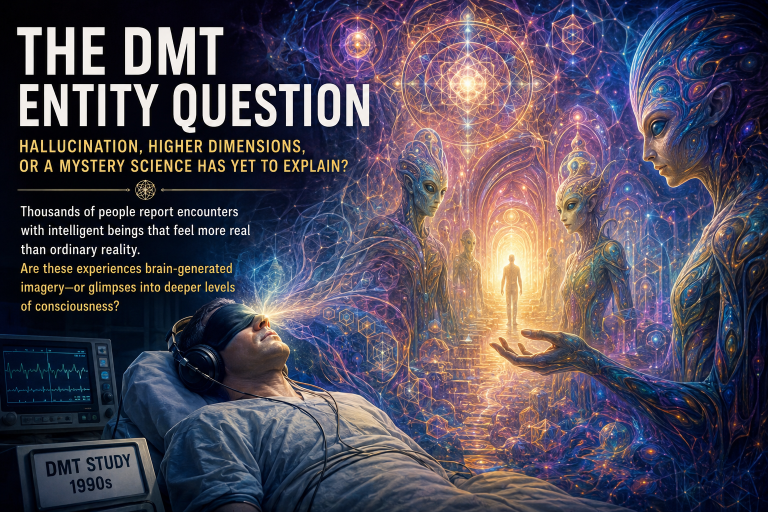
In the 1990s, psychiatrist and researcher Rick Strassman conducted one of the most remarkable studies in modern consciousness research.
With government approval, he administered DMT (dimethyltryptamine) to dozens of volunteers under carefully controlled clinical conditions. His intention was relatively straightforward: to understand the effects of one of the most powerful psychedelic compounds known to science.
What he encountered instead forced him to ask questions that challenged the very foundations of modern materialism.
Because again and again, participants reported something deeply strange.
Not merely visions.
Not dreams.
Not random hallucinations.
But encounters.
The Unexpected Pattern
Participants described meeting beings.
Some spoke of luminous guides.
Others encountered what they called elves, angels, aliens, teachers, ancestors, or spirits.
Many insisted these intelligences felt autonomous — possessing intentions, personalities, and awareness separate from their own minds.
Perhaps most astonishing was how frequently people described these encounters as:
“More real than ordinary reality.”
The experiences often carried an overwhelming sense of certainty.
People would return from only a few minutes under the influence of DMT convinced they had visited another realm entirely.
Not everyone saw the same things.
Yet remarkable similarities kept appearing.
Despite differences in culture, religion, age, and background, many subjects independently described:
- Hyperdimensional landscapes.
- Geometric architecture.
- Intelligent presences.
- Communication without language.
- A profound feeling of familiarity.
- Encounters with beings seemingly aware of their arrival.
These recurring themes captured Strassman’s attention.
Because if hallucinations are merely chaotic products of the brain, why would so many unrelated individuals report such strikingly similar experiences?
Beyond the Hallucination Model
Initially, conventional neuroscience offered an obvious explanation.
DMT floods serotonin receptors.
Neural networks become disorganized.
The brain generates fantastical imagery.
Case closed.
Yet this explanation leaves many questions unanswered.
Why do thousands of people across cultures report encounters with entities possessing apparent autonomy?
Why do descriptions often converge?
Why do subjects frequently insist they are not imagining these beings but interacting with something independent of themselves?
Over the years, Strassman’s own views became more nuanced.
He never abandoned scientific rigor.
Nor did he claim that these entities are objectively real.
But he increasingly questioned whether purely materialist explanations adequately account for what people experience.
He began considering the possibility that consciousness itself may be more mysterious than our current models suggest.
The Receiver Hypothesis
Modern neuroscience generally assumes that the brain produces consciousness.
Thoughts, emotions, memory, and identity are believed to arise from neural activity.
But another possibility has existed for centuries.
Instead of producing consciousness, perhaps the brain filters it.
This idea has been proposed by thinkers ranging from William James and Henri Bergson to modern neuroscientists and consciousness researchers.
Under this “receiver” or “filter” hypothesis, consciousness resembles a vast field.
The brain functions more like a radio.
It tunes and restricts awareness into the narrow band required for survival.
Ordinary waking consciousness would represent only a tiny fraction of a much larger reality.
In this framework, DMT does not create experiences.
It changes the tuning.
What appears may not be fantasy.
It may simply be aspects of consciousness normally hidden from view.
Whether those realms exist independently remains unknown.
But the possibility itself radically alters the question.
Perhaps psychedelics do not generate realities.
Perhaps they reveal them.
Ancient Traditions Have Suggested This for Millennia
Long before MRI scanners and neurotransmitters were discovered, spiritual traditions around the world proposed that human beings normally perceive only a limited slice of existence.
Yogic traditions speak of:
- Lokas (planes of reality).
- Devas and subtle intelligences.
- The causal and astral bodies.
- Expanded states reached through meditation.
Shamanic traditions describe spirit worlds populated by teachers and guides.
Mystics from Christianity, Islam, Judaism, and Buddhism have all reported encounters with seemingly autonomous intelligences.
Remarkably, many descriptions bear similarities to modern psychedelic experiences.
This does not prove their objective existence.
But it raises an intriguing possibility.
Perhaps humanity has been describing the same territory for thousands of years using different languages.
The neuroscientist sees neurotransmitters.
The yogi sees subtle realms.
The shaman sees spirits.
Perhaps each is describing one facet of a mystery larger than any single framework.
Are Similar Experiences Evidence?
Skeptics argue that recurring imagery proves nothing.
Human brains share common architecture.
Similar neural structures could naturally generate similar experiences.
This explanation is reasonable.
But another perspective asks:
If thousands of people independently report encounters with intelligent presences exhibiting autonomy and coherence, should these experiences simply be dismissed?
Science often begins not with explanations but with observations.
The falling apple came first.
Gravity came later.
Electricity was observed long before its mechanisms were understood.
Perhaps consciousness itself stands where electricity once stood — a phenomenon far more mysterious than we currently appreciate.
The Hard Problem of Consciousness
One of the greatest unsolved questions in science is not psychedelics.
It is consciousness itself.
How do electrochemical processes inside the brain give rise to subjective experience?
How does matter become awareness?
Despite enormous advances in neuroscience, no one truly knows.
This puzzle is known as the “hard problem of consciousness,” a term popularized by philosopher David Chalmers.
Some researchers now explore ideas once considered fringe:
- Panpsychism.
- Integrated information theory.
- Quantum approaches to consciousness.
- Field theories of mind.
- Non-local models of awareness.
None have solved the mystery.
But they suggest that materialism may not be the final word.
The Yogic Perspective
From a yogic viewpoint, consciousness is primary.
Matter emerges from consciousness, not the other way around.
The human mind acts as both a vehicle and a veil.
Ordinary awareness is conditioned by the senses, the nervous system, and the limitations necessary for functioning in the physical world.
Practices such as:
- Meditation.
- Pranayama.
- Kundalini Yoga.
- Samadhi.
- Deep states of absorption.
are said to temporarily dissolve these filters.
Ancient yogis described experiences of:
- Light beings.
- Teachers.
- Deities.
- Subtle realms.
- Timeless awareness.
Interestingly, they achieved these states without external substances.
The aim was never entertainment.
It was realization.
And most traditions warned that extraordinary visions, however fascinating, are not the destination.
They are scenery along the path.
Humility Before Mystery
Perhaps the most honest position is the one Strassman himself seems to embody today.
Neither blind belief.
Nor automatic dismissal.
He does not claim that DMT entities are extraterrestrials or objective beings.
But neither does he believe we have enough evidence to reduce these experiences to meaningless hallucinations.
The truth is that we do not know.
And that may be one of the most exciting possibilities.
For centuries humanity assumed Earth was the center of the universe.
Later we discovered otherwise.
Perhaps consciousness itself will undergo a similar revolution.
Until then, the question remains open.
If thousands of people consistently encounter seemingly intelligent presences that feel more real than ordinary life, are these experiences merely elaborate constructions of the brain?
Or are they glimpses into dimensions of consciousness that science has not yet learned how to measure?
No one knows.
But perhaps the mystery itself is inviting us toward greater humility.
For consciousness may ultimately prove to be stranger, deeper, and far more beautiful than our current models can explain.
And sometimes, the greatest act of science is not declaring certainty.
It is remaining curious.