When the Light Disappears, What Has Been Hidden Becomes Visible
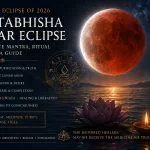
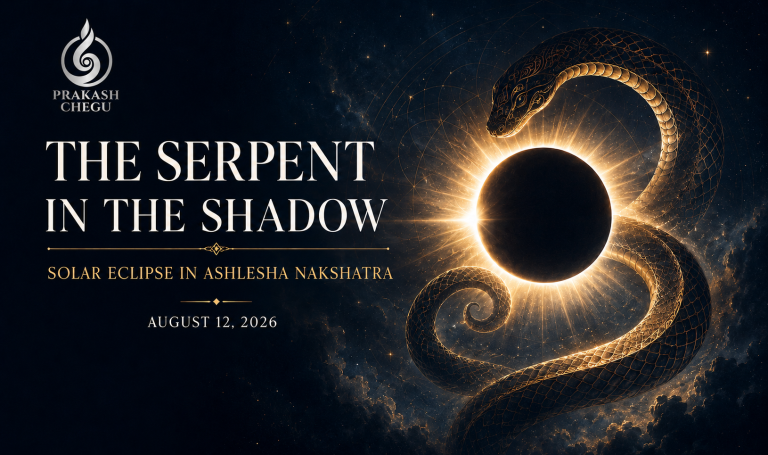
On August 12, 2026, a total solar eclipse will cross the skies of the Northern Hemisphere. Astronomically, the Moon will pass between Earth and the Sun, completely obscuring the solar disk along a narrow path through parts of Greenland, Iceland, Spain and Portugal. A partial eclipse will be visible across much of Europe, northeastern North America and portions of North Africa.
In Vedic Jyotish, however, this is more than a magnificent astronomical event.
Both the Sun and Moon come together in Ashlesha Nakshatra, at the end of sidereal Cancer. Ashlesha is the realm of the Nagas—the mysterious serpents associated with instinct, intuition, psychological penetration, hidden knowledge, hypnotic power and Kundalini Shakti.
Ashlesha does not merely show us what is happening on the surface. It coils around what has been concealed. It enters the places where memory, fear, desire, loyalty, shame and attachment have become entangled.
This eclipse may therefore feel less like an external event and more like an inner revelation.
It asks:
What has been holding you because some part of you is still holding it?
The eclipse is not necessarily creating the fear, mistrust, emotional pressure or attachment that arises. It may simply be removing enough ordinary light for us to recognize what has already been living in the shadows.
Eclipse Timings and Visibility
The global eclipse begins at approximately 3:35 p.m. UTC on August 12 and ends at approximately 7:59 p.m. UTC. The period of totality exists only along a narrow geographical path. Elsewhere, observers may see a partial eclipse—or no visible eclipse at all. NASA’s eclipse guide provides location-specific details.
New Delhi, India
The astronomical event occurs globally from approximately:
August 12, 9:05 p.m. to August 13, 1:29 a.m. IST
The eclipse is not visible from New Delhi or India because it occurs after sunset.
New York City, USA
The partial eclipse is visible locally:
August 12, 1:07 p.m. to 2:38 p.m. EDT
Maximum eclipse: approximately 1:54 p.m.
Only a small portion of the Sun—about nine percent of its disk—will be obscured from New York City.
London, United Kingdom
The partial eclipse begins at approximately:
August 12, 6:17 p.m. BST
Maximum eclipse: approximately 7:12 p.m.
Ending shortly after 8:00 p.m., close to sunset
London will experience a deep partial eclipse, with roughly 90 percent of the Sun covered near maximum. The Royal Observatory Greenwich provides guidance for observing it safely.
Local visibility matters astronomically and in the traditional observance of sutak, fasting and eclipse-related rituals. Yet the symbolic meaning of the eclipse may still be contemplated wherever you live.
Anyone observing the Sun must use authentic eclipse glasses compliant with the ISO 12312-2 safety standard or a safe indirect projection method. Ordinary sunglasses do not offer adequate protection. Never look directly at the partially eclipsed Sun through a camera, telescope or binoculars without a properly fitted solar filter.
For a complete guide to preparing consciously—including mantra, meditation and spiritual practices leading up to the eclipse—read Prepare for the August 12 Solar Eclipse: A Vedic Guide to Inner Transformation.
Ashlesha: The Power That Coils
The Sanskrit word Ashlesha carries the meaning of embracing, entwining, clinging or encircling. Its symbol is the coiled serpent, and its presiding forces are the Nagas.
This gives Ashlesha a complicated spiritual character.
The serpent can represent poison, concealment, seduction and danger. But it also represents regeneration, awakened perception, ancient wisdom and the life force coiled at the base of the spine.
A serpent does not announce itself loudly. It senses through vibration. It remains still until the precise moment for movement arrives. It can enter narrow and hidden spaces inaccessible to other creatures. It periodically sheds its skin, leaving behind an outer form it has outgrown.
Ashlesha grants a similar capacity to the human mind: the ability to perceive what has not been spoken, recognize subtle motivations and penetrate beneath appearances.
When this capacity is purified, it becomes intuition.
When distorted by fear, it becomes suspicion.
When purified, it becomes discernment.
When distorted, it becomes manipulation.
When purified, it becomes deep emotional intelligence.
When distorted, it becomes the ability to locate another person’s vulnerability and use it to maintain control.
The power itself is not inherently benevolent or destructive. Its expression depends upon the consciousness directing it.
That is why awareness is the central spiritual instruction of this eclipse.
When the Sun and Moon Disappear Into the Serpent
In Jyotish, the Sun represents identity, vitality, authority, clarity, purpose and the organizing light of consciousness. It is the principle within us that says, “This is who I am.”
The Moon represents the mind, emotional memory, instinct, receptivity, security and our subjective experience of life. It is the part of us that says, “This is how life feels to me.”
During a solar eclipse, the Moon temporarily obscures the Sun. Symbolically, emotional memory passes in front of conscious identity. Our ordinary sense of certainty may become clouded by something more instinctive, ancient or unresolved.
Because this meeting takes place in Cancer, themes involving home, belonging, family, nourishment, protection, motherhood and emotional security become especially important.
Because it takes place in Ashlesha, the questions become sharper:
- Where has protection become control?
- Where has loyalty become bondage?
- Where has sensitivity become hypervigilance?
- Where has intuition become suspicion?
- Where has care become emotional possession?
- Where have family expectations replaced your authentic direction?
- Where are you still trying to secure love by gripping it more tightly?
Ashlesha understands attachment intimately. It knows how human beings coil around people, beliefs and identities because letting go feels more dangerous than continuing to suffer.
Yet a fist cannot receive while it remains closed.
The eclipse may show us that what we call devotion is sometimes fear of abandonment. What we call responsibility may sometimes be guilt. What we call discernment may sometimes be mistrust. What we call patience may occasionally be our refusal to acknowledge that something has already ended.
This is not an invitation to condemn ourselves. It is an invitation to become honest about the hidden agreements shaping our lives.
The Emotional Poison We Learn to Carry
Ashlesha is often associated with poison, but poison is not always an obvious substance. Psychological poison can be an idea absorbed so early that we no longer recognize it as an idea.
Perhaps you learned that love must be earned through usefulness.
Perhaps belonging required silence.
Perhaps disagreeing with the family meant betraying the family.
Perhaps you learned to scan every room for danger before allowing yourself to relax.
Perhaps affection was mixed with control, praise with obligation or generosity with an invisible debt.
These patterns can pass through generations without anyone consciously choosing them. A parent transmits what they inherited. A child adapts in order to remain connected. The adaptation becomes a personality, and the personality eventually becomes a destiny—unless awareness interrupts the cycle.
The eclipse can illuminate the difference between what is genuinely yours and what you have been carrying on behalf of the family system.
Ancestral healing is not accomplished by blaming our ancestors. It happens when we stop unconsciously repeating what they were unable to resolve.
You can honor where you came from without remaining imprisoned by it.
You can love your family without reenacting every inherited fear.
You can respect tradition without allowing tradition to replace truth.
Ketu in Magha: Releasing the Inherited Throne
In the Jyotish framework being used for this eclipse, Ketu occupies Magha Nakshatra while the Sun and Moon meet nearby in Ashlesha. Although the luminaries are in Ashlesha, Ketu is the shadow force associated with this solar eclipse.
Magha is connected with the Pitris—the ancestors—as well as lineage, authority, status, inheritance, dignity and the throne.
Ketu does not usually strengthen our attachment to worldly identity. It separates, empties and spiritualizes. Its presence in Magha can expose our unconscious relationship with inherited power:
- The family name we feel compelled to protect
- The role we were assigned as a child
- The authority we are afraid to question
- The status we pursue to prove our worth
- The pride that prevents us from admitting vulnerability
- The ancestral expectation that quietly governs our choices
The movement from Ashlesha toward Magha is profoundly symbolic.
Before we can occupy the throne of authentic authority, we must understand the serpent beneath it.
Before claiming self-mastery, we must see what secretly controls us.
Before leading others, we must recognize where fear, pride or emotional hunger is directing our own decisions.
True authority does not come from domination. It arises when we are no longer governed by the hidden forces within ourselves.
Rahu in Dhanishta: What Are We Chasing?
Across the nodal axis, Rahu in Dhanishta can magnify ambition, visibility, influence, achievement, wealth and the desire to be recognized.
Dhanishta is connected with rhythm, prosperity, social participation and the ability to move within powerful collective currents. Rahu intensifies whatever it touches. It creates hunger—and hunger is rarely satisfied simply because it has been fed.
This does not mean ambition is wrong. Wealth, recognition and accomplishment can be expressions of dharma. But Rahu asks us to examine the quality of our desire.
Are you pursuing success because your soul is called to create something meaningful?
Or are you trying to silence an old feeling of inadequacy?
Are you building a life that truly belongs to you?
Or are you performing a version of success designed to impress people whose approval has never brought you peace?
Are you expanding because life is moving through you?
Or because stillness would force you to encounter yourself?
Rahu in Dhanishta can produce extraordinary worldly momentum. Ketu in Magha simultaneously loosens our identification with inherited status. Together they confront us with a decisive question:
What is worth becoming successful for?
Jupiter and Mercury in Pushya: The Medicine Beside the Poison
An eclipse in Ashlesha may expose emotional poison, but the chart also contains an important current of nourishment.
Jupiter and Mercury in Pushya Nakshatra offer a stabilizing, protective and instructive influence.
Pushya is associated with nourishment, spiritual teaching, discipline, protection and the conditions through which something wholesome can grow. Its symbol is the udder of the cow—an image of sustenance freely given.
Jupiter in Cancer is traditionally exalted. Here, wisdom becomes compassionate rather than abstract. Understanding is not merely intellectual; it becomes protective, emotionally intelligent and capable of restoring faith.
This does not mean Jupiter prevents every difficult experience. Its protection may arrive as perspective. It may reveal the meaning inside the disruption, place the right teacher in our path or help us recognize that what feels like loss is also liberation.
Mercury deserves particular attention because Mercury rules Ashlesha.
Mercury can calculate, strategize, interpret and communicate. In Ashlesha’s lower expression, these abilities can become deceptive, anxious or manipulative. But Mercury in nourishing Pushya offers another possibility: a mind that uses intelligence to heal rather than control.
This is why journaling, spiritual study, prayer, wise counsel and honest conversation can be especially helpful around the eclipse.
Do not believe every thought simply because it appears forcefully.
Do not make accusations based only on a feeling.
Do not confuse intensity with truth.
Write down what is arising. Sit with it. Ask where it began. Observe whether it belongs to the present moment or whether the present moment has activated something much older.
The mind that reacts immediately remains trapped inside the pattern.
The mind that witnesses gains the power to transform it.
From Psychological Entanglement to Kundalini Awakening
The serpent of Ashlesha is also related to Kundalini Shakti—the latent spiritual energy described as resting in a coiled state at the base of the spine.
This does not mean every intense emotional experience is a Kundalini awakening. Nor should eclipse energy be used to romanticize psychological destabilization. Genuine spiritual practice requires grounding, preparation, discernment and respect for the nervous system.
Yet the symbolism is significant.
The same life force that becomes trapped in attachment can be liberated through awareness.
The energy spent monitoring another person can return as intuition.
The energy spent controlling outcomes can become disciplined intention.
The energy trapped in resentment can become clarity.
The energy held inside secrecy and shame can become honest self-knowledge.
Kundalini is not merely energy rising dramatically through the spine. At a deeper level, it is consciousness becoming free from unconscious compulsion.
The serpent does not have to be destroyed. It must be understood, purified and directed.
How to Work With This Eclipse
The most appropriate response to an eclipse is not panic. It is simplicity, restraint and awareness.
Reduce Unnecessary Stimulation
Avoid filling every quiet space with conversation, entertainment or digital noise. Ashlesha works beneath the surface, and subtle material is easier to recognize when the outer environment becomes quieter.
Delay Major Reactions
If powerful suspicions, fears or impulses arise, observe them before acting. This is especially important in relationships. An eclipse can bring genuine insight, but insight becomes distorted when mixed with urgency.
You do not need to resolve your entire life during the eclipse.
Allow what is revealed to settle before making irreversible decisions.
Journal Without Censoring Yourself
Write in response to these questions:
- What am I afraid will happen if I let go?
- What relationship or identity do I maintain through fear rather than love?
- Where do I use control to create the illusion of safety?
- Which emotional pattern in my life feels older than the present situation?
- What am I ready to stop carrying for my family or lineage?
- What desire for recognition is attempting to compensate for an inner wound?
- What would conscious choice look like if I were no longer acting from fear?
Practice Naga Mudra
Sit comfortably with the spine upright. Form Naga Mudra as you have been taught and allow the hands to rest near the heart or upper abdomen. Breathe slowly and deeply for several minutes without forcing the breath.
After releasing the mudra, place your hands gently on your lap and remain in meditation for 10 to 20 minutes.
Do not demand an answer. Simply observe.
Notice which memory, fear, attachment or emotional contract asks to be acknowledged. Let the practice become an encounter with truth rather than another attempt to control your inner experience.
If strong emotions arise, return attention to the natural breath and the physical support beneath your body.
Offer What Nourishes
After the eclipse, donate rice, milk, white sweets or white clothing to someone genuinely in need. These offerings are traditionally connected with the Moon and the Cancerian principle of nourishment.
The spiritual value of donation is not in performing a transaction with the cosmos. It is in transforming contraction into generosity.
When fear says, “Hold more tightly,” giving says, “There is enough to share.”
When attachment says, “This is mine,” service reminds us that life moves through relationship.
Choose an offering that is useful, respectful and appropriate for the recipient. The consciousness behind the act matters more than its size.
Chant or Meditate
Those with an established spiritual practice may chant, meditate, pray or recite mantras during the eclipse period. In India, where the eclipse is not visible, traditional observance requirements vary by lineage and teacher. Even without a formal eclipse ritual, the evening can be used for quiet reflection.
Avoid turning the eclipse into spiritual performance. The purpose is not to prove purity. It is to become more aware.
Is the Eclipse “Bad”?
Eclipses have traditionally been treated with caution in Jyotish. They interrupt the ordinary functioning of the luminaries and are associated with obscuration, uncertainty and karmic intensification.
But caution does not require superstition.
An eclipse is not a sentence of misfortune. It does not guarantee loss, betrayal, illness or catastrophe. Nor does every person experience the same external events.
Its personal significance depends upon the house it activates in the natal chart, its relationship with natal planets, the condition of the Sun and Moon, and the planetary periods operating in the individual life.
For one person, the eclipse may correspond with a change in family dynamics. For another, it may activate questions of career, visibility, finances, health, residence or relationship. For many, its most meaningful expression may be internal: a realization that permanently changes how they understand the past.
Astrology is most useful when it increases consciousness. It becomes harmful when it removes agency or turns symbolic possibilities into frightening certainties.
The chart may describe the weather.
It does not eliminate your responsibility for how you travel through it.
The Great Teaching of Ashlesha
Ashlesha teaches that bondage is not always imposed from outside.
Sometimes we remain bound because the familiar pain appears safer than the unknown freedom.
We say we cannot move forward, but another part of us is still coiled around what was.
We say we want love, yet cling to the strategies that once protected us from intimacy.
We say we want transformation, yet negotiate to preserve the identity that transformation would require us to release.
The serpent is not only what traps us. It is also the intelligence that teaches us how to shed.
A snake does not remove its old skin by hating it. That skin once protected its growing body. But when the old form becomes too small, the serpent rubs against the necessary friction and leaves it behind.
Perhaps this eclipse is offering that friction.
Something that once protected you may now be restricting you.
A role that once gave you belonging may now be preventing authenticity.
A strategy that once kept you emotionally safe may now be keeping love outside.
A dream that once inspired you may now be maintained only because you do not know who you would be without it.
The invitation is not to reject the former self. Bless the intelligence that helped you survive.
Then recognize when survival is no longer the same as living.
When Suspicion Becomes Discernment
Ashlesha’s transformation is subtle but profound:
Suspicion becomes discernment when we stop projecting old fear onto the present.
Manipulation becomes conscious influence when we respect another person’s freedom.
Possessiveness becomes devotion when love no longer requires ownership.
Secrecy becomes sacred privacy when it is no longer hiding shame or deception.
Fear becomes wisdom when its message is heard without allowing it to govern every decision.
Attachment becomes conscious choice when we remain because love is present—not because we are terrified to leave.
This transformation cannot be forced. It begins with the willingness to observe ourselves without self-deception.
What Is the Eclipse Asking Us to See?
The light of the Sun disappears only briefly.
But in that temporary darkness, we may see the hidden architecture of our lives more clearly than we could in ordinary daylight.
This eclipse asks us to recognize the emotional cords we keep tightening, the inherited identities we have mistaken for destiny and the ambitions we pursue in exchange for validation.
It asks us to distinguish intuition from fear, loyalty from bondage and authority from control.
Most importantly, it reminds us that the serpent has two possibilities.
It can remain coiled around the past.
Or it can become the force of awakening.
On August 12, do not rush to conquer what rises from within you. Witness it. Listen to it. Ask what it has been protecting and whether that protection is still necessary.
The shadow is not revealing itself to punish you.
It is revealing itself because you may finally be ready to see without turning away.
And when awareness enters what was previously unconscious, the knot has already begun to loosen.
The eclipse does not ask you to fear the serpent.
It asks whether you are ready to stop being ruled by what has remained hidden inside its coils.