Pitru Paksha 2026 online · Day 1 of 16 · Sunday, September 27, 2026 · live at 7:00 AM CET, recording included.
Yesterday, we prepared the vessel.
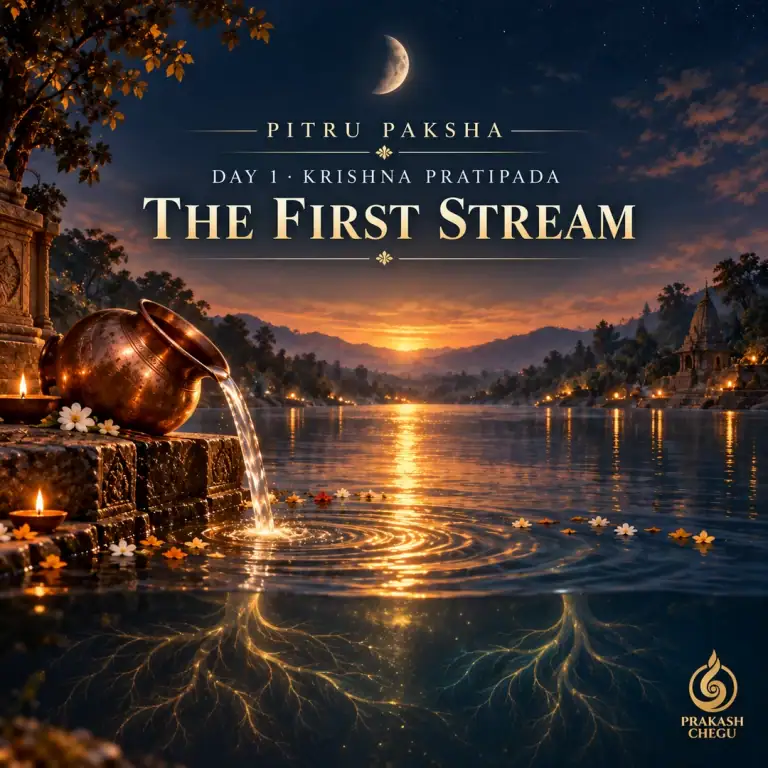
Today, the first stream of water begins to flow.
Krishna Pratipada is the first lunar day of the waning fortnight and the beginning of Pitru Paksha proper.
The Full Moon has passed. The movement toward Amavasya has begun. What was illuminated on Bhadrapada Purnima now enters the quiet, inward current of remembrance, nourishment and release.
Day 1 is where intention becomes action.
We do not merely think about the ancestors. We learn how to make an offering.
We prepare the water.
We understand the direction.
We learn how the hand becomes a sacred channel.
We speak the names we know.
We include the names that have been lost.
And we offer with śraddhā—sincerity, reverence and wholehearted attention.
This is The First Stream: a practical and deeply grounded introduction to performing a simple home Tarpanam.
This event may be experienced individually or as part of Pitru Paksha: The River Behind You, the complete journey from Bhadrapada Purnima to Sarva Pitru Amavasya.
Global Session Times
Live session at 7:00 AM Central European Time (CET)
- Central Europe (Berlin · Paris · Budapest) — 7:00 AM
- London — 6:00 AM
- Tallinn · Helsinki · Athens — 8:00 AM
- India (IST) — 10:30 AM
- New York (EDT) — 1:00 AM
- Tulum (Quintana Roo) — 12:00 AM (midnight)
- Mexico City — 11:00 PM the previous evening
- California (PDT) — 10:00 PM the previous evening
A recording is included for every session if the live time does not suit your location.
The True Beginning of Pitru Paksha
Bhadrapada Purnima opened the ancestral field. Krishna Pratipada begins the actual descent through the fifteen tithis of Pitru Paksha.
Pratipada means the first step, the first lunar measure, the point from which a new sequence unfolds.
Yet this is not a beginning that asks us to forget what came before. It is a beginning created precisely through remembering.
Pitru Paksha invites us to recognise that human life does not emerge in isolation. We inherit a body, a language, a way of relating, a relationship with food, work, love, money, prayer, grief and belonging. Some inheritances support us. Others require consciousness before they can be transformed.
The first tithi does not ask us to resolve the entire lineage.
It asks us to make the first sincere offering.
A river does not become a river because it understands its entire journey. It becomes a river because the first water begins to move.
Who Is Traditionally Honoured on Pratipada?
Pratipada Shraddha—also called Padwa Shraddha—is traditionally observed for departed family members whose death occurred on Pratipada tithi, whether during Shukla Paksha or Krishna Paksha.
This tithi also carries a special association with the maternal grandfather and maternal grandmother—the Nana and Nani.
Traditional guidance considers Pratipada suitable for honouring maternal grandparents when there is no one in the maternal household able to perform their Shraddha. This remembrance may also be offered when their exact death tithis are not known.
This gives Day 1 a subtle but important teaching.
Many ancestral systems become almost entirely focused on the paternal line because names, gotras and family identities are often carried publicly through it. The maternal stream can become less visible even though it contributes equally to the body, nervous system, nourishment, language and emotional inheritance of the descendant.
Pratipada asks us not to let the maternal river disappear.
We honour the ancestors according to the appropriate ritual order of our family tradition, and we also make conscious room for the maternal grandparents and the family through which our mother arrived.
What Is Tarpanam?
The word Tarpanam comes from the Sanskrit root tṛp—to satisfy, nourish, refresh or bring contentment.
Tarpanam is the offering of water made with intention, mantra and remembrance. In Pitru Tarpanam, water is traditionally combined with substances such as black sesame and darbha or kusha grass and offered to the ancestral beings.
The outer action is simple: water is poured.
The inner architecture is more precise:
- Sankalpa gives intention to the act.
- Direction places the practitioner in the ritual field.
- Water carries nourishment and remembrance.
- Black sesame is traditionally associated with ancestral offerings and purification.
- Darbha establishes ritual sanctity and containment.
- The hand becomes the point through which the offering is released.
- Name and gotra, when known, give specificity.
- Svadhā is the sacred principle through which the ancestral offering is received.
- Śraddhā gives the ritual its living heart.
Without sincerity, ritual can become performance.
Without structure, sincerity may have no vessel.
Day 1 brings the two together.
What We Will Learn
This event provides the essential practical foundation needed to perform a simple home Tarpanam with clarity and reverence.
We will explore:
- The distinction between Shraddha, Tarpanam and Pinda Dāna
- Why Tarpanam is offered during Pitru Paksha
- What can be performed at home and what properly belongs to a formal priest-led rite
- How to prepare the body, clothing and ritual space
- Why Pitru offerings are traditionally associated with the southern direction
- The essential materials and their meanings
- How to make sankalpa without using complicated language
- How to include names, relationships and gotra when known
- How to offer when names or gotra are unknown
- Pitru Tirtha—the ancestral point of release through the hand
- The difference between Deva, Rishi and Pitru offering orientations
- The use of black sesame, water and darbha
- How those who wear the yajñopavīta traditionally understand Savya, Nivita and Apasavya
- How to include paternal and maternal ancestors respectfully
- The place of the maternal grandparents on Pratipada
- How many offerings to make in the simplified practice taught in this event
- How to close the ritual and handle the offered water respectfully
- Alternatives for those whose family tradition restricts formal Pitru Tarpanam
The aim is not simply to watch a ritual.
The aim is to understand what you are doing well enough to practise sincerely and responsibly.
The Day 1 Ritual
The First Tarpanam
Day 1 introduces the foundational Tarpanam sequence that will support the remaining journey.
Participants joining only this event will receive a complete and self-contained practice. Those continuing through the full series will return to the same architecture each day while refining the dedication according to that tithi.
The guided practice will include:
1. Preparation
We begin with clean hands, a clear practice space and a few moments of conscious breathing. The intention is not ceremonial perfection but wakeful presence.
2. Establishing Sankalpa
We identify the purpose of the offering: to remember, nourish and honour the ancestors with sincerity. Participants may include the date, location, lineage, known names and the intention for the practice according to their capacity.
3. Entering the Direction
The traditional direction associated with the Pitrs is explained, along with the difference between symbolic orientation and rigid performance. Participants whose physical space does not allow an ideal setup will receive practical alternatives.
4. Preparing the Water
Clean water is prepared with black sesame and darbha when available. We will distinguish essential materials from regional additions and explain how to practise simply when a traditional item cannot be obtained.
5. Learning Pitru Tirtha
The hand is not treated casually. We will demonstrate the traditional point through which ancestral water is released and explain how this differs from offerings made to Devas and Rishis.
6. Naming the Lineage
Known ancestors may be addressed through name, relationship and gotra. When information is incomplete, the offering can be directed toward the known and unknown ancestors of the maternal and paternal lineages without inventing details.
7. Making the Offering
Water is released with mantra and focused remembrance. The offering is not rushed. Each stream becomes an act of recognition: You lived. Life travelled through you. You are remembered.
8. Remembering the Maternal Grandparents
After observing the appropriate lineage order, we include a special Pratipada remembrance for the maternal grandfather, maternal grandmother and their ancestral stream—especially where no one else is able to carry their observance.
9. The Inclusive Offering
A final offering is made for forgotten, unnamed, excluded and unrepresented ancestors, and for benefactors through whom protection or nourishment reached the family.
10. Completion
We close with gratitude, a prayer for peace and guidance on returning the offered water respectfully to earth or another appropriate place.
The Mantra of the First Stream
ॐ पितृभ्यः स्वधा नमः
Om Pitṛbhyaḥ Svadhā Namaḥ
Reverence to the ancestral beings; may this offering be received through Svadhā.
The practice will also include simple spoken dedications in English so that no participant feels compelled to use Sanskrit mechanically without understanding.
Sanskrit can hold the traditional vibration of the ritual. Meaning brings consciousness to the words. Both matter.
The Deeper Teaching: Receiving Life Without Carrying Everything
Ancestral practice can easily become confused with unquestioning loyalty.
But receiving life does not require us to repeat every belief, relationship pattern or survival response through which the lineage lived.
We can honour the ancestors and still choose differently.
We can be grateful for life without calling every family action sacred.
We can acknowledge sacrifice without making sacrifice our identity.
We can recognise pain without turning inherited pain into destiny.
The first stream teaches us to receive before we decide what must be carried forward.
This distinction will guide the entire Pitru Paksha journey:
Honour what gave life. Transform what diminishes life. Pass forward what blesses life.
Your Reflection for Day 1
Through whom did life first become personal for me?
You may also contemplate:
- Which maternal ancestors are still named in my family?
- What did I receive through my mother’s lineage?
- What did I receive through my father’s lineage?
- Which ancestor first taught me devotion, courage, responsibility or care?
- Whose offering to life made my life possible?
- Can I receive the gift of life without agreeing to carry every inherited pattern?
What to Bring
Please prepare:
- A clean copper, brass, steel or earthen vessel for water
- A second bowl or tray if performing the offering indoors
- Clean water
- Black sesame seeds
- Darbha or kusha grass, if available
- A clean cloth for your practice space
- A small lamp with oil or ghee
- One white or light-coloured flower
- A spoon for adding water or sesame if needed
- A notebook and pen
- Names, relationships and gotra of departed ancestors, if known
- Names of maternal grandparents, if known
- A small towel for the hands and practice area
If black sesame or darbha is unavailable, you may still attend. Adaptations will be explained during the event.
The Event Experience
This live online gathering will include:
- Teaching on Pratipada and the opening of Pitru Paksha proper
- Explanation of the maternal-grandparent association
- Practical Tarpanam foundations
- Live demonstration of preparation, direction and hand position
- Guided sankalpa
- The first complete water-and-sesame offering
- Sanskrit mantra with pronunciation and meaning
- Inclusive dedication for unknown ancestors
- Meditation and guided silence
- Journal reflection
- Questions and practical integration
The recording will be included so participants may revisit the instructions and perform the offering at the time appropriate for their location.
This Event Is for You If…
- You want to learn a simple home Tarpanam from the beginning
- You have never performed an ancestral water offering
- You have seen family rituals but were never taught what they mean
- You live away from your family, temple, river or customary ritual support
- You do not know every ancestral name, gotra or death tithi
- You want to remember your maternal grandparents or restore visibility to the maternal lineage
- You seek a practice grounded in reverence rather than fear
- You wish to attend one meaningful Pitru Paksha event without joining the entire series
- You want the ritual foundation for the complete sixteen-tithi journey
Beginners are fully welcome. Experienced practitioners may use the event to clarify meaning, refine their preparation and deepen the inner orientation of the ritual.
Can This Event Be Attended Individually?
Yes.
Day 1 is deliberately complete in itself. You do not need to have attended Day 0, and no prior knowledge of Sanskrit, Shraddha or Tarpanam is required.
You will receive:
- The complete Day 1 teaching
- A self-contained simple Tarpanam practice
- The Pratipada ritual card
- Mantra and reflection guidance
- Access to the recording
- Instructions for respectfully closing your practice
Continue into the Complete Journey
Pratipada establishes the ritual foundation. The tithis that follow bring different dimensions of the ancestral field into awareness—the two lineages, three generations, unfinished duties, lives outside expectation, bodily inheritance, feminine ancestors, householders, renunciants, young lives, difficult departures and the great completion of Amavasya.
The complete journey includes:
- All 16 tithi events
- Every daily ritual and reflection
- All recordings
- The River Behind You Workbook
- Sixteen printable ritual cards
- Lineage map and altar guide
- Sanskrit mantras with transliteration and meaning
- Community integration
- The final Sarva Pitru Amavasya ceremony
If you know that one stream is asking to become a river, you are invited into the full passage.
Respecting Family and Vedic Traditions
This event offers education, demonstration and an accessible household practice. It does not replace:
- Formal Parvana Shraddha
- A priest-led family ceremony
- First-year rites following a recent death
- Annual Shraddha performed according to death tithi
- The procedures of a particular shakha, sutra, sampradaya or regional tradition
If you have established family instructions, allow them to remain primary.
People who wear the yajñopavīta will be shown the traditional concepts relevant to its position, but no participant will be asked to imitate rites for which they have not received family or lineage instruction.
Some traditions restrict formal Pitru Tarpanam when the performer’s father is living. Participants for whom this applies will receive an alternative water-and-gratitude practice that honours the lineage without presenting itself as formal Pitru Tarpanam.
Let the First Water Move
You do not need a perfect family history.
You do not need every name.
You do not need to understand every ritual before you begin.
You need a vessel.
You need water.
You need a sincere intention.
You need the willingness to remember.
The lineage may be vast, but every river enters visibility through one stream.
On Krishna Pratipada, we make the first offering.
Not to remain in the past—but to meet the present with deeper roots.
Not to carry every ancestral burden—but to recognise the life that reached us.
Not to perform remembrance—but to become present within it.
The vessel is ready.
Let the first water move.
Join Day 1
Krishna Pratipada: The First Stream
Sunday, September 27, 2026 — India Reference Calendar
Live Online · Time to Be Announced · Recording Included
Individual Event · Part 1 of the 16-Tithi Pitru Paksha Journey
Learn the foundation.
Prepare the water.
Remember both lineages.
Make the first offering.
Series Navigation
Previous: Day 0 · Bhadrapada Purnima — The Opening of the Ancestral Field
View the Complete Pitru Paksha Calendar
Next: Day 2 · Krishna Dwitiya — The Two Rivers