Pitru Paksha 2026 online · Day 0 of 16 · Saturday, September 26, 2026 · live at 7:00 AM CET, recording included.
Before we ask what must be healed, we remember what allowed us to be here.
Before we release the past, we bow to the river of life that carried us into the present.
There is a moment before every sacred journey when we prepare to enter.
We clear the space.
We gather the materials.
We steady the mind.
We remember why we have come.
Bhadrapada Purnima is that threshold.
The Full Moon stands at the doorway of Pitru Paksha, the sacred ancestral fortnight. It is not yet the first tithi of the waning passage. It is the luminous moment before the descent—the night in which the field is made visible, the vessel is prepared and the intention is established.
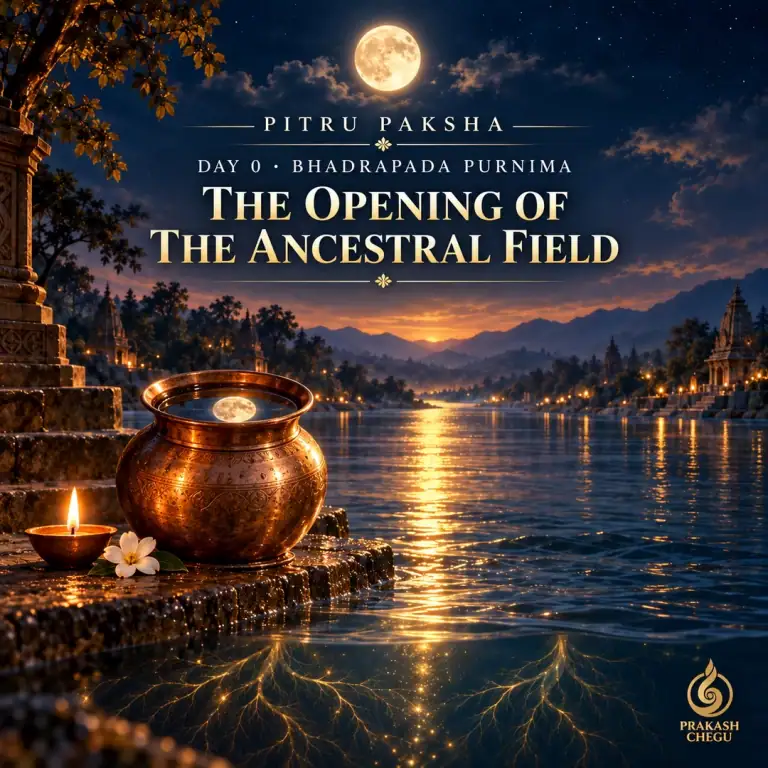
This is Day 0: The Opening of the Ancestral Field.
It can be experienced as a complete event on its own or as the opening gateway into Pitru Paksha: The River Behind You, our full journey from Bhadrapada Purnima to Sarva Pitru Amavasya.
Global Session Times
Live session at 7:00 AM Central European Time (CET)
- Central Europe (Berlin · Paris · Budapest) — 7:00 AM
- London — 6:00 AM
- Tallinn · Helsinki · Athens — 8:00 AM
- India (IST) — 10:30 AM
- New York (EDT) — 1:00 AM
- Tulum (Quintana Roo) — 12:00 AM (midnight)
- Mexico City — 11:00 PM the previous evening
- California (PDT) — 10:00 PM the previous evening
A recording is included for every session if the live time does not suit your location.
Why Begin Before Pitru Paksha Begins?
Pitru Paksha proper consists of the fifteen tithis of Krishna Paksha—the waning half of the lunar month—from Pratipada to Amavasya.
Bhadrapada Purnima stands immediately before it.
Traditional sources call this observance Shraddhi Purnima or Proshthapadi Purnima Shraddha. It is considered an auspicious time for ancestral remembrance, even though it is not technically one of the fifteen tithis of Pitru Paksha.
This Purnima carries a beautiful and less commonly explained orientation. While much of ancestral practice naturally begins with the immediately preceding generations, Bhadrapada Purnima invites remembrance of the lineage extending beyond the great-grandparents—the more distant ancestral field sometimes described as the Nandimukha Pitrs. Traditional descriptions also include the maternal ancestors in the observance of this day.
Day 0 therefore asks a different question from the days that follow:
Can we recognise the vast field behind our personal family stories?
There are ancestors whose names we know.
There are ancestors visible only through an old photograph, a family recipe, a gesture, a piece of land, a devotional habit or a story repeated through generations.
And there are innumerable ancestors whose names have disappeared completely—but whose lives still participate in our existence.
On Day 0, we make room for all of them.
The Full Moon as Witness
The Full Moon represents visibility. Nothing has yet disappeared into the darkness of the waning cycle.
This is why our first movement is not release. It is recognition.
We begin by seeing:
- The life that was received
- The protection and sacrifice that made survival possible
- The gifts, abilities and values that travelled through generations
- The losses, migrations and interruptions that shaped the family
- The names that remain
- The names that were forgotten
- The maternal and paternal streams meeting within us
- The spiritual ancestors and teachers who influenced the direction of our lives
We do not force gratitude for harm. We do not romanticise everything that happened in the family. We do not pretend that ancestry is always gentle.
Instead, we begin with one undeniable truth:
Life arrived through a lineage.
Day 0 gives us a way to acknowledge that truth without surrendering discernment, boundaries or honesty.
What Is the Ancestral Field?
The ancestral field is larger than a list of deceased relatives.
It includes the biological stream through which the body arrived, but it may also include adoptive family, guardians, elders, benefactors, teachers, cultural ancestors and spiritual lineages that gave direction, protection or knowledge.
It contains both memory and absence.
Some participants may know their family history across many generations. Others may carry only two or three names. Adoption, migration, displacement, estrangement, secrecy, early death and interrupted traditions can all create gaps in the visible lineage.
Those gaps do not disqualify anyone from remembrance.
During this event, we will learn how to address:
- Ancestors whose names and relationships are known
- Ancestors whose names have been forgotten
- The maternal and paternal lineages
- Adoptive and chosen family
- Spiritual teachers and benefactors
- Those who were excluded or erased from family memory
- All beings through whom protection, nourishment or knowledge reached us
The purpose is not to create an elaborate genealogy. It is to establish an honest inner orientation:
I remember that I did not begin with myself.
What We Will Explore
In this opening event, we will explore:
- Why Bhadrapada Purnima is called the threshold of Pitru Paksha
- The distinction between Purnima Shraddha and the fifteen tithis of Pitru Paksha
- The meaning of Shraddhi Purnima and Proshthapadi Purnima
- The distant lineage and the traditional idea of Nandimukha Pitrs
- Why maternal ancestors are explicitly included in this observance
- The difference between remembrance, reverence and attachment
- What Pitru Rina—the debt of gratitude to the ancestors—actually means
- How to create a temporary ancestral altar at home
- How to begin a lineage map when names or information are missing
- How to formulate a clear sankalpa for ancestral practice
- The meaning of water as the first and most universal offering
- How Day 0 prepares us for the Tarpanam practices that follow
- How to participate respectfully when family traditions or ritual eligibility differ
The Day 0 Ritual
Establishing the Ancestral Altar
Our central practice will be the creation of a simple, temporary ancestral altar.
This is not intended to become a permanent shrine or a place of ongoing attachment. It is a consciously opened ritual space that will hold the journey from Full Moon to New Moon and be respectfully dismantled at its completion.
The ritual will include:
1. Preparing the Ground
We begin by cleaning the physical space and settling the body. A short guided breath practice will help us arrive without urgency and separate the ritual moment from the movement of the ordinary day.
2. Placing the Vessel
A clean vessel of water becomes the centre of the altar. Water represents nourishment, continuity, memory and the capacity to carry an offering beyond the limits of language.
3. Lighting the Flame
The lamp represents conscious presence. We are not summoning fear, drama or fantasy. We are bringing the light of awareness to a relationship that already exists through life itself.
4. Mapping the Lineage
We begin with the names we know and leave visible space for those we do not. The map may include maternal and paternal relatives, adoptive family, guardians, teachers and benefactors according to each participant’s history.
5. Taking Sankalpa
Each participant will form an intention for the observance. The sankalpa will not attempt to control the ancestors or demand a particular result. It will establish the qualities with which we choose to enter: sincerity, gratitude, truth, humility, discernment and peace.
6. The First Water Offering
We make a simple offering of clear water to the ancestral field. This is an opening gesture rather than the complete daily Tarpanam that will be taught within the journey.
7. Mantra and Silence
We will use the simple ancestral mantra:
ॐ पितृभ्यः स्वधा नमः
Om Pitṛbhyaḥ Svadhā Namaḥ
Reverence to the ancestral beings; may this offering be received through Svadhā.
The mantra will be followed by guided silence, allowing remembrance to arise without forcing imagery, emotion or supernatural experience.
8. Closing Without Dismantling
The session closes carefully, but the temporary altar remains established for those continuing through the full Pitru Paksha journey. Participants attending only Day 0 will receive a simple method for respectfully completing and clearing the altar after their observance.
Your Reflection for Day 0
What reached me because someone before me endured, protected, prayed, worked, created or loved?
You may also contemplate:
- Which family names do I know?
- Which branches of the family have disappeared from memory?
- What strengths appear repeatedly in the lineage?
- What form of devotion, knowledge or service travelled toward me?
- Who protected the possibility of my life without ever knowing me?
- What would it mean to enter Pitru Paksha without fear?
You are not expected to answer everything during the session. Day 0 opens the inquiry; the remaining tithis deepen it.
What to Bring
Please prepare:
- A clean cloth for the temporary altar
- A clean vessel filled with water
- A second bowl or tray if you will make the offering indoors
- A small lamp with oil or ghee
- One white or light-coloured flower
- A notebook and pen
- The names of departed ancestors you wish to remember, if known
- Photographs, if they feel appropriate; photographs are optional
- Black sesame and darbha or kusha grass, if already available; they are not required for the simple Day 0 opening ritual
You do not need elaborate materials. The quality of attention matters more than display.
The Event Experience
This live online gathering will include:
- Teaching on Bhadrapada Purnima and its ancestral significance
- An introduction to Pitru Paksha and the complete sixteen-tithi arc
- Guided breath and preparation
- Step-by-step ancestral altar creation
- Lineage-mapping practice
- Sankalpa for the ancestral passage
- Simple water offering
- Sanskrit mantra with pronunciation and meaning
- Meditation and guided silence
- Journal reflection
- Questions and practical integration
The recording will be included so participants may revisit the teaching or perform the practice at an appropriate local time.
This Event Is for You If…
- You feel called to honour your ancestors but do not know how to begin
- You want a clear and respectful introduction to Pitru Paksha
- You live away from your family, temple or customary ritual support
- You do not know all your ancestors’ names or your complete family history
- You want to create an ancestral altar without creating fear or attachment
- You already perform Shraddha or Tarpanam and want to understand the deeper significance of Bhadrapada Purnima
- You want to join the complete journey but need a grounded opening
- You only wish to attend this one event and make a sincere Full Moon offering
Beginners and experienced practitioners are equally welcome.
An Important Clarification About Purnima Deaths
Bhadrapada Purnima Shraddha should not be confused with the Mahalaya Shraddha for a person who died on a Purnima tithi.
Traditional guidance places the Pitru Paksha Shraddha for someone who died on Purnima on Sarva Pitru Amavasya, rather than on this opening Purnima.
Day 0 is therefore oriented toward the distant ancestral field, Nandimukha Pitrs, maternal ancestors and preparation for the fortnight. Participants seeking to honour someone whose death tithi was Purnima should join the Sarva Pitru Amavasya observance or follow their family priest’s instructions.
Can This Event Be Attended Individually?
Yes.
Day 0 is a complete experience. You will receive the teaching, ritual guidance, mantra, reflection and instructions for respectfully closing the temporary altar if you are not continuing.
No previous knowledge is required.
Continue into the Complete Journey
Day 0 opens the door. The fifteen waning-moon tithis that follow carry us gradually through remembrance, reconciliation, nourishment, difficult departures, release and blessing.
The complete journey includes:
- All 16 tithi events
- Practical Tarpanam foundations
- Daily rituals and mantra guidance
- All recordings
- The River Behind You Workbook
- Sixteen printable ritual cards
- Lineage map and altar guide
- Community integration
- The final Sarva Pitru Amavasya ceremony
If you feel called to understand not only one ancestral day but the complete architecture of Pitru Paksha, the master journey offers the full passage.
Respecting Family and Lineage Traditions
This event is an educational and guided spiritual gathering. It does not replace:
- A formal priest-led Shraddha
- First-year rites following a recent death
- Annual family observances
- Instructions belonging to a particular Vedic shakha, sutra, sampradaya or regional tradition
Where you have established family guidance, allow it to remain primary. The practices shared here are designed to deepen understanding and offer a simple doorway for those without access to elaborate ritual support.
Some traditions place specific eligibility rules around formal Pitru Tarpanam, including rules for a person whose father is living. Alternative gratitude and remembrance practices will be provided wherever formal procedures may not apply.
You Did Not Begin with Yourself
There were lives before your life.
There were hands that built, cooked, carried, planted, protected, wrote, prayed and worked.
There were migrations you may never fully understand.
There were sacrifices no one documented.
There were gifts that became so natural in you that you forgot they were inherited.
Bhadrapada Purnima asks us to stand beneath the Full Moon and remember the magnitude of that inheritance.
We do not begin by trying to fix the ancestors.
We begin by becoming present.
We prepare the vessel.
We light the flame.
We offer the water.
We remember the river behind us.
And with humility, we enter.
Join Day 0
Bhadrapada Purnima: The Opening of the Ancestral Field
Saturday, September 26, 2026
Live Online · Time to Be Announced · Recording Included
Individual Event · Part 0 of the 16-Tithi Pitru Paksha Journey
Come with the names you know.
Come with the names that have been lost.
Come with a vessel of water and a willingness to remember.
Series Navigation
View the Complete Pitru Paksha Calendar
Next Event: Day 1 · Krishna Pratipada — The First Stream