
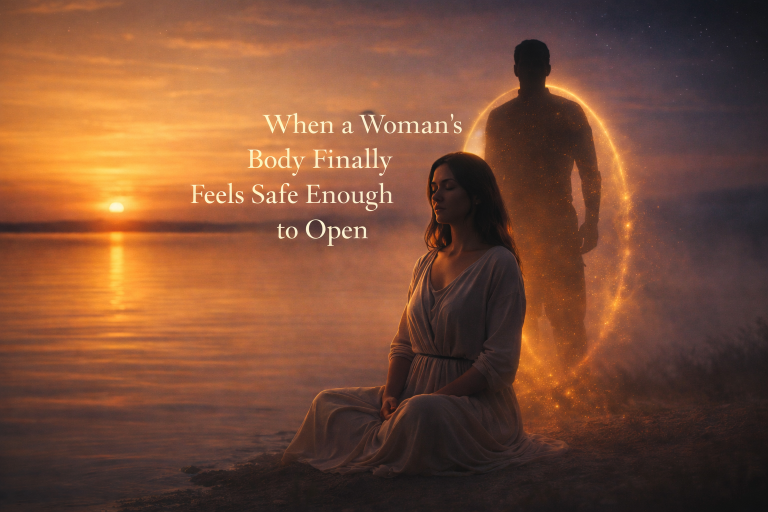
There is a depth of sexual and emotional surrender that does not arise from technique, performance, or persuasion.
It opens when a woman’s nervous system feels completely safe.
Not intellectually safe.
Not socially safe.
Not “he seems like a good guy” safe.
Physiologically safe.
For many women, that level of safety may only ever occur with one man — if it occurs at all. Because surrender is not a decision of the mind. It is a reflex of the body.
And trauma interrupts reflex.
The Nervous System, Not the Mind, Decides
A woman’s body is constantly scanning for threat.
This is not weakness. It is biology.
The autonomic nervous system — especially the vagus nerve — determines whether she moves into:
-
Fight
-
Flight
-
Freeze
-
Fawn
-
Or ventral vagal safety (connection, openness, receptivity)
Full sexual surrender requires ventral vagal dominance. It requires her system to register:
“I am safe here. I am not being taken. I am being met.”
When that signal is absent — even subtly — the body braces.
How Trauma Lives in the Pelvis
Unresolved trauma often stores in the body, particularly in the diaphragm, jaw, hips, psoas, and pelvic floor.
Common roots include:
-
Childhood neglect
-
Emotional unpredictability
-
Sexual violation
-
Betrayal
-
Coercive or pressured intimacy
-
Being touched without true consent
-
Being desired but not seen
Over time, the body adapts by tightening.
Not consciously. Protectively.
This can show up as:
-
Chronic pelvic floor contraction
-
Shallow chest breathing
-
Hypervigilance during intimacy
-
Dissociation during penetration
-
Freeze responses masked as compliance
The body learns:
“Stay alert. Stay braced. Don’t fully open.”
Signs of Unhealed Intimacy Patterns
These signs are not flaws. They are survival strategies.
But when unaddressed, they limit depth:
-
Minimal natural lubrication unless forcing arousal
-
Vaginal tightness or pain despite mental desire
-
Orgasms that feel mechanical or genital-only
-
Performing or faking pleasure
-
Mentally checking out during sex
-
Feeling empty, resentful, or emotionally flat afterward
-
Inability to relax into slow, devotional union
-
Needing intensity rather than presence to feel something
These are not character issues.
They are nervous system adaptations.
Surrender Cannot Be Forced
No amount of “good technique,” masculine confidence, or spiritual language can override a braced pelvis.
If the body does not feel safe, it will:
-
Withhold lubrication
-
Restrict breath
-
Limit sensation
-
Stay partially dissociated
Many women learn to override these signals. They “perform openness” while remaining armored internally.
But true surrender feels different.
It feels involuntary.
What Healing Actually Requires
Healing this depth of pattern is not cognitive. It is embodied.
1. Trauma Discharge
Somatic Experiencing, Sensorimotor Psychotherapy, or trauma-informed bodywork help discharge stored survival energy.
The body must complete the defensive responses it never finished.
Tremors. Tears. Breath release. Spontaneous movement.
Not analysis — completion.
2. Strengthening Ventral Vagal Safety
Co-regulation must become the default.
Practices that build this include:
-
Slow nasal breathing with extended exhales
-
Eye contact without performance
-
Rhythmic movement (walking, rocking, crawling)
-
Safe touch without sexual agenda
-
Consistent emotional presence over time
Safety is repetition-based.
3. Pelvic De-Armouring
The psoas, obturators, levator ani, and deep hip rotators often hold unconscious bracing.
Release work may include:
-
Breathwork into the lower belly
-
Hip openers done slowly with awareness
-
Trauma-informed pelvic floor therapy
-
Gentle internal bodywork (with trained practitioners)
-
Shaking and neurogenic tremor work
The goal is not stretching.
It is softening.
4. Rebuilding Trust in Receiving
Receiving gaze.
Receiving touch.
Receiving penetration without bracing.
This often begins non-sexually.
Safe masculine presence must be titrated gradually:
Non-sexual → Affectionate → Sensual → Sexual
Every step tracked.
Every contraction honored.
Nothing rushed.
5. Titrated Exposure to Safe Masculine Energy
If previous encounters were coercive or emotionally unsafe, the body may equate masculinity with threat.
Rewiring requires repeated exposure to:
-
Steady tone of voice
-
Predictable behavior
-
Emotional containment
-
No pressure for outcome
-
No withdrawal of connection when boundaries are expressed
Only then does the pelvis begin to believe:
“I can open and not be harmed.”
When the Body Shifts
When healing completes — and this can take years — the body changes.
Not symbolically. Physiologically.
You may notice:
-
Improved heart rate variability
-
Rapid shift into parasympathetic calm in his presence
-
Naturally deeper breath
-
Skin warming and flushing
-
Hypersensitivity to subtle touch
-
Pelvis softening without effort
-
Effortless, abundant lubrication
-
Arousal spreading through the entire body
-
Orgasms that feel like waves rather than spikes
-
Multiple, nonlinear climactic states
-
Afterglow that feels expansive and peaceful rather than depleted
Penetration may feel less like friction and more like energetic merging.
There is no bracing.
No performance.
No “doing.”
Just opening.
Why This Depth Is Rare
Because the healing is long.
It requires:
-
Facing grief
-
Feeling rage
-
Completing freeze responses
-
Releasing shame
-
Letting go of relationships that reinforce bracing
-
Sitting in vulnerability without armor
Most people stop halfway.
They optimize performance instead of resolving trauma.
They call intensity connection.
They call chemistry safety.
But safety is slow.
And it cannot be faked.
Meeting From Wholeness
When a woman completes this work, she does not surrender from need.
She surrenders from choice.
Her body, heart, and womb open not because she fears losing him — but because she feels deeply met.
At that depth:
There is no coercion.
No manipulation.
No dissociation.
There is presence.
And presence is the foundation of true union.
Not dominance.
Not submission.
Not technique.
Safety.
And from safety, everything else flows.