
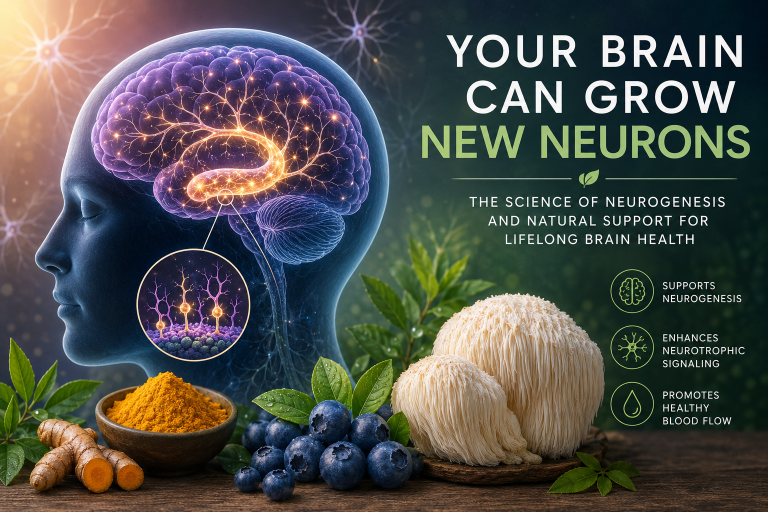
The Ancient Wisdom of Renewal Meets the Modern Science of Neurogenesis
For much of the twentieth century, neuroscience taught something that shaped how millions of people viewed aging.
Your brain, we were told, was like a machine with a fixed number of parts.
Lose a neuron, and it was gone forever.
Brain damage was permanent.
Memory loss was inevitable.
Cognitive decline was simply the price of growing older.
For decades, this belief was considered unquestionable scientific fact.
Then science discovered something remarkable.
It was wrong.
Today we know that certain regions of the adult brain possess an extraordinary capacity that was once thought impossible: they can generate entirely new neurons throughout life.
Not everywhere.
Not endlessly.
But enough to completely change how we understand learning, resilience, emotional healing, and even spiritual growth.
As someone who has spent years exploring the meeting point between Kundalini Yoga, Ayurveda, neuroscience, and consciousness, I find this discovery deeply beautiful.
Because long before microscopes revealed neurogenesis, the yogic traditions had already suggested that the human being is never truly fixed.
We are always becoming.
The Brain Is More Alive Than We Imagined
Deep inside your temporal lobe lies a remarkable structure called the hippocampus.
Its name comes from the Greek word for “seahorse” because of its curved shape.
Yet its function is far more extraordinary than its appearance.
The hippocampus plays a central role in:
- Learning new information
- Forming long-term memories
- Navigating space
- Emotional regulation
- Pattern recognition
- Adapting to new experiences
Embedded within the hippocampus is an incredibly specialized region known as the subgranular zone of the dentate gyrus.
This tiny area contains adult neural stem cells.
Unlike most neurons in the brain, these stem cells retain the ability to divide throughout adulthood.
When conditions are favorable, they produce immature neurons called neuroblasts.
These young cells begin extending delicate dendrites and axons, gradually weaving themselves into existing neural circuits.
Given enough support, they become fully functioning neurons capable of participating in memory, learning, and emotional regulation.
This process is called adult hippocampal neurogenesis.
In other words…
Your brain possesses its own renewal mechanism.
Your Brain Is Always Remodeling Itself
Many people imagine the brain as solid and permanent.
Reality is far more dynamic.
Every day, billions of synapses strengthen or weaken.
Proteins are continuously recycled.
Connections are reinforced.
Others disappear.
Entire neural networks reorganize themselves according to how you think, move, breathe, learn, and live.
This is known as neuroplasticity.
Neurogenesis is one of the most remarkable expressions of that plasticity.
The brain is not simply storing memories.
It is constantly rebuilding itself around your experiences.
Every meditation session…
Every new language…
Every meaningful conversation…
Every challenge you overcome…
Every skill you practice…
Leaves physical fingerprints within your nervous system.
The Silent Garden Inside Your Brain
I like to imagine the hippocampus as a sacred garden.
The neural stem cells are seeds.
The young neurons are tender shoots.
The surrounding environment determines whether those shoots flourish—or wither before they ever mature.
Like any garden, growth depends less on forcing the plants and more on creating the right conditions.
This is precisely what modern neuroscience has discovered.
Brain-Derived Neurotrophic Factor: Fertilizer for the Brain
One of the most important molecules involved in neurogenesis is Brain-Derived Neurotrophic Factor (BDNF).
BDNF is often described as “fertilizer for the brain.”
While the analogy is simplified, it captures an important truth.
BDNF helps developing neurons:
- Survive
- Mature
- Extend dendrites
- Form synaptic connections
- Integrate into existing neural networks
Without adequate BDNF signaling, many immature neurons simply never complete their journey.
They die before becoming part of the brain’s architecture.
This means the brain’s ability to adapt depends not merely on creating new cells but on nurturing them long enough to become functional.
Why Modern Life Works Against Neurogenesis
The brain’s regenerative capacity is extraordinary.
But it is also delicate.
Modern lifestyles create exactly the kind of environment that interferes with this process.
Chronic psychological stress.
Poor sleep.
Metabolic dysfunction.
Sedentary living.
Ultra-processed foods.
Persistent inflammation.
These factors gradually alter the biochemical environment surrounding the hippocampus.
The problem is not that the brain suddenly loses its ability to regenerate.
Rather, the environment becomes hostile to regeneration.
The Neurogenic Niche
Scientists often refer to the environment surrounding these neural stem cells as the neurogenic niche.
Think of it as an ecosystem.
Healthy ecosystems require balance.
So does your brain.
Three major pillars support this delicate environment.
1. Neural Stem Cell Proliferation
Stem cells must receive the proper biochemical signals encouraging them to divide and produce new neuroblasts.
When those signals are interrupted, cell production slows dramatically.
2. Neurotrophic Support
Young neurons require continuous exposure to neurotrophic factors—particularly BDNF.
BDNF binds to specialized receptors called TrkB receptors, helping immature neurons survive and mature into functional members of the hippocampal network.
Without sufficient neurotrophic support, these fragile cells fail to integrate successfully.
3. Healthy Cerebral Blood Flow
New neurons are metabolically demanding.
They require oxygen.
Glucose.
Micronutrients.
Stable blood flow.
An intricate network of tiny capillaries nourishes this environment while protecting it from excessive inflammatory stress.
Healthy circulation literally feeds learning.
When the Garden Begins to Struggle
The breakdown rarely happens overnight.
Instead, it unfolds gradually.
Persistent systemic inflammation increases inflammatory messengers such as cytokines, including TNF-α, which can influence signaling across the blood-brain barrier. This activates immune cells within the brain called microglia. When chronically activated, microglia release reactive molecules that create an environment less supportive of neural stem cell division.
At the same time, prolonged elevations in cortisol—the body’s primary stress hormone—are associated with reduced BDNF expression. Developing neurons lose one of their key survival signals.
Finally, impaired vascular function reduces efficient delivery of oxygen and nutrients, exposing these metabolically active young cells to oxidative stress.
One problem amplifies another.
Eventually, fewer new neurons survive.
You Feel the Effects Long Before You See Them
These changes are often invisible on routine brain scans.
Instead, they appear in daily life.
You may notice that learning feels harder.
Names escape you more often.
Your emotional resilience seems lower.
Small problems create disproportionately large reactions.
You struggle to remember where you placed your keys.
Mental fatigue arrives earlier than it once did.
These experiences do not necessarily mean neurons are dying in large numbers.
Sometimes they reflect a brain whose adaptive capacity has been diminished.
The garden has become less fertile.
Can Lifestyle Support a Healthier Neurogenic Environment?
One of the most exciting areas of neuroscience is not simply identifying neurogenesis but understanding what supports the environment in which it occurs.
Researchers have explored many lifestyle factors, including exercise, adequate sleep, learning, stress reduction, and nutrition. Certain botanicals have also attracted scientific interest, although much of the evidence remains preclinical or early-stage, and they should not be viewed as standalone treatments.
Turmeric (Curcuma longa)
Turmeric contains polyphenols such as curcumin, which have been extensively studied for their effects on inflammatory signaling pathways, including NF-κB. Researchers are investigating whether these actions may help support conditions favorable to healthy BDNF signaling and neural adaptation.
Rather than “growing neurons,” turmeric appears to support a healthier internal environment in which the brain’s own adaptive processes may function more effectively.
Blueberries (Vaccinium species)
Blueberries are rich in anthocyanins, plant compounds that have been investigated for their effects on vascular function and oxidative stress.
Healthy microcirculation is essential for supplying oxygen and nutrients to metabolically active brain tissue, and maintaining vascular health may help preserve the environment in which neurogenesis occurs.
Again, blueberries are not a magic bullet—but they are one example of how whole foods may contribute to long-term brain health.
Lion’s Mane (Hericium erinaceus)
Lion’s Mane mushroom has become one of the most discussed natural compounds in neuroscience.
Laboratory and animal studies have shown that compounds called erinacines, found primarily in the mycelium, can stimulate production of Nerve Growth Factor (NGF) in experimental models.
NGF is distinct from BDNF, but both belong to the family of neurotrophic molecules that support neuronal health and development.
Human studies are still relatively limited, yet the findings so far have generated significant scientific interest.
The Yogic Perspective
None of this surprises the yogic tradition.
Yoga has never viewed the human being as mechanically fixed.
Every breath changes us.
Every mantra reshapes attention.
Every meditation reorganizes perception.
Every conscious action leaves an imprint.
In Sanskrit, these impressions are called Samskaras.
Modern neuroscience speaks of neural pathways.
Yoga speaks of Samskaras.
The languages differ.
The insight is remarkably similar.
What we repeatedly think, feel, practice, and embody gradually becomes our nature.
The brain changes.
The mind changes.
Consciousness expresses itself through an ever-changing instrument.
Neurogenesis Beyond Biology
The deeper question is not simply:
“Can I grow new neurons?”
The deeper question is:
“What kind of life am I giving those neurons to grow into?”
If your days are filled with constant stress…
If your nervous system never experiences stillness…
If learning has stopped…
If wonder has disappeared…
If movement has been replaced by endless scrolling…
Then the brain adapts to that reality.
But the opposite is equally true.
Movement.
Meditation.
Meaningful relationships.
Deep sleep.
Nature.
Purpose.
Creative expression.
Lifelong learning.
These are not merely pleasant lifestyle choices.
They are signals.
Messages telling the brain:
“This organism still needs to grow.”
Final Thoughts
One of the most hopeful discoveries in modern neuroscience is not simply that the adult brain can generate new neurons.
It is that the brain remains responsive throughout much of life.
It continues to remodel itself in response to how we live.
This does not mean we can completely prevent aging or guarantee cognitive resilience. Neurogenesis is only one piece of a far more complex brain, and scientists continue to study how much it contributes across the lifespan.
Yet the broader message remains profoundly encouraging.
Your brain is not a static organ trapped by yesterday.
It is a living ecosystem.
A dynamic landscape of continuous adaptation.
Perhaps the greatest lesson from both neuroscience and yoga is the same:
Renewal is not an event.
It is a way of living.
Every breath.
Every thought.
Every habit.
Every choice.
You are not only shaping your future.
You are, quite literally, helping shape the architecture of your own mind.