
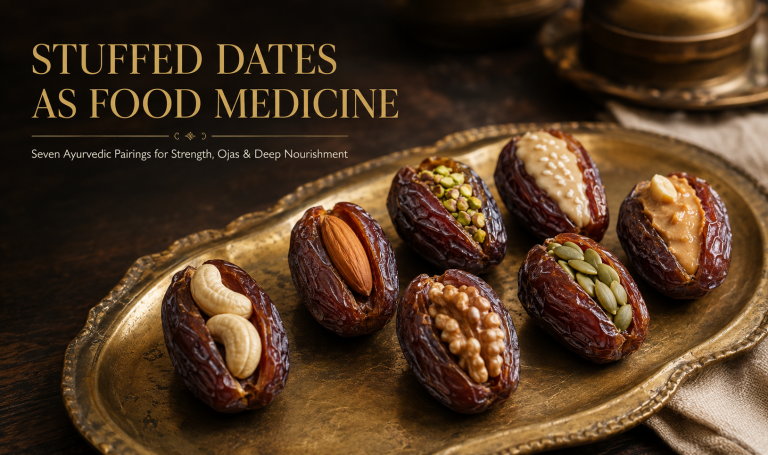
Seven Ayurvedic Pairings for Strength, Ojas, Calm and Deep Nourishment
The central perspective can be:
Dates are not miracle pills, but neither are they empty sugar. Ayurveda understands Kharjūra as a complete medicinal food whose effect changes according to what accompanies it, who consumes it, how much is eaten and the condition of agni.
The article can then cover:
- The Ayurvedic properties of Kharjūra
- Why Ayurveda recommends beginning with madhura rasa
- How nuts and seeds transform the qualities of dates
- The seven stuffed-date combinations
- Which patterns each pairing best supports
- How to use dates wisely in Prameha or blood-sugar sensitivity
- Recommended portions and preparation
- A gentle closing on food as relationship rather than nutritional fear
The tone should be affirmative: dates can nourish ojas, calm Vāta, support depleted tissues and offer a wholesome alternative to refined desserts. We only need to explain that nourishment must be matched to the person—because Ayurveda has never taught that one food is right in every quantity for every body.
Stuffed Dates as Food Medicine
Seven Ayurvedic Pairings for Strength, Ojas, Calm and Deep Nourishment
There are foods we eat simply because they taste good.
There are foods we consume because a nutrition label tells us they contain protein, fiber, minerals or antioxidants.
And then there are foods that Ayurveda recognizes as something more: substances that carry a distinct intelligence, a pattern of qualities capable of influencing digestion, vitality, the nervous system and the deeper tissues of the body.
Dates belong to this third category.
Known in Ayurveda as Kharjūra, dates have been valued for centuries as a strengthening, cooling and deeply nourishing food. Their sweetness is not understood merely as sugar. It is understood through the complete Ayurvedic language of rasa, guṇa, vīrya, vipāka and karma—taste, qualities, energetic potency, post-digestive influence and physiological action.
When dates are paired with almonds, walnuts, sesame, pumpkin seeds, cashews or pistachios, they become more than a sweet snack. Each pairing creates a different nutritional and energetic relationship.
One combination may be especially grounding for an anxious mind. Another may nourish depleted bones and joints. Another may help restore strength after exhaustion. Another may support ojas—the subtle essence Ayurveda associates with immunity, resilience, radiance and the capacity to withstand stress.
This does not mean that one stuffed date magically cures a disease. It means that food can be selected intelligently.
Ayurveda has never taught us to fear food. Nor has it taught us to consume even the most nourishing food without awareness. It asks a more refined question:
What does this food do, in this quantity, for this person, in this season, in this condition?
Let us explore the medicine hidden inside the humble date.
Kharjūra: The Ayurvedic Intelligence of Dates
Ayurveda describes dates as predominantly madhura rasa, or sweet in taste, with some sources also recognizing a subtle astringent quality.
Their principal characteristics include:
- Madhura rasa — sweet and nourishing
- Guru guṇa — substantial and somewhat heavy
- Snigdha guṇa — moistening and unctuous
- Śīta vīrya — cooling in energetic effect
- Madhura vipāka — nourishing after digestion
- Balya — supportive of strength
- Bṛṃhaṇa — tissue-building
- Tarpana — satisfying and replenishing
- Hṛdya — pleasing and supportive to the heart
- Vṛṣya — supportive of reproductive vitality
Through these qualities, dates generally help pacify excessive Vāta and Pitta.
Their moisture and substance counter Vāta’s dryness and depletion. Their cooling nature can soften excessive Pitta heat. Their sweetness offers the body a message of nourishment, safety and restoration.
However, because dates are sweet, heavy and building, excessive consumption may increase Kapha—especially when digestion is weak or when the diet is already rich in sweets, dairy, fried food and other heavy substances.
The medicine, as always, lies in the relationship between the food and the person.
Madhura Rasa Is Not the Enemy
Modern dietary culture often treats sweetness as morally suspicious.
Sweet foods are frequently described as guilty pleasures, indulgences or dietary failures. But Ayurveda offers a far more nuanced understanding.
Madhura rasa is one of the six essential tastes.
It is formed primarily from the earth and water elements. It nourishes the body, supports growth, strengthens the tissues, promotes satisfaction and calms the nervous system.
When used appropriately, the sweet taste supports:
- Rasa dhātu, the plasma and primary nutritive fluids
- Rakta dhātu, the blood tissue
- Māṃsa dhātu, the muscles
- Meda dhātu, the body’s healthy lubrication and reserves
- Asthi dhātu, the bones
- Majjā dhātu, marrow and nervous tissue
- Śukra and artava dhātus, the reproductive tissues
- Ojas, the refined essence of nourishment and vitality
The problem is not madhura rasa itself.
The problem is the excessive consumption of refined, isolated sweetness without fiber, vitality, minerals, satisfaction or respect for digestive capacity.
A ripe date and a piece of industrial candy may both taste sweet, but Ayurveda would never assume they possess identical qualities simply because they contain sugar.
One is a whole fruit carrying fiber, minerals, moisture and botanical intelligence. The other may be an engineered concentration of refined sugar, flavorings and fats designed to encourage continued consumption.
Sweetness is not the enemy. Unconsciousness is.
Why Ayurveda Traditionally Places Sweetness First
One of Ayurveda’s most interesting dietary teachings concerns the order of tastes within a meal.
The classical sequence generally begins with:
- Madhura — sweet
- Amla — sour
- Lavaṇa — salty
- Kaṭu — pungent
- Tikta — bitter
- Kaṣāya — astringent
This does not mean beginning every meal with cake or a large bowl of pudding.
Madhura rasa includes far more than desserts. Rice, wheat, milk, root vegetables, squash, dates, certain fruits, almonds and many nourishing staple foods express the sweet taste.
Ayurveda places heavier, nourishing tastes nearer the beginning of the meal because digestive power is ready to receive them. Bitter, pungent and astringent tastes can then complete the meal with their lighter, clarifying and drying qualities.
There is also a psychological intelligence in this practice.
A small, wholesome expression of sweetness at the beginning of a meal can create satisfaction. It tells the body that nourishment has arrived. This may reduce the restless search for dessert after the stomach is already full.
A single stuffed date can therefore be used as a conscious opening to a meal—or as a complete, satisfying alternative to a larger refined dessert.
It is not meant to become a loophole:
“I ate a date first, so now I can eat unlimited sweets.”
The date is meant to satisfy the desire for sweetness, not introduce an avalanche of it.
Seven Stuffed-Date Pairings Through the Ayurvedic Lens
1. Dates and Cashews for Dry, Stiff Joints
Joint discomfort does not have only one cause.
Ayurveda distinguishes between joints that are dry, cracking and degenerative and joints that are hot, swollen, congested or burdened by āma.
Dates and cashews are most relevant to the first pattern: Vāta-dominant joint depletion.
Vāta is dry, light, rough, cold and mobile. When aggravated, it may express itself in the joints as:
- Cracking and popping
- Dryness
- Stiffness
- Pain that moves
- Discomfort aggravated by cold weather
- Loss of cushioning
- Degenerative changes
- Increased discomfort during stress or exhaustion
Dates offer sweetness, moisture and substance. Cashews provide natural oils, protein, minerals and grounding heaviness. Together, they create a bṛṃhaṇa and Vāta-pacifying combination.
This is not the same as saying dates and cashews cure arthritis. Rather, the pairing may serve as supportive nourishment when the joint pattern is associated with dryness, depletion and insufficient tissue support.
How to prepare it
Slice one or two soft dates lengthwise, remove the pits and fill each with one or two cashews. A small pinch of dry ginger or cinnamon may make the combination easier to digest, especially for someone with slow agni.
If the joints are visibly hot, inflamed and swollen, the deeper imbalance may require an entirely different approach.
2. Dates and Pumpkin Seeds for Reproductive Nourishment
“Hormonal imbalance” has become a broad phrase used to describe everything from menstrual irregularity and fatigue to thyroid disorders, menopause, acne and polycystic ovarian syndrome.
Ayurveda would not place all these conditions in a single category. It would examine the doṣas, agni, tissues, channels, menstrual qualities, emotional state and degree of depletion or congestion.
Yet dates and pumpkin seeds can still form a valuable reproductive-nourishing food.
Dates are traditionally considered bṛṃhaṇa and vṛṣya. Pumpkin seeds provide:
- Zinc
- Magnesium
- Protein
- Unsaturated fats
- Plant sterols
- Antioxidant compounds
These nutrients participate in normal reproductive and endocrine physiology. From an Ayurvedic perspective, the pairing supplies the raw substance required for healthy śukra and artava dhātus.
This may be particularly helpful for a person experiencing:
- Depletion after menstruation
- Low body weight
- Excessive exercise
- Chronic stress
- Vāta-dominant menstrual irregularity
- Reduced reproductive vitality
- Dryness and insufficient nourishment
However, where the reproductive disturbance is accompanied by pronounced Kapha accumulation, insulin resistance, heaviness or āma, the portion should remain small and the larger diet must address the underlying congestion.
How to prepare it
Fill one pitted date with a teaspoon of unsalted pumpkin seeds. A pinch of cardamom brings aroma and supports the digestive experience.
3. Dates and Almonds for Ojas and Resilience
Of all the combinations, dates and almonds may have the clearest Ayurvedic relationship with ojas.
Ojas is not identical to the immune system, although immune resilience is one of its expressions. It is the most refined essence created when food is properly digested, transformed and assimilated through all seven dhātus.
When ojas is strong, a person often possesses:
- Stable energy
- Emotional steadiness
- Clear eyes
- Healthy luster
- Good endurance
- Strong recovery
- Natural contentment
- Resistance to excessive stress
- A sense of being inwardly held
When ojas is depleted, the person may feel fragile, exhausted, fearful, dry, undernourished or slow to recover after illness.
Both dates and almonds are substantial, sweet and building. Almonds provide vitamin E, magnesium, protein and beneficial fats, while dates contribute accessible energy, fiber, potassium and polyphenols.
Together, they can support someone recovering from:
- Physical exhaustion
- Travel
- Illness
- Undereating
- Emotional strain
- Excessive mental work
- Chronic Vāta aggravation
- Loss of strength
But Ayurveda adds an essential insight: ojas cannot be created merely by eating heavy foods.
If agni is weak and the food is not digested, nourishment may become āma rather than ojas. Therefore, this pairing should feel satisfying—not leaden.
How to prepare it
Soak almonds overnight, remove their skins and place one almond inside each pitted date. Begin with one or two. A pinch of cardamom or saffron can make the pairing more refined and aromatic.
This is especially beautiful as a morning or midday restorative food.
4. Dates and Peanut Butter for Sustained Energy
When someone feels tired, the instinct is often to reach for sugar, caffeine or both.
The result can be rapid stimulation followed by another crash.
Dates provide quickly accessible carbohydrate. Peanut butter contributes fat, protein and greater staying power. Together, they create a snack that is both immediately energizing and more sustaining than dates alone.
From an Ayurvedic perspective, this combination is:
- Grounding
- Strengthening
- Substantial
- Vāta-pacifying
- Supportive after exertion
- Useful when meals have been missed
It may be particularly helpful for fatigue caused by:
- Hunger
- Travel
- Overwork
- Excessive exercise
- Irregular eating
- Low weight
- Vāta aggravation
- Temporary physical depletion
Not all tiredness means the body needs more food. Sometimes fatigue arises from poor sleep, weak digestion, anemia, thyroid dysfunction, emotional exhaustion or excessive Kapha.
The body communicates differently in each case.
If eating this combination creates clarity, stability and strength, it may be appropriate. If it creates heaviness, sleepiness, coating or dullness, the body may need something lighter and more agni-supportive.
How to prepare it
Fill one date with one teaspoon of unsweetened peanut butter. Add cinnamon, cardamom or a tiny pinch of rock salt.
Choose peanut butter without added sugar or hydrogenated oils.
5. Dates and Tahini for Vāta, Bones and Deep Tissue Nourishment
Sesame holds an honored place in Ayurveda.
Known as tila, sesame is deeply associated with strength, lubrication, Vāta pacification and tissue nourishment. Sesame oil is used extensively in abhyanga precisely because of its capacity to penetrate, warm, ground and nourish.
Tahini is a paste made from sesame seeds. It contains:
- Calcium
- Magnesium
- Phosphorus
- Copper
- Healthy fats
- Plant protein
- Lignans and other beneficial compounds
The Ayurvedic logic of combining dates and tahini is especially compelling for dry, depleted and Vāta-dominant constitutions.
Vāta naturally has an affinity with the bones. As Vāta increases with age, stress, travel, fasting, menopause or chronic depletion, dryness may begin to affect the joints, skin, nervous system and skeletal tissues.
Dates add bṛṃhaṇa and cooling nourishment, while sesame contributes concentrated oiliness, minerals and grounding strength.
This snack alone cannot rebuild severely compromised bones. But as part of a complete pattern—including adequate protein, sunlight or vitamin D, minerals, weight-bearing movement, sleep and hormonal health—it can be a beautiful supportive food.
How to prepare it
Fill one pitted date with a teaspoon of tahini. Sprinkle a few sesame seeds on top. Cardamom can balance the richness; a small amount of cinnamon may support digestion.
One or two dates are generally sufficient.
6. Dates and Walnuts for Balanced Sweetness
Dates and walnuts are sometimes promoted specifically for people with blood-sugar concerns.
The reasoning is understandable.
Dates contain naturally occurring sugars, while walnuts provide fat, fiber and protein. Pairing carbohydrate with these slower-digesting components creates a more complete snack than consuming a sweet food by itself.
Walnuts also resemble the brain, although Ayurveda does not determine a food’s complete action merely through visual resemblance. Their rich oils and grounding qualities nevertheless make them relevant to Vāta, majjā dhātu and nervous-system nourishment.
Can a person with diabetes eat dates?
The balanced answer is that many people with well-managed blood sugar can include a small amount of whole fruit, including dates, within an appropriately structured diet. Dates are not the same as refined sugar, but they still contribute carbohydrate.
Ayurveda adds another level of personalization.
Dates may be more appropriate when blood-sugar disturbance accompanies:
- Low weight
- Dryness
- Weakness
- Tissue loss
- Vāta aggravation
- Excessive hunger with depletion
- Convalescence
Greater care is needed when it accompanies:
- Heaviness
- Central obesity
- Strong Kapha accumulation
- Sedentary living
- Poor digestion
- Excessive sleep
- Thick coating
- Congestion and āma
In other words, the name of the condition does not tell us the whole story.
How to prepare it
Fill one small date with half a walnut or a few walnut pieces. Eat it slowly and consciously rather than consuming a plate of several stuffed dates.
For someone monitoring glucose, the body itself can provide useful information through post-meal readings and the guidance of an informed practitioner.
The purpose is not to fear sweetness. It is to develop a conscious relationship with it.
7. Dates and Pistachios for a Grounded Mind
Anxiety often carries the unmistakable movement of Vāta:
- Racing thoughts
- Restlessness
- Fear
- Irregular breathing
- Difficulty settling
- Light sleep
- Sensory overwhelm
- A feeling of not being fully inside the body
Madhura rasa can be calming because it carries the earth and water elements. It communicates stability, satisfaction and containment.
Dates provide sweetness and substance. Pistachios offer fats, protein, magnesium, vitamin B6 and a pleasant texture that encourages slower eating.
This pairing may be helpful when anxiousness is worsened by:
- Skipping meals
- Low blood sugar
- Excessive caffeine
- Travel
- Overwork
- Fasting
- Insufficient sleep
- Vāta season
- Emotional depletion
A stuffed date cannot resolve the roots of chronic anxiety. But food rhythm matters. A nervous system repeatedly subjected to hunger, stimulants and irregular meals may struggle to feel safe.
Sometimes one small, grounding act begins to change the message the body receives.
How to prepare it
Fill one date with chopped unsalted pistachios. Add a hint of cardamom or rose powder for a more cooling, heart-centered quality.
Sit down while eating it. Take three slow breaths. Let nourishment become a practice rather than another task.
Why the Nut or Seed Matters
A date eaten alone and a date stuffed with nuts or seeds do not create precisely the same experience.
The nut or seed adds:
- Fat
- Protein
- Fiber
- Minerals
- Greater satiety
- A slower and more satisfying eating rhythm
- Additional Ayurvedic qualities
This is an important principle in both Ayurveda and modern nutrition: foods change one another.
Ayurveda calls attention to saṃyoga, or combination. A substance may express differently depending upon what accompanies it, how it is prepared and how much is consumed.
The same date may be:
- Lightly restorative when eaten alone
- More grounding when filled with almond butter
- More mineral-rich when paired with tahini
- More satisfying when paired with walnuts
- More warming when dusted with cinnamon
- More cooling and aromatic with cardamom or rose
- Too heavy when combined with excessive nuts, oils and a large meal
Food is dynamic. Its intelligence is relational.
How Many Stuffed Dates Should You Eat?
The images accompanying many online claims show enormous platters of dates generously filled with nuts and seed butters.
They are beautiful—but they should not necessarily be interpreted as a single serving.
For many people:
- One stuffed date is a mindful sweet beginning or a light restorative bite.
- Two stuffed dates may form a satisfying snack.
- Larger quantities may be appropriate after significant physical exertion or for someone requiring deep nourishment, but not as an automatic daily prescription.
A Medjool date is substantially larger than many smaller varieties, so the size matters.
Ayurveda does not define moderation through rigid numbers alone. The appropriate quantity is the amount that leaves you:
- Satisfied but not dull
- Nourished but not congested
- Energized but not restless
- Comfortably digested
- Ready for the next meal at the appropriate time
The body should feel supported—not burdened.
Fresh Dates, Dried Dates and Soaking
Not every date has the same moisture, heaviness or concentration.
Soft, fresh dates tend to be more naturally moist. Very dry dates are denser and may benefit from soaking, particularly for Vāta constitutions or people with sensitive digestion.
Soaking may:
- Restore softness
- Make the date easier to chew
- Reduce its dry, dense quality
- Support a gentler digestive experience
Nuts—especially almonds—may also be soaked when appropriate. Removing the almond skin is a traditional practice that creates a softer and more refined food.
However, soaking is not mandatory for every person. Someone with strong agni may digest a fresh, soft date and a few nuts comfortably.
The best preparation is the one your body can transform into energy, clarity and tissue nourishment.
When Is the Best Time to Eat Stuffed Dates?
These combinations are generally best enjoyed:
- In the morning when genuine hunger is present
- At the beginning of the midday meal
- Between meals when substantial nourishment is truly needed
- Before sustained physical activity
- After exertion, when the body requires replenishment
- During travel, as an alternative to processed snacks
They may be less appropriate:
- Late at night
- Immediately after a large meal
- When appetite is absent
- During pronounced indigestion
- When the tongue is heavily coated
- When the body already feels congested and dull
Because dates and nuts are substantial, daytime agni is usually better equipped to receive them.
When Nourishment Becomes Too Much
Ayurveda honors nourishing foods without pretending that more nourishment is always better.
Bṛṃhaṇa foods are powerful when the body needs rebuilding. But when channels are congested, agni is weak or Kapha is already excessive, the same foods may create further heaviness.
Signs that the combination may be too heavy include:
- Loss of appetite
- Thick tongue coating
- Bloating
- Nausea
- Excessive sleepiness
- Sticky elimination
- Congestion
- A sense that the previous meal has not digested
In that moment, the answer is not to declare dates unhealthy. The answer is to recognize that the body presently needs a different quality—perhaps warmth, lightness, movement, bitterness, pungency or digestive rest.
Ayurveda is the art of choosing the opposite quality at the appropriate time.
A Simple Seven-Day Stuffed-Date Ritual
You do not need to prepare a large platter or eat all seven varieties at once.
Try one pairing each day and observe how it feels.
Day 1: Dates and almonds
For restoration, resilience and ojas.
Day 2: Dates and pistachios
For grounding and nervous-system nourishment.
Day 3: Dates and tahini
For Vāta pacification and deep tissue support.
Day 4: Dates and pumpkin seeds
For reproductive nourishment and mineral support.
Day 5: Dates and walnuts
For a more balanced and satisfying expression of sweetness.
Day 6: Dates and cashews
For dry, depleted and Vāta-dominant constitutions.
Day 7: Dates and peanut butter
For sustained energy after exertion or during a demanding day.
Use only one or two dates at a time. Eat without distraction. Notice your appetite, mood, energy and digestion.
This transforms a snack into self-study.
And self-study—svādhyāya—is itself a form of healing.
Food Is More Than Its Most Frightening Ingredient
The modern mind often reduces food to one isolated component:
Dates become sugar.
Nuts become fat.
Rice becomes carbohydrate.
Salt becomes sodium.
Yet the body never encounters these foods as abstract numbers. It encounters their complete structure, their combination, their preparation, their quantity and the consciousness with which they are eaten.
Ayurveda does not deny that dates are sweet. It asks us to understand what kind of sweetness they carry, what that sweetness builds, when it becomes excessive and how it can be used intelligently.
Dates are not a cure for every condition.
But neither are they a nutritional mistake.
They are a potent, beautiful expression of madhura rasa—capable of strengthening the weak, grounding the restless, moistening the dry, replenishing the depleted and restoring satisfaction when used with discernment.
The date becomes even more interesting when paired with the particular intelligence of a nut or seed.
Almonds invite ojas.
Sesame brings depth and stability.
Walnuts bring rich nervous-system nourishment.
Pumpkin seeds provide mineral strength.
Pistachios bring grounding pleasure.
Cashews soften Vāta’s roughness.
Peanuts extend and sustain energy.
This is the beauty of food medicine: not the fantasy that one bite cures everything, but the recognition that every bite participates in what we are becoming.
Choose the pairing your body needs.
Eat it with presence.
Let sweetness arrive without guilt—and let wisdom determine when enough is enough.