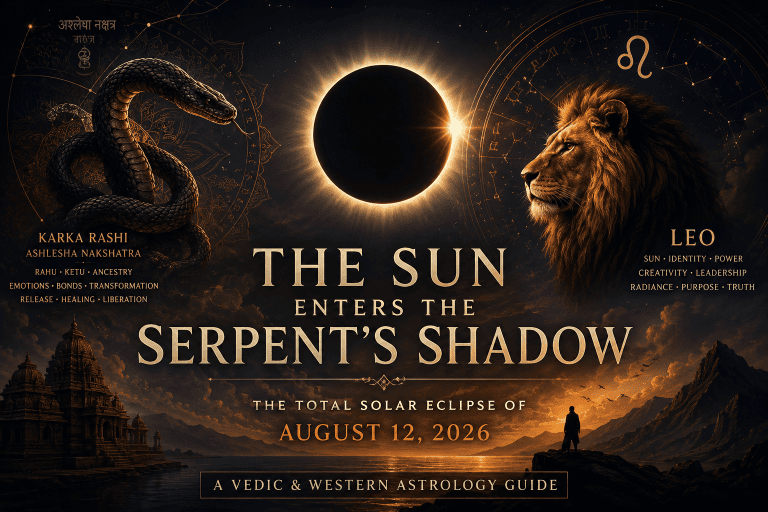
The Total Solar Eclipse of August 12, 2026: A Vedic and Western Astrology Guide
On August 12, 2026, the Moon will pass directly between the Earth and the Sun, creating one of the most powerful celestial events we can witness: a total solar eclipse.
For a few extraordinary moments, daylight will disappear.
The familiar brilliance of the Sun will be covered by the dark silhouette of the Moon. The sky will deepen into an unnatural twilight. Temperatures may fall. Birds may return to their nests. Animals may become still or confused. Stars and planets may suddenly become visible in the middle of the day.
Astronomically, we understand exactly what is happening.
The Moon, while appearing much smaller than the Sun in reality, is also much closer to the Earth. From our perspective, the two appear almost exactly the same size. When their paths align perfectly, the Moon can temporarily cover the solar disc and reveal the luminous corona surrounding it.
But astrology does not only ask what is happening in the sky.
Astrology asks what the sky is reflecting within us.
The total solar eclipse of August 12 is especially significant because it carries two different but deeply complementary messages.
In Western tropical astrology, the eclipse takes place in Leo, the sign of the Sun, identity, leadership, creativity and the courage to be fully seen.
In Vedic astrology, using the sidereal zodiac, the eclipse takes place in Karka Rashi—Cancer—within Ashlesha Nakshatra, the mysterious lunar mansion associated with serpents, emotional entanglements, hidden power, ancestral conditioning and transformation.
One system speaks about sovereignty.
The other speaks about what binds us.
Together, they ask a profound question:
Can we truly stand in our power without first examining the emotional, ancestral and psychological patterns wrapped around that power?
This is not merely an eclipse of the Sun.
It is an eclipse of the identities we have mistaken for the Self.
When the Light Disappears
The Sun is so constant that we rarely contemplate what life would feel like without it.
Every day, it rises.
Every day, it gives light without hesitation.
The Sun regulates time, seasons, climate, plant life, biological rhythms and nearly every form of visible life on Earth. Even when hidden behind clouds, we know it is there.
During a total solar eclipse, however, that certainty is briefly interrupted.
The Sun does not actually disappear. It is not extinguished. Its light is simply blocked from our point of view.
This distinction carries the entire spiritual teaching of an eclipse.
There are moments in life when clarity appears to vanish.
We may lose confidence in a direction that once seemed certain. A relationship, career, belief system or identity may no longer feel stable. We may question our purpose, our authority or even our understanding of ourselves.
But the essential light has not disappeared.
It has been obscured.
An eclipse reminds us that confusion is not always evidence that we have lost our path. Sometimes confusion appears because an old way of seeing is being interrupted.
The darkness is not necessarily punishment.
It may be revelation.
What Creates a Solar Eclipse?
A solar eclipse can only happen during a New Moon, when the Sun and Moon occupy the same region of the zodiac.
Yet we do not experience an eclipse every month.
The Moon’s orbit around the Earth is tilted slightly in relation to the Earth’s orbit around the Sun. Most months, the Moon passes a little above or below the Sun from our viewpoint.
An eclipse occurs only when the New Moon forms close to one of two invisible intersection points called the lunar nodes.
These nodes are not physical planets. They are mathematical points where the orbit of the Moon crosses the apparent path of the Sun.
In Western astrology, they are called the North Node and South Node.
In Vedic astrology, they are known as Rahu and Ketu.
The August 12 eclipse occurs on the South Node or Ketu side of the nodal axis.
This is important because South Node eclipses tend to emphasize completion, release, karmic familiarity and the exhaustion of something that has already served its purpose.
They do not always bring immediate beginnings.
They often reveal what must be emptied before something more authentic can be born.
The Ancient Story of Rahu and Ketu
The Vedic understanding of eclipses is expressed through the story of the churning of the cosmic ocean.
The devas and asuras worked together to churn the ocean of existence in search of Amrita, the nectar of immortality.
When the nectar finally appeared, Vishnu took the form of Mohini and began distributing it among the devas.
One asura, however, disguised himself and quietly sat among them.
He received the nectar.
But before he could swallow it completely, Surya—the Sun—and Chandra—the Moon—recognized the deception and exposed him.
Vishnu immediately severed the asura’s head with the Sudarshana Chakra.
Yet because the nectar had already touched him, he could not die.
His immortal head became Rahu.
His headless body became Ketu.
From that moment onward, Rahu and Ketu pursued the Sun and Moon across the heavens. When they caught them, an eclipse occurred.
This mythology is not simply a primitive attempt to explain an astronomical event.
It describes something deeply psychological.
The Sun represents truth, identity, consciousness and illumination.
The Moon represents mind, memory, emotional perception and instinct.
Rahu represents hunger, obsession, amplification and the desire to possess experience.
Ketu represents separation, release, past-life residue and the dissolution of attachment.
During an eclipse, the shadow interrupts the light.
But it can never hold it permanently.
The Sun always returns.
The Western Astrology of the Eclipse
A Solar Eclipse in Leo
In Western tropical astrology, the August 12 eclipse occurs in Leo.
Leo is ruled by the Sun itself.
This makes the eclipse especially potent because the Sun is being obscured within the very sign associated with solar qualities.
Leo represents the radiant self.
It is the part of us that wants to create, express, lead, love, play and offer something unique to the world.
Leo is connected with:
- Leadership
- Self-expression
- Creativity
- Confidence
- Visibility
- Recognition
- Romance
- Children
- Joy and pleasure
- Performance
- Personal authority
- The courage of the heart
At its highest expression, Leo is warm, generous, loyal and life-giving.
True Leo energy does not dominate because it does not feel threatened by the radiance of others. It shines naturally and gives others permission to shine as well.
Leo is the king or queen who leads through presence rather than intimidation.
It is the artist who creates because something inside must be expressed.
It is the teacher who uplifts without demanding worship.
It is the lover who celebrates rather than possesses.
But every sign also carries a shadow.
When Radiance Becomes Performance
The shadow of Leo emerges when authentic self-expression is replaced by performance.
This happens when being seen becomes more important than being true.
A person may appear confident while privately feeling empty.
They may seek applause because silence makes them confront their own uncertainty.
They may become attached to being admired, followed, praised or treated as special.
They may confuse leadership with control.
They may experience disagreement as disrespect.
They may become so loyal to a public identity that they can no longer admit when that identity has become false.
Many of us perform versions of ourselves long after those versions have expired.
We perform strength because we are afraid to be vulnerable.
We perform success because we are afraid to admit exhaustion.
We perform spirituality because we are afraid of our humanity.
We perform independence because we are afraid to need anyone.
We perform happiness because we believe sadness makes us less lovable.
The eclipse in Leo may temporarily remove the stage lights.
It may reveal which parts of our identity are genuinely alive and which parts only survive through attention.
The deeper question of this eclipse is not:
How can I become more visible?
It is:
Who am I when there is no audience?
The South Node in Leo: Releasing the Old Performance
Because this is a South Node eclipse, its Leo symbolism is not only about stepping into confidence.
It is also about releasing forms of confidence that are built upon compensation.
The South Node represents what is familiar.
It can describe abilities we have already developed, roles we know how to play and identities we can inhabit almost automatically.
But familiarity is not always the same as alignment.
A role may feel natural because we have performed it for years.
A relationship pattern may feel intense because we have repeated it many times.
A form of leadership may feel powerful because it once helped us survive.
Yet an eclipse can reveal that what once protected us is now limiting us.
The South Node eclipse in Leo may ask us to release:
- The need to be the center of every story
- The need to be indispensable
- Dependence upon praise and validation
- Drama created to secure attention
- Pride that prevents apology
- Leadership based on fear or control
- Creative identities that no longer feel alive
- Loyalty to a public image that contradicts private truth
- The belief that worth must be continuously proven
The eclipse is not asking us to abandon our radiance.
It is asking us to stop confusing radiance with performance.
Sovereignty Without Spectacle
Leo’s highest teaching is sovereignty.
But sovereignty is often misunderstood.
It does not mean becoming emotionally unreachable.
It does not mean refusing guidance.
It does not mean dominating others or insisting that our perception is always correct.
True sovereignty is the ability to remain connected to our inner center without requiring the world to constantly confirm who we are.
Sovereignty is quiet.
It does not need to announce itself every few minutes.
It does not collapse when someone else succeeds.
It does not become smaller when someone else shines.
It does not need followers in order to possess direction.
The August eclipse may ask:
Can you create when no one is watching?
Can you lead without needing to be worshipped?
Can you serve without making people dependent upon you?
Can you celebrate the brilliance of another person without experiencing it as a threat?
Can you remain connected to your purpose when applause disappears?
Can your work survive the loss of attention?
The outer Sun may be temporarily hidden so that the inner Sun can be examined.
The Leo–Aquarius Axis
The Individual and the Collective
The eclipse also activates the relationship between Leo and Aquarius.
Leo represents individual creative power.
Aquarius represents the larger field: community, networks, systems, ideas, movements and the future.
Leo says:
I carry a unique flame.
Aquarius says:
That flame exists within a larger constellation.
An unbalanced Leo may believe everything revolves around the individual.
An unbalanced Aquarius may erase the individual in service of the group.
One can become narcissistic.
The other can become impersonal.
The higher expression of the axis is the unique individual offering their gifts in service to something larger than themselves.
This eclipse may therefore raise questions around leadership and community.
Does the leader exist to empower the community, or does the community exist to glorify the leader?
Does an organization serve its purpose, or has it become obsessed with protecting its image?
Does a spiritual teacher create independent practitioners, or emotionally dependent followers?
Does a movement allow individuality, or does it demand conformity in the name of belonging?
The eclipse may expose where personal charisma has replaced accountability.
It may also reveal where group ideology has suppressed authentic individual expression.
The medicine is not to destroy the individual or the collective.
It is to restore right relationship between them.
The Vedic Astrology of the Eclipse
Surya Grahan in Karka Rashi
In Vedic astrology, the eclipse occurs in Karka Rashi, the sign of Cancer.
Cancer is ruled by the Moon.
It represents the emotional body, home, family, nourishment, belonging, memory and the instinct to protect.
Where Leo asks who we are in the world, Cancer asks where we feel safe enough to be ourselves.
Karka governs:
- Home
- Mother
- Family
- Homeland
- Emotional security
- Memory
- Food and nourishment
- Caregiving
- The private self
- The need to belong
- The instinct to protect
- Ancestral and family conditioning
Cancer is the womb.
It is the home we return to after meeting the world.
It is the emotional environment that shapes us before we have language.
It is where we learn whether love feels safe, conditional, chaotic, nurturing or unavailable.
When an eclipse occurs in Cancer, the structures that once gave us safety may need to be reevaluated.
The question becomes:
Is this truly nourishing me, or is it only familiar?
When Protection Becomes Imprisonment
The Cancerian instinct is to protect.
But protection can become control when fear enters the heart.
A parent may restrict a child and call it love.
A family may demand obedience and call it loyalty.
A relationship may discourage freedom and call it commitment.
A community may punish individuality and call it belonging.
We may remain loyal to painful emotional environments simply because leaving them feels like betrayal.
We may protect an old identity because it once helped us survive.
We may hold onto grief because releasing it feels like abandoning the person we lost.
We may continue carrying family expectations because we are afraid that choosing our own life will make us selfish.
The eclipse in Cancer asks:
What am I protecting?
And even more importantly:
What is that protection costing me?
Cancer preserves memory.
But not every memory should be given authority over the future.
Surya and Chandra
When the Mind Covers the Self
In Jyotisha, Surya represents far more than the physical Sun.
Surya signifies:
- Atman, the essential Self
- Vitality
- Purpose
- Dharma
- Authority
- Father and paternal inheritance
- Honor
- Reputation
- Government and leadership
- The capacity to stand upright in one’s truth
Chandra, the Moon, represents:
- Manas, the sensory and emotional mind
- Memory
- Habit
- Mood
- Psychological responsiveness
- The need for safety
- The way we receive and interpret experience
During a solar eclipse, the Moon covers the Sun.
Symbolically, the conditioned mind temporarily obscures the light of the Self.
Emotion may overpower discernment.
Old memories may speak more loudly than present truth.
Family conditioning may be mistaken for dharma.
Fear may sound like intuition.
Attachment may disguise itself as love.
During the eclipse period, it becomes especially important to distinguish between an emotional reaction and inner knowing.
Not every intense feeling is guidance.
Not every fear is a warning.
Not every longing is destiny.
Sometimes the mind is simply repeating a pattern it has learned.
The eclipse gives us an opportunity to witness that pattern without immediately obeying it.
Ashlesha Nakshatra
The Serpent That Binds and Heals
The eclipse occurs within Ashlesha Nakshatra.
Ashlesha is one of the most psychologically complex and spiritually potent nakshatras in Vedic astrology.
Its symbol is the coiled serpent.
Its presiding energies are the Nagas, the ancient serpent intelligences associated with hidden wisdom, subterranean power, medicine, poison, transformation and the mysteries of consciousness.
The serpent is never a simple symbol.
It can represent danger or healing.
It can seduce, protect, poison, awaken or transform.
A serpent sheds its skin and is therefore associated with rebirth.
Its venom can kill, yet serpent venom has also been used medicinally.
It moves close to the Earth, yet it is also associated with Kundalini Shakti, the evolutionary energy said to rest coiled at the base of the spine.
Ashlesha teaches us that power is rarely neutral.
The same sensitivity can become compassion or manipulation.
The same intelligence can become wisdom or deception.
The same intimacy can become sacred union or emotional entanglement.
The same devotion can become liberation or bondage.
The same ancestral connection can become guidance or unconscious repetition.
The eclipse may reveal how we use our emotional and intuitive power.
Do we heal?
Do we control?
Do we communicate directly?
Or do we create invisible emotional hooks?
The Patterns That Coil Around Us
A serpent does not move in a straight line.
It coils.
Ashlesha therefore describes patterns that return again and again.
These may include:
- Emotional attachments that are difficult to release
- Unspoken family loyalties
- Secret agreements
- Inherited fears
- Seductive but destructive relationships
- Psychological manipulation
- Words that remain in the mind long after they were spoken
- Shame carried from childhood
- Intimacy confused with possession
- Spiritual bonds used to justify unhealthy behavior
- Power exercised indirectly
- The fear of abandonment
- The fear of losing control
Some bonds are visible.
Others are energetic and psychological.
We may have physically left a relationship but remain emotionally tied to it.
We may have separated from our family but still organize our life around seeking their approval.
We may reject the beliefs of our childhood while unconsciously repeating the same emotional patterns.
We may call something destiny because we do not yet know how to release it.
Ashlesha asks us to examine the coil.
Where does the pattern begin?
What keeps tightening it?
What fear prevents us from unwinding it?
The Poison and the Medicine
One of the deepest teachings of Ashlesha is that the poison often contains the medicine.
The pattern itself may reveal the place where healing is needed.
Jealousy may expose a wound around worthiness.
Control may reveal a profound fear of abandonment.
People-pleasing may reveal the belief that love must be earned.
Emotional withdrawal may reveal a history of not feeling safe enough to be vulnerable.
The eclipse does not ask us to shame these patterns.
It asks us to see them clearly enough that they no longer operate from the shadows.
We do not heal by pretending the poison never existed.
We heal by understanding its origin, respecting its power and learning the correct antidote.
The eclipse may reveal that one of our greatest gifts has been distorted by fear.
Sensitivity became hypervigilance.
Devotion became self-abandonment.
Discernment became suspicion.
Strength became emotional armor.
Leadership became control.
The gift does not need to be destroyed.
It needs to be purified.
Ketu and the Ancestral Threshold
Because this eclipse occurs on the descending-node side, Ketu becomes an important part of its Vedic meaning.
Ketu is associated with:
- Detachment
- Past-life impressions
- Completion
- Spiritual insight
- Disillusionment
- Separation
- Loss of worldly fascination
- The dissolution of false identity
- Mysticism
- Liberation
Ketu often removes our attachment to something by revealing its emptiness.
What once appeared impressive may suddenly feel hollow.
What once seemed essential may lose its emotional power.
What once defined us may no longer feel relevant.
This can initially feel disorienting.
We may interpret the loss of interest as failure.
But sometimes it is the soul withdrawing energy from a chapter that has completed.
Around this eclipse, Ketu occupies Magha Nakshatra, the realm of ancestors, lineage, inheritance, authority and the ancestral throne.
This creates a profound bridge between Ashlesha and Magha.
Ashlesha contains the emotional bonds of the family system.
Magha contains the ancestral throne and the power inherited through lineage.
The eclipse stands between them.
It asks us to examine how our identity has been shaped by what came before us.
Some people unconsciously make themselves smaller to remain loyal to their family.
Others become excessively ambitious to compensate for ancestral shame, poverty or exclusion.
Some repeat the authority patterns of their fathers while believing they are rebelling against them.
Some carry the unfulfilled dreams of their mothers.
Some inherit fear around wealth, intimacy, visibility or spiritual power.
Some feel responsible for repairing an entire lineage.
The eclipse asks:
Which inheritance is truly yours to carry?
And:
Which burden has simply been passed from one generation to the next because no one knew how to put it down?
Honoring the ancestors does not mean repeating their suffering.
Sometimes the greatest act of ancestral devotion is to end a pattern they could not end themselves.
The Western and Vedic Message Together
Western astrology places the eclipse in Leo, the sign of visible identity, creativity and sovereignty.
Vedic astrology places it in Cancer and Ashlesha, the realm of emotional memory, family conditioning and entanglement.
One system asks:
Who are you when the stage goes dark?
The other asks:
What has been wrapped around your identity for so long that you mistake it for yourself?
Together, they reveal the central teaching of the eclipse:
Authentic power cannot be built upon emotional bondage or external validation.
Western astrology asks us to release the performance.
Vedic astrology asks us to untie the emotional coil beneath the performance.
Leo says: Become sovereign.
Cancer says: Heal the place that never felt safe.
Ashlesha says: Recognize the binding.
Ketu says: Release what has completed.
The eclipse does not ask us to become less radiant.
It asks us to become less false.
Possible Collective Themes
Solar eclipses have traditionally been connected with leaders, governments, authority structures and public figures because the Sun symbolizes rulership.
This does not mean that every eclipse produces a dramatic political event.
Astrology is not a machine that guarantees literal outcomes.
It describes patterns, pressures and fields of meaning.
Because this eclipse engages Leo in the Western zodiac and Cancer–Ashlesha in the Vedic zodiac, collective themes may include questions around:
- Leadership and legitimacy
- Political or public succession
- Dynasties and inheritance
- Celebrity culture
- Children and education
- National identity
- Homeland and migration
- Housing, food and water
- Family-controlled institutions
- Emotional propaganda
- Manipulation through fear
- Loyalty and exclusion
- Hidden alliances
- The relationship between charisma and accountability
- Public image versus private reality
We may see greater scrutiny of leaders who rely upon personality rather than integrity.
Institutions may be challenged to reveal whether they genuinely protect the people they claim to serve.
Communities may confront the difference between belonging and conformity.
Families, organizations and nations may have to examine the stories they tell about themselves.
Eclipses often expose places where the image and the underlying reality no longer match.
Who May Feel This Eclipse Most Strongly?
Everyone experiences eclipse seasons differently.
The eclipse may feel especially personal when it closely activates the Sun, Moon, Ascendant, Midheaven or important planets in the natal chart.
In Western astrology, people with strong placements in Leo, Aquarius, Taurus and Scorpio may notice the eclipse more intensely, particularly when those placements fall near the eclipse degree.
In Vedic astrology, the eclipse may be especially relevant for those with:
- Important planets in late Cancer
- Moon or Ascendant in Ashlesha
- Cancer Ascendant or Moon sign
- Strong Sun, Moon, Mercury or Ketu periods
- Important placements near the Cancer–Leo boundary
- Planets in Ashlesha or Magha
- Significant dasha or antardasha activation involving the eclipse planets
Yet an eclipse should never be interpreted from the Sun sign or Moon sign alone.
The entire chart matters.
The activated house, planetary condition, dasha sequence and personal circumstances determine how the symbolism may express itself.
An eclipse does not automatically bring misfortune.
It may bring an ending, revelation, redirection, release or change of perception.
Sometimes the event is external.
Sometimes the most important shift happens within consciousness.
The House Activated by the Eclipse
In a Western tropical chart, look for the house containing Leo.
In a Vedic sidereal chart, look for the house containing Cancer.
That house shows the area of life in which eclipse themes may unfold.
First House
Identity, vitality, direction, appearance and the way you enter the world.
Second House
Money, possessions, family values, self-worth, speech and security.
Third House
Communication, courage, siblings, writing, learning and the immediate environment.
Fourth House
Home, mother, ancestry, emotional foundations and private life.
Fifth House
Creativity, children, romance, intelligence, joy and self-expression.
Sixth House
Health, daily routines, work, service, conflict, debt and discipline.
Seventh House
Partnership, marriage, agreements, contracts and one-to-one relationships.
Eighth House
Intimacy, shared resources, grief, inheritance, secrecy and transformation.
Ninth House
Beliefs, teachers, pilgrimage, higher learning, publishing and purpose.
Tenth House
Career, reputation, leadership, public contribution and authority.
Eleventh House
Community, networks, friendships, patrons, income and long-term aspirations.
Twelfth House
Retreat, rest, endings, sleep, foreign lands, hidden patterns and liberation.
The eclipse may not produce an obvious event on August 12 itself.
Its themes can begin appearing weeks beforehand and continue unfolding for several months.
Eclipse energy often works through a process.
First something is obscured.
Then something is revealed.
Only later do we understand what changed.
How to Approach the Eclipse Spiritually
Traditional Vedic practice treats an eclipse as a time of inwardness.
It is not necessary to fear the day.
It is equally unnecessary to treat it like an ordinary New Moon and immediately use it for aggressive manifestation.
An eclipse is not always the best moment to demand that life give us what we want.
It is often a better moment to ask what we are finally ready to release.
The atmosphere may feel emotionally charged, psychologically intense or strangely quiet.
The most powerful response is simplicity.
Reduce unnecessary noise.
Avoid creating drama simply because emotions feel stronger.
Pause before making irreversible decisions.
Listen before speaking.
Observe before reacting.
Let the eclipse show you what is moving beneath the surface.
Before the Eclipse
In the hours before the eclipse, create a calmer environment.
Clean your meditation space.
Reduce excessive media and conversation.
Complete essential tasks early if possible.
Eat lightly if that supports your health and constitution.
Choose simple, sattvic food rather than heavy or overstimulating meals.
You may prepare a candle or ghee lamp, a bowl of water, mala beads and a journal.
Fasting is traditionally observed in some lineages, but it should never be approached rigidly.
Children, pregnant women, elderly people and anyone with medical conditions, blood-sugar concerns or medication requirements should follow appropriate health guidance.
Spiritual practice should deepen intelligence, not override it.
During the Eclipse
The eclipse period may be used for:
- Silent meditation
- Mantra japa
- Gentle pranayama
- Prayer
- Witnessing the mind
- Contemplating impermanence
- Honoring the ancestors
- Releasing emotional agreements
- Resting from unnecessary speech
- Writing privately
- Sitting in darkness
- Observing fear without feeding it
This is not the moment to perform spirituality for others.
It is a time to become intimate with your own consciousness.
You may notice memories, emotions or old relationships resurfacing.
Do not assume that everything that returns must be acted upon.
Sometimes something returns only because it is ready to be understood and released.
The eclipse can reveal the difference between a true calling and an emotional compulsion.
After the Eclipse
Traditional observance often includes bathing, changing clothes, cleaning the practice space and preparing fresh food.
You may also offer water to the Sun the following morning.
Charity is especially meaningful after an eclipse.
Feed someone.
Support a child.
Offer food to animals.
Help a family in need.
Contribute toward water, shelter or nourishment.
Care for someone who does not possess the security you may take for granted.
This is a beautiful way to transform emotional insight into living dharma.
Mantras for the Eclipse
Choose one mantra rather than moving through many.
Depth is more important than variety.
Surya Mantra
Om Suryaya Namaha
This mantra honors Surya, the solar intelligence, inner clarity, vitality and rightful purpose.
You may repeat it 108 times.
Surya Gayatri
Om Bhaskaraya Vidmahe
Mahadyutikaraya Dhimahi
Tanno Aditya Prachodayat
May we know the radiant source.
May we meditate upon the great light.
May Aditya illuminate our understanding.
Maha Mrityunjaya Mantra
Om Tryambakam Yajamahe
Sugandhim Pushtivardhanam
Urvarukamiva Bandhanan
Mrityor Mukshiya Maamritat
This mantra is especially powerful for an Ashlesha eclipse because of the word bandhanan, referring to bondage or binding.
The mantra asks for release from attachment as naturally as a ripe fruit separates from the vine.
It is not a rejection of life.
It is a prayer to live without being imprisoned by fear.
Ketu Mantra
Om Ketave Namaha
This may be used when the intention is karmic release, spiritual discernment, detachment and freedom from identities that have completed their purpose.
After mantra repetition, sit in silence.
Let the vibration settle.
Do not rush to interpret everything you experience.
An Ashlesha Release Ritual
This simple ritual can be performed during the eclipse period or the following morning.
Take a piece of natural thread, cotton cord or ribbon.
Sit quietly and bring one emotional bond to mind.
This may be a relationship, ancestral expectation, old promise, identity, family role or repeated emotional pattern.
The purpose is not to reject another person.
It is not to deny love.
The intention is to release unconscious binding.
Gently wind the thread around your fingers.
As you do, acknowledge what the pattern once protected.
Perhaps control protected you from abandonment.
Perhaps silence protected you from conflict.
Perhaps perfection protected you from criticism.
Perhaps emotional distance protected you from disappointment.
Honor the intelligence of the survival pattern.
Then acknowledge its cost.
When you are ready, say:
I honor what this bond once protected.
I acknowledge what it has cost.
I release the unconscious agreement to remain bound.
May wisdom remain.
May fear depart.
May love exist without captivity.
Slowly unwind the thread.
Place it in a bowl of water for a few minutes.
Then dispose of it respectfully.
Complete the practice with the Maha Mrityunjaya Mantra or 11 repetitions of Om Suryaya Namaha.
Eclipse Journal Reflections
You may contemplate the following questions before, during or after the eclipse:
Where have I confused being admired with being loved?
Which identity requires the greatest amount of performance to maintain?
What family role am I afraid to outgrow?
Where has protection become control?
What emotional pattern keeps returning through different relationships?
Which ancestral strength genuinely belongs in my future?
Which inherited fear no longer deserves authority over my life?
Where do I manipulate indirectly because I am afraid to ask directly?
What would I create without the promise of recognition?
What does sovereignty feel like when it is quiet?
What would change if I no longer needed everyone to understand me?
Which version of myself is ready to be released?
What Not to Do During Eclipse Season
Avoid fear-based predictions.
An eclipse is not a guarantee of catastrophe, death, loss or punishment.
Do not assume that every person with Leo, Cancer or Ashlesha placements will experience hardship.
Do not make impulsive decisions merely because emotions are intense.
Do not confuse urgency with intuition.
Avoid forcing immediate clarity.
The purpose of an eclipse is not always to give answers.
Sometimes it removes the false answer that prevented a deeper truth from emerging.
Allow space for integration.
Some realizations need silence before they can become wisdom.
A Note on Eclipse Safety
Spiritual reverence must include physical intelligence.
Never look directly at the Sun during the partial phases of a solar eclipse without proper certified eclipse glasses or solar viewers.
Ordinary sunglasses are not sufficient.
Cameras, telescopes and binoculars require correctly fitted solar filters placed over the front of the instrument.
Looking through an optical device while wearing eclipse glasses is still dangerous because concentrated sunlight can damage both the viewer and the eyes.
Only people within the path of totality may briefly remove solar protection during the short period when the bright surface of the Sun is completely covered.
The moment any part of the Sun reappears, eye protection must be restored.
When the Sun Returns
This eclipse brings together two powerful images.
In Western astrology, the royal Sun is obscured in Leo, the sign of personal radiance, leadership and creative identity.
In Vedic astrology, the eclipse unfolds in Ashlesha, the serpent that coils around memory, attachment and hidden emotional power.
One system asks:
Who are you when the stage goes dark?
The other asks:
What has been wrapped around your identity for so long that you mistake it for yourself?
This is not an eclipse asking you to become smaller.
It is asking you to become more truthful.
The authentic Sun does not disappear when admiration disappears.
Dharma does not vanish when a title is removed.
Creativity does not die when the audience looks elsewhere.
Love does not require emotional captivity.
Your soul does not lose its radiance simply because the outer world cannot see it for a moment.
For a few extraordinary minutes, the Sun will be hidden.
But the deeper teaching of every eclipse is that light is not destroyed by darkness.
It is only concealed long enough for us to recognize how much of our lives depended upon seeing it outside ourselves.
And when the Sun returns, the question will not be whether the light has changed.
The question will be whether we have.