
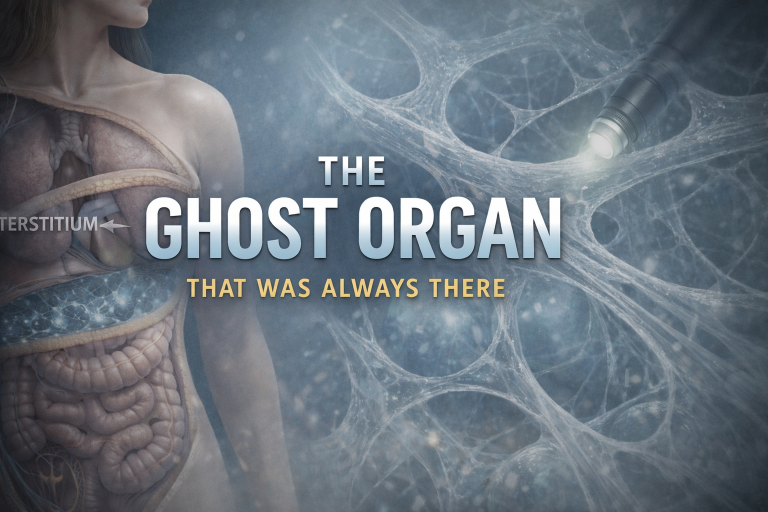
Imagine opening an anatomy textbook printed in 2015.
The diagrams are clean and orderly.
Skin sits on top. Beneath it lies fat. Beneath that, muscle. Beneath muscle, bone.
Everything appears neatly stacked—like solid layers in a biological sandwich.
For generations, that is how we believed the body was structured.
But something extraordinary happened.
We discovered that those drawings were wrong.
Not slightly wrong.
Fundamentally wrong.
The Problem With How We Studied the Body
For over a century, scientists studied human tissue through histology—the microscopic examination of tissue samples.
But there was a hidden flaw in the process.
To examine tissue under a microscope, scientists traditionally had to:
-
Remove the tissue
-
Fix it chemically
-
Dehydrate it
-
Slice it thinly
-
Stain it
During this process, the tissue is dried and compressed.
Any fluid-filled spaces collapse.
The result?
What scientists saw looked like dense, solid layers.
But those layers were not truly solid in a living body.
The preparation process had unintentionally erased a crucial structure.
The Discovery That Changed Anatomy
In 2018, researchers using probe-based confocal laser endomicroscopy—a technology that allows scientists to observe tissue inside the living body in real time—made a startling discovery.
What had appeared to be dense connective tissue was actually something very different.
It was full of fluid-filled spaces.
These spaces formed a vast, interconnected network throughout the body.
Researchers named this structure:
The Interstitium.
Some scientists now refer to it as a newly recognized organ system.
Not because it suddenly appeared—but because we finally saw it as it truly exists in living tissue.
The Body Is Not Solid
Beneath your skin, surrounding your organs, wrapping your muscles, and lining your arteries exists a vast network of microscopic compartments filled with fluid.
These spaces exist within connective tissue and fascia, forming an elastic, flexible mesh.
Instead of dense layers, the body contains a dynamic lattice of fluid channels.
Think of it as:
-
A hydraulic shock absorber
-
A fluid transport highway
-
A communication network
It connects nearly everything in the body.
Skin
Muscle
Blood vessels
Lungs
Digestive tract
Fascia
Joints
All of it is interlinked through this fluid-filled architecture.
You are not built like a brick wall.
You are built like a living sponge filled with flowing water.
Why This Discovery Matters
The discovery of the interstitium is not just a curiosity of anatomy.
It may change how we understand disease, healing, and body mechanics.
1. A New Pathway for Cancer Spread
Traditionally, scientists believed cancer spread primarily through:
-
Blood vessels
-
Lymphatic vessels
But researchers now suspect that interstitial spaces may act as rapid transport channels for migrating cancer cells.
Because the interstitium connects many tissues directly, cancer cells may travel along these pathways before entering the lymphatic system.
Understanding this may lead to:
-
New diagnostic approaches
-
Earlier detection of metastasis
-
New strategies for blocking cancer spread
Oncology is beginning to explore this possibility seriously.
2. A Possible Anatomical Basis for Ancient Medicine
For thousands of years, Traditional Chinese Medicine described networks of energy channels called meridians through which Qi flows.
These channels do not correspond to nerves, arteries, or veins.
Because they were invisible to traditional anatomy, many Western scientists dismissed them.
But the discovery of the interstitium is forcing a reconsideration.
The interstitial network is:
-
Rich in fluid
-
Conductive due to electrolytes
-
Mechanically connected across tissues
Some researchers propose that acupuncture needles may stimulate this fascia-interstitial system, sending mechanical and electrical signals through the connective tissue network.
In other words:
Ancient descriptions of energy flow may correspond to fluid and mechanical signaling within connective tissue.
The language was different.
But the observation may have been accurate.
3. The Body Functions as a Hydraulic System
If the interstitium is a continuous fluid network, it changes how we understand physical tension and movement.
Stiffness in one area of the body may influence distant regions because the fluid and fascial network is continuous.
A restriction in the ankle can affect the knee.
A tight hip can influence the spine.
A rigid thoracic fascia can change neck mobility.
This idea echoes principles from biomechanics and fascial research, including the concept of biotensegrity, where the body functions as a unified tension network rather than isolated parts.
Your body is not a stack of independent components.
It is a connected hydraulic organism.
The Forgotten Language of Fluid
Traditional systems of medicine often spoke about fluid stagnation.
In Ayurveda, impaired movement of fluids relates to imbalances in Kapha and Vata.
In Chinese medicine, blocked Qi corresponds to stagnation within the body’s channels.
For centuries, these descriptions were interpreted metaphorically.
But today, modern research is revealing that fluid movement through connective tissues is fundamental to health.
When fluids stagnate, tissues become:
-
Stiff
-
Inflamed
-
Poorly nourished
When fluids move freely, tissues remain:
-
Elastic
-
Resilient
-
Well oxygenated
Movement is not simply about muscles.
It is about maintaining the circulation of fluid through the body’s connective architecture.
Why Modern Life Disrupts the Interstitium
The interstitial network relies on motion and pressure changes to circulate its fluid.
But modern lifestyles often eliminate those natural pumps.
Long periods of sitting reduce fluid exchange.
Lack of joint movement compresses tissues.
Poor hydration thickens interstitial fluid.
Over time, tissues can become dehydrated and adhesive, reducing elasticity and increasing stiffness.
The body begins to feel rigid not because of aging alone, but because fluid movement has slowed.
How to Support Interstitial Health
Maintaining this fluid network does not require complex interventions.
The fundamentals are surprisingly simple.
1. Hydration With Electrolytes
Interstitial fluid contains salts and minerals, not pure water.
Drinking large amounts of plain water without electrolytes can dilute the body’s mineral balance.
A small pinch of unrefined sea salt or mineral salts in water can help support proper fluid balance.
This allows water to remain within tissues rather than simply passing through the kidneys.
2. Oscillatory Movement
Gentle bouncing movements—such as rebounding on a trampoline or light rhythmic jumping—are particularly effective at moving interstitial fluid.
These oscillations create pressure waves that help circulate fluid through connective tissue compartments.
This is one reason traditional cultures incorporated rhythmic movement and dance into daily life.
3. Myofascial Release
Tools such as foam rollers or massage balls apply pressure to fascia and connective tissue.
This pressure temporarily compresses tissues and then allows them to rehydrate when released.
The process can improve:
-
Tissue elasticity
-
Fluid exchange
-
Mobility
Many people notice reduced stiffness and improved movement after regular fascial release.
The Body as a Living River
You are roughly 70 percent water.
But that water is not stored in a bucket.
It is flowing through a dynamic architecture of channels, compartments, and connective tissues that weave through your entire body.
A network that cushions your organs.
Transmits mechanical forces.
Moves nutrients and signals.
And connects every region to every other.
For centuries, we thought the body was built like a machine.
Solid parts assembled together.
But the deeper we look, the clearer it becomes:
The human body behaves more like a river system than a machine.
Fluid pathways weaving through living landscapes.
And the interstitium may be one of the most important parts of that hidden river.
An organ that was always there.
We simply needed the right lens to finally see it.