There is a reason certain parts of the body have always been treated with reverence across civilizations—not merely as anatomical structures, but as gateways. The sacrum is one such structure. Quietly positioned at the base of the spine, it is often overlooked in modern discourse, yet in ancient sciences, it was understood as a threshold: where biology meets consciousness, where matter begins to remember its origin.
The very word sacrum comes from the Latin os sacrum—“holy bone.” This is not poetic exaggeration. It is an encoded recognition.
The Architecture of the Sacred
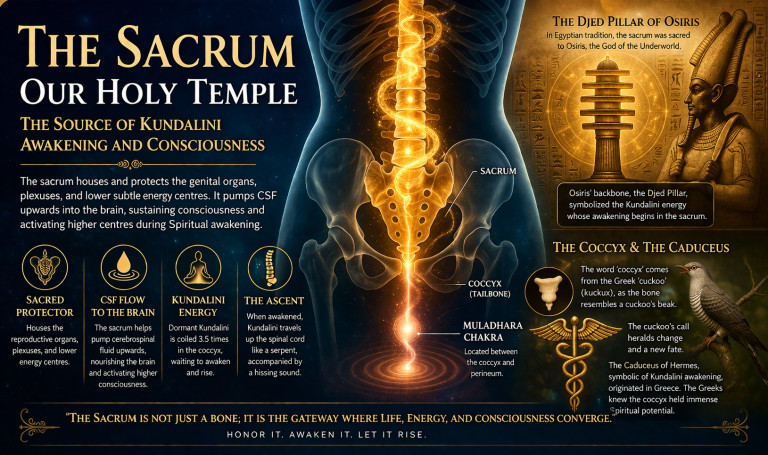
The sacrum is a triangular bone formed by the fusion of five vertebrae, anchoring the spine into the pelvis. It houses and protects some of the most vital systems in the human body:
- The reproductive organs
- The sacral nerve plexus
- The lower subtle energy centers
- The base of the spinal canal
This is not incidental design. This is a convergence point.
It is here that survival, creation, sexuality, and continuity of life intersect. It is here that the body holds its most primal intelligence—the intelligence that sustains species, not just individuals.
But beyond its structural and neurological roles, the sacrum participates in something far more subtle: the regulation of flow.
Cerebrospinal Fluid: The River of Consciousness
Within the spinal column circulates cerebrospinal fluid (CSF)—a clear, life-sustaining medium that cushions the brain and spinal cord, transports nutrients, and removes waste.
Yet, in deeper traditions, CSF is not just fluid—it is essence.
The sacrum plays a critical role in the rhythmic pumping of this fluid. Through micro-movements—subtle oscillations influenced by breath, posture, and internal pressure—the sacrum contributes to the upward movement of CSF toward the brain.
From a physiological lens, this supports neural function and brain health.
From a yogic lens, this movement is far more profound:
It is the ascent of life-force into awareness.
As this fluid reaches higher centers, particularly the limbic system and cortex, it correlates with heightened perception, clarity, and altered states of consciousness. In spiritual traditions, this is described as the activation of “higher centers”—not as metaphor, but as lived experience.
The Coccyx: The Point of Potential
At the base of the sacrum lies the coccyx—the tailbone. Small, triangular, and seemingly insignificant, it is often dismissed as a vestigial remnant.
But ancient systems did not see it this way.
They saw it as a coil point.
In yogic science, Kundalini energy is described as being coiled three and a half times at the base of the spine, near the coccyx. This coiling represents latent potential—energy not yet expressed, consciousness not yet awakened.
The Muladhara Chakra, the root energy center, is located between the coccyx and the perineum. It governs stability, survival, grounding—but also serves as the ignition point of transformation.
When this dormant energy is activated, it begins a journey upward through the spinal axis, often described as a serpent rising.
This is not mythology in the casual sense—it is symbolic language for a real experiential process.
Practitioners often report sensations of heat, vibration, or movement along the spine. In some cases, even an internal auditory phenomenon—described as a hissing or subtle sound—accompanies this ascent.
The body, in these moments, is not imagining.
It is translating.
The Serpent, the Spine, and the Symbol
Across cultures, the imagery of the serpent appears repeatedly—not as something sinister, but as a representation of transformation, renewal, and awakened energy.
In Greek tradition, the staff of Caduceus of Hermes—associated with Hermes—depicts two serpents spiraling around a central rod, rising upward.
This is not random iconography.
It mirrors the spinal column, with dual energy currents (often described in yogic science as Ida and Pingala) intertwining and ascending toward higher consciousness.
The Greeks, like many ancient civilizations, encoded physiological and energetic truths into symbolic forms.
Even the word coccyx itself originates from the Greek word for “cuckoo,” referencing the beak-like shape of the bone. But beyond anatomy, the cuckoo bird has long been associated with cycles, timing, and the announcement of change.
Its call signals transition.
Just as the activation of this region signals a shift—not just in the body, but in the trajectory of one’s inner life.
The Djed Pillar: Stability and Resurrection
In ancient Egypt, the sacrum and spine were symbolically represented through the Djed Pillar, associated with Osiris.
The Djed was not merely a symbol of stability—it was a representation of resurrection.
Osiris, dismembered and reassembled, embodies the process of fragmentation and reintegration. His backbone—the Djed—symbolized the re-establishment of order, coherence, and life.
In this context, the spine becomes more than structure.
It becomes a pathway of return.
The awakening of energy from the sacrum upward mirrors this mythic journey—from fragmentation to wholeness, from unconsciousness to awareness.
The Sacrum as a Living Temple
To call the sacrum a “holy temple” is not metaphorical embellishment.
It is an acknowledgment of function, position, and potential.
It is where:
- Life begins (through reproduction)
- Stability is rooted (through structure)
- Energy is stored (through potential)
- Consciousness can ascend (through activation)
In a world that often treats the body as mechanical, this perspective restores its sacred dimension—not in opposition to science, but in completion of it.
Because what we are observing is not separate domains.
It is one continuum.
Awakening Is Not an Event—It Is a Reorganization
Kundalini awakening is often misunderstood as a dramatic, singular event.
In reality, it is a progressive reorganization of the nervous system, the endocrine system, and perception itself.
The sacrum is the starting point—but not in isolation.
Its activation depends on:
- Structural alignment (posture, spine integrity)
- Breath dynamics (pressure regulation)
- Nervous system stability
- Emotional coherence
Without these, the system cannot sustain the rise.
This is why traditional practices—Kriya, Pranayama, Bandhas—exist. Not as rituals, but as technologies.
They prepare the “temple” so that what rises does not overwhelm, but integrates.
The Forgotten Intelligence of the Body
Modern culture often places the brain at the center of identity, intelligence, and consciousness.
But the sacrum reminds us of something essential:
Consciousness is not produced only in the brain.
It is distributed. It is embodied. It is expressed through structure, fluid, and flow.
The base of the spine is not the lowest point in a hierarchy.
It is the foundation of the entire system.
And what rests there—quietly, patiently—is not primitive.
It is potential waiting for direction.
Final Reflection
The sacrum is not just a bone.
It is a convergence point of biology, symbolism, and consciousness.
It holds the memory of life’s origin, the mechanics of stability, and the seed of transformation.
To understand it is to begin seeing the body not as an object—but as a living, intelligent field where structure and awareness continuously shape each other.
And perhaps that is the deeper teaching:
Awakening does not come from escaping the body.
It comes from entering it fully—down to its very foundation—where the sacred has always been waiting.