There are days in the spiritual calendar that invite celebration.
And then there are days that invite transformation.
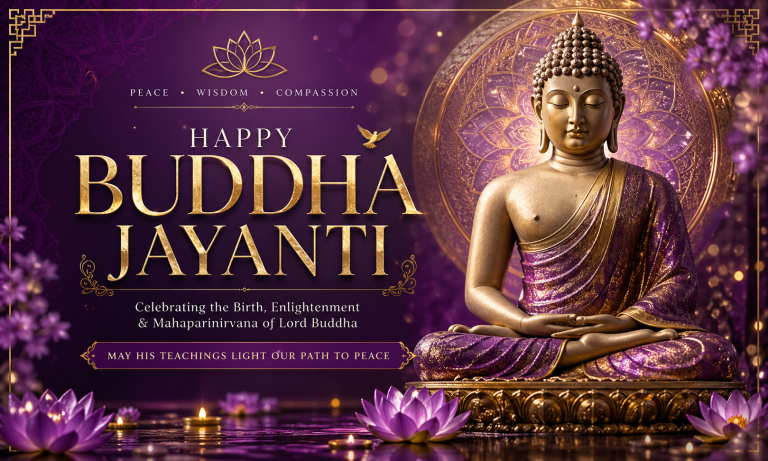
Buddha Jayanti (Purnima) is one of those rare moments where time itself seems to pause—honoring not just the birth, but the enlightenment and final liberation (Mahaparinirvana) of Gautama Buddha.
It is not merely a remembrance of a historical figure.
It is a mirror held up to humanity—asking a simple yet profound question:
What if peace is not something you find… but something you become?
The Life That Redefined Suffering


Over 2,500 years ago, in the foothills of the Himalayas, a prince was born into luxury—shielded from the harsh realities of life.
That prince was Siddhartha.
But destiny does not bend to comfort.
When Siddhartha encountered what are now known as the Four Sights—old age, sickness, death, and a wandering ascetic—something within him fractured open. The illusion of permanence dissolved.
What followed was not a casual spiritual curiosity.
It was a total existential rebellion.
He renounced his kingdom, his identity, and every external anchor… to answer one burning question:
Why do we suffer?
After years of extreme austerity, he realized something radical:
Truth is not found in indulgence… nor in deprivation… but in balance.
Seated beneath the sacred Bodhi Tree, he entered deep meditation. Through the stillness of his being, he saw the mechanics of existence itself.
And in that moment, Siddhartha became the Buddha — “The Awakened One.”
The Core Realization: Understanding Suffering
At the heart of Buddha’s teaching lies a framework so precise, it feels almost scientific:
The Four Noble Truths
- Life contains suffering (Dukkha)
- Suffering has a cause (attachment and desire)
- Suffering can end
- There is a path to end it
This was not philosophy for contemplation alone.
It was a diagnostic system for human experience.
A map.
A way out.
The Eightfold Path: A Technology of Liberation

If the Four Noble Truths diagnose the human condition, the Eightfold Path is the prescription:
- Right Understanding
- Right Intention
- Right Speech
- Right Action
- Right Livelihood
- Right Effort
- Right Mindfulness
- Right Concentration
This is not a rigid doctrine.
It is a living system of alignment—integrating ethics, mental discipline, and wisdom.
In modern language, you could call it:
A complete nervous system recalibration protocol.
Why Buddha Jayanti Still Matters Today
We live in an age of infinite stimulation.
Endless information.
Constant comparison.
Relentless striving.
And yet—an epidemic of anxiety, burnout, and inner emptiness.
The Buddha’s insight cuts through all of it with surgical precision:
Suffering is not caused by the world… but by our relationship to it.
On Buddha Jayanti, we are not asked to worship.
We are invited to observe.
- Observe the mind.
- Observe the breath.
- Observe the patterns of craving and aversion.
Because awareness itself is the beginning of liberation.
Rituals & Sacred Observances

Across countries like Sri Lanka, India, Nepal, Thailand, and beyond, Buddha Jayanti (also called Vesak) is observed with deep reverence and beauty.
Common Rituals Include:
1. Temple Visits
Devotees gather at monasteries to offer flowers, incense, and candles—symbols of impermanence, devotion, and awakening.
2. Acts of Compassion (Dana)
Feeding the poor, helping animals, giving freely—embodying the Buddha’s path through action.
3. Meditation & Silence
Extended periods of mindfulness practice to align with the Buddha’s inner journey.
4. Lighting Lanterns
Illuminating the night as a symbol of dispelling ignorance with wisdom.
5. Observing Precepts
Many follow ethical vows for the day—cultivating purity in thought, word, and action.
The Deeper Symbolism: The Buddha Within

Buddha Jayanti is not ultimately about a person.
It is about a possibility.
The possibility that:
- Your mind can become still.
- Your suffering can dissolve.
- Your awareness can expand beyond identity.
In Buddhist philosophy, this is called Buddha Nature—the inherent potential for awakening present in every being.
Not earned.
Not given.
Remembered.
A Practice for This Day
If you want to truly honor Buddha Jayanti, keep it simple.
Sit.
Breathe.
Observe.
For just 11 minutes:
- Watch your breath without changing it
- Notice thoughts without engaging them
- Let everything arise and pass
No effort.
No control.
Just awareness.
Because in that space…
You begin to taste what the Buddha discovered:
Freedom is not somewhere else.
It is hidden in the way you experience this moment.
Closing Reflection
Buddha Jayanti is not asking you to become Buddhist.
It is inviting you to become awake.
In a world obsessed with becoming more…
the Buddha showed us the power of becoming nothing.
And in that nothingness…
Everything is found.