Nature, Selection, and the Ancient Wisdom of Swayamvara
Watch nature closely.
The male peacock spreads his radiant feathers into a living fan of color and vibration.
The male bird of paradise performs elaborate dances that seem almost theatrical.
The lion grows a thick mane that signals power and vitality.
Even the humble male firefly flashes light patterns into the night, hoping the right female will notice.
They do not sit back and hope.
They perform.
They compete.
They demonstrate strength, beauty, intelligence, or endurance.
They prove themselves worthy.
And then something important happens.
The female decides.
Across species, this pattern appears again and again.
It is one of the oldest evolutionary dynamics on Earth: sexual selection.
The female carries the greater biological investment in reproduction. She gestates, nurtures, and often protects the offspring. Because of this, nature gave her the role of the chooser.
The male competes for the privilege.
This is not weakness.
This is design.
And long before modern debates about gender roles, ancient civilizations understood this deeply.
The Biological Reality of Selection
In evolutionary biology, female selection is not a minor detail — it is a fundamental driver of species development.
Charles Darwin himself noted that many of the most extravagant traits in nature evolved not because they were necessary for survival, but because they helped males win the attention of females.
The peacock’s feathers, for example, are not practical for survival. They make the bird more visible to predators.
Yet the feathers persisted.
Why?
Because peahens consistently chose the males with the most impressive displays.
Over generations, those displays became more elaborate.
Female choice shaped the species.
This pattern repeats across thousands of species:
-
Male birds sing complex songs.
-
Male deer clash antlers in violent competitions.
-
Male frogs produce loud mating calls.
-
Male fish build intricate nests.
All of these are essentially saying one thing:
“Choose me.”
Nature designed a world where the continuation of life depends on earning selection.
Human Civilization Followed the Same Pattern
Humans are not separate from nature.
For most of human history, men did not simply expect women to choose them. They had to prove themselves worthy.
They hunted.
They protected.
They built communities.
They developed skills, status, and character.
Civilizations were not built in spite of female selection.
They were built because of it.
The desire to be chosen has driven men to:
-
build cities
-
write poetry
-
explore oceans
-
fight wars
-
accumulate wealth
-
master skills
-
create art and music
Much of male ambition throughout history has been fueled by one ancient instinct:
To become the man a woman would choose.
Ancient cultures understood this so well that they built social rituals around it.
One of the most fascinating examples comes from the traditions of Sanatan Dharma.
The Tradition of Swayamvara
In ancient India, there existed a powerful institution called Swayamvara.
The word literally means:
“self-choice.”
It was a ceremony where a princess or noble woman publicly chose her husband from among many suitors.
Kings, warriors, and princes from across kingdoms would gather to compete.
But the final decision belonged to the woman.
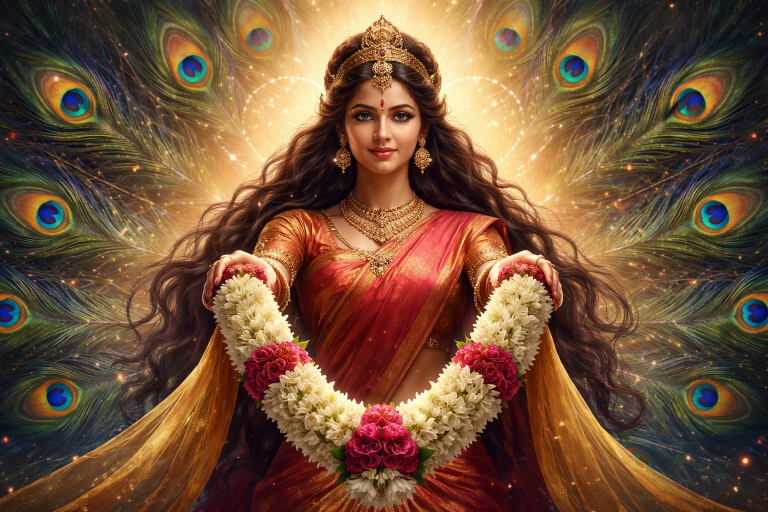
She would walk through the assembly hall holding a garland of flowers.
And when she placed the garland around a man’s neck, he became her husband.
The symbolism was unmistakable:
The woman chose.
The man earned.
Often, these ceremonies involved incredible tests of skill, strength, and character.
Only the most worthy would succeed.
The Story of Rama and Sita
One of the most famous Swayamvaras appears in the Ramayana.
Princess Sita, the daughter of King Janaka, was known for her grace, wisdom, and beauty.
Her father declared that the man who could lift and string the mighty bow of Lord Shiva would win her hand.
This bow was no ordinary weapon.
It was so heavy and powerful that no king or warrior had been able to move it.
Many princes arrived, confident in their strength.
One by one, they failed.
Then a young prince named Rama stepped forward.
Calm.
Centered.
Without arrogance.
He lifted the bow effortlessly.
As he began to string it, the bow snapped in two with a thunderous sound that echoed across the hall.
The crowd was stunned.
Sita walked forward quietly and placed the garland around Rama’s neck.
Not because he demanded it.
Because he proved himself worthy.
Their union became one of the most revered partnerships in Hindu tradition.
Krishna and the Choice of Rukmini
Another powerful example appears in the story of Krishna and Rukmini.
Princess Rukmini was destined to marry another king through political arrangement.
But she had heard of Krishna’s character, wisdom, and divine nature.
She wrote him a secret letter declaring her wish to marry him.
Krishna arrived and carried her away before the arranged marriage could occur.
But the deeper message in the story is often overlooked:
Rukmini chose Krishna first.
Her heart recognized his worth.
And Krishna responded to that choice.
Even in divine mythology, the feminine principle remains the chooser.
Shiva and Parvati — When Even the Gods Must Earn the Feminine
Perhaps the most profound illustration of this dynamic in Sanatan Dharma is the story of Shiva and Parvati.
Parvati was no ordinary woman. She was the embodiment of Shakti itself — the cosmic feminine power that animates the universe.
Yet even for someone as extraordinary as her, the choice of a partner was not casual.
Shiva, the great ascetic yogi, lived in deep meditation high in the Himalayas. Detached from the world, unconcerned with status, wealth, or social recognition, he existed in a state of transcendence.
But Parvati saw something deeper.
She recognized in Shiva a consciousness beyond ego — a being who had mastered himself completely.
Still, recognition alone was not enough.
The tradition tells us that Parvati performed intense tapas (spiritual discipline) for years to awaken Shiva’s attention and align herself with his consciousness.
And Shiva did not immediately accept her.
He tested her.
In some versions of the story, Shiva even appeared disguised as a wandering sage who mocked Shiva himself, trying to provoke Parvati into abandoning her devotion.
But she remained unwavering.
Her discernment was clear.
Her choice was not based on wealth, power, or appearance.
It was based on truth of being.
Only then did Shiva accept her.
Their union became one of the most sacred archetypes in Hindu tradition — the perfect balance of Shiva (consciousness) and Shakti (creative power).
From their union, the cosmos itself is said to dance.
What this story reveals is something subtle but powerful.
Even among the gods, the masculine does not simply claim the feminine.
The feminine chooses.
But she chooses not from impulse.
She chooses from clarity, discipline, and deep recognition.
And the masculine must rise to meet that standard.
The Feminine as the Gatekeeper of Life
There is a profound truth embedded in both biology and mythology.
The feminine holds the gate to the continuation of life.
Across species and civilizations, women have historically been the ones who decide:
Who enters the bloodline.
Who becomes a father.
Whose legacy continues.
This responsibility requires discernment.
Because choosing poorly affects not just one generation, but many.
Ancient societies recognized this power and often treated women — especially mothers — with deep reverence.
The feminine was not seen as weak.
It was seen as sacred.
In Sanskrit traditions, the feminine principle is called Shakti — the creative power of the universe itself.
Why This Dynamic Still Exists Today
Modern culture sometimes tries to pretend these dynamics are outdated.
But biology does not change because social trends do.
Men still compete.
They compete in status, resources, intelligence, charisma, and creativity.
Women still evaluate.
They observe character, stability, emotional intelligence, and leadership.
Even in modern dating culture, the pattern repeats:
Men approach.
Men impress.
Men attempt to demonstrate value.
Women observe.
And they decide.
This dynamic has existed for thousands of years.
Not because of social programming.
But because of evolutionary reality.
When Men Forget the Ancient Game
Problems arise when men forget this ancient dance.
When a man believes he deserves admiration without developing strength, integrity, or purpose, frustration follows.
The ancient warrior cultures understood something modern society sometimes forgets:
A man must build himself.
Not for validation.
But because excellence is attractive.
Discipline.
Courage.
Competence.
Leadership.
These qualities naturally draw attention.
Just as the peacock grows its feathers, men historically developed character and capability.
That was the real display.
The Deeper Truth Behind the Dance
At the deepest level, this dynamic is not about domination or power struggles.
It is about balance.
The masculine expands outward — striving, building, competing.
The feminine evaluates inward — sensing, selecting, nurturing.
Together, they create the continuation of life.
Civilization itself emerges from this dance.
Men striving to become worthy.
Women choosing wisely.
The Question for Our Time
Perhaps the real question today is not whether this dynamic exists.
Nature has already answered that.
The question is:
Are men willing to become the kind of men worth choosing?
And are women willing to honor the power of discernment that nature entrusted to them?
When both sides understand this ancient balance, relationships stop becoming battles.
They become alignment.
Just as they were meant to be.
The Real Meaning of These Stories
These ancient stories were never merely romantic tales.
They were teachings about alignment, worthiness, and the sacred balance between masculine effort and feminine discernment.
Rama proved his strength.
Krishna responded to devotion.
Shiva met the unwavering clarity of Parvati.
Each story reflects the same eternal dance.
Men rising to their highest potential.
Women choosing from their deepest wisdom.
And when that alignment happens, something extraordinary occurs.
Not just relationships.
But Dharma itself begins to flourish.
An Invitation to Women: Choose from Consciousness
These ancient stories were never merely romantic tales.
They were teachings.
They revealed the deeper architecture of life itself.
Rama did not demand Sita.
He proved his strength and character.
Krishna did not manipulate Rukmini.
He responded to her clarity of heart.
Even Shiva, the great yogi, did not simply claim Parvati.
Their union arose from discipline, devotion, and profound recognition.
Across these stories, one truth quietly repeats:
The feminine chooses.
But the wisdom of the tradition was never about choosing quickly, impulsively, or from shallow attraction.
The power of the feminine was meant to be exercised from consciousness.
In ancient times, a Swayamvara was not a moment of emotional excitement.
It was a moment of discernment.
A woman was not choosing a companion for a season.
She was choosing:
-
the father of her children
-
the guardian of her lineage
-
the man whose character would shape future generations
This required clarity.
It required patience.
It required the ability to see beyond charm, wealth, or temporary excitement.
It required the wisdom to recognize Dharma in a man.
And that is perhaps the deeper invitation hidden inside these stories.
Not for women to abandon their power.
But to honor it more consciously.
Because when the feminine chooses from insecurity, impulse, or social pressure, chaos follows.
But when the feminine chooses from presence, intelligence, and inner alignment, something remarkable happens.
Men rise.
Civilizations stabilize.
Families become strong.
And Dharma begins to flourish.
Nature has always entrusted women with the power of selection.
The real question is not whether that power exists.
The question is how consciously it will be used.
So perhaps the invitation today is simple.
Not to compete with men.
Not to imitate them.
But to stand fully in the power nature already gave you.
To choose slowly.
To choose wisely.
To choose from clarity.
Just as the ancient princesses once did when they walked into the Swayamvara hall holding a garland in their hands.
And somewhere among the gathered men stood the one who had prepared himself for that moment.
The one who had done the work.
The one who had become worthy of being chosen.