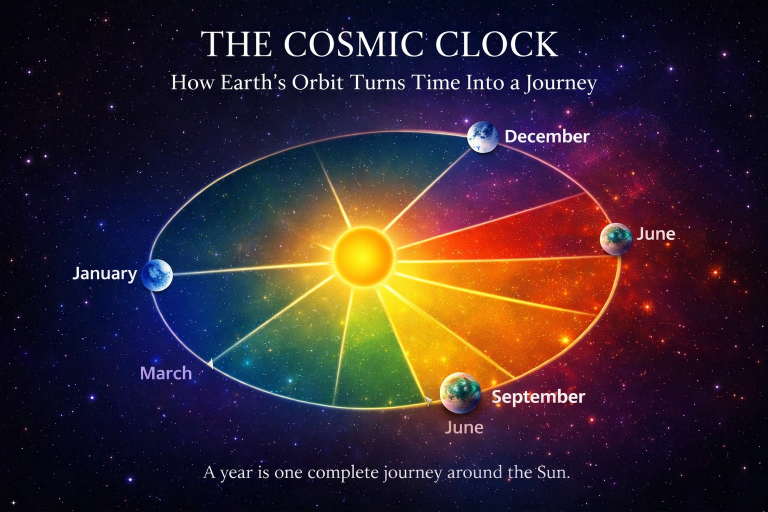
Most of us grow up thinking about the year as a simple circle of months. January becomes February, February becomes March, and before long the calendar loops back to January again. It feels like time is something abstract—numbers changing on a page or reminders popping up on a phone.
But the truth is far more profound.
A year is not just a human invention.
A year is a journey through space.
Every day, every week, and every month marks our planet’s movement along an immense cosmic path around the Sun.
The image above transforms this idea into something we can actually see. Instead of imagining months as squares on a calendar, it shows them as positions in Earth’s orbit, turning time into a beautiful celestial clock.
Time Is Movement Through Space
Earth does not sit still while the calendar turns.
Our planet is constantly moving—sweeping through space at a breathtaking speed of about 30 kilometers per second (67,000 miles per hour) as it travels around the Sun.
That means that while you read this sentence, Earth has already moved thousands of kilometers along its orbit.
A full year represents one complete revolution of Earth around our star. When we celebrate a birthday or mark a new year, what we are really celebrating is something extraordinary:
Another full lap around the Sun.
The months simply help us track our position along this journey.
The Orbit That Shapes Our Lives
Earth’s path around the Sun is not just a scientific curiosity—it shapes nearly every aspect of life on this planet.
Our orbit determines:
• The length of the year
• The changing seasons
• The rhythm of ecosystems
• The cycles of agriculture
• The patterns of climate and weather
Because Earth’s axis is tilted by about 23.5 degrees, different parts of the planet receive varying amounts of sunlight as we move through the orbit. This tilt is what gives us winter, spring, summer, and autumn.
Without the tilt, there would be no seasons.
Without the orbit, there would be no year at all.
January to December: A Celestial Path
When we look at a calendar, the months may appear evenly spaced and orderly.
But in reality, they represent different stages of Earth’s cosmic position.
Each month marks a slightly different direction in space relative to the Sun.
Think of it this way:
• January places Earth in one region of its orbit.
• March places it further along the same path.
• June and July place us on the opposite side of the Sun from where we were in December.
• By the time we reach December again, Earth has completed the full loop.
This perspective transforms the ordinary calendar into something far more meaningful.
Instead of time passing in place, we are moving through the universe.
The Speed of the Cosmic Clock
Earth’s orbit is enormous.
The average distance between Earth and the Sun is about 150 million kilometers (93 million miles). This distance is known as one astronomical unit (AU).
The circumference of Earth’s orbit is roughly:
940 million kilometers (584 million miles).
To complete this journey in about 365.25 days, our planet must move incredibly fast.
That means that in the time it takes you to drink your morning coffee, Earth has already traveled tens of thousands of kilometers through space.
And yet we feel nothing.
The motion is smooth, constant, and perfectly balanced by gravity.
Gravity: The Invisible Architect
What keeps Earth from flying off into deep space?
The answer is gravity.
The Sun’s immense mass—about 333,000 times heavier than Earth—creates a powerful gravitational pull that keeps our planet bound in orbit.
At the same time, Earth’s forward motion prevents it from falling directly into the Sun.
The result is a delicate cosmic balance:
Gravity pulls inward.
Motion moves forward.
Together they create the elegant curve of Earth’s orbit.
This balance is what allows the cosmic clock to keep ticking year after year.
A Calendar Written in the Stars
Long before modern astronomy, ancient civilizations recognized that time was connected to the movement of the heavens.
Early cultures carefully observed:
• The rising and setting of the Sun
• The shifting positions of stars
• The cycles of the Moon
• The changing seasons
From these observations came the first calendars.
Agriculture, navigation, festivals, and rituals were all guided by the rhythms of the sky.
Even today, the structure of our calendar—365 days divided into months—exists because of Earth’s journey around the Sun.
The calendar on your wall is, in a sense, a simplified map of the solar system.
The Universe Hidden in Everyday Life
What makes astronomy so powerful is that it changes how we see ordinary things.
A date is not just a number.
It represents a precise point in space.
A birthday is not just another year older.
It means Earth has carried you through another 940 million kilometer journey around the Sun.
A new month is not just another page in a planner.
It is another step along our planet’s endless orbit.
Suddenly, the routines of life—work, family, celebrations, goals—are happening on a spacecraft moving through the cosmos.
And that spacecraft is Earth.
The Perspective Shift
Images like this do something remarkable.
They help us step outside our everyday perspective.
Instead of seeing time as something abstract, we begin to see it as movement, rhythm, and cosmic alignment.
We realize that:
• We are passengers on a planet in motion
• Our calendar reflects the architecture of the solar system
• Our lives unfold inside a much larger celestial choreography
The universe is not distant.
It is the stage on which our daily lives unfold.
A Journey We Share
Every person on Earth is traveling this orbit together.
Every celebration, every challenge, every new beginning happens while our planet glides silently around the Sun.
We rarely think about it.
But we should.
Because when you zoom out far enough, something extraordinary becomes clear:
Your life is not just happening on Earth.
It is happening within the grand movement of the cosmos.
And every new month marks another step in that journey.
The Beauty of the Cosmic Clock
Astronomy has a way of making the familiar feel magical again.
A year becomes a voyage.
A calendar becomes an orbital map.
And the quiet turning of time reveals itself as something much bigger:
A planet, carrying billions of lives,
moving with perfect precision
around a star that makes all life possible.
That is the true meaning of a year.
Not just time passing.
But Earth completing another chapter in its endless dance around the Sun.