
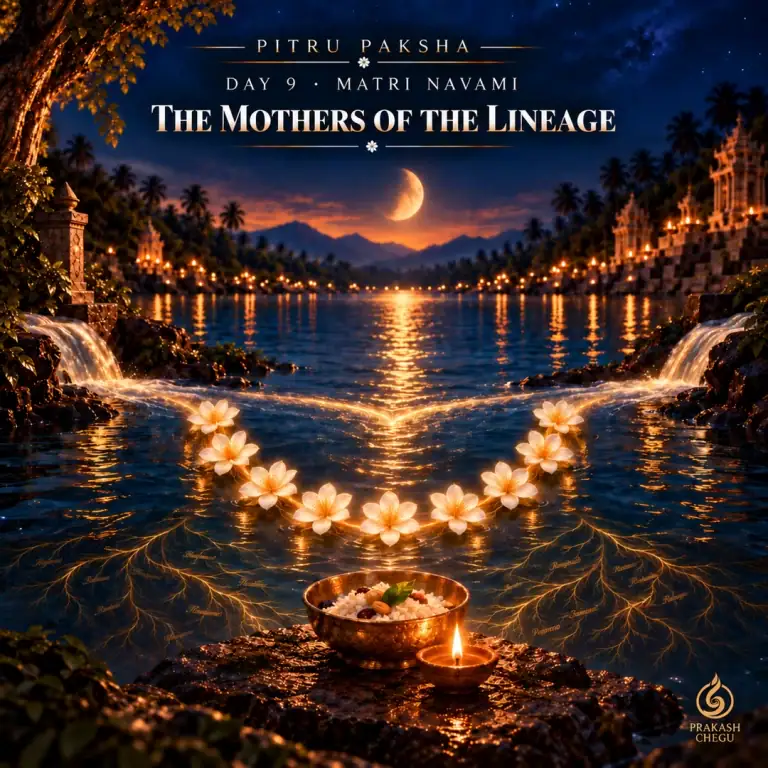
Pitru Paksha 2026 online · Day 9 of 16 · Sunday, October 4, 2026 · live at 7:00 AM CET, recording included.
Before a family becomes a family tree,
life is carried through a body, a kitchen, a story, a name and an act of care.
Every lineage contains women whose work became so ordinary that the family forgot it was work.
They carried pregnancies and children. They fed households. They remembered who belonged to whom. They preserved recipes, prayers, songs, medicines, languages and rituals. They stretched limited resources. They watched through illness. They negotiated conflict. They kept letters and photographs. They protected reputations, absorbed grief and often held the emotional continuity of a family without being named as its leaders.
Some were cherished.
Some were taken for granted.
Some were remembered only as someone’s wife or mother.
Some lost their birth names within marriage and disappeared from the written family record.
Some mothered children they did not give birth to. Some longed to mother and could not. Some chose another path. Some had their children taken from them. Some died young. Some survived motherhood but were never allowed a life beyond service. Some caused harm as well as giving life.
Day 9 brings these women into fuller remembrance.
Matri Navami — The Mothers of the Lineage is a special event for honouring departed mothers and female ancestors through Navami Tarpanam, flowers, food, restored names and a nine-petal remembrance ritual.
Navami Shraddha is traditionally performed for ancestors who died on Navami tithi in either lunar fortnight. It is also widely known as Matri Navami, Matra Navami, Naumi Shraddha and, in particular regional traditions, Avidhava Navami. The day carries special significance for the Shraddha of departed mothers and other female members of the family.
The event honours this traditional focus while making careful room for the many forms through which women have carried, protected and nourished a lineage.
This event may be attended individually or as part of Pitru Paksha: The River Behind You, the complete journey from Bhadrapada Purnima to Sarva Pitru Amavasya.
Global Session Times
Live session at 7:00 AM Central European Time (CET)
- Central Europe (Berlin · Paris · Budapest) — 7:00 AM
- London — 6:00 AM
- Tallinn · Helsinki · Athens — 8:00 AM
- India (IST) — 10:30 AM
- New York (EDT) — 1:00 AM
- Tulum (Quintana Roo) — 12:00 AM (midnight)
- Mexico City — 11:00 PM the previous evening
- California (PDT) — 10:00 PM the previous evening
A recording is included for every session if the live time does not suit your location.
The Meaning of Matri Navami
Navami is the ninth lunar day.
Within Pitru Paksha, Navami receives a distinctive maternal emphasis. It is a day on which the women of the lineage are not included merely as an addition to a story centred elsewhere. They become the centre of remembrance.
The word Matri points toward the mother—not only as an individual person, but as a principle of origin, nourishment, gestation, protection and continuity.
Yet the maternal principle must not become a romantic image that hides actual women.
A mother is not only tenderness. She may also be exhausted, frightened, ambitious, angry, unsupported, creative, disciplined, grieving or constrained by circumstances no one later remembers.
A grandmother is not only a source of recipes and blessings. She may have had work she wanted to do, choices she could not make and a name that mattered before she became everyone’s grandmother.
Matri Navami asks us to remember the woman inside the role.
We honour motherhood most deeply when we allow mothers to remain whole human beings.
Who Is Traditionally Honoured on Navami?
Navami Shraddha is traditionally observed for departed family members whose death occurred on Navami tithi, whether during Shukla Paksha or Krishna Paksha.
The day is especially associated with the Shraddha of departed mothers and female ancestors, including grandmothers, sisters and other women of the family. Although its emphasis is maternal and feminine, a male ancestor whose death tithi was Navami may also be honoured according to tithi-based family practice.
In some regions, the observance is known as Avidhava Navami and is particularly connected with a married woman who died while her husband was still living. Customs may include feeding married women and offering clothes, food or articles associated with married life. These are specific inherited practices—not universal requirements for every participant.
The words Matri Navami and Avidhava Navami are often used together, but their ritual emphasis is not identical in every community. A widow, unmarried woman, renunciate, child or woman who died in a particular circumstance may be treated differently within formal family procedures.
This event therefore makes an important distinction:
- Formal Shraddha categories should follow family, regional and priestly guidance.
- The wider field of remembrance may lovingly include departed women whose lives, care and contributions deserve to be named.
The practice will not suggest that marital status determines a woman’s spiritual worth. Nor will it claim that every departed woman belongs to one undifferentiated ritual category.
The Maternal Line Is More Than the Mother’s Side
The phrase maternal lineage often means the ancestors reached through one’s mother.
Matri Navami holds something wider as well.
There are mothers and female ancestors on both sides of the family.
The paternal grandmother carried the father’s life. The maternal grandmother carried the mother’s life. A paternal aunt may have become the family’s emotional centre. A maternal aunt may have protected children who were not her own. A sister may have preserved stories that would otherwise be lost. A daughter-in-law may have entered the family and quietly sustained its elders, rituals or relationships for decades.
The mothers of the lineage include:
- Biological, adoptive, foster and stepmothers
- Maternal and paternal grandmothers
- Great-grandmothers and earlier female ancestors
- Sisters, aunts, daughters and daughters-in-law who carried family continuity
- Women who raised, taught, protected or nourished children they did not give birth to
- Women whose pregnancies, children or maternal grief were never publicly acknowledged
- Women who remained unmarried or childless
- Women whose names changed, vanished or were never recorded
- Women whose domestic, agricultural, professional, ritual or emotional labour was overlooked
- Women whose relationships with the family were difficult, distant or broken
Not all of these women belong to the same formal rite. All may belong to truthful family remembrance.
The Nine Forms of Maternal Inheritance
For this event, the number nine becomes a contemplative structure through which to recognise what travelled through the women of the family. These are not prescribed scriptural correspondences for Navami. They are nine doors into remembrance.
1. The Body
Life reaches us through bodies.
The women of a lineage may transmit constitution, features, gestures, sensitivities, fertility stories, illnesses, strength and ways of inhabiting the physical world. Their bodies may also have borne the cost of labour, childbirth, malnutrition, violence, medical neglect or relentless service.
We honour the body without reducing a woman to reproduction.
2. Nourishment
Food is one of the most persistent languages of family memory.
A taste can return a whole kitchen, season or person to awareness. But nourishment includes more than cooking. It includes earning, growing, carrying, rationing, serving, remembering preferences and ensuring that someone else eats first.
3. Labour
Much of the work performed by women was described as duty rather than labour.
Cleaning, caring, nursing, farming, teaching, organising ceremonies, managing relationships and keeping a household functioning may have remained economically invisible while being structurally essential.
4. Protection
Women protected families through tenderness, vigilance, negotiation, secrecy, courage and practical intelligence.
Sometimes protection became control. Sometimes fear shaped what daughters and sons were allowed to become. We can honour the intention to protect while examining its consequences honestly.
5. Language and Story
Lullabies, family sayings, dialects, prayers, gossip, warnings, folktales and remembered genealogies often travelled through women.
When a woman’s voice disappears, the family may lose not only a person but a whole way of interpreting life.
6. Ritual and Faith
Many women maintained daily spiritual life without public recognition: lighting the lamp, drawing rangoli, keeping vrata, remembering festival preparations, tending the altar, feeding guests and teaching children how reverence enters ordinary time.
7. Grief
The women of the lineage carried bereavement, separation, pregnancy loss, child loss, widowhood, migration, abandoned dreams and relationships they were not permitted to name.
Some grief became story. Some became silence. Both may still be felt within the family atmosphere.
8. Desire and Unlived Life
Every mother was also a person with desires beyond motherhood.
Education, travel, vocation, creative work, partnership, solitude, spiritual pursuit or simple rest may have been available, denied, postponed or sacrificed.
Remembering an unlived possibility does not make a life tragic. It allows the woman’s humanity to become visible.
9. Blessing and Continuity
A blessing is not only a spoken benediction.
It can be the capacity that continues: patience, intelligence, beauty, discernment, humour, devotion, skill, hospitality, resilience or the courage to live differently.
The ninth inheritance asks: What did these women make possible that can now become more conscious through us?
What We Will Explore
- The traditional purpose of Navami Shraddha
- Why the day is known as Matri or Matra Navami
- The relationship and distinctions between Matri Navami, Navami Shraddha and Avidhava Navami
- Who is traditionally remembered when an ancestor died on Navami tithi
- Why Matri Navami gives special attention to departed mothers and female relatives
- The difference between honouring motherhood and idealising every mother
- How women’s names, labour, knowledge and desires disappear from family history
- The mothers and maternal figures present in both paternal and maternal lineages
- How to include women who mothered beyond biological motherhood
- How to approach complicated, estranged or harmful maternal relationships without forced forgiveness
- How food, flowers, prayer and story become offerings of restored remembrance
- How to perform an accessible Navami Tarpanam
- How to create a nine-petal map of the women who carried the lineage
- How to restore one woman’s name, story or contribution through a living act
No previous class is required. First-time participants will receive the essential Tarpanam foundations, while those continuing through the series will deepen the daily sequence.
The Day 9 Ritual
The Garland of Remembered Women
The Day 9 ritual creates a garland without requiring thread.
Nine flowers or petals are placed one by one, each restoring a person or field of feminine contribution to the ancestral space. The garland does not need to be physically connected. Its continuity is created through attention.
If nine flowers are not available, use leaves, grains, seeds or nine marks drawn on paper. One flower may also be moved through all nine positions.
The ritual includes both the traditional Navami tithi offering and a wider contemplative remembrance of the women of the family.
The guided practice will include:
1. Preparing the Ancestral Cloth
Lay a clean cloth, leaf or simple plate before you.
Place the Tarpanam vessel and receiving bowl nearby. Arrange the nine flowers or petals in a loose circle, keeping the centre open for the food offering.
If using a photograph, choose one that can be handled respectfully. Avoid using an image containing living people unless it can be appropriately cropped or replaced with a written name.
2. Writing the Two Banks of Women
Divide a page into two sides:
The women through my mother
The women through my father
Write every name you know. Include birth names, family names, nicknames or places of origin when genuinely known.
Do not worry if one side contains only a few names. An empty space is also information. Mark an unknown woman simply as name not yet recovered rather than inventing a biography.
3. Remembering the Woman Before the Role
Choose one departed woman.
Write her full name as accurately as possible. Beneath it, write what is known beyond her relationship to others:
- What did she enjoy?
- What work did she do?
- What did she know how to make, repair, grow or organise?
- What language, song, prayer or saying did she carry?
- What difficulty did she navigate?
- What did she desire?
- How did she affect the family?
If only her role is known, do not fill the silence with fantasy. Let the unanswered questions become part of the remembrance.
4. Establishing the Sankalpa
Place both hands near the heart and say:
For the departed mothers and female ancestors of my maternal and paternal lineages, and especially for those whose death tithi was Navami, I offer remembrance. May their names be restored, their labour acknowledged, their grief held with compassion and their gifts carried with wisdom.
If the relationship with a mother or female ancestor was painful, add:
I offer only what is truthful and safe. I do not erase harm. I allow remembrance and boundary to exist together.
5. Preparing the Tarpanam
Prepare clean water in a suitable vessel. Black sesame and darbha may be included according to family practice and availability.
Participants will receive concise instruction on posture, direction, Pitru Tirtha and respectful handling of the offered water. Those with formal family instructions concerning Navami or Matri Navami should follow their tradition instead.
6. The First Offering · For Navami Ancestors
Offer the first stream for departed family members whose death tithi was Navami, known and unknown.
ॐ पितृभ्यः स्वधा नमः
Om Pitṛbhyaḥ Svadhā Namaḥ
For the ancestors remembered on Navami, I offer this water with reverence. May it be received in peace.
7. The Second Offering · For Mothers and Grandmothers
Offer a second stream for departed mothers, grandmothers, great-grandmothers and those who stood in a maternal role.
Name individuals when known.
For the life carried, the food prepared, the protection given, the nights watched and the futures made possible, I offer gratitude.
Gratitude need not claim that every relationship was nurturing. It may be directed toward life itself, toward one honest gift, or toward the possibility of peace.
8. Placing the Nine Petals
Place or touch the petals one by one:
- For the bodies through which life travelled
- For nourishment given visibly and invisibly
- For labour that held the family together
- For protection, courage and difficult choices
- For language, story and memory
- For ritual, faith and sacred continuity
- For grief that was carried or silenced
- For dreams lived, delayed or denied
- For blessing, transformation and what continues
After each placement, pause. A name, face, sensation, memory or silence may arise. Nothing needs to be forced.
9. The Third Offering · For the Forgotten Women
Offer a third stream for women whose names or contributions were lost.
Include, according to your conscience and family field:
- Women known only through a relationship title
- Women whose birth names disappeared after marriage
- Domestic workers, caregivers or community members whose labour sustained the household but whose stories were excluded
- Women separated through migration, adoption, conflict or social taboo
- Women who died young
- Women whose relationships, children or grief could not be spoken about
- Women judged primarily through marital status, fertility, widowhood or conformity
Say:
You are more than the role history recorded. Where your name is known, may it be spoken. Where it is lost, may your humanity still be honoured.
10. Offering Food
Place a small portion of a milk-based sweet, fruit or simple sattvic family food in the open centre of the flower circle.
If a departed woman’s beloved dish is genuinely known and suitable to the observance, it may be offered according to family custom.
Do not prepare an elaborate offering from pressure. A single fruit, date, spoonful of cooked rice or simple sweet is enough for the accessible ritual.
Participants with allergies, vegan practice or other dietary needs may choose an appropriate plant-based offering. The item should be handled after the ritual according to family tradition rather than consumed or distributed casually where specific rules apply.
11. Speaking One Name Fully
Choose one woman whose story deserves greater space.
Speak her name slowly. Then speak one sentence that remembers her as a person:
She knew how to…
She protected…
She loved…
She endured…
She wanted…
She changed our family by…
If the relationship was difficult, the sentence may be:
Her life affected our family in ways we are still learning to understand.
Truth is a more respectful offering than compulsory praise.
12. The Offering for Unfinished Maternal Grief
Place a small amount of water beside the ninth petal.
This may hold grief related to pregnancy, childbirth, infertility, adoption, separation, child loss, a mother’s early death or a maternal bond that never became what was needed.
This contemplative offering does not assign every such loss to the formal Avidhava or Navami Shraddha category. It simply allows maternal grief to be acknowledged within prayer.
No one is required to name a private experience aloud.
13. Receiving the Maternal Gift
Touch the petal that represents the quality you most wish to continue.
It may be hospitality, intuition, discipline, devotion, humour, practical intelligence, courage, artistry, tenderness, financial skill, healing knowledge or the capacity to begin again.
Say:
What was life-giving, may it continue with greater freedom. What was carried through compulsion, may it soften. May this gift serve the living.
14. Choosing a Living Act of Restoration
Select one action to complete within nine days:
- Add a woman’s full name to the family tree
- Record an elder speaking about a mother or grandmother
- Preserve a recipe together with the story of the woman who carried it
- Label an old photograph with names, place and approximate date
- Ask what work, education or dream mattered to a female ancestor
- Acknowledge a living woman’s unpaid or invisible labour
- Share a domestic or caregiving task that has fallen automatically to one person
- Restore authorship to a prayer, remedy, craft or tradition casually described as “the family’s”
- Support a woman, mother or caregiver in a way that preserves her agency
- Keep a boundary that ends a harmful maternal pattern without erasing the person
Restoration should change the record or the living relationship—not remain only an emotion during ritual.
15. Completion
Close with the ancestral mantra, gratitude and silence.
Return the Tarpanam water respectfully to clean earth, a suitable plant or another place consistent with family tradition and local conditions.
The flowers may remain on the altar for the day. Handle food and other offerings according to inherited practice.
The Mantra of Remembrance
ॐ पितृभ्यः स्वधा नमः
Om Pitṛbhyaḥ Svadhā Namaḥ
Reverence to the ancestral beings; may this offering be received through Svadhā.
The accompanying spoken prayer is:
For the mothers and women of the lineage: may your names be remembered, your labour be honoured, your grief be given dignity and your life-giving wisdom continue in freedom.
Participants who have received specific Navami, Matri Navami or lineage mantras should follow their tradition. No one needs to improvise Sanskrit, gotra or ritual formulas that are not known.
Mothering Beyond Biological Motherhood
Motherhood is a specific embodied and relational reality. It should not be diluted into a vague label applied to every woman.
At the same time, life is often nourished through more than one person.
An aunt may raise a child. A grandmother may become the stable parent. A sister may protect younger siblings. A teacher may offer the first experience of encouragement. A neighbour may feed a household during crisis. A nurse, midwife, friend or community elder may hold a person through a threshold when their biological mother cannot.
Some women give birth and do not raise the child. Some raise children they did not bear. Some lose children. Some do not want motherhood. Some long for it and are denied it. Some women’s maternal histories remain private or unknown.
Day 9 does not measure womanhood through motherhood.
It honours mothers distinctly while also recognising the wider ecology of women’s care that allows families and communities to live.
A woman does not need to become a mother to belong fully to the lineage. A mother does not cease to be a woman with a life of her own.
When the Mother Relationship Was Painful
Matri Navami may evoke love, longing, gratitude, anger, numbness, relief or several of these at once.
Some mothers were unavailable through death, illness, poverty, migration or circumstances beyond their control. Some were emotionally absent. Some repeated harm that had travelled through generations. Some relationships remained estranged. Some children became caretakers for the person who was meant to care for them.
The ritual does not require idealisation.
You are not asked to call neglect nurturing, abuse a lesson, or silence forgiveness.
You may honour the transmission of life without reopening a relationship internally. You may name one genuine gift while retaining a boundary. You may offer only for peace. You may direct the practice toward an earlier grandmother, another maternal figure or the unknown women behind the painful relationship.
Forgiveness, where it is meaningful, cannot be demanded by a calendar.
Truthful remembrance is enough.
The Deeper Teaching: The Woman Inside the Role
Family language can swallow a woman’s identity.
She becomes Amma, Ajji, Nani, Dadi, Aunty, someone’s wife, someone’s mother—a relationship without a biography.
These names of love are not the problem. The loss occurs when the relationship title becomes all that remains.
What was her full name?
Where was she born?
What did she know?
What made her laugh?
What was she afraid of?
What did she create?
What choice changed her life?
Which part of her did motherhood reveal, and which part did it conceal?
Restoring these questions changes the family archive. A woman reappears not only as the passage through which descendants arrived, but as a complete participant in history.
The purpose is not to modernise the ancestor into someone we would find easier to admire. It is to let her be particular.
Her name. Her time. Her circumstances. Her complexity. Her contribution.
Your Reflection for Day 9
Which woman in my lineage deserves to be named more fully?
You may also contemplate:
- How many generations of women can I name on my mother’s side?
- How many can I name on my father’s side?
- Which women are known only through a relationship title?
- Whose domestic, emotional or ritual labour held the family together?
- What food, language, song, prayer or skill travelled through a woman?
- Which woman mothered beyond biological motherhood?
- Who was reduced to marital status, fertility or sacrifice?
- What grief did the women of the family have no permission to speak?
- Which maternal pattern requires a boundary rather than repetition?
- What did a mother or grandmother make possible for me?
- What part of her own life disappeared inside her role?
- What name, story or contribution can I restore now?
What to Bring
Please prepare:
- A clean vessel for pouring water
- A bowl, plate or vessel to receive the offering
- Clean water
- Black sesame seeds, if available
- Darbha or kusha grass, if available and appropriate to your practice
- Nine flowers, petals, leaves, grains or seeds
- A small clean cloth, leaf or plate for the ancestral arrangement
- A fruit, milk-based sweet or simple sattvic family food
- A plant-based alternative if preferred
- A notebook and pen
- Names or photographs of departed mothers and female ancestors, optional
- A lamp or candle, if safe and desired
Please do not postpone participation if every traditional material is unavailable. Simple alternatives will be explained.
Choose a modest food offering and follow family practice for its handling after the ritual.
The Event Experience
The gathering will move through nine stages:
- Navami teaching — the ninth tithi and the traditional Matri Navami observance
- Ritual distinctions — Navami Shraddha, Matri Navami and regional Avidhava Navami customs
- The two banks — women of the maternal and paternal lineages
- The woman before the role — restoring name, biography and contribution
- Practical preparation — water, sankalpa, direction and offering method
- Guided Tarpanam — offerings for Navami ancestors, mothers and female relatives
- The nine-petal ritual — body, nourishment, labour, protection, story, faith, grief, desire and blessing
- Food and restored name — honouring one woman through an offering and spoken remembrance
- Integration — one living act that changes the family record or distribution of care
No previous knowledge of Tarpanam, Sanskrit or ancestral ritual is required.
This Event Is for You If…
- You want to honour a departed mother or female ancestor
- An ancestor’s death tithi was Navami
- You want to understand Matri Navami without flattening regional traditions
- You want to remember women from both sides of the family
- A mother or grandmother’s labour was essential but rarely acknowledged
- Important women’s names or stories are disappearing from your family history
- Your maternal relationships contain love, grief and complexity
- You want to honour women who mothered outside biological motherhood
- You want a respectful practice that does not measure women through marriage or fertility
- You want practical Tarpanam guidance within an inclusive spiritual container
- You are entering the Pitru Paksha journey for the first time on Day 9
Can This Event Be Attended Individually?
Yes.
Day 9 is a complete standalone event. You will receive the traditional Navami and Matri Navami context, essential Tarpanam guidance, the full Garland of Remembered Women ritual, reflection prompts, integration practices and the recording.
You do not need to have attended Days 0–8.
Those continuing through the series will experience a natural progression: Day 8 honoured those who carried impossible weight; Day 9 turns toward the women whose carrying, nourishment and invisible intelligence often became the unrecorded foundation of the family.
Continue into the Complete Journey
Day 9 restores mothers and female ancestors to fuller remembrance. Day 10 turns toward The Householders—those who built homes, raised families, preserved knowledge, managed resources and carried the lineage through the responsibilities of Grihastha life.
The complete journey includes:
- Sixteen tithi-based teachings from Purnima to Amavasya
- A distinct ritual and reflection for every day
- Practical Tarpanam instruction
- Maternal, paternal, known, unknown and excluded ancestral remembrance
- Space for family nourishment, labour, grief, names and unfinished stories
- Live ceremonies and recordings
- The concluding Sarva Pitru Amavasya offering
Respecting Family and Vedic Traditions
Shraddha and Tarpanam procedures vary according to Veda, śākhā, sutra, sampradaya, region and family custom. Matri Navami and Avidhava Navami customs may include specific rules concerning performers, marital categories, invited recipients, sacred-thread position, direction, mantras, food, clothing, gifts, pindas and timing.
Where you have inherited or received such instructions, they take precedence.
This class offers education, guided reflection and an accessible household practice. It does not replace annual Shraddha, first-year death rites, priest-led Pinda Dāna or formal Navami Shraddha.
The wider inclusion of departed women in the flower ritual does not alter formal Shraddha categories. Participants should not invent gotra, death tithi, relationship or ritual eligibility when details are unknown.
Participants for whom formal Pitru Tarpanam is restricted may offer a flower, lamp, prayer, scripture reading, feeding or charity in the ancestors’ memory.
Speak Her Name Into the River
The women of the lineage were never merely background.
They were the intelligence through which daily life continued.
They knew how much grain remained.
They remembered which child needed watching.
They carried the prayer, the remedy, the route home, the date of the festival, the family disagreement, the hidden tenderness and the grief no one else could bear to name.
Some gave freely.
Some gave because they were never permitted to say no.
Some received honour.
Some disappeared inside the honour given to others.
On Matri Navami, we do not ask them to remain symbols of endless sacrifice.
We offer water.
We place the flowers.
We remember the food.
We restore the name.
And we allow each woman to return to the ancestral story as a person—not only a role.
May your name remain.
May your labour be seen.
May your grief find dignity.
May what you carried become freedom in those who follow.
Join Day 9
Matri Navami: The Mothers of the Lineage
Sunday, October 4, 2026 — India Reference Calendar
Special Remembrance: Departed Mothers and Female Ancestors
Live Online · Time to Be Announced · Recording Included
Series Navigation
Previous: Day 8 · Krishna Ashtami — Strength Without Burden
View the Complete Pitru Paksha Calendar
Next: Day 10 · Krishna Dashami — The Householders