Pleasure Is Not the Opposite of Pain—It Is the Capacity to Remain Open
Pleasure has been misunderstood.
For many people, pleasure means entertainment, indulgence, luxury, sexuality, excess, or escape. It is treated as something optional—something we may enjoy after the important work is finished.
We are taught to earn pleasure.
First work.
First sacrifice.
First prove your worth.
First take care of everyone else.
Then, perhaps, you may rest.
Perhaps you may enjoy your life.
Perhaps you may receive.
But Ayurveda presents a very different understanding.
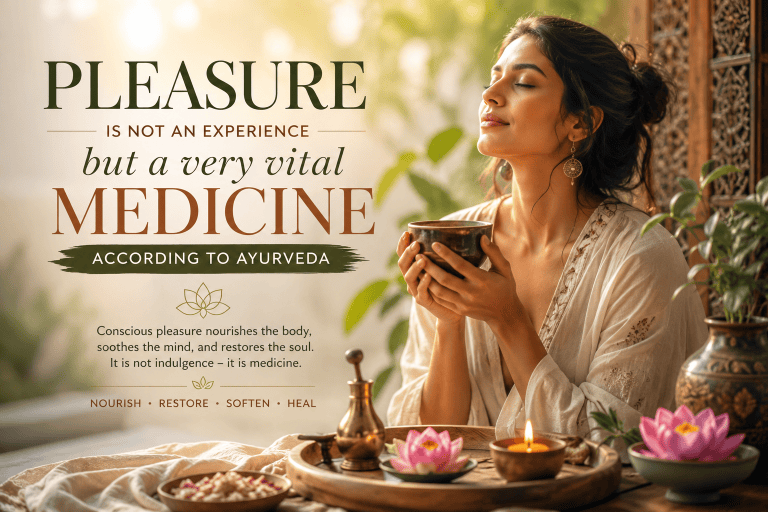
Pleasure is not merely an experience.
Pleasure is medicine.
Not because it distracts us from suffering, but because conscious pleasure changes the condition of the body that is carrying the suffering.
It softens contraction.
It restores circulation.
It regulates the senses.
It replenishes vitality.
It reminds the nervous system that life is not only danger, demand, duty, and survival.
Pleasure tells the body:
You are still alive.
You are still allowed to receive.
There is more here than what hurts.
This does not mean denying pain.
It does not mean covering grief with positive thinking.
It does not mean forcing gratitude while the heart is breaking.
Conscious pleasure does not remove us from reality.
It gives us enough capacity to remain present within reality.
That is why pleasure can be deeply medicinal.
Ayurveda Does Not Define Health as the Absence of Disease
Ayurveda understands health as a state of harmony.
The classical definition of health includes balanced doshas, healthy digestion, properly nourished tissues, efficient elimination, and something equally important: a joyful soul, peaceful mind, and contented senses.
This matters.
According to Ayurveda, a person is not fully healthy merely because the body is functioning.
The mind must have ease.
The senses must receive appropriate nourishment.
The heart must experience some form of contentment.
The soul must be able to participate in life.
Joy is therefore not a decorative addition to health.
It is one of its expressions.
A person may eat organic food, take herbs, practice yoga, and follow a disciplined routine, yet still live in emotional deprivation.
The body may be fed while the senses are starving.
The stomach may be full while the heart remains empty.
Pleasure, in its conscious form, nourishes what food alone cannot reach.
Pleasure Begins in the Senses
Ayurveda teaches that the senses are gateways.
Through them, the world enters us.
What we see, hear, smell, taste, and touch does not remain outside the body. It influences the mind, breath, digestion, hormones, energy, and emotional state.
A harsh environment affects us.
So does beauty.
Noise affects us.
So does music.
Loneliness affects us.
So does loving touch.
The senses are constantly digesting life.
This is why Ayurveda pays such careful attention to sensory nourishment.
The fragrance of flowers.
Warm oil on the skin.
Food prepared with love.
Sacred sound.
Beautiful colors.
Fresh air.
Moonlight.
Nature.
Soft fabrics.
Gentle conversation.
These experiences are not meaningless pleasures.
They shape physiology.
A nervous system repeatedly exposed to harshness learns contraction.
A nervous system repeatedly exposed to safe, nourishing pleasure learns receptivity.
Pleasure and Ojas
Ayurveda describes Ojas as the subtle essence of nourishment.
It is associated with vitality, immunity, resilience, emotional stability, fertility, endurance, radiance, and the capacity to recover.
Ojas is not built only by food.
It is also built through:
- deep sleep,
- loving relationships,
- emotional safety,
- meaningful connection,
- moderation,
- spiritual practice,
- calm breathing,
- beauty,
- affection,
- and wholesome pleasure.
Chronic stress depletes Ojas.
Overwork depletes Ojas.
Fear depletes Ojas.
Emotional conflict depletes Ojas.
So does a life with no sweetness.
Pleasure restores something that constant effort cannot.
It gives the organism a reason to unclench.
This is important because healing rarely occurs in deep contraction.
The body repairs best when it feels safe enough to direct energy away from emergency.
Pleasure can become one of the signals that safety is returning.
Pain Is Not Only in the Body
Pain is real.
But the experience of pain is not produced by sensation alone.
The nervous system interprets sensation through context, memory, meaning, expectation, emotion, and perceived safety.
The same intensity may be experienced differently depending on the condition of the person receiving it.
A long walk may feel exhausting to one person and exhilarating to another.
Silence may feel peaceful to one person and unbearable to another.
Vulnerability may feel intimate to one person and threatening to another.
A strong stretch may feel satisfying to a trained body and frightening to an injured one.
The sensation is not the whole experience.
The relationship to the sensation matters.
This does not mean pain is imaginary.
It means pain is multidimensional.
The body is always asking:
Is this dangerous?
Can I handle this?
Am I alone?
Will this end?
Do I have enough support?
The answers influence the experience.
Perception Can Change Pain
Perception has enormous power.
When discomfort is interpreted as punishment, threat, failure, or entrapment, suffering increases.
When the same discomfort is understood as temporary, meaningful, chosen, supported, or purposeful, the experience may change.
This is why intense exercise can feel rewarding.
Why childbirth can be remembered as sacred despite pain.
Why fasting can feel clarifying when undertaken consciously.
Why grief can feel devastating and yet also reveal the depth of love.
Meaning changes the nervous system’s relationship to intensity.
But perception must not become denial.
It is not healthy to say:
“This does not hurt.”
when it does.
A more conscious perception says:
“This hurts, but I am here.”
“This is intense, but I am supported.”
“This is painful, but it is not the whole of me.”
“I do not have to abandon myself inside this experience.”
That is not bypassing.
That is presence.
Capacity Changes Pain Even More Deeply
Perception is powerful.
But capacity may be even more fundamental.
Imagine placing a spoonful of salt into a glass of water.
The water becomes difficult to drink.
Place the same spoonful into a lake.
The lake remains a lake.
The salt did not change.
The container did.
This is how emotional and nervous-system capacity works.
When we are depleted, overwhelmed, underslept, unsupported, or frightened, even small discomforts may feel unbearable.
When we are rested, nourished, connected, regulated, and resourced, the same event may feel manageable.
Capacity changes experience.
A beginner may experience one mile of running as suffering.
A trained runner may experience it as pleasure.
A new meditator may experience ten minutes of silence as agitation.
An experienced practitioner may experience an hour as spaciousness.
A person with limited capacity for intimacy may experience love as danger.
A person who has cultivated emotional safety may experience the same vulnerability as connection.
Pleasure is not always produced by removing intensity.
Sometimes it emerges because capacity has increased.
Pleasure Also Requires Capacity
We often speak about increasing our capacity to tolerate pain.
But many people also have a limited capacity for pleasure.
They can handle work but not rest.
They can handle disappointment but not intimacy.
They can handle struggle but not success.
They can handle giving but not receiving.
They can endure stress, yet feel uncomfortable when life becomes gentle.
Why?
Because the nervous system prefers familiarity, even when familiarity is painful.
For someone accustomed to chaos, peace may feel suspicious.
For someone accustomed to rejection, love may feel unsafe.
For someone accustomed to overwork, rest may create guilt.
For someone accustomed to scarcity, abundance may create anxiety.
Pleasure asks us to open.
Opening can feel vulnerable.
The body may not immediately trust goodness.
This is why receiving pleasure consciously is a practice.
We may need to build the capacity for joy slowly.
Pleasure Is Not the Same as Stimulation
Modern culture offers endless stimulation.
Scrolling.
Shopping.
Processed food.
Noise.
Sexual imagery.
Notifications.
Entertainment.
Constant novelty.
But stimulation and pleasure are not the same.
Stimulation often creates craving.
True pleasure creates satisfaction.
Stimulation agitates.
Pleasure settles.
Stimulation demands more.
Pleasure allows enoughness.
Stimulation can pull us away from ourselves.
Pleasure, when conscious, brings us more deeply into the body.
After genuine pleasure, we often feel softer, fuller, calmer, and more present.
After compulsive stimulation, we often feel restless, depleted, distracted, or empty.
This distinction is essential.
Ayurveda does not recommend uncontrolled indulgence.
It teaches appropriate enjoyment.
Pleasure should support life, not consume it.
It should leave behind nourishment, not exhaustion.
Conscious Pleasure Does Not Bypass Pain
Spiritual bypassing occurs when we use spiritual ideas, gratitude, pleasure, positivity, or transcendence to avoid what needs to be felt.
Someone is grieving, and they are told to focus on the blessing.
Someone is angry, and they are told to choose love.
Someone is exhausted, and they are told to raise their vibration.
Someone is hurt, and they are encouraged to forgive before the wound has even been acknowledged.
This is not healing.
It is abandonment disguised as wisdom.
Conscious pleasure follows a different sequence.
First, we acknowledge what is here.
Then we allow it to be real.
We listen to what the pain is communicating.
We offer support.
And only then do we invite a little softness.
Not to erase the pain.
To help the body hold it.
A person may cry while receiving a massage.
They may grieve while sitting in the sun.
They may feel loneliness while drinking warm tea.
They may carry sorrow while walking through a beautiful forest.
Pleasure and pain can coexist.
The presence of beauty does not invalidate grief.
The presence of grief does not cancel beauty.
Healing often begins when both are allowed.
Pleasure Expands the Window of Tolerance
The nervous system has a range within which we can remain present, responsive, and connected.
When an experience exceeds our capacity, we may move into agitation, panic, collapse, numbness, dissociation, or shutdown.
Pleasure can gently expand the range within which we can remain present.
Not overwhelming pleasure.
Not forced pleasure.
Small, tolerable, safe pleasure.
Warm sunlight on the face.
A soft blanket.
A familiar song.
The scent of cardamom.
A hand on the heart.
A trustworthy voice.
A nourishing meal.
The body begins to learn:
“I can feel something pleasant without losing control.”
“I can soften without becoming unsafe.”
“I can receive without owing anyone.”
“I can rest without everything falling apart.”
Each small experience builds capacity.
The Medicine of Savoring
Pleasure becomes more powerful when it is consciously received.
Many pleasant experiences pass through us too quickly to become nourishment.
We eat without tasting.
We receive affection without allowing it in.
We witness beauty while thinking about the next task.
We hear praise and immediately dismiss it.
We rest while feeling guilty.
Savoring means staying with a pleasant experience long enough for the nervous system to register it.
Pause.
Taste.
Feel.
Breathe.
Let the warmth remain for a few moments.
Let the beauty reach you.
Let the compliment land.
Let the embrace be received.
Pleasure is not only about what happens.
It is about whether we allow ourselves to experience what is happening.
The Body Learns Through Repetition
One pleasant moment may help.
Repeated moments change patterns.
A nervous system trained in fear does not become trusting through one beautiful afternoon.
It learns through consistency.
The daily walk.
The regular meal.
The repeated practice of Abhyanga.
The trustworthy relationship.
The evening prayer.
The morning sunlight.
The breath that lengthens each time the body contracts.
The voice that says:
“I will not abandon you.”
Healing is often less dramatic than people expect.
It is built through repetition.
The body slowly learns that the present does not have to repeat the past.
Pleasure becomes medicine because it gives the body a new experience to remember.
Twenty Conscious Ways to Move From Pain Toward Pleasure
The goal is not to force a switch.
The goal is to widen the experience.
Pain may be present, but it does not need to occupy the entire field of awareness.
1. Name the Pain
Say what is true.
“This is grief.”
“This is fear.”
“This is disappointment.”
Naming reduces confusion and creates inner space.
2. Locate It in the Body
Ask where the sensation lives.
Is it pressure in the chest?
Heat in the face?
Tightness in the throat?
Stay with sensation rather than the entire story.
3. Offer Supportive Touch
Place a hand on the heart, belly, face, or shoulders.
Let touch communicate safety without trying to fix anything.
4. Lengthen the Exhale
A longer, softer exhale can reduce physiological activation.
Do not force the breath.
Invite it.
5. Use Warmth
Warm tea, a bath, sunlight, blankets, or warm oil can reduce contraction and bring comfort to the senses.
6. Practice Abhyanga
Massage warm oil into the body slowly and respectfully.
This can become an act of returning to oneself.
7. Listen to Nourishing Sound
Choose music, mantra, chanting, humming, or natural sounds that soften rather than stimulate.
8. Move the Emotion
Walk, shake, stretch, sway, dance, or breathe through the body.
Emotion often needs movement more than explanation.
9. Allow Tears
Crying can release tension and restore emotional flow.
Tears are not failure.
10. Go Into Nature
Nature offers sensory regulation without demanding performance.
Sit near trees, water, sunlight, or open sky.
11. Eat With Full Attention
Choose one nourishing meal and eat without distraction.
Notice aroma, texture, temperature, taste, and satisfaction.
12. Create Beauty
Arrange flowers.
Light a candle.
Clean one small space.
Wear something that feels beautiful.
Outer harmony can support inner harmony.
13. Receive Safe Affection
A hug, massage, hand-holding, or gentle presence can help the body feel less alone.
Consent and trust are essential.
14. Laugh Without Guilt
Laughter does not betray pain.
It gives the body a moment to breathe.
15. Remember a Loving Moment
Recall a real experience of safety, connection, wonder, or belonging.
Let the memory become sensory rather than merely mental.
16. Let Someone Help
Receiving support expands capacity.
You do not need to carry every experience alone.
17. Create Something
Write, cook, sing, paint, garden, or make something with your hands.
Creation redirects pain into movement and meaning.
18. Rest Before Exhaustion
Do not wait until collapse.
Rest becomes more medicinal when it is offered proactively.
19. Practice Micro-Pleasure
Do not demand joy.
Begin with one percent more comfort.
A softer pillow.
A slower breath.
A sweeter fragrance.
A patch of sunlight.
20. Let Pleasure and Pain Exist Together
This is perhaps the most mature practice.
Say:
“This hurts, and this tea is warm.”
“I am grieving, and the sunset is beautiful.”
“I feel afraid, and I can feel my feet on the ground.”
“I am not denying the pain. I am allowing life to remain larger than the pain.”
Pleasure Is Relationship
Pleasure is not only something we consume.
It is a relationship with experience.
A person can sit in paradise and feel nothing.
Another can receive a single flower as a blessing.
The capacity to experience pleasure depends on attention, safety, openness, embodiment, and permission.
Pleasure therefore cannot be reduced to circumstances.
It is also the ability to receive what is already here.
Many people do not lack beauty.
They lack permission to pause for it.
They do not lack affection.
They struggle to trust it.
They do not lack nourishment.
They rush past the moment of receiving it.
The work is not always to find more pleasure.
Sometimes the work is to become available to it.
Pleasure and the Sacred
In spiritual life, pleasure is often treated with suspicion.
Yet the sacred has always reached humanity through the senses.
Incense.
Flowers.
Music.
Mantra.
Temple architecture.
Sacred food.
Oil lamps.
Touch.
Dance.
Color.
Rhythm.
The spiritual traditions of the world have rarely relied on ideas alone.
They use beauty to open consciousness.
The problem is not pleasure.
The problem is unconsciousness.
Pleasure without awareness can become attachment.
Pleasure with awareness can become reverence.
One grasps.
The other receives.
One consumes.
The other communes.
Conscious pleasure can become a form of prayer.
Pain, Pleasure, and Intensity
Pain and pleasure are not always absolute opposites.
Both involve intensity.
Both command attention.
Both can dissolve ordinary mental boundaries.
Both can change our sense of time.
The experience often depends on safety, context, choice, meaning, and capacity.
This does not mean all pain should be embraced.
Pain may be a warning.
It may signal injury, violation, illness, overload, or the need for change.
We should never romanticize harmful pain.
But some forms of discomfort are part of growth, intimacy, effort, healing, birth, grief, discipline, and transformation.
When held within sufficient capacity, intensity may stop feeling like an enemy.
It may begin to feel like aliveness.
When Pleasure Is Difficult
For some people, pleasure does not initially feel pleasant.
It may bring guilt.
Grief.
Fear.
Suspicion.
Sadness for what was missing.
A massage may reveal how long the body has gone without care.
A loving relationship may expose old abandonment wounds.
Rest may reveal exhaustion.
Beauty may awaken tears.
This does not mean the pleasure is wrong.
It may mean the body is thawing.
Go slowly.
Do not force openness.
Let pleasure arrive in amounts the nervous system can receive.
The medicine is in the dosage.
Pleasure Is Not Earned
You do not need to complete your healing before you are allowed to enjoy life.
You do not need to become perfect before you may rest.
You do not need to prove your value before receiving love.
You do not need to finish every task before stepping into the sun.
Pleasure is not a prize awarded to the most productive person.
It is part of being alive.
A tree does not apologize for flowering.
A bird does not earn the right to sing.
The body itself is designed to experience warmth, taste, touch, rhythm, closeness, satisfaction, and rest.
Pleasure is not evidence that you have forgotten your responsibilities.
Sometimes it is what gives you the strength to meet them.
The Deepest Shift
The deepest healing may not be the removal of every painful experience.
Life will continue to include grief, uncertainty, aging, disappointment, separation, and change.
The deeper transformation is becoming large enough to hold life without closing.
Pain may still move through you.
But it no longer defines the entire landscape.
Pleasure may arise beside it.
Beauty may remain visible.
Love may remain possible.
The heart may stay open.
This is capacity.
This is resilience.
This is Ojas.
This is the return of life force.
Pleasure as a Daily Medicine
You do not need a dramatic experience.
Begin simply.
Feel the first sip of warm water.
Stand in the morning light.
Massage oil into your feet.
Listen to one song with complete attention.
Eat one meal without a screen.
Receive one compliment without rejecting it.
Rest for ten minutes before the body demands collapse.
Look at the moon.
Touch the earth.
Laugh.
Cry.
Pray.
Let someone love you.
Let life reach you.
Pleasure does not always arrive as ecstasy.
Often it comes as relief.
A softening.
A deeper breath.
A moment in which the body realizes it does not have to fight.
That moment is medicine.
Conclusion: Learning to Receive Life Again
Pleasure is not the denial of pain.
It is the refusal to let pain become the only reality.
Pleasure is not always an escape.
It can be a return.
A return to the senses.
A return to the body.
A return to trust.
A return to beauty.
A return to relationship.
A return to the quiet knowledge that life is still offering nourishment.
Perception can change pain.
Meaning can change pain.
Capacity can change pain.
But pleasure does something more.
It expands the field around pain.
It reminds us that we are more than what happened to us.
More than what we lost.
More than what we are carrying.
The conscious practice of pleasure is not about pretending that everything is good.
It is about discovering that even when everything is not good, goodness has not disappeared completely.
There is still warmth.
There is still breath.
There is still beauty.
There is still touch.
There is still love.
There is still life.
And the body heals each time it learns that it is safe enough to receive that life again.