Entering the Sacred Night of the Gods
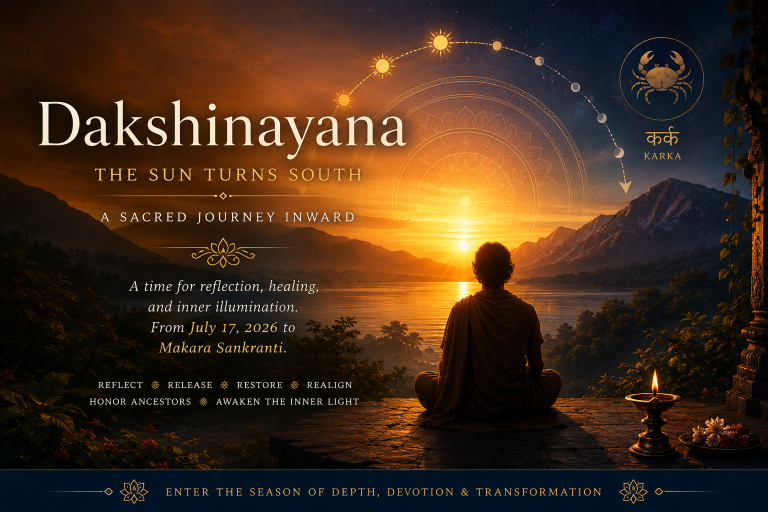
On the night of July 16, 2026, the Sun enters Karka Rashi—Cancer—in the Vedic sidereal zodiac, opening the six-month passage known as Dakshinayana.
The precise Sankranti moment in India occurs at approximately 11:45 PM IST on July 16. Therefore, July 17 becomes the first complete day beneath the new solar current: the first sunrise of Dakshinayana, the sacred southern journey of the Sun.
Something subtle changes at this threshold.
The Sun does not disappear. Its brilliance does not diminish. Yet its apparent journey begins moving southward, and the rhythm of life slowly turns from outward expansion toward inward assimilation.
Uttarayana—the northern journey—is often associated with emergence, action, visibility, aspiration and ascent.
Dakshinayana carries another medicine.
It is the descent into depth.
It is the movement from achievement toward meaning, from expression toward integration, from the visible world toward the invisible foundations that sustain it.
It is a time to ask:
What has my life produced during the months of outward movement?
What now needs to be digested?
What must be released?
What requires healing before another cycle of expansion begins?
Dakshinayana does not ask us to abandon the world. It asks us to enter the world more deeply—to act from roots rather than restlessness, from inner alignment rather than external pressure.
This is not the disappearance of light.
It is the beginning of interior illumination.
What Does Dakshinayana Mean?
The Sanskrit word Dakshinayana is formed from two essential ideas:
Dakshina means south or southward.
Ayana means movement, path, passage or journey.
Dakshinayana therefore means the southward journey.
In the traditional Hindu solar calendar, it begins with Karka Sankranti, when Surya enters Karka Rashi, and continues until Makara Sankranti, when the Sun enters Capricorn and Uttarayana begins again.
Each Sankranti marks the Sun’s entrance into a new zodiacal sign. Karka Sankranti is particularly significant because it marks one of the two great divisions of the solar year.
The year is not seen merely as twelve unrelated months. It is understood as a breath with two great movements:
Uttarayana: the ascending, northern, outward-moving current.
Dakshinayana: the descending, southern, inward-moving current.
Together, these two ayanas form one complete cycle of solar consciousness—expansion and return, manifestation and integration, inhalation and exhalation.
Without Uttarayana, there would be no courageous movement into life.
Without Dakshinayana, there would be no digestion of experience, no restoration of the roots and no preparation for rebirth.
Is Dakshinayana the Same as the Summer Solstice?
This is where astronomy and the traditional sacred calendar must be understood carefully.
Astronomically, the Sun reaches its northernmost apparent position at the June solstice. In 2026, the June solstice occurs on June 21 at 08:24 UTC, or 1:54 PM IST. After this point, the Sun’s apparent position gradually begins moving southward. NASA explains that this seasonal motion is produced not by the Sun literally travelling north and south around Earth, but by Earth’s axial tilt and changing orientation toward the Sun.
Why, then, does the traditional observance occur in mid-July?
The difference arises because the astronomical solstice and Karka Sankranti are calculated through different reference systems.
The modern astronomical solstice is based on the tropical zodiac and Earth’s seasonal relationship with the Sun.
Karka Sankranti is calculated through the sidereal zodiac, which tracks the Sun’s position relative to the stellar zodiac used in Jyotisha.
These are not necessarily competing truths. They are two systems of observing time.
Astronomy identifies the physical turning point of solar declination.
The sacred calendar identifies a ritual and zodiacal threshold through which human beings consciously participate in the change.
We may therefore understand the June solstice as the astronomical turning of the solar current, while Karka Sankranti becomes the traditional doorway through which Dakshinayana is ritually acknowledged.
Why Is Dakshinayana Called the Night of the Gods?
Traditional Hindu cosmology describes Uttarayana as the day of the devas and Dakshinayana as their night.
This does not mean that the Divine becomes absent, inactive or unreachable.
Night, within sacred symbolism, is not simply darkness. Night is gestation.
Seeds germinate beneath the soil.
The embryo develops within the womb.
The mind reorganizes itself during sleep.
The deepest healing often takes place beyond the noise of conscious activity.
Calling Dakshinayana the Night of the Gods points toward a period in which divine activity becomes less visibly demonstrative and more inwardly transformative.
During the day, we see forms.
During the night, we enter mystery.
During Uttarayana, consciousness may be drawn toward becoming, building, travelling, teaching, producing and achieving.
During Dakshinayana, consciousness is invited to descend beneath those accomplishments and examine their foundations.
Were our actions aligned with dharma?
Did our expansion nourish the soul?
Did we grow in wisdom, or merely increase our activity?
Did success make us more generous?
Did visibility bring us closer to truth, or simply strengthen the identity we present to the world?
Dakshinayana is the cosmic night in which these questions can finally be heard.
Dakshinayana and the Bhagavad Gita
The Bhagavad Gita refers to the northern and southern solar paths in Chapter 8.
Verse 8.25 speaks of smoke, night, the dark fortnight and the six months of the Sun’s southern course. Traditional commentaries connect this imagery with Pitriyana, the ancestral or lunar path through which the soul eventually returns to embodied existence.
These verses have occasionally been interpreted fearfully, as though dying during Dakshinayana automatically condemns a person to an inferior destiny.
Such a literal and fatalistic interpretation can obscure the larger spiritual teaching.
The Gita is not reducing liberation to an accidental calendar date. Its deeper concern is the state of consciousness, the nature of one’s realization and the direction in which awareness has been trained throughout life.
Light and darkness, day and night, fire and smoke can also be contemplated as inner states.
Light is clarity.
Smoke is obscuration.
Day is awakened awareness.
Night is unconsciousness.
The bright path is the movement of consciousness that knows its source.
The returning path is the movement shaped by attachment, unfinished desire and unresolved karma.
Dakshinayana therefore need not be feared. It can become a season in which we consciously enter our obscurations so they no longer direct our lives unconsciously.
The purpose of entering darkness consciously is not to become lost within it.
It is to bring light into the places we have avoided.
The Spiritual Meaning of the Southern Direction
In Vedic symbolism, the southern direction carries a profound relationship with Yama, the Pitris and ancestral consciousness.
Yama is often narrowly understood as the god of death. Yet Yama also represents order, restraint, truth, consequence and the intelligence that ensures life is not lived without accountability.
Death, in this context, is not merely the ending of the physical body.
It is the principle that says:
Everything false must eventually fall away.
Everything borrowed must be returned.
Everything unresolved must be faced.
Everything born in time must undergo transformation.
To turn southward is therefore to remember mortality—not morbidly, but medicinally.
It is to remember that time is sacred because it is not unlimited.
It is to ask whether we are living what truly matters.
Dakshinayana reminds us that spiritual maturity is not measured only by what we attract, manifest or accomplish. It is also measured by what we are willing to release.
Can we allow an identity to die when it no longer represents our truth?
Can we end a pattern even when it once protected us?
Can we forgive what the ego would prefer to keep rehearsing?
Can we bow to our ancestors without repeating their suffering?
Can we accept that transformation sometimes requires descent before rebirth?
The southern path teaches us that liberation is not always an upward movement.
Sometimes liberation begins by going down—into the body, the roots, the memory, the grief and the unfinished places of the soul.
Dakshinayana as Visarga Kala in Ayurveda
Ayurveda divides the solar year into two broad energetic periods.
Uttarayana is known as Adana Kala, the period of drawing away or depletion. The intensifying qualities of the Sun and wind are traditionally understood to extract moisture and gradually reduce the strength of living beings.
Dakshinayana is known as Visarga Kala, the period of release, nourishment or restoration.
It includes:
- Varsha Ritu—the rainy or monsoon season
- Sharad Ritu—the clear autumn season
- Hemanta Ritu—the early winter season
Ayurvedic seasonal theory describes bodily strength as initially low during the monsoon, gradually improving through autumn and becoming stronger by early winter. The beginning of Dakshinayana is therefore not an invitation to force the body. It is a transition requiring careful adaptation, especially where humidity, unstable digestion, changing temperatures and monsoon conditions are present.
This offers an important spiritual lesson.
Restoration does not happen instantly.
The moment a depleted period ends, we do not suddenly become strong. Strength returns gradually when the body is protected, digestion is respected and energy is no longer squandered.
Dakshinayana asks us to become more intelligent about nourishment.
Not only:
What am I eating?
But also:
What am I emotionally consuming?
What conversations leave me depleted?
What information enters my mind before sleep?
What relationships nourish my nervous system?
What environments allow my body to soften?
What spiritual practices genuinely rebuild me rather than becoming another form of pressure?
True nourishment is not indulgence. It is the conscious restoration of life force.
Ayurvedic recommendations must always be adapted to constitution, health conditions, geography and actual climate. The deeper principle, however, is universal: as the season changes, our way of living must also change.
The Great Festivals of the Inner Journey
Dakshinayana contains some of the most spiritually powerful observances of the Hindu calendar.
This alone tells us that it should never be dismissed as an inauspicious or spiritually inferior half of the year.
Within its vast arc come sacred periods associated with the Guru, Shiva, Krishna, Ganesha, the ancestors, the Divine Mother, Rama, Lakshmi and the awakening of divine light.
Guru Purnima
Near the beginning of this inward journey comes Guru Purnima, reminding us that descent requires guidance.
When we move outward, ambition may be enough to propel us.
When we move inward, we require discernment.
The Guru principle is the light that prevents introspection from becoming confusion and prevents spiritual darkness from becoming unconsciousness.
Shravana
The sacred month of Shravana is deeply connected with devotion to Shiva.
The word Shravana also evokes listening.
Dakshinayana teaches us to listen beneath the obvious—to hear the communication of the body, the voice of intuition, the wisdom hidden within silence and the guidance we miss when life becomes too loud.
Krishna Janmashtami
Krishna is born at midnight.
This symbolism belongs perfectly within Dakshinayana.
Divine consciousness is not always born in broad daylight. Sometimes it emerges in the middle of uncertainty, concealment and danger.
The darkest hour can become the birthplace of divine intelligence.
Ganesha Chaturthi
Ganesha teaches that the obstacles on the inward path are not always enemies. Sometimes they are guardians.
An obstacle may prevent us from entering a path for which we are not ready.
A delay may expose an unconscious motive.
A disappointment may redirect us toward our actual dharma.
Pitru Paksha
During Pitru Paksha, attention turns toward the ancestors.
We remember that we did not begin with ourselves.
Our bodies, languages, beliefs, fears, strengths and survival patterns were shaped by countless lives before ours.
Honouring the ancestors does not require romanticizing everything they did. It means acknowledging what was received, completing what remains unfinished and refusing to pass unnecessary suffering to the next generation.
Navaratri
Then comes Navaratri—the nine nights of the Divine Mother.
Again, revelation unfolds through night.
The Goddess does not merely comfort. She removes distortion, confronts inner demons, awakens courage and restores sacred order.
The darkness of Navaratri is not empty. It is filled with Shakti.
Vijaya Dashami
After nine nights of purification comes victory.
But this is not victory over another person.
It is victory over the forces within us that once appeared stronger than our awareness.
Diwali
Diwali arrives as the great festival of light during the darker half of the solar year.
Its timing reveals its teaching.
We do not light lamps because darkness has never existed.
We light them because darkness exists—and consciousness has the power to meet it.
The lamp of Diwali is not merely decorative. It represents the light that has been protected through the inner journey.
The Sacred Month of Kartika
Kartika deepens devotion through lamps, prayer, purification and disciplined spiritual practice.
By this stage of Dakshinayana, the inward journey begins producing radiance. The light is no longer dependent entirely on external conditions.
It has been kindled within.
Dakshinayana Is Not a Season of Inactivity
Turning inward does not mean abandoning one’s responsibilities.
Silence does not mean passivity.
Surrender does not mean helplessness.
Rest does not mean stagnation.
Dakshinayana is a period of conscious consolidation.
A tree may appear quiet after producing flowers and fruit, yet beneath the visible surface it is redistributing nutrients, strengthening roots and preparing for another cycle.
Human beings also require seasons in which energy is withdrawn from constant display and returned to the foundations of life.
This may be a powerful period for:
- Deepening an existing spiritual practice
- Studying sacred teachings
- Healing ancestral and family patterns
- Simplifying commitments
- Repairing the body and nervous system
- Completing unfinished emotional processes
- Serving without needing recognition
- Strengthening integrity
- Practising forgiveness
- Reducing unnecessary consumption
- Establishing a sustainable rhythm of prayer, meditation or japa
Dakshinayana is not asking us to become smaller.
It is asking us to become deeper.
A Simple Dakshinayana Opening Ritual for July 17, 2026
This ritual may be performed at sunrise on July 17, or at another quiet time appropriate to your location and circumstances.
Ritual practices differ between regions, families and spiritual lineages. What follows is a simple contemplative observance rather than a replacement for lineage-specific instructions.
1. Purify the Space
Clean the area in which you will practise.
Bathe and wear fresh, comfortable clothing.
Create a simple altar with:
- A lamp or candle
- A bowl of clean water
- Flowers
- Incense, if appropriate
- An image or symbol of Surya, Shiva, Vishnu, Devi or your Guru
- A small representation of your ancestors, if desired
The purpose is not decoration. It is to signal to the mind that you are crossing a threshold consciously.
2. Offer Water to Surya
At sunrise, face east and offer clean water to the Sun from a small copper or other suitable vessel.
As the water pours, allow the sunlight to pass through it.
Offer gratitude for life, clarity, nourishment and the intelligence that sustains all cycles.
Chant:
Om Suryaya Namah
ॐ सूर्याय नमः
Repeat it 11, 27 or 108 times.
As you chant, contemplate:
May the outer Sun awaken the inner Sun.
May I carry light even while walking through the inward half of the year.
3. Light a Lamp
Light a ghee or oil lamp and sit quietly before it.
Do not immediately ask for anything.
Simply witness the flame.
Observe that the flame moves upward even while rooted in matter.
Let it represent the awareness you intend to preserve throughout Dakshinayana.
4. Honour the Ancestors
Offer a small bowl of water, flowers or a simple prayer to your known and unknown ancestors.
You may say:
Om Pitrubhyo Namah
ॐ पितृभ्यो नमः
“I bow to the ancestors.”
Then speak from the heart:
To those whose lives made mine possible, I offer gratitude.
May what was noble in you continue through me.
May what remained wounded find healing.
May patterns of suffering end where awareness has now arisen.
May the merit of my practice benefit those who came before and those who will come after.
When formal ancestral rites are part of your tradition, follow the guidance of your family, teacher or priest.
5. Establish a Six-Month Sankalpa
Choose one commitment that can be sustained until Makara Sankranti.
Do not choose an impressive vow that will be abandoned after a few days.
Choose something honest.
Examples include:
- A daily meditation practice
- Eleven minutes of pranayama
- One mala of mantra each day
- One day of simplified food each week
- A weekly act of anonymous charity
- A regular digital sabbath
- A commitment to complete a sacred text
- A practice of speaking truthfully without unnecessary harshness
- A monthly ancestral offering
- A commitment to repair one important relationship
- A discipline of saving, simplifying or reducing waste
The power of sankalpa does not come from intensity alone.
It comes from continuity.
6. Practise Charity
Karka Sankranti is traditionally associated with dana—charitable giving.
Offer food, clothing, money, time, teaching or practical support according to your capacity.
Give without humiliating the receiver.
Give without turning generosity into performance.
Give as an acknowledgement that whatever flows through your hands does not belong to you alone.
Mantras for the Dakshinayana Period
A simple solar mantra:
Om Suryaya Namah
Salutations to the solar consciousness.
A mantra of inner illumination:
Om Bhur Bhuvah Svah
Tat Savitur Varenyam
Bhargo Devasya Dhimahi
Dhiyo Yo Nah Prachodayat
May we meditate upon the divine radiance of the Source. May that light illuminate our intelligence.
A mantra for surrender and divine protection:
Om Namo Narayanaya
ॐ नमो नारायणाय
A mantra for Shiva, the consciousness that transforms endings into liberation:
Om Namah Shivaya
ॐ नमः शिवाय
Choose one mantra and develop a relationship with it. Depth comes not from collecting many practices but from entering one practice completely.
Journal Prompts for the Beginning of Dakshinayana
Sit with these questions slowly. There is no need to answer all of them at once.
- What has expanded in my life during the previous six months?
- Which achievements feel genuinely aligned with my soul?
- What have I created but not yet fully integrated?
- Where am I using activity to avoid feeling?
- What identity has become too small, too heavy or no longer true?
- What ancestral pattern is asking to end with me?
- What form of nourishment is my body requesting?
- Where has my life become unnecessarily complicated?
- What truth becomes audible when I stop performing?
- What spiritual discipline am I willing to sustain until Makara Sankranti?
- What must be forgiven—not necessarily reconciled with, but released from my inner world?
- What light do I wish to protect through the coming darkness?
The Deeper Invitation of Dakshinayana
The modern world constantly encourages expansion.
More reach.
More speed.
More visibility.
More production.
More information.
More possessions.
More proof that we are succeeding.
But nature does not expand continuously.
The ocean advances and retreats.
The lungs inhale and exhale.
The heart contracts and releases.
The Moon waxes and wanes.
The soil produces and rests.
A life that knows only expansion eventually becomes exhausted.
Dakshinayana restores the missing half of the rhythm.
It teaches that withdrawal can be sacred.
That rest can be intelligent.
That endings can be initiations.
That darkness can become a womb.
That the ancestors can become sources of wisdom rather than unconscious repetition.
That devotion may deepen when external certainty disappears.
That our inner light becomes most meaningful when it no longer depends upon constant daylight.
As the Sun begins its sacred southern journey, we are not being asked to fear the shortening light.
We are being invited to discover the light that does not shorten.
The light of awareness.
The light of truth.
The light maintained by practice.
The light carried through generations.
The light that shines quietly in the cave of the heart.
A Prayer for Dakshinayana
May this southern journey return me to what is essential.
May all that has expanded become integrated.
May all that has been wounded receive compassion.
May all that has become false fall away without resistance.
May I honour my ancestors without being imprisoned by their pain.
May I enter darkness without surrendering awareness.
May discipline become devotion.
May solitude become communion.
May rest restore my strength.
May silence reveal what noise concealed.
May the light I seek outside awaken within me.
As Surya turns southward,
may my consciousness turn inward.
As the nights gradually lengthen,
may the flame within grow steadier.
As one half of the sacred year closes,
may another chamber of the soul open.
May this Dakshinayana become not a retreat from life,
but a return to the source from which a truer life can emerge.
Om Suryaya Namah.
Om Namo Narayanaya.
Om Shanti, Shanti, Shanti.