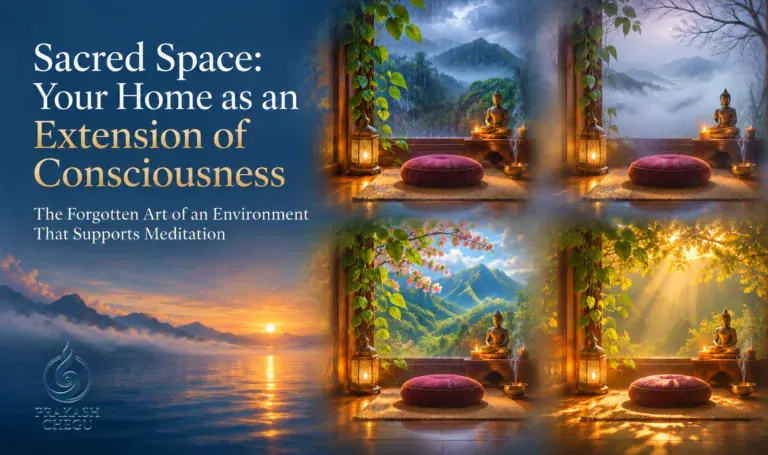
The Forgotten Art of Creating an Environment That Supports Meditation, Clarity and Inner Transformation
The Sacred Fire Code · Part 8 of 15
We spend an extraordinary amount of time designing spaces for the things we value.
We create kitchens to prepare food.
Bedrooms to rest.
Offices to work.
Living rooms to entertain.
Studios to exercise.
Workshops to build.
And increasingly, elaborate spaces to store everything we have accumulated.
But I wonder how often we ask a different question.
Where in our home have we created a space simply to become more conscious?
Not a place to produce something.
Not a place to impress visitors.
Not a place to escape into entertainment.
But a space where we can meet ourselves without constant distraction.
A place that invites stillness.
A place that supports awareness.
A place where the ordinary activities of the day can temporarily settle, allowing us to enter a different relationship with life.
Over the years, I have practiced and taught Kundalini Yoga, meditation, and Sat Nam Rasayan in many different environments.
Some have been extraordinarily beautiful.
Others have been remarkably simple.
Yet one observation has remained consistent.
The appearance of a space does not automatically determine the quality of the experience that unfolds within it.
A magnificent temple can be approached with a restless mind.
A modest room can become the setting for profound contemplation.
The real question is not whether a space looks spiritual.
The question is whether it supports the process of becoming more aware.
And that question brings together an extraordinary range of subjects.
The Bhagavad Gita.
The Yoga Sutras.
Traditional ideas of sacred space.
The principles of Vastu.
Modern environmental psychology.
The science of habit formation.
And the contemplative understanding that the most important sanctuary is ultimately the quality of awareness we bring wherever we go.
1. The Bhagavad Gita: Begin With a Clean and Steady Place
The Bhagavad Gita gives remarkably practical instructions for meditation.
In chapter 6, verse 11, Krishna says:
शुचौ देशे प्रतिष्ठाप्य स्थिरमासनमात्मनः।
नात्युच्छ्रितं नातिनीचं चैलाजिनकुशोत्तरम्॥
Śucau deśe pratiṣṭhāpya sthiram āsanam ātmanaḥ,
nātyucchritaṃ nātinīcaṃ cailājina-kuśottaram.
The verse instructs the practitioner to establish a steady seat in a clean place, neither too high nor too low, using the traditional materials described in the text.
Notice the simplicity of the instruction.
A clean place.
A stable seat.
An appropriate environment.
The next verse continues:
तत्रैकाग्रं मनः कृत्वा यतचित्तेन्द्रियक्रियः।
उपविश्यासने युञ्ज्याद्योगमात्मविशुद्धये॥
Tatraikāgraṃ manaḥ kṛtvā yata-cittendriya-kriyaḥ,
upaviśyāsane yuñjyād yogam ātma-viśuddhaye.
Having made the mind one-pointed and regulated the activity of mind and senses, one should practice yoga while seated there, for purification of the self.
— Bhagavad Gita 6.12
These instructions are profound precisely because they do not begin with extravagance.
The practitioner is not instructed to acquire expensive objects.
There is no demand for elaborate interior decoration.
The focus is on suitability, steadiness, and disciplined attention.
The external environment prepares the conditions.
The inward work remains essential.
This distinction is vital.
A meditation room is not successful because it contains beautiful objects.
It is successful when it helps the practitioner engage more consistently and deeply with practice.
2. The Difference Between a Beautiful Room and a Sacred Space
Consider two rooms.
The first is professionally designed.
Soft lighting.
Beautiful statues.
Expensive cushions.
Decorative plants.
Sacred geometry on the walls.
Perhaps an impressive collection of crystals and ritual objects.
The second contains a simple mat, a clean surface, and perhaps one lamp.
Which room is more suitable for meditation?
The answer depends on the practitioner.
Beauty can inspire.
Symbolism can be meaningful.
An orderly environment can support attention.
But beauty alone does not establish spiritual depth.
A person may become so absorbed in acquiring sacred objects that the process of preparing the room becomes another form of consumption.
Another purchase.
Another improvement.
Another arrangement.
Another attempt to create the perfect atmosphere before beginning the actual work.
I have seen how easily spiritual preparation can become spiritual procrastination.
We want the right cushion.
The right incense.
The right mantra recording.
The right wall hanging.
The right alignment.
The right moment.
And meanwhile, we postpone sitting.
There is nothing wrong with taking care of our environment.
But the environment should serve the practice.
Not become a reason to avoid it.
The most sacred object in a meditation room may be the willingness to sit there consistently.
3. What Makes a Place Sacred?
Across Indian traditions, different terms describe places, fields, sanctuaries, and sacred locations.
Tīrtha is particularly interesting.
The word can refer to a crossing place or ford, and in religious contexts it often refers to a place of pilgrimage.
A Tirtha is not simply a beautiful destination.
It is a place associated with a movement across a boundary.
From ordinary activity toward sacred participation.
From one condition toward another.
This image resonates with the experience of entering a meditation space.
A person may begin the day surrounded by responsibilities.
There are messages to answer.
Financial decisions.
Family concerns.
Plans.
Appointments.
Unfinished conversations.
The ordinary world makes demands.
Then the practitioner enters a designated space.
The physical distance may be no more than a few steps.
Yet the intended change in relationship is significant.
For a little while, the practitioner is no longer required to respond to every demand.
There is an opportunity to observe.
To become still.
To return to awareness.
A sacred space can therefore function as a threshold.
Not necessarily because the room contains a measurable supernatural field.
But because it is deliberately associated with a different quality of participation.
4. Vastu Shastra: The Traditional Intelligence of Space
Any serious exploration of sacred environments in India eventually encounters Vastu Shastra.
But we must approach the subject with care.
Vāstu concerns dwelling, site, or built environment, while śāstra refers to a body of systematic teaching.
Vastu traditions contain principles concerning architecture, orientation, proportion, placement, site characteristics, and symbolic relationships with the cosmos.
Their historical literature is extensive and diverse.
Texts associated with architecture and site planning include works such as the Mānasāra and Mayamata, alongside numerous regional and technical traditions.
However, Vastu should not be reduced to the modern popular claim that every problem in life can be traced to the direction of a door, bedroom, or kitchen.
That kind of oversimplification creates fear.
It can also lead people to make expensive and unnecessary changes to their homes.
The traditional literature deserves more serious treatment.
Its architectural, ritual, historical, and cosmological dimensions should be understood within their contexts.
Certain principles of building design—such as daylight, ventilation, thermal comfort, drainage, and suitability for climate—can be investigated scientifically.
Other Vastu claims concern symbolic or cosmological correspondences that have not been established through controlled evidence.
We should distinguish these categories.
A well-ventilated room may support comfort.
A quiet environment may reduce distraction.
Access to natural daylight may influence mood and circadian rhythms.
These are researchable effects.
But a claim that a particular compass direction necessarily produces wealth, illness, marriage, or spiritual liberation requires separate evidence.
The direction of a meditation room should not become a source of anxiety.
Choose a place that is safe, quiet, comfortable, and available for practice.
The purpose is to support awareness—not manufacture fear about invisible architectural mistakes.
5. The Psychology of Environmental Cues
Modern behavioral science offers an interesting perspective.
Human behavior is influenced by context.
We develop associations between places, cues, and repeated activities.
A familiar environment can make a particular behavior easier to initiate.
For example, an individual who regularly exercises in the same place at the same time may gradually develop a more stable routine.
A person who repeatedly works at a particular desk may begin associating that environment with focused activity.
A meditation space can serve a similar function.
The cushion becomes a cue.
The preparation of the room becomes a cue.
The act of turning off the phone becomes a cue.
The transition from standing to sitting becomes a cue.
And over time, the sequence may support regularity.
Research on habit formation has examined how repeated behaviors in stable contexts can become increasingly automatic.
This does not establish that a room accumulates a scientifically measurable spiritual aura.
It suggests a plausible behavioral mechanism through which a consistent setting can support a practice.
The distinction is worth preserving.
Traditional practitioners may describe an atmosphere as spiritually charged.
Modern behavioral science may describe learned associations and contextual cues.
These explanations are not automatically equivalent.
But the existence of a behavioral mechanism does not prevent the practitioner from finding spiritual meaning in the experience.
Different questions are being asked.
6. The Problem With Always Changing Our Environment
We live in a time when novelty has become extraordinarily accessible.
New devices.
New applications.
New destinations.
New experiences.
New practices.
New forms of entertainment.
There is nothing inherently wrong with novelty.
Curiosity is one of the great gifts of human intelligence.
But novelty can also become a way of avoiding depth.
A person may attend one meditation workshop and immediately search for another.
Try one technique and begin comparing it with five others.
Purchase a new spiritual tool before learning to use the previous one.
Constantly rearrange the practice space in search of a feeling that has not yet appeared.
But depth frequently requires continuity.
Not endless stimulation.
A single practice repeated with sincerity may reveal dimensions that remain inaccessible when attention is continually redirected toward the next experience.
This is particularly important in Sadhana.
The ordinary repetition of practice is not necessarily a limitation.
It can become the very condition through which deeper awareness develops.
The same familiar cushion.
The same quiet place.
The same willingness to sit.
Day after day.
And gradually, the practitioner may begin to recognize something that was obscured by the constant search for novelty.
7. Abhyasa: The Discipline of Returning
Patanjali’s Yoga Sutra 1.12 states:
अभ्यासवैराग्याभ्यां तन्निरोधः॥
Abhyāsa-vairāgyābhyāṃ tan-nirodhaḥ.
The stilling of the fluctuations is through practice and dispassion.
The next sutra defines Abhyasa:
तत्र स्थितौ यत्नोऽभ्यासः॥
Tatra sthitau yatno’bhyāsaḥ.
Practice is the effort toward steadiness.
Then Yoga Sutra 1.14 explains:
स तु दीर्घकालनैरन्तर्यसत्कारासेवितो दृढभूमिः॥
Sa tu dīrgha-kāla-nairantarya-satkārāsevito dṛḍha-bhūmiḥ.
Practice becomes firmly grounded when cultivated over a long period, without interruption, and with sincere regard.
This is a crucial teaching.
We often measure practice according to intensity.
How long was the meditation?
How powerful was the kriya?
How extraordinary was the experience?
But Patanjali emphasizes continuity.
Duration over time.
Consistency.
Respect for the discipline.
A meaningful meditation space can support these qualities.
Not because a particular arrangement guarantees spiritual attainment.
But because it reduces unnecessary barriers to beginning.
If the space is ready, the practitioner does not have to negotiate with themselves every morning about where to sit.
If the practice has a stable rhythm, there is less dependence upon temporary motivation.
And if the environment remains associated with Sadhana, returning may become easier.
8. The Sat Nam Rasayan Perspective: Space as Awareness
My own experience with Sat Nam Rasayan has shaped how I understand sacred space.
The practice has repeatedly brought me back to one fundamental consideration.
The quality of awareness matters.
A room may be quiet, but the mind can remain restless.
A room may contain other people, yet a practitioner may remain deeply attentive.
We can become fascinated by the atmosphere surrounding us while overlooking the state from which we are perceiving that atmosphere.
In Sat Nam Rasayan, the refinement of awareness invites us to become less dominated by habitual reactions and interpretations.
I do not present this as evidence that a scientifically measurable energetic field has been changed.
It is a description of a contemplative discipline and the experiences through which it is explored.
The practical implication is important.
If we make the room responsible for our meditation, we may become dependent upon perfect external conditions.
The temperature must be right.
The lighting must be right.
Nobody may make a sound.
The incense must be burning.
The music must be playing.
The cushion must be arranged precisely.
And if anything changes, we become disturbed.
At some point, the very space designed to support freedom begins to impose conditions upon it.
This is where the practice must mature.
The environment can support us.
But eventually, we must also become capable of remaining aware when the environment is less than ideal.
Otherwise, we have not developed freedom.
We have developed a more sophisticated dependency.
9. A Meditation Room Should Not Become Another Source of Pollution
There is another dimension of sacred-space design that deserves attention.
Air quality.
Traditional spiritual environments frequently incorporate incense, candles, oil lamps, and other sources of combustion.
These may have cultural, symbolic, or sensory significance.
But combustion produces emissions.
Depending on the material and conditions, these can include fine particles and other pollutants.
A room filled with fragrant smoke is not automatically a healthy room.
And a strong fragrance is not evidence of purification.
This is particularly important when children, elderly people, or individuals with respiratory vulnerabilities use the space.
The ideal sacred environment should not require prolonged exposure to smoke.
Natural ventilation, safe lighting, and the absence of unnecessary pollutants are sensible priorities.
If a traditional lamp is meaningful, it can be used briefly and responsibly where appropriate.
A flameless light may be a better choice in some homes.
There is no need to compromise physical safety in order to create a contemplative atmosphere.
A meaningful spiritual practice should make us more attentive to the body and the environment—not less.
10. The Seven Principles of a Supportive Meditation Space
I would approach the design of a home meditation space through seven practical principles.
First: Simplicity
Begin with less.
A clean floor.
A stable seat.
Appropriate lighting.
A small number of meaningful objects, if desired.
Avoid filling every available surface.
A space does not become more sacred merely because it contains more symbols.
Second: Consistency
Choose a place you can return to regularly.
A beautiful room that is rarely available may be less useful than a simple corner you can access every day.
Third: Physical Comfort
Choose a seat that supports the body.
There is no need to endure unnecessary pain.
A cushion, chair, bench, or other suitable support may be appropriate.
The goal is steadiness rather than physical performance.
Fourth: Sensory Balance
Consider light, sound, temperature, and air.
Avoid unnecessarily bright lighting during evening practice.
Maintain ventilation.
Reduce avoidable noise where possible, while recognizing that silence need not be absolute.
Fifth: Meaningful Symbolism
A lamp.
A sacred text.
A photograph of a teacher.
A deity image.
A flower.
A meaningful object.
These may serve as reminders of intention.
But their value is connected to the relationship the practitioner develops with them.
Sixth: Accessibility
Make the practice easy to begin.
If every session requires moving furniture, assembling elaborate equipment, and reorganizing the room, the practical burden may gradually undermine consistency.
Seventh: Inner Freedom
Remember that the room is a support.
Not a prison.
Not an exclusive source of spiritual experience.
Eventually, the quality of awareness cultivated there should become available in ordinary life.
11. A Thirty-Minute Daily Sacred-Space Practice
I would like to offer a simple structure that can be adapted to different levels of experience.
It is intended for general contemplative practice rather than advanced Kundalini techniques.
Minutes 0–5: Preparation
Enter the space.
Put away the phone.
Adjust the seat.
Allow the body to settle.
Notice the transition from ordinary activity into practice.
Minutes 5–10: Grounding
Become aware of contact with the floor or chair.
Notice natural breathing.
Feel the body without attempting to change every sensation.
Minutes 10–20: Meditation
Choose a simple attentional anchor appropriate to your experience.
It may be the natural breath, a familiar mantra, or open observation.
When attention wanders, recognize it and return without self-criticism.
There is no need to force a special state.
Minutes 20–25: Silence
Release the deliberate anchor if comfortable.
Allow awareness to remain open.
Notice thoughts, sensations, and sounds without needing to follow each one.
Minutes 25–30: Integration
Before rising, reflect briefly.
How do I wish to carry this practice into my day?
What quality of awareness could change the way I approach my next conversation?
Then return to ordinary activity.
If meditation intensifies distress, disorientation, or difficult symptoms, pause and seek appropriate guidance. Practices should be adapted to the individual rather than forced.
12. Can a Room Accumulate Spiritual Energy?
This is a question many practitioners ask.
Traditional teachers sometimes describe a sacred place as holding an atmosphere created through repeated meditation, mantra, or ritual.
Such descriptions are meaningful within their respective spiritual frameworks.
But we should distinguish subjective reports from established physical measurements.
A practitioner may experience a familiar meditation room as unusually peaceful.
That experience may reflect several contributing factors.
Learned associations.
Reduced distraction.
Expectations.
Sensory characteristics.
Ritual preparation.
Memories of previous experiences.
The practitioner’s present state.
And perhaps other factors not yet adequately studied.
But the experience alone does not establish the presence of a separately measurable spiritual energy field.
I do not think this distinction diminishes the practice.
In fact, it frees us from exaggerated claims.
We do not have to prove an invisible substance has accumulated in the walls in order to recognize that a consistent meditation environment can become meaningful.
The room may support a habit.
The habit may support attention.
Attention may support self-understanding.
And self-understanding may influence the way we live.
That is already an extraordinary possibility.
13. The Sacred Space Must Eventually Expand Beyond the Room
This is where I believe the teaching becomes truly important.
Imagine a person who meditates beautifully each morning.
They sit in silence.
They chant.
They observe the breath.
They light a lamp.
They maintain an immaculate sacred space.
Then they leave the room.
And immediately become impatient with their family.
Harsh with their colleagues.
Dishonest in business.
Insensitive toward people who disagree with them.
What has the practice accomplished?
We should be careful not to demand perfection.
Every practitioner encounters difficulties.
Spiritual maturity is gradual.
But the direction matters.
If meditation does not begin influencing how we participate in ordinary life, we must examine what we are practicing.
The purpose of sacred space is not to create a beautiful separation between spirituality and daily existence.
It is to cultivate qualities that gradually become available everywhere.
Patience.
Clarity.
Compassion.
Discernment.
Presence.
The willingness to listen.
The capacity to remain steady without becoming rigid.
This is the real integration.
A meditation room becomes meaningful when its influence extends into the kitchen, the workplace, the family, the classroom, and the world.
14. The Grihastha’s Sanctuary
There is something especially beautiful about the idea of sacred space within a household.
In the traditional framework of the Grihastha Ashrama, household life is not merely a distraction from spirituality.
It is also a field of responsibility, relationship, service, and ethical participation.
The householder cares for family.
Supports dependents.
Participates in society.
Offers hospitality.
Practices generosity.
And, within many traditions, maintains sacred observances.
A home should therefore not become spiritual only in one decorated corner while the rest of its relationships remain neglected.
A truly meaningful sanctuary is not defined merely by the presence of an altar.
It is also defined by the quality of life taking place around it.
How do the people in the home speak to one another?
Are children treated with care?
Are elders respected?
Is food prepared with attention?
Do guests feel welcome?
Can disagreements occur without humiliation?
Is there room for solitude as well as relationship?
These questions may reveal more about the spiritual condition of a home than the number of sacred objects it contains.
The altar reminds us of our values.
The household gives us opportunities to practice them.
And the two should not be separated.
15. The Difference Between Isolation and Sacred Solitude
When discussing meditation spaces, we must also distinguish solitude from isolation.
Solitude can be nourishing.
It may support reflection, prayer, contemplation, and the renewal of attention.
But isolation can become painful when a person is disconnected from meaningful relationships and support.
The distinction is not always visible from the outside.
A person sitting alone may be deeply content.
Another may be suffering.
We should not romanticize withdrawal simply because it resembles the outward behavior of an ascetic.
The purpose of a home sanctuary is not necessarily to become less involved in life.
It may help us return to life with greater clarity.
Sometimes that requires silence.
Sometimes it requires conversation.
Sometimes it requires rest.
Sometimes it requires the courage to engage with a difficult responsibility.
A mature practice should improve our capacity for discernment.
Not impose one behavior as the solution to every condition.
16. When Your Presence Becomes the Sacred Space
I began by asking what makes a space sacred.
The architecture?
The objects?
The ritual?
Or the quality of awareness?
I believe the deepest answer is found in the relationship among these dimensions.
A well-prepared environment can help.
A consistent practice can help.
Meaningful symbols can help.
A lineage can provide structure.
A teacher can provide guidance.
But ultimately, the practitioner must become capable of participating consciously.
There is a beautiful paradox here.
We begin by creating a place for meditation.
But as practice matures, we discover that awareness cannot remain confined to that place.
The purpose of becoming still is not merely to become good at sitting still.
It is to become more conscious while living.
More conscious while walking.
While speaking.
While eating.
While teaching.
While listening.
While facing uncertainty.
While caring for another human being.
If we require perfect surroundings before we can remain present, then the environment still governs us.
But if the environment becomes a support from which awareness gradually develops greater independence, it has fulfilled its purpose.
This is where external sacred space begins to reveal its deeper meaning.
The room was never the destination.
It was a place of preparation.
The lamp was never the ultimate source of illumination.
It was a reminder.
The altar was never a replacement for reverence.
It was an invitation to practice it.
The highest sacred space is not the place where we escape life. It is the awareness through which we become capable of meeting life fully.
And perhaps that is the most beautiful transformation a home can undergo.
Not that every room becomes a temple in appearance.
But that the people who live there become a little more conscious.
A little more compassionate.
A little more available to one another.
A little less governed by fear and compulsion.
And a little more willing to recognize the extraordinary possibility of being alive.
Create a space.
Return to it.
Practice sincerely.
Then allow the quality of that practice to accompany you wherever life takes you.
That is how the sacred space gradually ceases to be merely a location.
And begins to become a way of being.
Continue Exploring The Sacred Fire Code
Previously: The Fires Within — From Jatharagni to Chitagni.
Next: Why the Sadhu Keeps His Own Fire — The Mysticism of Dhuni.
Related articles: Panchagni — How to Create a Sacred Meditation Space in Your Home; Bhuta Shuddhi — The Ancient Art of Purifying the Five Elements; When the Inner Fire Awakens, Ritual Becomes Unnecessary.
Sources and Further Reading
-
Bhagavad Gita 6.10–13 — Preparation for meditation, solitude, the seat, and one-pointedness. https://heritage.iitk.ac.in/SBG/6.11
-
Patanjali, Yoga Sutra 1.12–14 — Abhyasa, Vairagya, and the importance of sustained practice.
-
Patanjali, Yoga Sutra 2.46 — Sthira Sukham Asanam.
-
Lally, P., & Gardner, B. (2013). Promoting Habit Formation. Health Psychology Review. https://doi.org/10.1080/17437199.2011.603640
-
Traditional architectural literature including the Mānasāra and Mayamata, for the historical study of Vastu Shastra.
-
National Fire Protection Association — Candle and open-flame safety. https://www.nfpa.org/education-and-research/home-fire-safety/candles
Research note: Environmental effects, contemplative experiences, and sacred-space traditions are discussed as distinct but potentially complementary subjects. The article does not claim that a meditation room generates scientifically verified supernatural energy fields.
Series Navigation
Previous: Part 7 · The Fires Within: From Jatharagni to Chitagni
View the Complete Sacred Fire Code series
Next: Part 9 · Why the Sadhu Keeps His Own Fire
Frequently Asked Questions
How do I create a sacred space in my home?
Start by being honest about its purpose. A sacred space is not a room to impress visitors, produce something, or escape into entertainment, it is a place to meet yourself without constant distraction, one that invites stillness and supports awareness. In my experience a simple mat, a clean surface and perhaps one lamp are enough. What makes it sacred is the relationship you bring to it, not what fills it.
Do I need beautiful statues, crystals and decor for a meditation room?
No. Beauty can inspire and an orderly environment can support attention, but beauty alone does not establish spiritual depth. I have seen people become so absorbed in acquiring sacred objects that preparing the room becomes just another form of consumption, another purchase, another arrangement. A magnificent temple can be entered with a restless mind, and a modest room can hold profound contemplation.
What actually makes a space sacred?
Consistency and depth of practice. A meditation room succeeds not when it contains beautiful things, but when it helps you engage more regularly and more deeply with your practice. The space becomes an extension of your consciousness because of how you return to it and who you become while you are there, not because of what is on the walls.