The meaning of Dev Uthani Ekadashi, the completion of Chaturmas, and the invitation to renew our devotion.
There are seasons when life asks us to step forward, and seasons when it asks us to wait.
During the waiting, we continue with ordinary responsibilities. We cook, work, care for others, and offer our prayers. Yet something within us may be quietly changing. A familiar ambition loses its hold. A relationship asks for greater honesty. A practice that once felt mechanical begins to reveal its depth.
The change may remain invisible for a long time.
Prabodhini Ekadashi gives sacred expression to the moment when inward preparation becomes a renewed willingness to participate in life.
In Hindu tradition, this is the day Lord Vishnu awakens from his four-month yogic repose. Devotees welcome him with worship, fasting, song, and remembrance. The season of Chaturmas reaches its completion, and a new cycle of auspicious activity opens.
Within that celebration lives a question we can carry into our own homes: What is ready to awaken through the way I live?
The meaning of Prabodhini Ekadashi
Prabodhini Ekadashi falls on the eleventh lunar day of the bright fortnight of Kartika, known as Kartika Shukla Ekadashi. Its familiar names include Dev Uthani, Devutthana, Utthana, and Haribodhini Ekadashi. Each emphasizes awakening or rising, with Hari referring to Vishnu. Vaishnava tradition associates it with Vishnu’s awakening from the four months of Chaturmasya.
The Sanskrit word prabodha carries the sense of awakening, understanding, and coming into awareness.
That meaning allows the festival to speak on several levels. There is the sacred event celebrated in the temple, the seasonal transition recognized by the community, and the inner work undertaken by the devotee.
These levels can coexist. A person may worship Vishnu as a beloved, living divine presence while also reflecting on the habits that obscure their own awareness.
Devotion becomes especially intimate when the festival’s meaning enters the details of the day: how we speak, what we consume, what we protect, and whether we remember the sacred while fulfilling our responsibilities.
Prabodhini Ekadashi in 2026: why calendars differ
For New Delhi, Devutthana Ekadashi is observed on Friday, November 20, 2026, with a second, Gauna observance on Saturday, November 21; some traditions observe on November 21. These differences reflect the calendrical rules followed by different lineages.
The fasting day and the time for breaking the fast (parana) should therefore be checked for your location and religious tradition. A date or parana time published for an Indian city should not automatically be applied to someone observing in Mexico, Europe, or North America.
For those writing the day into a family calendar, this small act of checking is part of preparing thoughtfully.
The four-month journey from repose to awakening
The traditional cycle begins with Shayani Ekadashi in Ashadha and reaches its awakening at Prabodhini Ekadashi in Kartika. Chaturmas is a season of religious observance during which devotees may undertake particular restraints, prayers, dietary commitments, or acts of service. Details vary across communities.
Four months is long enough for an intention to encounter ordinary life.
The initial enthusiasm fades. There are days when prayer feels nourishing and days when the mind wanders. A vow meets travel, fatigue, family needs, and the temptation to make exceptions.
This is where a practice begins to teach.
We discover whether we have chosen something sustainable. We notice how easily disappointment becomes an excuse to abandon our effort. We learn to return without needing every return to feel extraordinary.
At the completion of such a season, the useful question is: What has this commitment taught me about living?
Perhaps we have become more patient. Perhaps we have discovered how much attention was being spent on unnecessary conflict. Perhaps the most meaningful achievement has been learning to begin again after an imperfect day.
Prabodhini gives that quiet learning a place in the ritual year.
Understanding Vishnu’s yogic repose
The image of Vishnu resting upon the serpent Ananta in the cosmic ocean is among Hinduism’s most evocative sacred images.
Within devotional understanding, his repose expresses divine mystery and cosmic rhythm. The festival’s language of yoga-nidra belongs to that theological setting. Contemporary guided relaxation practices also use the term, but they do not exhaust its meaning here.
A contemplative reading of the image invites us to consider the relationship between stillness and action.
We often judge ourselves by what can be seen: the project completed, the journey undertaken, the decision announced. Much of what supports meaningful action develops quietly. Discernment takes time. Grief changes us gradually. Trust grows through repeated experience.
The resting Vishnu offers an image through which to contemplate that hidden dimension of life. His awakening can then become a prayer for action that emerges from depth: action with enough steadiness to sustain what it begins.
This is a symbolic reflection on the festival, rather than a claim about a measurable physiological event.
The stories surrounding the awakening
Hindu festivals often carry several narrative traditions. Some accounts record Vishnu returning after a period of rest following battle, and of his return after guarding King Bali’s doorway for four months. These sit alongside the widely celebrated account of his awakening from yogic repose.
The presence of different stories reflects the richness of living religious traditions.
One family may emphasize divine protection. Another may focus on Vishnu’s faithfulness to a devotee. A temple may celebrate the Lord’s awakening through a particular liturgy inherited across generations.
For a contemporary reader, these stories offer an opportunity to listen before reducing everything to a single psychological explanation. Vishnu’s protection of Bali, for instance, can invite reflection on fidelity: the willingness to remain present to a commitment. The awakening narrative can invite reflection on renewal.
The stories retain their devotional character even as they illuminate human experience.
Tulsi Vivah: awakening enters the household
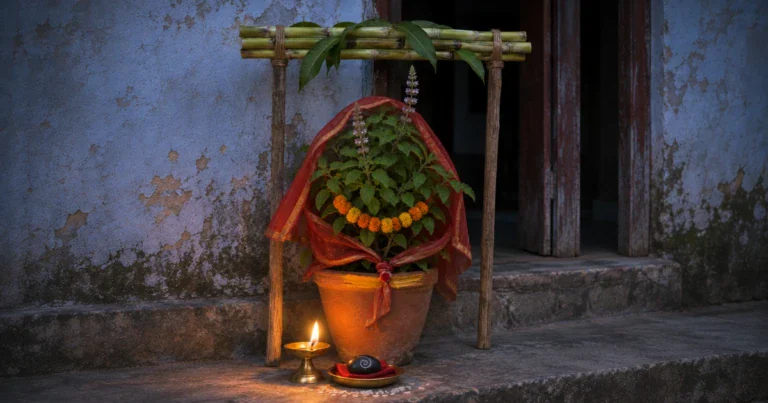
Prabodhini Ekadashi is closely associated with the season of Tulsi Vivah, the ceremonial marriage of Tulsi Devi to Vishnu, often represented by Shaligram or an image of Vishnu or Krishna. Depending on local and lineage customs, the celebration may take place on Ekadashi, Dwadashi, or another day through Kartika Purnima.
The sequence is beautiful to contemplate. The divine awakens, and the household prepares to welcome sacred relationship.
A Tulsi plant may stand in a courtyard that has witnessed years of family life: births, bereavements, arguments, reconciliations, departures, and returns. To decorate that plant and gather around it brings worship into the place where people actually live together.
For householders, this offers a powerful field of reflection. How do we make a home where care can be trusted? How do we speak when we are tired? How do we share responsibility? How do we honor the living world that sustains the household?
Marriage and family life ask these questions repeatedly. Tulsi Vivah allows us to contemplate devotion through the daily work of relationship: tending, showing up, repairing harm, and giving attention to something beyond our own immediate preference.
The opening of an auspicious season
In many Hindu communities, the completion of Chaturmas is associated with the resumption of weddings and other auspicious ceremonies. Particular wedding dates still depend on the relevant calendar and customary muhurta considerations.
Alongside its social meaning, this transition offers a useful personal reflection. A period of preparation eventually asks for participation.
We can spend years collecting teachings while postponing a modest daily practice. We can imagine a more generous life while delaying the first concrete act of generosity. We can wait for complete certainty before having an honest conversation.
The festival creates an occasion to choose one step. That step may be small enough to keep: ten minutes of prayer, a regular contribution to someone’s care, or a promise to complete an unfinished responsibility.
Readiness often becomes clearer through faithful participation.
Ekadashi and the gathering of attention
Ekadashi is observed through fasting and devotion in many Hindu traditions. One traditional interpretation also connects its discipline with directing the ten senses and the mind toward worship.
This offers a helpful way to think about attention. During an ordinary day, our attention moves through a crowded landscape. We read a message while eating, rehearse an argument while walking, and reach for another distraction before the previous one has ended.
A day of observance can introduce deliberate pauses into that movement. We might eat more simply, reduce entertainment, spend time in prayer, or refrain from a conversation that reliably becomes gossip. Each choice creates room to notice what usually passes unquestioned.
Some impulses soften when we stop feeding them immediately. Others reveal a need that deserves care: loneliness, fatigue, sorrow, or the wish to be heard.
Such observations belong to personal experience. They do not require claims that a particular lunar day produces a universal change in human biology. The devotional calendar simply provides a recurring opportunity to practice remembering.
Fasting with discernment
Ekadashi fasting takes different forms. Some devotees abstain from food, some take water, and others observe a modified diet. Avoidance of grains and pulses is common, while accepted foods and the strictness of the observance differ by tradition. Choose the form of your vow with awareness of your circumstances.
The practical purpose is to support worship with a commitment you can honor. A complicated feast of fasting foods may absorb the whole day in preparation. A simpler meal may leave more time for chanting, service, and quiet. Equally, a person who needs regular nourishment can still make the day meaningful through prayer and restraint in other areas of life.
A note on safety: If you have diabetes or take medication affected by food intake, plan any fast with your clinician. Religious fasting can involve risks including low blood glucose and dehydration, and medication changes require individual guidance. The same spirit of care should guide anyone whose circumstances make food or water restriction unsuitable — you can honor the occasion through an adapted observance.
There is dignity in choosing a practice that supports your ability to remain attentive, kind, and available to others.
A simple way to observe at home
The following is an accessible devotional framework, rather than a complete lineage-specific puja manual. Adapt it to your family’s practice.
Prepare a clean space. Place an image of Vishnu, Narayana, Krishna, or the form of the divine you worship on a clean surface. A small, cared-for space is sufficient.
Make a clear intention. Decide what you are undertaking for the day. You might say: “May this observance help me remember you and fulfill my responsibilities with greater care.”
Offer what is available. Water, flowers, fruit, and a safely tended lamp can accompany your prayer. Follow your tradition concerning Tulsi offerings.
Give time to remembrance. Chant a familiar divine name, read a passage of sacred teaching, or join a temple’s worship. Allow a little silence afterward.
Let the intention shape your conduct. Return to it while working, preparing food, or speaking with family. Notice whether your observance is helping you become more considerate.
Include service. Offer practical help, share food appropriately, or contribute to a trustworthy effort that relieves someone’s difficulty.
Close with gratitude. In the evening, acknowledge what the day revealed. If you have undertaken a formal fast, follow the appropriate local parana time and guidance for completing it.
These choices make room for devotion in an ordinary home. Elaborate arrangements are optional.
A prayer of awakening
A well-known verse from the Sri Venkatesa Suprabhatam offers language beautifully suited to contemplating divine awakening:
उत्तिष्ठोत्तिष्ठ गोविन्द उत्तिष्ठ गरुडध्वज ।
उत्तिष्ठ कमलाकान्त त्रैलोक्यं मङ्गलं कुरु ॥Uttiṣṭhottiṣṭha Govinda, uttiṣṭha Garuḍadhvaja;
uttiṣṭha Kamalākānta, trailokyaṃ maṅgalaṃ kuru.
“Arise, arise, Govinda; arise, bearer of Garuda’s banner. Arise, beloved of Lakshmi; bring auspiciousness to the three worlds.”
This is a rendering of a traditional awakening verse, rather than an exclusive mantra prescribed only for Prabodhini Ekadashi. Its final movement deserves attention: the prayer extends toward the welfare of the worlds. We can allow our own prayers to widen in the same direction — praying not only for our personal concerns, but for the people affected by our choices: our families, students, colleagues, neighbors, and those whose work makes our lives possible.
A simple Vishnu mantra for personal remembrance is:
ॐ नमो नारायणाय
Om Namo Narayanaya.
Chant at an unhurried pace, according to your capacity or received practice. Listen to the sound, then give yourself a moment to remain quiet. Let the prayer have somewhere to land.
Kartiki Ekadashi and the pilgrimage to Pandharpur
In Maharashtra, Kartiki Ekadashi is an important pilgrimage occasion at Pandharpur, where devotees worship Vitthal and Rukmini. Prabodhini Ekadashi is the central day of the Kartik pilgrimage, with bhajan, kirtan, and communal devotion forming part of the celebration.
The pilgrimage offers a communal expression of remembrance. A person walking with other devotees has to inhabit the journey step by step. Songs are repeated. The destination remains ahead. Companions have different capacities, and the group’s life includes waiting, sharing, and helping.
There is wisdom here for anyone whose spiritual life has become overly private. We need places where devotion can be expressed together. We need opportunities to receive help as well as give it. We need reminders that the sacred belongs within a shared world.
Even when we cannot travel to Pandharpur, we can bring something of that spirit into a local gathering: sing together, prepare food together, and make room for someone who would otherwise remain alone.
The final days of Kartika
In some Vaishnava traditions, Prabodhini Ekadashi also begins Bhishma Panchaka, an observance extending through the final five days of Kartika. Its disciplines should be learned through the tradition in which one intends to undertake them.
For a reader who is simply seeking a way to carry the festival forward, these days can inspire a modest period of continued remembrance. Choose something small and specific. Sit for prayer at the same time each morning. Read a few verses with care. Complete one act of service without seeking recognition.
This is a contemporary personal practice suggestion, separate from the formal Bhishma Panchaka vrata. Its value lies in continuity: a meaningful festival can become a beginning whose effect remains visible in the following week.
The inner awakening: what changes afterward?
The devotional image of Vishnu awakening invites us to examine the quality of our own participation in life. Where have we become careless? Which responsibilities have we repeatedly postponed? What receives our best attention, and what receives whatever remains?
These questions can be approached gently and honestly. Perhaps someone in our family needs a dependable hour of our time. Perhaps we have used busyness to avoid grief. Perhaps a creative work needs the simple discipline of returning to it each day.
We do not have to turn the festival into a demand for sudden transformation. Choose one area where greater awareness can become an observable action. If you want to listen more deeply, put the phone away during a conversation. If you want to honor your teachers, practice something they taught. If you want a more peaceful home, take responsibility for a recurring source of tension that lies within your control.
Such actions give devotional intention a daily form. They also make humility possible. We can see where we are still learning, ask for help, and return to our commitments without declaring ourselves finished.
A reflection for Prabodhini Ekadashi
Set aside a few quiet minutes and write about these questions:
- What has the past season taught me that I have yet to put into practice?
- Which commitment needs my steady attention?
- Where can I make life easier for someone who depends on me?
- What am I ready to begin with patience?
- What will help me remember this intention tomorrow?
Read your answers once, without editing them into something impressive. Then choose a single action you can complete.
There may also be something you need to release: an unrealistic promise, a resentment you keep rehearsing, or the demand that every meaningful effort produce an immediate result. Bring that into prayer too.
Awakening can include the honesty to recognize what is ready to end, and the courage to care for what is ready to grow.
Welcoming the awakening
At a home altar or within a temple, a lamp is offered. A name is sung. Devotees gather to welcome Vishnu’s awakening.
Some arrive with gratitude. Some carry uncertainty. Some have kept their vows steadily; others are returning after a long absence. The festival gives them a shared day of remembrance.
We can enter it with our lives as they are, bringing both devotion and unfinished work. We can ask for clarity, offer thanks for what has sustained us, and renew a promise that has become faint through repetition. Then we can carry that promise into the next conversation, the next meal, and the next responsibility.
May Prabodhini Ekadashi renew our love for the sacred. May that love become visible in the care we give.
Om Namo Narayanaya.
Sources & further reading
- Drik Panchang — Devutthana (Prabodhini) Ekadashi 2026 dates and parana timing
- Panchang / Vaishnava calendars — names and significance of Kartika Shukla Ekadashi
- ISKCON (Attapur, Raichur, Bhiwandi) — Chaturmas, Tulsi Vivah customs, and Bhishma Panchaka
- BAPS — narrative traditions of Vishnu’s awakening and the discipline of the senses
- Sri Venkatesa Suprabhatam (ebooks.tirumala.org) — the awakening verse
- Maharashtra Tourism — Kartiki Ekadashi and the Pandharpur pilgrimage
- NIDDK (U.S. National Institute of Diabetes and Digestive and Kidney Diseases) — fasting and medication safety