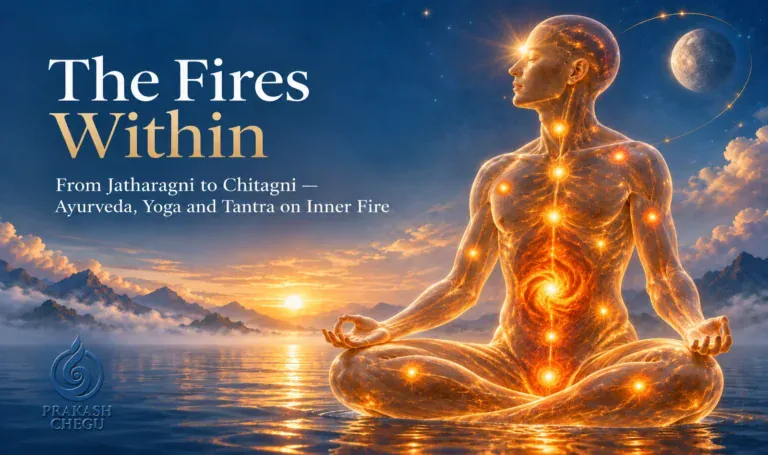
How Ayurveda, Yoga and Tantra Understand the Transformative Intelligence of Fire
The Sacred Fire Code · Part 7 of 15
There is a strange imbalance in the way we approach human development.
We are willing to spend enormous amounts of energy improving the body.
We learn about nutrition.
We exercise.
We optimize sleep.
We experiment with fasting.
We examine our metabolism.
We track biological measurements.
And there is tremendous value in understanding the body.
But how much attention do we give to the quality of intelligence through which we direct our lives?
A person can be physically strong and profoundly confused.
Highly educated and deeply compulsive.
Financially successful and inwardly dissatisfied.
A person can have remarkable vitality and use that vitality to create suffering.
This raises a question that has fascinated me for years.
What is the value of enormous energy if we have not cultivated the intelligence to use it consciously?
The ancient language of Agni offers a beautiful way of entering this inquiry.
In Vedic ritual, Agni is sacred fire.
In Ayurveda, Agni is central to the explanation of digestion, nourishment, and transformation.
In yogic and contemporary spiritual teachings, the language of fire also extends into awareness, intelligence, elemental processes, and liberation.
But these different uses of Agni must be distinguished carefully.
They belong to related yet distinct bodies of teaching.
One of the great mistakes we can make is to assume that every traditional use of the word Agni refers to one identical doctrine.
The deeper investigation is much more rewarding.
1. Agni Is More Than Flame
The Sanskrit word Agni primarily evokes fire.
In the Rigveda, Agni is one of the most important deities.
The very first hymn begins:
अग्निमीळे पुरोहितं यज्ञस्य देवमृत्विजम्।
Agnim īḷe purohitaṃ yajñasya devam ṛtvijam.
I praise Agni, the divine priest of the sacrifice.
— Rigveda 1.1.1
In the Vedic ritual world, Agni is associated with the offering, the priestly function, and the relationship between human beings and the divine.
Fire receives offerings and transforms them.
But as the language of Agni develops in different Indian traditions, it also becomes important in explanations of bodily transformation.
Food enters the body.
It is broken down.
Its components become available for energy, growth, and maintenance.
Within classical Ayurveda, Agni provides a conceptual framework for these transformations.
Modern physiology describes digestion and metabolism through enzymes, acids, transport processes, cellular reactions, and complex regulatory systems.
The two descriptions are not identical.
Yet the Ayurvedic understanding of Agni deserves careful examination as part of a sophisticated historical medical system.
And to begin, we must distinguish the different classifications of fire found within that system.
2. The Charaka Samhita: Why Agni Is Considered Fundamental to Life
One of the most important passages concerning Agni occurs in the Charaka Samhita, Chikitsa Sthana, chapter 15.
Verse 3 states:
आयुर्वर्णो बलं स्वास्थ्यमुत्साहोपचयौ प्रभा।
ओजस्तेजोऽग्नयः प्राणाश्चोक्ता देहाग्निहेतुकाः॥
Āyur varṇo balaṃ svāsthyam utsāhopacayau prabhā,
ojas tejo’gnayaḥ prāṇāś cokta dehāgnihetukāḥ.
The verse attributes lifespan, strength, health, vitality, bodily development, radiance, Ojas, Tejas, and life-supporting processes to Dehagni, the body’s transformative fire.
The following verse explains that life and health depend upon the proper functioning of Agni.
This language is emphatic.
But we should understand it within the classical Ayurvedic framework rather than converting it directly into a modern scientific statement.
Ayurveda places Agni at the center of its explanations of digestion, nourishment, health, and disease.
Contemporary physiology identifies many mechanisms that contribute to these processes.
The historical concept of Agni should not be reduced to one digestive enzyme, one hormone, body temperature, or the metabolic rate.
Its conceptual scope is broader.
It is a functional principle within the Ayurvedic model.
3. Jatharagni: The Fire of Digestion
Jathara refers to the abdomen or digestive region.
Jatharagni is the principal digestive fire in the familiar Ayurvedic classification.
The Charaka tradition regards it as fundamental to the processing of food and the nourishment of bodily tissues.
The importance of digestion seems obvious.
But consider how extraordinary the process actually is.
A piece of fruit enters the mouth.
Its carbohydrates, fiber, water, vitamins, and other constituents begin a journey through the digestive system.
Mechanical and chemical processes alter its structure.
Some components are absorbed.
Others move through the digestive tract without being absorbed.
The body uses what becomes available according to highly complex physiological requirements.
Food is not transformed into bodily tissue merely because it has entered the stomach.
Transformation must occur.
This makes digestive fire a powerful traditional metaphor.
But it also raises a practical question.
What happens when we turn every digestive discomfort into a spiritual diagnosis?
A person with persistent abdominal pain may have many possible causes.
Inflammatory conditions.
Food intolerances.
Medication effects.
Infections.
Functional digestive disorders.
And other medical conditions requiring evaluation.
It would be irresponsible to assume that every symptom can be corrected simply by strengthening Agni through herbs, fasting, or pranayama.
Traditional Ayurvedic approaches may have a place in a person’s broader wellness practices, but medical symptoms deserve appropriate assessment.
The philosophical value of Jatharagni does not require medical overconfidence.
4. The Thirteen Agnis of Classical Ayurveda
One of the better-known Ayurvedic classifications identifies thirteen forms of Agni.
One Jatharagni.
Five Bhutagnis.
Seven Dhatvagnis.
This classification is discussed in relation to the Charaka Samhita, including Chikitsa Sthana chapter 15.
One Jatharagni
The primary digestive fire.
It is associated with the processing of consumed food.
Five Bhutagnis
These relate to the five elemental principles within the Ayurvedic explanation of transformation.
They are not five separate experimentally identified flames or biochemical organs.
Seven Dhatvagnis
These are associated with the seven Dhatus, the traditional bodily tissues.
The seven are commonly named:
Rasa.
Rakta.
Mamsa.
Meda.
Asthi.
Majja.
Shukra.
Their translation into modern anatomical language requires care because their historical meanings do not correspond perfectly to contemporary categories of tissues.
The Dhatvagni framework explains nourishment and transformation within the classical theory of tissue development and maintenance.
The important point is that Ayurveda does not treat Agni as merely one undifferentiated phenomenon.
It recognizes different functional levels within its own explanatory system.
Yet we must also acknowledge that other Ayurvedic texts employ differing classifications.
The thirteenfold scheme is important, but it is not the only way Agni has been described.
5. Why Bhutagni Can Mean Different Things in Different Teachings
Here we encounter a subtle but very important distinction.
In the classical Ayurvedic classification, Bhutagni refers to five elemental fires associated with the transformation of elemental components within food and the body.
In a contemporary teaching by Sadhguru, Bhutagni is described as a dimension of elemental fire whose awakening is associated with deeper mastery over the processes of life.
These explanations are related through their use of the word bhūta, meaning element.
But they are not identical doctrines.
We should not automatically conclude that Sadhguru’s contemporary description of Bhutagni is a direct quotation from Charaka’s classification of thirteen Agnis.
It is better understood as an interpretation within his own spiritual framework.
This distinction matters because otherwise we may accidentally give a modern formulation the authority of a classical text that does not actually present it in the same way.
Traditions evolve.
Teachers interpret.
Different systems borrow and reinterpret familiar Sanskrit vocabulary.
That process is not necessarily illegitimate.
But good scholarship requires us to identify it.
6. Chitagni: The Fire of Intelligence
Sadhguru also describes another fire called Chitagni.
Within his teaching, this is associated with a dimension of intelligence beyond ordinary mental functioning.
To appreciate this idea, we must be attentive to the word itself.
Chit or Cit can refer to consciousness or awareness in Indian philosophical vocabulary.
Citta has different technical meanings across Yoga, Sankhya, and other traditions, often relating to mind or the field of mental processes.
The English word consciousness can conceal these distinctions.
Sadhguru uses Chitagni within a particular account of intelligence and spiritual development.
It should not be confused with the standard thirteen-Agni classification in classical Ayurveda.
Nor should it be assumed that every Sanskrit text uses the term identically.
Nevertheless, I find the philosophical direction of the teaching extremely interesting.
We spend so much time discussing the energy required to live.
But far less time examining the intelligence required to live well.
A person may have enormous physical vitality.
They may act quickly.
Work relentlessly.
Build businesses.
Accumulate wealth.
Pursue pleasure.
Yet activity itself is not evidence of clarity.
A person can move at extraordinary speed in the wrong direction.
Sometimes greater energy simply allows our compulsions to express themselves more efficiently.
This is why I find the distinction between bodily vitality and conscious intelligence so useful.
Energy gives us the capacity to act. Discernment helps us understand which actions are worth taking.
One without the other can become destructive.
7. The Difference Between Information and Intelligence
We live in an extraordinary age of information.
I can access scientific research, philosophical texts, historical records, and technical knowledge within seconds.
As an engineer, I appreciate this deeply.
The democratization of information is one of the remarkable developments of modern civilization.
But information is not the same as wisdom.
A person can know hundreds of facts about nutrition and still relate to food compulsively.
A person can study relationships and remain unwilling to listen to their partner.
A person can memorize spiritual teachings and continue behaving without awareness.
Information changes what we know.
Wisdom influences how we live.
And the difference becomes particularly visible under pressure.
When someone disagrees with us.
When our plans fail.
When we feel rejected.
When a relationship becomes uncomfortable.
When we must choose between convenience and integrity.
At such moments, our accumulated knowledge may be less important than the quality of awareness available to us.
Can we recognize what is happening?
Can we resist the immediate urge to react?
Can we distinguish an assumption from a fact?
Can we act without needing to punish someone for disappointing us?
To me, these are meaningful expressions of refined intelligence.
Not because they prove the activation of an invisible inner flame.
But because they reveal a more conscious relationship with life.
8. Sarvagni: The Fire Beyond the Elements
Sadhguru’s fourfold teaching also includes Sarvagni.
He describes Jatharagni, Chitagni, Bhutagni, and Sarvagni, presenting Sarvagni as the most fundamental fire associated with a dimension beyond physical manifestation.
This is an explicitly spiritual description.
It should not be equated with a measurable physical field or a scientifically established energy source.
The word sarva means all or everything.
In this teaching, Sarvagni evokes a fire that is not simply another combustion process.
It represents an ultimate dimension.
The paradox is beautiful.
The more fundamental the fire becomes within the teaching, the less it resembles the flame that first gave the concept its name.
Jatharagni is associated with bodily transformation.
Chitagni with intelligence.
Bhutagni with the elements.
Sarvagni with what is described as beyond the elemental world.
The movement is from the tangible toward the subtle.
From ordinary biological existence toward an ultimate spiritual possibility.
But we must resist the temptation to present this as a scientific hierarchy.
When the teaching refers to dimensions beyond physical existence, it makes a metaphysical claim.
Modern cosmology cannot be invoked as proof simply because it also studies aspects of the universe that remain poorly understood.
Dark matter, dark energy, quantum fields, and cosmic expansion are specific scientific subjects.
They are not interchangeable with Sarvagni.
An unexplained scientific phenomenon is not evidence for whichever spiritual concept we wish to associate with it.
The value of Sarvagni as a teaching lies in its metaphysical and contemplative significance.
9. Agni, Tapas and the Transformation of Character
There is another important use of fire language in yoga.
Tapas.
The term is related to heat, austerity, and disciplined effort.
Patanjali includes Tapas among the Niyamas in Yoga Sutra 2.32.
Then Yoga Sutra 2.43 states:
कायेन्द्रियसिद्धिरशुद्धिक्षयात्तपसः॥
Kāyendriya-siddhir aśuddhi-kṣayāt tapasaḥ.
Through Tapas, the diminution of impurity is associated with perfection or mastery of body and senses.
This is a classical yogic statement within a particular soteriological framework.
It does not establish that intense heat exposure, prolonged fasting, or physically punishing austerities produce superior medical health.
The broader principle is disciplined transformation.
And I believe that principle deserves careful consideration.
A person who wishes to become more patient must eventually encounter impatience.
A person who wishes to develop concentration must confront distraction.
A person who wishes to become truthful must recognize the occasions when falsehood appears convenient.
A person seeking freedom from compulsive behavior must become familiar with the moments when the compulsion arises.
This is where discipline becomes meaningful.
Not as self-punishment.
But as a willingness to remain conscious when unconscious habits would be easier.
10. More Fire Is Not Always Better
One misconception appears repeatedly in contemporary spiritual language.
If fire represents transformation, perhaps more fire must always be desirable.
But this is not how balanced systems work.
A physical furnace requires appropriate conditions.
Excess heat can damage the materials it is intended to process.
A human body also depends upon regulation.
The digestive system does not become healthier simply because we pursue the hottest foods, strongest spices, longest fasts, or most intense breathing practices.
Indeed, excessive stimulation can become harmful.
The same is true psychologically.
A person who continually pushes themselves toward higher performance may eventually become exhausted.
What appears outwardly as intense discipline may sometimes conceal an inability to rest.
A yogic practitioner may become so focused on producing extraordinary experiences that ordinary life begins to feel inadequate.
This is not necessarily growth.
It may simply be another form of compulsion.
The classical emphasis on balance deserves attention.
Agni must be understood in relation to the larger system.
There is no wisdom in intensifying one dimension while neglecting everything that allows it to function.
11. Ojas, Tejas and Prana: Three Words We Should Not Confuse
In contemporary yoga conversations, Ojas, Tejas, and Prana are often used as though they were identical forms of spiritual energy.
But traditional systems distinguish them.
Ojas is associated in Ayurveda with vitality and the essence of tissue nourishment within its classical physiological framework.
Tejas can refer to brilliance, heat, radiance, or transformative qualities, depending on context.
Prana has meanings connected to life, breath, and vital functioning in various philosophical and yogic systems.
These are not simply interchangeable synonyms.
Nor should Ojas be equated directly with an immune-cell count, Tejas with a laboratory measurement of metabolism, or Prana with the amount of oxygen in the blood.
Such comparisons can be misleading.
The terms belong to traditional models.
Modern measurements belong to specific scientific frameworks.
An intelligent investigation can explore possible correlations without declaring equivalence prematurely.
This is especially important when teaching students.
The use of Sanskrit terminology should increase precision, not create an impression of mystery where no explanation has been offered.
12. A Practical Inquiry Into the Fires of Life
I would like to offer a simple reflective practice inspired by these teachings.
It does not attempt to manipulate subtle fires.
It invites us to examine the relationship between physical nourishment, attention, action, and awareness.
Begin by sitting comfortably.
Take a few natural breaths.
First, contemplate the body.
How have you nourished it today?
Have you eaten appropriately?
Rested?
Moved?
Responded to its needs?
Next, contemplate the quality of your attention.
Have you spent the day reacting automatically?
Have you allowed your attention to be pulled endlessly from one stimulation to another?
Was there a moment when you genuinely listened?
Now contemplate your actions.
Where did you use your energy wisely?
Where did you act from insecurity, impatience, or the desire for approval?
Finally, release the questions.
Sit without attempting to improve yourself for a few moments.
Notice what remains when self-evaluation begins to settle.
There is no need to manufacture a special experience.
The purpose is to recognize the difference between activity and awareness.
Over time, such reflection can become a useful part of daily Sadhana.
13. The Real Fire of Transformation
I began this article by asking what value enormous energy possesses when we have not cultivated the intelligence to use it consciously.
That question returns us to something fundamental.
The aim of a yogic life cannot simply be the accumulation of power.
Not physical power.
Not psychological influence.
Not extraordinary experiences.
Not even the ability to perform increasingly demanding practices.
Power without discernment can become dangerous.
Knowledge without humility can become arrogance.
Discipline without compassion can become rigidity.
And spirituality without self-examination can become another identity that protects us from seeing ourselves clearly.
The language of Agni gives us a way to examine these imbalances.
Jatharagni reminds us of the body’s dependence upon transformation.
The wider Ayurvedic classifications invite us to consider nourishment as a complex process.
Chitagni, in Sadhguru’s teaching, raises questions about the intelligence with which we engage life.
Bhutagni points toward the elemental basis of existence.
Sarvagni evokes an ultimate spiritual possibility beyond the ordinary physical framework.
These teachings need not be flattened into one doctrine.
Their differences are part of their richness.
And their practical invitation can be expressed through a simple question:
Am I merely increasing the energy available to my life, or am I becoming more conscious of the life through which that energy moves?
That distinction may determine the difference between achievement and fulfillment.
Between stimulation and vitality.
Between accumulating experiences and developing wisdom.
And perhaps, eventually, between the need to control life and the capacity to participate in it freely.
The outer fire transforms what enters it.
The inner work asks us to examine what is transformed through our participation in life.
May our discipline make us clearer.
May our vitality make us more useful.
May our knowledge make us humbler.
And may the fire of awareness illuminate not only what we are capable of doing, but what is truly worth doing.
Continue Exploring The Sacred Fire Code
Previously: Bhuta Shuddhi — The Ancient Art of Purifying the Five Elements.
Next: Sacred Space — How Your Home Becomes an Extension of Your Consciousness.
Related articles: The Forgotten Science of Lighting an Oil Lamp; The Flame and the Brain; When the Inner Fire Awakens, Ritual Becomes Unnecessary.
Sources and Further Reading
-
Rigveda 1.1.1 — Opening hymn to Agni.
-
Charaka Samhita, Chikitsa Sthana 15.3–5 and 15.38–40 — Dehagni, Jatharagni, Bhutagni, and Dhatvagni. https://www.vedicsamhita.in/ayurveda/caraka/6/15
-
Physiological Aspects of Agni, peer-reviewed overview of classical Ayurvedic classifications. https://pmc.ncbi.nlm.nih.gov/articles/PMC3221079/
-
Charak Samhita Online, Dhatvagni, 2022. https://carakasamhitaonline.com/index.php?title=Dhatvagni
-
Patanjali, Yoga Sutra 2.32 and 2.43 — Tapas as yogic discipline.
-
Sadhguru, The Fire Element and Four Types of Agni. https://isha.sadhguru.org/en/wisdom/article/fire-element-four-types-of-agni
Research note: Classical Ayurvedic classifications, contemporary spiritual interpretations, and modern physiological explanations are intentionally distinguished. Their shared use of the language of fire should not be mistaken for scientific equivalence.
Series Navigation
Previous: Part 6 · Bhuta Shuddhi: The Ancient Art of Purifying the Five Elements
View the Complete Sacred Fire Code series
Next: Part 8 · Sacred Space: How Your Home Becomes an Extension of Your Consciousness
Frequently Asked Questions
What does Agni, or inner fire, actually mean?
Agni is the language of sacred fire, and it works on several layers that are worth keeping distinct. In Vedic ritual it is the sacred flame, in Ayurveda it is central to digestion, nourishment and transformation, and in yogic teaching it extends into awareness and intelligence. These are related but distinct bodies of teaching, so part of understanding Agni is not collapsing them all into one thing.
What is Jatharagni?
Jathara refers to the abdomen or digestive region, so Jatharagni is the principal digestive fire in the Ayurvedic classification, regarded as central to how the body transforms food into nourishment, vitality and the subtler essences the tradition calls Ojas and Tejas. I would add one caution: Agni should not be reduced to a single enzyme, hormone, or your metabolic rate. It is a broader functional principle within the Ayurvedic model, not a modern physiological measurement.
How does digestive fire relate to the fire of consciousness?
That is the real arc. The fires move from the physical, Jatharagni the fire of digestion, toward Chitagni, the fire of consciousness or intelligence. The question that has fascinated me for years is this: what is the value of enormous energy if we have not cultivated the intelligence to use it well? A person can have remarkable vitality and use it to create suffering. The inner fires are about refining energy into conscious intelligence, not just accumulating power.