The Mysticism of Dhuni, Sacred Solitude, Spiritual Boundaries and the Fire of Renunciation
The Sacred Fire Code · Part 9 of 15
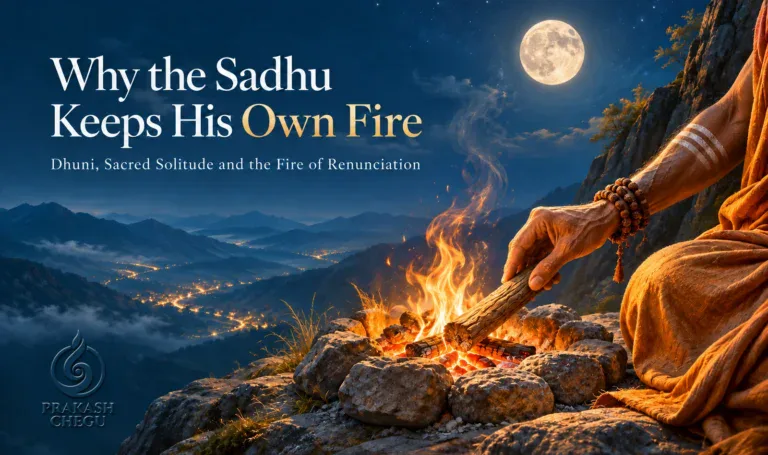
There is a certain image of an Indian sadhu that has remained almost unchanged in our collective imagination.
A solitary figure.
Perhaps seated beneath a tree, beside a river, or in a remote Himalayan cave.
His possessions are few.
His body may be covered in sacred ash.
And somewhere nearby, a small fire burns.
Sometimes the fire has been maintained for years.
Sometimes the sadhu travels with almost nothing, yet establishes a new fire wherever his practice takes him.
Why?
A person who has renounced worldly possessions could certainly live without many things.
Why would fire remain so important?
Is it simply for warmth?
For preparing food?
For keeping animals away?
For performing rituals?
Or does the fire represent something much more fundamental about the relationship between the individual, the world, and the Divine?
This question becomes particularly interesting when we encounter the concept of Dhuni.
A Dhuni is not merely a campfire.
Within several Indian ascetic traditions, it is a sacred fire associated with worship, discipline, renunciation, continuity, and the presence of a spiritual lineage.
But perhaps the deepest question is not why the sadhu maintains the fire.
It is why he sometimes chooses to maintain his own fire.
And what that choice tells us about solitude, attention, boundaries, and the purpose of spiritual life.
1. Fire Has Accompanied the Spiritual Life Since the Vedas
The importance of fire in Indian spirituality begins long before the traditions of the solitary ascetic as we commonly imagine him today.
The Rigveda opens with the invocation:
अग्निमीळे पुरोहितं यज्ञस्य देवमृत्विजम्।
होतारं रत्नधातमम्॥
Agnim īḷe purohitaṃ yajñasya devam ṛtvijam,
hotāraṃ ratnadhātamam.
I praise Agni, the divine priest of the sacrifice, the invoker and bestower of treasures.
— Rigveda 1.1.1
The opening hymn does not describe Agni as simply a physical phenomenon.
Agni is a deity, a priestly mediator, a receiver of offerings, and a central presence in the Vedic sacrificial world.
This is significant.
Fire was not merely useful.
It was sacred.
But we must be careful not to assume that every later fire practice is identical to the Vedic yajna.
The sacred fire of a Vedic householder, the Dhuni of a Nath yogi, the asceticism of Panchatapas, and the ritual Homa of a Tantric practitioner may share important imagery while belonging to different traditions.
Their purposes, procedures, and underlying philosophies can differ considerably.
To understand Dhuni, we must examine the particular spiritual world in which it operates.
2. What Is a Dhuni?
The word Dhūnī is used for a sacred fire or fire pit maintained by certain renunciates and religious communities.
Its specific form varies.
It may be a shallow pit in the earth.
A prepared hearth.
A fire maintained near an ascetic’s dwelling.
Or a central sacred presence within an ashram or lineage.
In Nath traditions, Dhuni has particular importance.
Some practitioners understand the sacred fire as a living ritual presence rather than simply a symbolic object.
The fire may receive offerings.
Mantras may be recited near it.
Ash from the fire may be used as Vibhuti, sacred ash.
The continuity of the fire can become part of the continuity of practice.
But not every sadhu maintains a Dhuni.
Nor do all renunciates interpret its significance in the same way.
India’s ascetic traditions are remarkably diverse.
There are Shaiva renunciates, Vaishnava renunciates, Nath yogis, Ramanandi ascetics, Dashanami sannyasis, and numerous other lineages.
Their relationships with fire, ritual, austerity, deity worship, and meditation are not interchangeable.
The Dhuni therefore deserves to be understood as a living tradition rather than a universal symbol assigned one meaning.
3. The Fire That Must Be Tended
Consider the difference between an object and a fire.
A stone can be placed on an altar and left there.
A statue can remain in its position.
A painting can hang upon a wall.
A fire is different.
It must be maintained.
It requires fuel.
It responds to its surroundings.
It changes continuously.
If its conditions are not sustained, it goes out.
This makes fire a particularly powerful ritual presence.
The practitioner must participate in its continuity.
The fire asks for attention.
And in the process of giving attention, the practitioner may encounter the condition of his own mind.
Am I restless?
Impatient?
Distracted?
Careless?
Am I acting mechanically?
Or am I fully present?
This does not mean that tending a fire automatically makes someone spiritually mature.
A person can maintain a sacred flame without cultivating awareness.
But the act contains the possibility of discipline.
The fire becomes a recurring invitation to return.
And over the years, a repetitive act performed with genuine attention can acquire extraordinary personal significance.
This is something I have come to appreciate through daily Sadhana.
The practice itself may appear very simple.
Yet the person who enters it each day is never quite the same.
Our thoughts change.
Our emotions change.
Our circumstances change.
The discipline offers continuity amid those changes.
4. Why Does the Sadhu Seek Solitude?
The word Sadhu is associated with spiritual practice, discipline, and a life oriented toward a religious or liberative aim.
But solitude in the ascetic life is not necessarily a rejection of humanity.
It can be a deliberate reorganization of priorities.
Ordinary life constantly asks for participation.
We maintain relationships.
Earn a living.
Respond to responsibilities.
Negotiate expectations.
Care for families.
Make decisions.
These are meaningful activities.
Yet they also draw attention outward.
A renunciate may seek to reduce certain forms of worldly involvement so that greater attention can be devoted to religious practice and the ultimate spiritual goal.
The relationship between renunciation and society is complex.
Many sadhus teach.
Receive visitors.
Participate in festivals.
Travel among communities.
Maintain disciples.
And remain connected to social and religious networks.
The image of the completely isolated ascetic is only one part of a much larger reality.
Still, the deliberate cultivation of solitude raises an important question.
How much of our identity depends upon continual interaction with other people?
We often do not realize how strongly we are shaped by the expectations surrounding us.
We become the teacher.
The parent.
The professional.
The partner.
The successful person.
The disappointed person.
The person who must always have an answer.
The person who must constantly be needed.
These roles may be legitimate.
But they can also become so dominant that we lose the ability to experience ourselves outside them.
Solitude can make those dependencies visible.
Not because the world is inherently impure.
But because we begin to recognize how frequently our attention moves toward maintaining an identity.
5. The Meaning of Having Your Own Fire
Sadhguru offers an intriguing explanation for why a sadhu may choose to maintain a separate fire.
He suggests that sitting around a common fire involves a subtle form of energetic mingling.
In this interpretation, an ascetic who wishes to maintain a particular quality of spiritual practice may prefer not to share the same fire with people whose attention and priorities are oriented toward ordinary worldly life.
The sadhu maintains his own fire because his intention is directed toward the Divine.
This is a spiritual explanation within Sadhguru’s teaching.
It is not a scientifically established mechanism of energy transfer between people sitting around a flame.
Nor should we assume that all ascetic lineages historically explain Dhuni in precisely this way.
But there is an interesting philosophical dimension worth examining.
What does it mean to choose the conditions in which our attention develops?
Consider how differently we experience ourselves in different social environments.
In one company, we may become restless.
In another, competitive.
In another, defensive.
In another, peaceful.
In another, deeply inspired.
These changes do not require us to invoke mysterious energy exchange as their explanation.
Human behavior is responsive to social cues, emotional context, expectations, and learned patterns.
The environment influences participation.
A sadhu’s separate fire can therefore inspire a broader reflection.
Sometimes we need an environment where our attention is not continually pulled into the concerns of everyone around us.
Not because others are spiritually inferior.
But because certain disciplines require sustained conditions.
6. Spiritual Boundaries Are Not Spiritual Superiority
This distinction matters tremendously.
It is easy for the language of energetic protection to become an excuse for judging other people.
We begin to imagine that our energy is pure and theirs is contaminated.
That we are spiritually advanced and others are too worldly.
That ordinary human relationships are obstacles to enlightenment.
But this is not necessarily discernment.
It may simply be another form of ego.
A meaningful boundary does not require contempt.
A person can choose solitude without rejecting relationship.
A practitioner can protect time for Sadhana without declaring that everyone else is spiritually inferior.
A teacher can maintain professional boundaries without withholding compassion.
And a person can decline participation in an environment that does not support their values without condemning those who choose differently.
This is especially important for people who teach and hold space for others.
If we become available to everyone at every moment, our capacity to serve may eventually diminish.
But if we become so protective of our own spiritual identity that we are unwilling to participate in the ordinary difficulties of human life, we have created another problem.
The question is one of discernment.
When is openness appropriate?
When is solitude necessary?
When does service nourish the practitioner?
And when does it become a way of avoiding personal responsibility or the need for rest?
The sadhu’s fire offers a metaphor for intentional boundaries.
But those boundaries must be guided by wisdom rather than fear.
7. Dhuni and the Sacred Ash
Another important dimension of the Dhuni is the ash it produces.
In various Shaiva and ascetic traditions, sacred ash—Vibhuti or Bhasma—has religious significance.
It may be applied to the body.
Associated with Shiva.
Used in ritual.
Or understood as a reminder of impermanence.
The symbolism is striking.
What was once wood becomes ash.
The original structure can no longer be recovered simply by rearranging the residue.
Fire reveals the impermanence of form.
And the ash becomes a reminder of that transformation.
For a renunciate, the symbolism may be particularly meaningful.
Everything we ordinarily identify with is subject to change.
The body ages.
Possessions come and go.
Social status changes.
Relationships change.
Even civilizations rise and disappear.
The ash offers a stark reminder.
What exactly are we trying to preserve?
And how much suffering arises from our insistence that what is changing must remain unchanged?
This does not mean that life should be rejected.
Nor does impermanence make relationships meaningless.
Quite the opposite.
The recognition of impermanence can deepen our appreciation of what is present.
We may become less careless with time.
Less consumed by superficial conflict.
More willing to express gratitude.
More conscious of the people we love.
The teaching of ash need not become a fascination with death.
It can become a greater appreciation of life.
8. Dhuni Is Not Panchagni Tapas
Another distinction deserves attention.
A Dhuni is not automatically the same as Panchagni Tapas, sometimes described as the austerity of five fires.
In certain ascetic forms of Panchatapas, the practitioner sits amid four surrounding fires while exposed to the sun as the fifth.
This is a demanding austerity associated with particular traditions.
It should not be confused with the household Panchagni arrangement discussed earlier in this series.
Nor should it be undertaken as an improvised spiritual experiment.
Extreme heat exposure can cause dehydration, burns, heat exhaustion, and heatstroke.
The historical existence of an ascetic practice does not establish that it is medically safe or suitable for general practitioners.
The distinction is important because modern spiritual culture sometimes borrows the appearance of advanced practices while overlooking the training, discipline, historical context, and risks involved.
The purpose of studying an ascetic tradition is not necessarily to imitate its most demanding external form.
It is to understand what that form means within its own system.
9. The Shared Fire and the Human Community
There is another side to this teaching that deserves attention.
The sadhu may choose a separate fire.
But fire has also served as a center of human gathering.
People sit around fires to share stories.
Prepare food.
Sing.
Perform rituals.
Remember ancestors.
Transmit knowledge.
And create a sense of community.
The same element can therefore serve very different purposes.
A sacred fire may support solitude.
Or collective worship.
An individual discipline.
Or shared celebration.
A renunciate’s austerity.
Or a householder’s hospitality.
These are not necessarily contradictory uses.
They express different human needs.
There are times when we need to withdraw from collective activity.
And times when we need to participate more fully.
The capacity to recognize the difference is an important part of spiritual maturity.
An individual who is always seeking solitude may be avoiding relationship.
An individual who is never willing to be alone may be avoiding themselves.
Neither extreme should automatically be mistaken for wisdom.
10. The Householder’s Own Fire
What does this mean for someone who is not a renunciate?
Most of us are not going to leave our homes, careers, relationships, and responsibilities to become wandering ascetics.
Nor should we assume that renunciation is the appropriate path for everyone.
The classical Indian framework recognizes the importance of household life.
The Grihastha participates in family responsibilities, social obligations, hospitality, and the support of others.
A householder’s spiritual challenge is therefore different from that of a solitary renunciate.
The question is not how to eliminate every relationship.
It is how to remain conscious within relationship.
How do we maintain a daily practice without abandoning our responsibilities?
How do we protect silence without becoming unavailable to those who depend upon us?
How do we remain devoted to spiritual growth while participating in the world?
Perhaps the sadhu’s separate fire offers a practical lesson.
Every person may need a little space that is not governed by the expectations of others.
A few moments in the morning.
A place for meditation.
A period of silence.
A regular discipline.
A sanctuary where attention can return inward.
It need not contain an actual fire.
The flame can remain symbolic.
What matters is the deliberate creation of conditions that support awareness.
11. A Practice of Conscious Solitude
I would like to offer a simple experiment.
For seven days, choose fifteen minutes in which you do not seek stimulation.
No phone.
No conversation.
No music.
No work.
No attempt to solve every unresolved problem.
Sit in a quiet, safe place.
Allow the body to settle.
Notice what happens.
At first, you may encounter restlessness.
Perhaps a desire to check messages.
Perhaps an uncomfortable emotion.
Perhaps the sense that you are wasting time.
Do not treat these reactions as failures.
They are observations.
Notice how strongly the mind associates value with activity.
Notice whether silence feels nourishing or uncomfortable.
Notice whether solitude is chosen freely or accompanied by a desire to withdraw from responsibilities.
When the time is complete, return deliberately to ordinary life.
If silence intensifies distress, shorten the practice or seek appropriate support.
The purpose is not to force isolation.
It is to discover whether you can remain with yourself without immediately seeking distraction.
And then ask a final question.
Does this solitude make me more available to life?
Or less?
The answer matters.
12. When the Fire Becomes an Inner Discipline
I began with the image of a sadhu seated beside his fire.
At first, the image seems distant from modern life.
Few of us will maintain a Dhuni.
Fewer still will adopt the disciplines of traditional asceticism.
But perhaps the teaching is closer to our lives than it appears.
The sadhu’s fire reminds us that attention requires care.
That meaningful discipline benefits from continuity.
That solitude can serve a purpose.
That boundaries need not become hostility.
That impermanence deserves contemplation.
And that the outer forms of a spiritual life should always be understood in relation to the inner direction they serve.
But there is another possibility.
Perhaps a person can maintain all the external appearances of renunciation while remaining inwardly attached to recognition, superiority, and identity.
And perhaps a householder, deeply engaged in family and service, can cultivate remarkable freedom from compulsion.
This is why the outer form should never become the only measure of spiritual depth.
The sadhu has his Dhuni.
The householder has a different field of practice.
The teacher encounters the classroom.
The parent encounters the child.
The partner encounters relationship.
The worker encounters responsibility.
Each may become an opportunity for consciousness.
The deepest meaning of having your own fire is not that you must separate yourself from humanity. It is that you must take responsibility for the quality of awareness you bring into your participation with humanity.
That is a fire worth tending.
Not only in a monastery.
Not only beside a sacred river.
Not only in the solitude of a Himalayan cave.
But wherever life has placed us.
Continue Exploring The Sacred Fire Code
Previously: Sacred Space — How Your Home Becomes an Extension of Your Consciousness.
Next: Conscious Stillness vs. Compulsive Inertia — The Yogic Understanding of Depression.
Related articles: Panchagni — Creating a Sacred Meditation Space; Agnihotra, Homa, Havan and Yajna; When the Inner Fire Awakens, Ritual Becomes Unnecessary.
Sources and Further Reading
-
Rigveda 1.1.1 — The opening invocation to Agni.
-
Harvard Divinity School, Center for the Study of World Religions, Sadhus (2026), for contemporary scholarship on ascetic practices and Dhuni. https://cswr.hds.harvard.edu/news/2026/03/27/sadhus
-
International Nath Order, Dhuni, for an account of living Nath ritual interpretation. https://www.internationalnathorder.org/dhuni/
-
University of Vienna, Dhun / Dhūnī — The Fires of the Name, an ethnographically informed project exploring mantra, ascetic fire, and Panchatapas.
-
Khushwant Singh Chauhan (2025), The Ritual of Dhuni: An Integral Aspect of Sadhu Practices in Cultural Landscape of Rajasthan. https://doi.org/10.70135/seejph.vi.4563
-
Sadhguru’s discussion of the sadhu’s individual fire in the broader teaching on Panchagni and sacred space.
Research note: Claims about subtle energetic mingling around fire are identified as spiritual teachings rather than established physical mechanisms. The practices of different ascetic lineages should not be treated as identical.
Series Navigation
Previous: Part 8 · Sacred Space: How Your Home Becomes an Extension of Your Consciousness
View the Complete Sacred Fire Code series
Next: Part 10 · Conscious Stillness vs. Compulsive Inertia
Frequently Asked Questions
What is the sadhu’s fire, and why does he keep it?
It is the dhuni, the perpetual sacred fire a renunciate tends, often seated beneath a tree, by a river, or in a remote cave with almost no possessions. For someone who has renounced nearly everything, the fire becomes companion, hearth, altar and discipline at once. Keeping it alive is a daily practice of presence, a living center around which a life of austerity is organized.
Is keeping a constant fire just a practical necessity?
It is both, and that is the beauty of it. Yes, the fire gives warmth, light and a way to prepare simple food. But for the sadhu it is also symbolic: a continuous flame mirrors a continuous inner attention. The practical and the sacred are not separated here; tending the fire faithfully is itself the practice, not a chore around the edges of it.
What can a householder learn from the sadhu’s fire?
Most of us will not keep a dhuni in a cave, but the principle travels. It is about tending something faithfully every day, a flame, a practice, an attention, so that it does not go out. The sadhu’s fire is a reminder that discipline is not grand gestures; it is the quiet, repeated act of keeping the inner fire alive when no one is watching.