The Forgotten Tantric Practice of Dissolving the Body, Refining Perception and Returning to the Source
The Sacred Fire Code · Part 6 of 15
What exactly are we trying to purify when we practice yoga?
The body?
The breath?
The mind?
Our emotions?
Our karma?
Or something more fundamental?
The word purification appears so frequently in spiritual teachings that we rarely stop to examine its meaning.
We speak of cleansing the chakras, releasing negative energy, purifying the aura, removing toxins, clearing the subconscious, and balancing the elements.
But are all these expressions describing the same process?
And when an ancient Tantric text speaks of purifying the elements, is it describing something that can be understood through ordinary physical cleansing?
The answer is far more interesting.
In an important family of Tantric rituals, purification is not primarily about removing a contaminant from the physical body.
It is about a profound transformation of the way the practitioner understands embodiment.
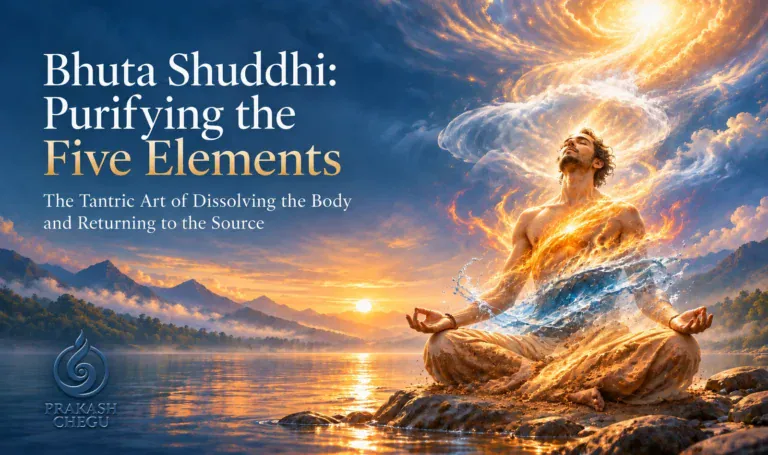
The body is symbolically dissolved into its constituent principles.
The elements are returned to subtler causes.
The ordinary sense of being a separate physical individual is temporarily reimagined through a sacred cosmological sequence.
And the body is then ritually reconstituted as a suitable vehicle for worship.
This is Bhuta Shuddhi.
Not merely elemental balancing.
Not simply a relaxation exercise.
Not a technique for eliminating mysterious toxins.
But a sophisticated ritual process that places the human body inside an entire philosophy of creation and dissolution.
To understand its depth, we must first understand what is being purified.
1. What Does Bhuta Shuddhi Mean?
The Sanskrit expression Bhūtaśuddhi combines two terms.
Bhūta can refer to a being, something that has come into existence, or, in this context, an element.
Śuddhi means purification or cleansing.
Within the relevant Tantric traditions, Bhuta Shuddhi refers to the purification of the elemental constitution of the practitioner’s body.
But purification is not always equivalent to washing something dirty.
Consider what happens when we clean a mirror.
We remove substances obscuring its surface.
Now consider what happens when we examine an assumption.
There may be nothing physically dirty to remove.
Instead, a misunderstanding is recognized.
The result is clarity, but the process is fundamentally different.
Similarly, the ritual purification of the elements may involve visualization, mantra, mental dissolution, and the reconstruction of one’s relationship with the body.
It belongs to a symbolic and metaphysical process.
This distinction is particularly important because the modern wellness industry frequently uses the word purification without explaining whether it means physical cleansing, psychological reflection, ritual consecration, or spiritual liberation.
Those are not interchangeable outcomes.
2. The Five Elements and the Human Body
The five great elements—Pancha Mahabhuta—are described in several traditional Indian philosophical systems.
Prithvi.
Apas.
Agni.
Vayu.
Akasha.
Within the Tantric ritual framework, these elements are related to increasingly subtle dimensions of manifestation.
Earth is associated with smell.
Water with taste.
Fire with form or sight.
Air with touch.
Akasha with sound.
This sequence belongs to the traditional relationships between the gross elements and the subtle sensory qualities known as Tanmatras.
It is not a modern classification of the chemical composition of the human body.
Nor should it be used to diagnose illness by claiming that a person literally possesses too much of one physical element and too little of another.
The value of the elemental framework lies in its traditional philosophical function.
It connects the human body to a larger account of manifestation.
The body is not considered an isolated object.
It is a localized expression of the principles through which the world itself is described.
This gives Bhuta Shuddhi an extraordinary starting point.
If the elements that constitute the individual also constitute the world, what truly separates the individual from the whole?
The ritual investigates that question not merely through discussion, but through a carefully structured contemplative process.
3. The Classical Principle: Creation Must Be Reversed
In the Taittiriya Upanishad, we encounter the familiar sequence:
तस्माद्वा एतस्मादात्मन आकाशः सम्भूतः।
आकाशाद्वायुः। वायोरग्निः। अग्नेरापः। अद्भ्यः पृथिवी।
Tasmād vā etasmād ātmana ākāśaḥ sambhūtaḥ.
Ākāśād vāyuḥ. Vāyor agniḥ. Agner āpaḥ. Adbhyaḥ pṛthivī.
From Atman, Akasha arose.
From Akasha, air.
From air, fire.
From fire, water.
From water, earth.
— Taittiriya Upanishad 2.1.1
This is a philosophical account of manifestation.
The movement proceeds from subtle to gross.
Bhuta Shuddhi, in certain Tantric formulations, reverses that movement.
Earth is dissolved into water.
Water into fire.
Fire into air.
Air into Akasha.
Akasha is subsequently dissolved into subtler principles.
Eventually, the contemplative process returns toward the ultimate source identified within the particular tradition.
The logic is beautiful.
Manifestation moves outward into differentiation.
Purification reverses the movement toward increasing subtlety.
In this context, dissolution does not mean physically destroying the body.
It means deliberately transforming how the body is represented within consciousness.
One might call it a ritualized reversal of cosmology.
But even that description only captures part of the process.
Because after dissolution comes reconstitution.
The practitioner does not simply disappear from the ritual imagination.
The body is restored or reconstructed as a sacred body suitable for worship.
4. What the Mahanirvana Tantra Actually Describes
One important textual example appears in chapter 5 of the Mahānirvāṇa Tantra.
Verses 93 onward describe a form of Bhuta Shuddhi involving Kundalini, mantra, and elemental dissolution.
Verse 93 begins:
स्वाङ्के निधाय च करावुत्तानौ साधकोत्तमः।
मनो निवेश्य मूले च हुङ्कारेणैव कुण्डलीम्॥
Svāṅke nidhāya ca karāv uttānau sādhakottamaḥ,
mano niveśya mūle ca huṅkāreṇaiva kuṇḍalīm.
The practitioner places the hands in the lap, directs the mind toward the root center, and begins the prescribed Kundalini process using mantra.
The following verses describe the movement of Kundalini together with the elements and the dissolution of one element into another.
Earth and its associated sensory qualities are dissolved into water.
Water into fire.
Fire into air.
The process continues through subtler levels of the ritual cosmology.
This is considerably more sophisticated than simply imagining five colors or repeating five syllables.
The practice is embedded within a larger Tantric ritual structure involving mantra, visualization, the subtle body, and the consecration of worship.
Historically, different lineages employ different details.
We should not assume that every Bhuta Shuddhi ritual follows precisely the same sequence or uses identical mantras.
The Mahānirvāṇa Tantra is one textual witness, not the sole authority for every Tantric tradition.
Modern scholarship also documents elemental purification in Shaiva, Vaishnava, and Buddhist Tantric sources.
The practice has multiple historical expressions.
5. Purification Through Dissolution
Now consider the psychological beauty of this ritual structure.
We ordinarily experience the body as something solid and continuous.
I am this body.
I occupy this position.
I have these characteristics.
This is my identity.
This is my history.
These are my limitations.
The sense of continuity is useful.
Without it, we could not organize ordinary life.
But we may also become so identified with our habitual self-description that we forget how much of our identity is constructed through memory, language, and experience.
Bhuta Shuddhi offers a ritual framework in which that familiar structure is deliberately transformed.
The body is not treated as an isolated possession.
It is contemplated as an arrangement of principles.
Those principles are dissolved.
And the practitioner encounters, within the ritual’s philosophical framework, the possibility that identity is not exhausted by the familiar bodily form.
This does not mean the ancient ritual should be reduced to modern psychotherapy.
Nor does it mean psychological studies have demonstrated the metaphysical claims of Tantra.
It means the ritual contains a contemplative structure that modern readers can appreciate without pretending its historical purpose was psychological treatment.
The distinction is important.
A traditional ritual may have therapeutic significance for some practitioners.
But its original theological and metaphysical intentions deserve to be understood on their own terms.
6. The Body as a Microcosm
A central idea in numerous Indian spiritual traditions is that the individual and the cosmos are not fundamentally unrelated.
The body can become a representation of the larger universe.
This is sometimes expressed through the language of Pinda and Brahmanda.
The individual embodiment and the cosmic whole.
Different traditions develop the correspondence in different ways.
Some employ subtle-body visualizations.
Some employ mandalas.
Some employ deity identification.
Some employ ritual offerings.
In Bhuta Shuddhi, the movement from the gross elements toward subtler principles provides one particular way of exploring this relationship.
The body is treated as a sacred field.
But there is a difference between calling the body sacred and assuming that every physical sensation has a cosmic explanation.
A tingling sensation may have an ordinary neurological cause.
A feeling of warmth may reflect changes in circulation, temperature, attention, or breathing.
A sense of expansion may be a meaningful meditative experience without proving that a literal boundary of the physical body has disappeared.
The mature practitioner does not need to deny physiology in order to appreciate contemplative experience.
The two questions can coexist.
What happened physically?
And what did the experience mean within the practice?
7. Why Does Bhuta Shuddhi Come Before Worship?
In several Tantric ritual systems, Bhuta Shuddhi is performed as a preparation for worship.
This is a detail that modern discussions often miss.
The purpose is not merely to make the practitioner feel better.
It is to transform the status of the worshipper.
The ordinary body is ritually purified.
The practitioner becomes prepared to engage in sacred action.
This is closely related to the broader Tantric importance of Nyasa, the ritual placement or installation of mantras and sacred powers upon the body.
Through such processes, the body is no longer approached as merely ordinary flesh.
It becomes a consecrated instrument within the ritual worldview.
This gives us a profoundly different interpretation of purification.
Instead of asking only, “What should I remove from myself?” the practice also asks:
What must I become capable of embodying?
Purification is preparation.
The purpose is not simply subtraction.
It is transformation.
This idea can be meaningful even for someone who does not perform classical Tantric rites.
Before speaking, what quality of presence do we wish to bring?
Before teaching, how do we prepare ourselves?
Before entering a relationship, what attitudes require examination?
Before serving another person, can we become less dominated by our expectations?
The external form may change, but the principle of preparation remains significant.
8. Bhuta Shuddhi Is Not the Same as Panchagni
Because this series began with sacred fire, it is especially important to distinguish these practices.
Panchagni can refer to several different five-fire traditions.
The household arrangement discussed earlier uses triangles, earthy materials, water, and lamps.
Bhuta Shuddhi refers to ritual purification of the elements, typically involving an internal contemplative process in the Tantric sources under discussion.
The two can be related through a shared elemental philosophy.
But they are not interchangeable.
A household arrangement does not automatically reproduce a classical Bhuta Shuddhi ritual.
Similarly, meditating on the five elements does not establish that one has completed a lineage-specific practice involving prescribed mantras, deity visualization, and ritual consecration.
This distinction is not meant to discourage practice.
It is meant to encourage precision.
When we understand what a tradition actually teaches, we are better equipped to respect it.
9. What Does Modern Science Contribute?
There are interesting scientific questions associated with meditation, body awareness, and visualization.
Contemplative practices can influence attention.
Some meditation interventions have shown effects on stress, emotion regulation, and aspects of well-being.
Researchers also investigate how the brain represents the body and how attention changes bodily experience.
But none of these findings establishes the literal existence of the five Mahabhutas as independently measurable subtle substances.
Nor have studies demonstrated that Tantric elemental dissolution physically eliminates toxins, repairs disease, or transforms biological tissues according to the ritual sequence.
We should resist the temptation to claim such proof.
The traditional purpose of Bhuta Shuddhi is not dependent upon inventing scientific explanations.
It belongs to a ritual and philosophical system in which the body, cosmos, deity, mantra, and consciousness are understood through interrelated principles.
Science may investigate some physiological consequences of practice.
It does not thereby confirm the entire metaphysical framework.
And the reverse is also true.
A meaningful subjective experience does not require us to reject scientific understanding.
The challenge is to avoid confusing categories.
10. Can We Explore the Elements Without Performing an Initiatory Ritual?
Yes—but the distinction must be explicit.
A person can undertake a simple contemplative reflection inspired by the five elements without claiming to perform classical Bhuta Shuddhi.
Here is an approach I find useful.
Sit in a quiet place.
Allow the body to be comfortable.
There is no need to hold the breath, perform forceful pranayama, or attempt to awaken Kundalini.
Begin with earth.
Notice the physical support beneath you.
The weight of the body.
The firmness of the ground.
Reflect on your dependence upon material existence.
Next, contemplate water.
Recognize that the body depends upon fluid balance and countless internal processes.
Reflect on adaptability.
Notice where you resist change unnecessarily.
Then contemplate fire.
Feel the body’s natural warmth.
Consider the extraordinary transformations through which food becomes usable energy.
Reflect on your capacity to act with clarity.
Next, contemplate air.
Allow the breath to remain natural.
Notice that breathing is continually supported by an exchange with the environment.
Reflect on the relationship between movement and stillness.
Finally, contemplate Akasha.
Become aware of the space around the body.
Notice sounds arising and disappearing.
Allow experience to unfold without immediately trying to organize it.
Then release the elemental sequence entirely.
Sit for a few moments in simple awareness.
This is an original five-element reflection for general contemplative use.
It is not a substitute for the formal Bhuta Shuddhi rituals preserved within Tantric lineages.
Its purpose is not to reproduce their ritual effects.
It is simply an opportunity to investigate our relationship with the conditions that support life.
11. The Danger of Turning Purification Into Self-Rejection
There is another issue I want to address.
Spiritual practitioners can become obsessed with purification.
Everything becomes a contaminant.
An uncomfortable emotion is considered negative energy.
A difficult memory is considered an impurity.
A moment of anger becomes evidence of spiritual failure.
A perfectly ordinary bodily symptom becomes proof that a chakra is blocked.
And gradually, the spiritual journey becomes a struggle against one’s own existence.
I do not consider this a healthy relationship with practice.
The body is not an enemy.
The mind is not something to hate.
Emotions are not automatically impurities.
A difficult experience does not mean that we are spiritually defective.
Of course, disciplines exist for refining conduct, attention, and behavior.
But refinement should not become hostility toward ourselves.
One of the most valuable qualities that Sadhana can cultivate is the ability to observe without immediately condemning.
We can recognize an unhelpful pattern without constructing an identity around it.
We can take responsibility for our actions without treating ourselves as permanently impure.
We can work toward greater clarity without declaring war on ordinary human experience.
This is particularly important when we use traditional language such as purification, karma, and cleansing.
These concepts deserve depth and discernment, not fear.
12. What Is Really Being Dissolved?
At the beginning of this article, I asked what we are attempting to purify.
The body?
The mind?
The elements?
Perhaps the deeper issue is our relationship with identity.
The classical Tantric process has its own specific purpose and ritual meaning.
Yet it also inspires an important philosophical inquiry.
How much of what we call ourselves is truly permanent?
Our bodies change.
Our thoughts change.
Our relationships change.
Our roles change.
Our understanding changes.
Even the stories we tell about our past can change as we develop new perspectives.
And yet we are constantly trying to secure a fixed identity.
I am this kind of person.
I always behave this way.
I cannot change.
My past defines me.
My limitations are permanent.
Spiritual practice challenges these assumptions.
Not by denying the reality of our history.
But by asking whether the way we have organized that history is the only way we can exist.
There is freedom in recognizing that the structure of identity is not as solid as we imagine.
And there is responsibility in recognizing that freedom does not absolve us from caring for the body and the world.
Bhuta Shuddhi is a traditional ritual language for dissolution and reconstitution.
Its deeper contemplative invitation is profound.
What if transformation does not always require adding something new, but sometimes requires recognizing what we have mistaken for permanent?
13. From Purification to Participation
I would like to end with a simple observation.
The five elements are frequently discussed as things we must balance within ourselves.
But there is a beautiful alternative way of approaching them.
We belong to the world.
The earth supports us.
Water sustains us.
The processes symbolized by fire transform what we consume.
The atmosphere makes ordinary breathing possible.
And space allows life to unfold in relationship.
We are not independent of these conditions.
The language of the five elements reminds us of that interdependence.
And the Tantric ritual of Bhuta Shuddhi takes the reflection further, placing individual embodiment within a cosmological vision.
The point is not to become fascinated with metaphysical explanations while neglecting life.
It is to become more conscious of the extraordinary reality of being alive.
Perhaps the deepest purification is not a declaration that we have become superior to ordinary existence.
Perhaps it is the gradual removal of the ignorance that makes us behave as though we are separate from it.
When we approach the body with care, the mind with discernment, other beings with compassion, and the world with reverence, the philosophy begins to acquire practical meaning.
And when our awareness becomes less fragmented, the need to prove that we are spiritual begins to diminish.
The elements are not merely symbols to master. They are also reminders of the life in which we are already participating.
That is where the ancient art of Bhuta Shuddhi becomes a truly meaningful subject of inquiry.
Not in the fantasy that we can escape embodiment through ritual.
But in the possibility that we can inhabit life with greater consciousness.
Continue Exploring The Sacred Fire Code
Previously: Six Chakras, Seven Centers — Why the Crown Cannot Be Manipulated.
Next: The Fires Within — From Jatharagni to Chitagni.
Related articles: Akasha — The Fifth Element and the Forgotten Dimension of Perception; Panchagni — How to Create a Sacred Meditation Space in Your Home; Panchagni Vidya — The Five Fires of the Upanishads.
Sources and Further Reading
-
Taittiriya Upanishad 2.1.1 — The traditional sequence of elemental manifestation.
-
Mahānirvāṇa Tantra, chapter 5, verses 92–100 — The ritual sequence of elemental purification. Sanskrit text and commentary: https://enjoylearningsanskrit.com/scriptures/maha-nirvana-tantra/chapter-5/
-
Sir John Woodroffe (Arthur Avalon), Introduction to Tantra Shastra, section on Bhuta Shuddhi. https://sacred-texts.com/tantra/maha/maha00.htm
-
Transforming the Body by Mastering the Elements: Some Tantric Sources, Oxford Academic, 2024. https://academic.oup.com/edited-volume/44001/chapter-abstract/437276085
-
Mahānirvāṇa Tantra, chapter 5, English translation. https://sacred-texts.com/tantra/maha/maha05.htm
Editorial note: Advanced Tantric Bhuta Shuddhi practices may include lineage-specific mantras, visualizations, and breath techniques. The simple reflective exercise presented here is not an initiation or reproduction of those practices.
Series Navigation
Previous: Part 5 · Six Chakras, Seven Centers: Why the Crown Cannot Be Manipulated
View the Complete Sacred Fire Code series
Next: Part 7 · The Fires Within: From Jatharagni to Chitagni
Frequently Asked Questions
What is Bhuta Shuddhi?
Bhuta Shuddhi is a Tantric practice of purifying the five elements, but purification here does not mean physical cleansing. In this family of rituals the body is symbolically dissolved into its constituent principles, the elements are returned to their subtler causes, and the body is then ritually reconstituted as a fit vehicle for worship. It is less about removing a contaminant and more about transforming how you understand being embodied at all.
Does Bhuta Shuddhi mean I have too much of one physical element in my body?
No, and I would gently steer you away from that reading. The five elements in this tradition are tied to the Tanmatras, the subtle sensory qualities, like earth with smell, water with taste, fire with sight, air with touch and akasha with sound. They are not a chemical analysis of your body, and the practice is not a way to diagnose illness by claiming you have too much fire or too little water. Its value is philosophical, not clinical.
What is Bhuta Shuddhi actually pointing to?
To non-separation. If the same elements that make up you also make up the world, then what truly divides the individual from the whole? Bhuta Shuddhi does not just raise that question intellectually, it walks you through it with a carefully structured contemplative sequence, so the insight is felt rather than merely discussed.