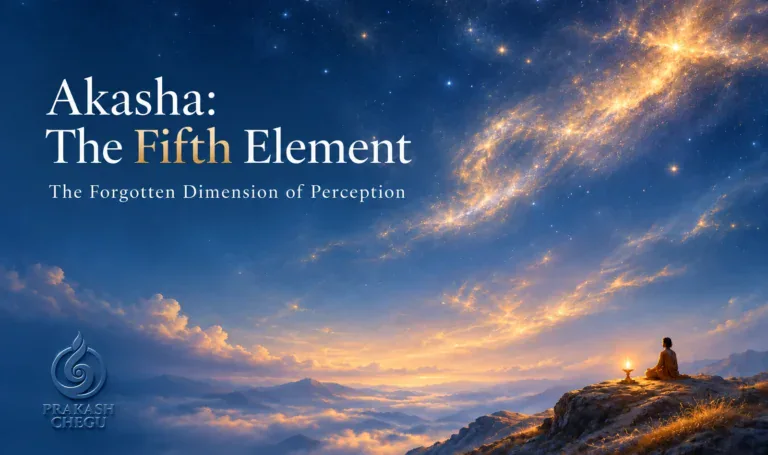
What Happens When Life Is No Longer Limited to Survival?
The Sacred Fire Code · Part 3 of 15
We have learned how to measure extraordinary things.
The distance between planets.
The electrical activity of the brain.
The chemical composition of distant stars.
The minute changes in the gravitational field of the Earth.
We can examine the building blocks of matter, study the mechanisms of biological life, and send instruments beyond the limits of our solar system.
Yet one of the most intimate mysteries remains remarkably difficult to explain.
What is the nature of the space in which our experience occurs?
Not merely the physical space around our bodies.
But the openness within which we hear, see, remember, imagine, and become aware.
The ancient yogic traditions approached questions of existence using a language very different from modern physics.
One of their most intriguing concepts is Akasha.
Usually translated as space or ether, Akasha is considered the subtlest of the five great elements in several classical Indian philosophical systems.
But calling it the fifth element is only the beginning.
To appreciate its significance, we need to examine the relationship between space, sound, perception, the senses, and consciousness.
And perhaps we also need to ask whether our ordinary idea of perception is much too narrow.
1. The Five Elements Are Not Five Chemical Substances
In traditional Indian philosophy, the Pancha Mahabhutas are:
Prithvi — Earth.
Apas or Jala — Water.
Agni or Tejas — Fire.
Vayu — Air.
Akasha — Space.
It is tempting to compare this framework directly with modern chemistry.
But that creates a problem.
Earth is not a single chemical element.
Water is a compound.
Air is a mixture of gases.
Fire is a process involving energy release, chemical reactions, and light.
And space is not a material substance in the same sense as water or oxygen.
If we insist that the five Mahabhutas must function as scientific categories, we misunderstand their philosophical purpose.
They form part of traditional explanations of experience, embodiment, qualities, and the structure of the manifest world.
Different Indian schools interpret these categories differently.
In Sankhya, the gross elements are related to subtler principles called Tanmatras.
In Vedantic cosmological accounts, the elements appear in descriptions of manifestation.
In Ayurveda, the elemental framework contributes to a broader account of bodily processes and qualities.
These traditions are not identical.
Their shared vocabulary should not make us overlook their differences.
The real question is not whether Akasha is secretly a modern particle or force.
The question is what the concept was originally meant to illuminate.
2. The Taittiriya Upanishad and the Emergence of the Elements
The Taittiriya Upanishad offers a remarkable sequence in its second chapter.
तस्माद्वा एतस्मादात्मन आकाशः सम्भूतः।
आकाशाद्वायुः। वायोरग्निः। अग्नेरापः। अद्भ्यः पृथिवी।
Tasmād vā etasmād ātmana ākāśaḥ sambhūtaḥ.
Ākāśād vāyuḥ. Vāyor agniḥ. Agner āpaḥ. Adbhyaḥ pṛthivī.
From the Self, Akasha arose.
From Akasha, air.
From air, fire.
From fire, water.
From water, earth.
— Taittiriya Upanishad 2.1.1
This is a cosmological teaching, not a modern experimentally established account of the origin of chemical elements.
Its philosophical significance lies in the movement from the subtle toward the increasingly tangible.
Akasha comes first in the elemental sequence.
The more familiar forms of existence arise afterward.
This suggests an interesting contemplative possibility.
Before something can occupy a place, there must be the possibility of extension or location.
Before two objects can stand apart, there must be a relationship of distance.
Before movement can be recognized, there must be a field within which change becomes apparent.
Akasha symbolizes that openness.
It is not simply another object among objects.
It represents an essential dimension of the framework in which objects are encountered.
We should be careful not to import modern spacetime physics into the Sanskrit text.
But we need not lose the philosophical beauty of its imagery.
It asks us to contemplate existence from the perspective of what allows manifestation, rather than only from the perspective of what has manifested.
3. Why Is Akasha Associated With Sound?
This is one of the most interesting features of the classical elemental framework.
In systems that relate the five gross elements to the five sensory qualities, Akasha is associated with Shabda, or sound.
Vayu is associated with touch.
Tejas with form or visibility.
Water with taste.
Earth with smell.
This is not an acoustic theory in the modern scientific sense.
Sound waves in ordinary air require a material medium, and an ideal vacuum does not transmit conventional sound waves.
The classical relationship between Akasha and Shabda belongs to a different philosophical explanation of sensory qualities.
Still, the association invites us to contemplate something important.
When we hear someone speak, we ordinarily focus on the words.
Rarely do we consciously attend to the silence around them.
But the pauses matter.
Without intervals, distinctions, and changing patterns, meaningful speech would be difficult to recognize.
Music gives us another example.
A melody is not simply a collection of notes.
Its rhythm depends on duration.
Its expression depends on relationship.
Its emotional impact frequently depends as much on what is withheld as on what is played.
The space between sounds is not meaningless.
In our own conversations, silence can be equally important.
Sometimes a person needs a response.
Sometimes they need the presence of someone who can listen without immediately filling the space with advice.
This has become particularly meaningful to me through the practice of Sat Nam Rasayan.
The discipline invites a practitioner to refine awareness and become less dominated by habitual interpretation.
That does not establish that a measurable Akashic field is being manipulated.
But it does point toward a profound experiential question.
How much of what we call perception is actually the constant interpretation of perception?
And what becomes available when interpretation begins to settle?
4. The Chandogya Upanishad: Space Is Greater Than Fire
There is another fascinating passage in the Chandogya Upanishad.
In chapter 7, Sanatkumara gradually guides Narada through a sequence of contemplative principles.
At one point, the text declares:
आकाशो वाव तेजसो भूयान्।
Ākāśo vāva tejaso bhūyān.
Akasha is indeed greater than fire.
— Chandogya Upanishad 7.12.1
The passage continues by explaining that the sun, moon, stars, lightning, and fire exist in space.
It also associates space with calling, hearing, responding, enjoyment, and the conditions in which beings arise.
The instruction culminates in an invitation to contemplate Akasha.
What I find beautiful is the progression.
Fire is extraordinary.
It illuminates.
It transforms.
It produces heat.
But fire itself exists within something more encompassing.
This offers a powerful analogy for meditation.
Thought can be intense.
Emotion can be intense.
Desire can be intense.
Yet none of these experiences remains unchanged forever.
They arise.
They transform.
They fade.
What happens when our attention shifts from the intensity of an individual experience toward the larger field in which it is being known?
A person who is angry may become entirely absorbed in anger.
A person who is frightened may become identified with fear.
A person who is grieving may feel that grief occupies the whole of existence.
But with practice, we may discover the ability to recognize an experience without reducing our entire identity to it.
This is not emotional suppression.
Nor is it denial.
It is a refinement in our relationship with experience.
There is room for the emotion to exist.
And there may also be room for a response that is not dictated entirely by the emotion.
That room is a beautiful way to approach the symbolism of Akasha.
5. Is Akasha the Same as Consciousness?
This question requires great care.
In popular spiritual conversation, Akasha is sometimes spoken of as though it were identical to infinite awareness, universal memory, cosmic energy, or the source of all existence.
Different schools, however, make important distinctions.
In classical Sankhya, Akasha is one of the evolved elements of Prakriti.
Purusha, the witnessing principle, is distinct from Prakriti and its evolutes.
In Advaita Vedanta, the relationship between Atman, Brahman, and the elements is explained through a different metaphysical framework.
In particular Tantric traditions, the symbolic relationships among space, consciousness, sound, and manifestation become more elaborate.
We cannot take a statement from one system, combine it with another, and assume the resulting synthesis represents an ancient universal doctrine.
That would be convenient, but inaccurate.
Akasha may be a profound contemplative symbol.
Yet the exact relationship between Akasha and consciousness depends upon the philosophical tradition we are studying.
For me, this distinction does not reduce the importance of Akasha.
It makes the investigation richer.
We begin to recognize that ancient India did not preserve a single undifferentiated philosophy.
It preserved multiple disciplined approaches to the mystery of existence.
And each asks us to examine what we ordinarily assume.
6. Can Fire Enhance Akashic Perception?
This question brings us back to the oil lamp.
In a contemporary teaching, Sadhguru describes a subtle Akashic region surrounding a properly burning flame.
He suggests that an oil lamp can support an environment conducive to perception and that particular arrangements of fire may influence the subtle atmosphere of a space.
These are spiritual claims within his teaching framework.
We should understand them accurately rather than silently converting them into established scientific conclusions.
A flame does produce measurable effects.
It changes the local temperature.
It generates air currents through convection.
It emits electromagnetic radiation.
It releases combustion products.
And its moving light can become a focus for attention.
What has not been scientifically established is the existence of a distinct Akashic sphere around the flame, or a reliable measurement connecting that proposed sphere to expanded human perception.
So what can we investigate?
We can examine whether a person feels more settled while meditating near a lamp.
We can compare the experience with meditation under warm electric lighting.
We can measure temperature, ventilation, particulate emissions, and lighting conditions.
We can examine attention and subjective experience.
These are meaningful investigations.
But their results should not be presented as proof of an Akashic field unless they actually demonstrate one.
This is where I find the meeting of engineering and yoga especially productive.
Engineering teaches us to distinguish between an observation and its proposed mechanism.
Yoga invites us to investigate experience directly.
Both can become more useful when we remain clear about their methods.
7. Are We Living Only Through the First Four Elements?
One of the more provocative ideas in the teaching is that human life often remains absorbed in food, sleep, reproduction, security, and the struggles of survival.
Within the speaker’s framework, these concerns occupy the more tangible dimensions of existence, while Akasha represents a subtler dimension of perception.
I would not treat this as a literal rule that everyday life involves only four of the five classical elements.
That is not a universal doctrine across Indian philosophy.
But I find the existential observation worth examining.
How much of human life is organized around maintaining what already exists?
We work to support our bodies.
We seek shelter.
We protect our relationships.
We plan for the future.
We organize our lives around responsibilities.
These are necessary activities.
There is no spiritual virtue in neglecting them.
The problem begins when survival becomes the entirety of our identity.
A human being can become so consumed with maintaining life that there is little time left to experience its depth.
We may spend years working toward financial security without examining what security is supposed to make possible.
We may become skilled at managing relationships without learning how to be present with another person.
We may acquire knowledge without growing in wisdom.
And we may preserve the body while giving almost no attention to the consciousness through which bodily life is experienced.
Perhaps the invitation of Akasha is to stop reducing our existence to the problems we must solve.
To make room for wonder.
For silence.
For contemplation.
For an encounter with life that is not immediately organized around utility.
8. The Modern Fear of Empty Space
Have you noticed how uncomfortable many people become when nothing is happening?
We reach for a phone.
We open another application.
We play music.
We begin a conversation.
We search for something to read.
We look for stimulation.
This is not inherently wrong.
Technology is extraordinary, and I am grateful for the possibilities it creates.
But perpetual stimulation can become a way of avoiding direct contact with ourselves.
There is a difference between choosing to engage with the world and being unable to remain without engagement.
One is freedom.
The other may be compulsion.
Meditation provides an opportunity to examine that difference.
When we sit quietly, we begin to observe the mechanisms of distraction.
We notice how frequently attention seeks something new.
How quickly the mind manufactures a problem to solve.
How easily an uncomfortable sensation becomes a story about who we are.
And sometimes we recognize that we do not actually need to follow every movement.
The experience can arise without becoming a command.
This is a very practical form of inner freedom.
We do not need to claim that a mysterious substance has entered the body.
We need only begin recognizing that our relationship with experience can change.
9. An Akasha Contemplation: Making Room for Awareness
I would like to offer a simple contemplative exercise.
It is inspired by the traditional symbolism of Akasha, but it is not presented as a classical Tantric initiation or lineage-specific practice.
Begin by sitting in a clean, quiet place.
Allow the spine to be comfortably upright.
Close the eyes if that feels natural.
First notice the body.
Its weight.
Its temperature.
Its contact with the surface beneath you.
Then notice the breath.
Do not force it into a particular rhythm.
Simply recognize the movement.
Now become aware of sounds.
A distant vehicle.
A bird.
The movement of air.
The subtle sounds of your own breathing.
Instead of searching for the source of every sound, allow sounds to arise and pass.
Notice that awareness does not have to chase each one.
Then begin to recognize the spaces between thoughts.
Do not attempt to manufacture silence.
That effort can become another form of mental agitation.
Simply observe.
A thought appears.
It remains for a moment.
It changes.
Another thought follows.
Can you recognize the appearance of thought without immediately becoming involved in its content?
Continue for five to ten minutes.
If you become distracted, return gently to the experience of sitting.
When you finish, ask yourself:
What changes when I stop trying to control every experience and begin allowing myself to observe?
There may be no dramatic revelation.
That is perfectly fine.
The purpose is to cultivate a more intimate relationship with attention.
10. Akasha and the Responsibility of Spiritual Discernment
In the modern spiritual marketplace, it is easy to confuse fascination with understanding.
Words such as frequency, vibration, quantum, field, ether, and consciousness are often combined in ways that sound impressive but explain very little.
I believe ancient knowledge deserves better.
We do not honor the Upanishads by attaching modern scientific terminology to their teachings without justification.
We honor them by studying their questions, examining their philosophical arguments, understanding their historical context, and allowing them to deepen our own inquiry.
Likewise, we do not honor science by using it as a weapon against every subjective or spiritual experience.
Science is extraordinarily powerful within the domains it can investigate.
But the meaning a person finds in a ritual, the beauty of a contemplative realization, and the existential significance of human life also require philosophical and experiential reflection.
The challenge is to know which kind of claim we are making.
A spiritual metaphor should not be presented as a laboratory measurement.
A subjective experience should not automatically be dismissed because its mechanism is unknown.
And a traditional scripture should not be forced to predict every discovery of modern physics.
When we preserve these distinctions, genuine dialogue becomes possible.
11. The Space That Allows Life to Be
Return once more to the small oil lamp.
We began this series with fire.
Now we are contemplating the space in which fire appears.
The flame is visible because of its light.
Its movement becomes apparent because of its changing relationship with the surroundings.
Its warmth is experienced through the body.
Its meaning arises through attention, memory, culture, and interpretation.
So many conditions are involved in what appears to be one simple event.
Perhaps the deeper invitation is not to become obsessed with the flame.
Perhaps it is to recognize the richness of the experience itself.
To become aware that existence is not merely a collection of objects.
It is also relationship.
Possibility.
Presence.
And the mysterious fact that we are capable of knowing anything at all.
The classical philosophers examined these questions through their own conceptual worlds.
Modern science approaches related questions using different methods.
Meditation invites an intimate investigation through direct experience.
We do not have to pretend that all three are saying the same thing.
We can allow each to contribute something distinct.
And perhaps that itself is an expression of Akasha.
The willingness to make room.
Room for inquiry.
Room for uncertainty.
Room for different forms of knowledge.
Room for a deeper awareness that does not need to reduce every mystery to an immediate conclusion.
When we stop filling every available space with activity, we may discover how much of life has been waiting for our attention.
That is where this exploration of Akasha begins.
Not with the promise of supernatural perception.
But with the possibility of becoming more fully present to existence.
Continue Exploring The Sacred Fire Code
Previously: Deepavali — The Festival That Keeps the Inner Fire Alive.
Next: Panchagni — How to Create a Sacred Meditation Space in Your Home.
Related articles: Bhuta Shuddhi — The Ancient Art of Purifying the Five Elements; Sacred Space — How Your Home Becomes an Extension of Your Consciousness; Panchagni Vidya — The Five Fires of the Upanishads.
Sources and Further Reading
-
Taittiriya Upanishad 2.1.1 — The traditional sequence of manifestation from Atman through the elements. https://hatha.es/en/texts/upanishads/taittiriya-2-02/
-
Chandogya Upanishad 7.12.1–2 — Sanatkumara’s teaching on Akasha. https://upanishads.org.in/u/chhandogya/p/7.12.1
-
Classical Sankhya — The distinction between Purusha, Prakriti, Tanmatras, and Mahabhutas.
-
Isha Foundation — The Significance of Lighting Oil Lamps. https://isha.sadhguru.org/en/wisdom/article/significance-lighting-oil-lamps
-
Inner Engineering — Perform This Process for Health and Wellbeing. https://innerengineering.sadhguru.org/online/blog/perform-this-process-for-health-and-wellbeing
The contemplative practices described here are educational and experiential. Claims about Akashic fields are identified as spiritual interpretations, not established scientific measurements.
Series Navigation
Previous: Part 2 · Deepavali: The Festival That Keeps the Inner Fire Alive
View the Complete Sacred Fire Code series
Next: Part 4 · Panchagni: How to Create a Sacred Meditation Space in Your Home
Frequently Asked Questions
What is Akasha?
Akasha is usually translated as space or ether, and in several classical Indian systems it is considered the subtlest of the five great elements. But calling it the fifth element is only the start. Akasha is less an object among objects and more the openness within which anything can appear at all, the field in which we hear, see, remember and become aware.
Why is Akasha called the subtlest or first element?
Because in the traditional sequence the elements move from subtle toward tangible, and Akasha comes first. The reasoning is contemplative: before anything can occupy a place there must be the possibility of extension, before two things can stand apart there must be distance, before movement can be noticed there must be a field in which change shows up. Akasha symbolizes that prior openness.
Is Akasha the same as space in modern physics?
I would be careful there. It is tempting to map Akasha onto spacetime, but that imports modern physics into an ancient text that was asking a different kind of question. Akasha is not a scientific claim about the cosmos, it is an invitation to contemplate existence from the side of openness itself, the dimension that makes encountering anything possible. You can hold its beauty without turning it into physics.