The Forgotten Relationship Between Light, Winter, Human Vitality and Consciousness
The Sacred Fire Code · Part 2 of 15
There is a beautiful intelligence in the way our ancestors organized life.
Festivals were not merely interruptions to everyday existence. They often marked changes in seasons, agricultural cycles, family responsibilities, social relationships, and spiritual priorities.
A festival could be a celebration, a reminder, a ritual, a social gathering, and an invitation to examine one’s life—all at once.
Somewhere along the way, we began separating these dimensions.
Religion became something we did in a temple.
Health became something we discussed with a doctor.
Psychology became something we explored with a therapist.
Astronomy became the responsibility of scientists.
And celebration became entertainment.
But human life was never experienced in such neatly divided compartments.
When I look at Deepavali through this wider perspective, I find myself asking a fascinating question.
What if the significance of a festival of lights extends beyond the stories we tell about it?
What if it also reminds us of our relationship with darkness, seasonal change, community, vitality, and the inner dimensions of consciousness?
To explore that possibility, we must begin with the difference between light and illumination.
1. A Thousand Lamps Cannot Illuminate an Unexamined Life
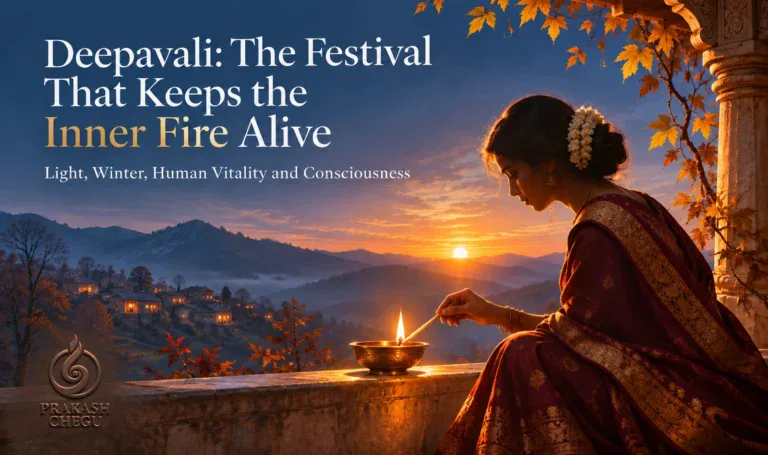
Imagine an entire village preparing for Deepavali.
Homes are cleaned.
Courtyards are decorated.
Oil lamps are arranged along thresholds.
Families prepare sweets.
Children anticipate celebration.
Neighbors visit one another.
The ordinary rhythms of life begin to change.
For a few days, people participate in something larger than the daily struggle of earning, eating, sleeping, and surviving.
The environment becomes festive.
But notice something interesting.
The light is not the only thing that changes.
Human behavior changes.
Attention changes.
Social participation changes.
People remember relationships and traditions that may have been neglected during the rest of the year.
There is a movement from the private world of daily concerns toward a shared experience of celebration.
This, to me, is one of the beautiful dimensions of a festival.
A lamp illuminates physical darkness.
A meaningful festival can remind us of aspects of life we have allowed to become invisible.
And sometimes, what we need is not more information.
We need an occasion to remember what matters.
2. What Does Deepavali Actually Mean?
The word Deepavali is commonly derived from Sanskrit dīpa, a lamp, and āvalī, a row or series.
A row of lamps.
Such a simple name for an extraordinarily rich cultural celebration.
Across India and beyond, Deepavali carries different meanings.
In many Hindu traditions, it is associated with Rama’s return to Ayodhya.
In other traditions, it celebrates Krishna’s victory over Narakasura, the worship of Lakshmi, or the veneration of Kali.
In Jainism, Diwali is associated with Mahavira’s liberation.
Sikhs commemorate Bandi Chhor Divas during the same festive period, recalling the release of Guru Hargobind and other prisoners.
Regional calendars, customs, foods, stories, and ritual sequences differ.
We should honor these distinctions.
There is no need to erase the religious and historical richness of Deepavali in order to explore its wider significance.
A festival can have profound religious meanings and also express human concerns that extend across religious boundaries.
Light is one of those concerns.
Every human being knows darkness.
Every human being understands the importance of illumination.
And every human being, at some point, must confront the difference between merely remaining alive and truly participating in life.
3. Why Does the Timing of Deepavali Matter?
Deepavali is observed according to traditional lunisolar calendars, with its principal celebrations commonly falling around the dark moon of the autumn season.
In much of northern India, this period arrives as the days are shortening and the transition toward cooler weather is becoming noticeable.
That seasonal setting is worth examining.
The Earth travels around the Sun with its rotational axis tilted relative to its orbital plane.
As the year progresses, the duration and angle of sunlight change across different latitudes.
In the Northern Hemisphere, the period following the September equinox brings progressively shorter days until the December solstice.
These astronomical changes influence temperature, agriculture, ecosystems, and the timing of human activity.
But the effects are not uniform.
The winter experienced in northern Europe is very different from winter in southern India.
A person near the equator does not experience the same seasonal variation in day length as someone living in Scandinavia.
And Deepavali is not celebrated at precisely the same stage of winter everywhere.
Therefore, we should be careful with the claim that the festival was universally designed to prevent winter depression.
The historical evidence does not establish that.
Nevertheless, the proximity of Deepavali to the autumn transition in much of India invites a meaningful question.
What role can celebrations of light, togetherness, and renewal play when the natural environment begins changing around us?
4. The Human Body Is Not Independent of the Sun
We sometimes behave as though the human body is a machine that should function identically at every hour, in every season, and under every condition.
But biology is rhythmic.
The body contains systems that respond to the alternation between day and night.
One of the best studied is the circadian timing system.
Specialized cells in the retina detect environmental light and help synchronize biological rhythms.
Light exposure can influence alertness, sleep timing, and the secretion of melatonin.
Its effect depends not merely on whether light is present, but on its intensity, spectral qualities, timing, and duration.
This is one reason exposure to daylight and exposure to bright artificial lighting late at night can have very different physiological implications.
It is also why the popular statement that warm evening light is always beneficial is too simplistic.
The circumstances matter.
For an individual living in a place with long, dark winters, sufficient daytime light can become particularly important.
For a person preparing for sleep, reducing bright light exposure in the evening may be helpful.
A traditional oil lamp offers one kind of illumination.
But its warm light is not a replacement for daylight, and burning oil is not necessary to create a circadian-friendly evening environment.
A well-designed electric light can also be dim and warm.
This distinction is important because understanding tradition should help us make more intelligent choices—not force us to reject the useful discoveries of the modern world.
5. Conscious Stillness Is Not the Same as Losing Vitality
A teaching that inspired this entire series makes a particularly important distinction.
There is a difference between consciously becoming still and being involuntarily pulled into a state of withdrawal.
I find this profound.
A meditator may sit for hours in silence while remaining inwardly alert, receptive, and deeply present.
Another person may spend the same number of hours sitting quietly, unable to find the motivation to engage with ordinary life.
Outwardly, the two may appear similar.
Inwardly, they may be experiencing very different conditions.
The first might be participating in a cultivated contemplative state.
The second might be exhausted, distressed, depressed, or struggling with a health condition.
We should never confuse these states.
Nor should we assume that someone experiencing depression lacks discipline, spiritual maturity, or inner fire.
Depression is a complex health condition with biological, psychological, environmental, and social dimensions.
In some people, depressive episodes follow a seasonal pattern.
Seasonal affective disorder is a recognized clinical presentation, and evidence-based treatments may include appropriately timed bright-light therapy, psychotherapy, medication, or other individualized care.
A diya is not a clinical treatment for depression.
Yet this scientific clarity does not diminish the deeper philosophical question.
How do we distinguish genuine rest from a gradual loss of our willingness or capacity to participate in life?
How do we recognize when we need silence, and when we need connection?
When does solitude nourish us?
And when does isolation deepen our suffering?
These questions deserve more attention than they usually receive.
6. Sattva, Rajas and Tamas: The Yogic Language of Inner Movement
The Bhagavad Gita provides another useful framework.
In chapter 14, Krishna discusses the three gunas of Prakriti: Sattva, Rajas, and Tamas.
These are not modern medical categories.
They are philosophical qualities through which classical Indian thought describes the functioning of nature.
Sattva is associated with clarity, harmony, luminosity, and knowledge.
Rajas is associated with activity, desire, restlessness, and movement.
Tamas is associated with obscuration, inertia, and delusion.
However, it is a mistake to assume that Sattva is simply good, Rajas is bad, and Tamas is worse.
Ordinary life requires activity.
The body requires sleep.
Even rest has an indispensable role in well-being.
The problem is not that we possess these qualities.
The problem arises when we are unable to respond intelligently to the condition of our lives.
A person who is exhausted may need rest, not stimulation.
A person overwhelmed by activity may need silence.
A person caught in prolonged withdrawal may need care, movement, social support, or treatment.
Yogic maturity is not the compulsive pursuit of constant exuberance.
It is the development of discernment.
The capacity to recognize what is happening within us—and respond without becoming enslaved by it—is one of the most valuable fruits of Sadhana.
7. Why Celebration Matters
Think about the human experience of preparing for a festival.
You clean your home.
You light lamps.
You cook.
You decorate.
You remember people.
You invite others.
You prepare gifts.
You listen to music.
You make time for something that is not strictly necessary for survival.
Yet perhaps it is necessary for something else.
A human being does not flourish through food, sleep, and economic productivity alone.
We also seek belonging, beauty, purpose, play, and meaning.
Festivals create opportunities for these dimensions to become visible.
They can provide continuity between generations.
They can offer moments of generosity.
They can interrupt isolation.
They can create memories that become part of a family’s emotional inheritance.
Of course, festivals can also become burdensome.
Financial pressure, social expectations, conflict, and excessive consumption can transform a celebration into another source of exhaustion.
So the deeper question is not how grandly we celebrate.
It is whether celebration helps us become more connected with life.
A small gathering with genuine warmth may nourish a person more than an elaborate event filled with obligation.
A single lamp lit with awareness may be more meaningful than hundreds arranged for display.
8. Deepavali as an Invitation to Renew Our Relationship With Darkness
There is something else we rarely consider.
Darkness is not inherently an enemy.
Without darkness, the body would struggle to maintain normal rhythms of rest.
Without night, we would lose the opportunity to experience certain forms of quietness.
Without rest, activity loses its balance.
The yogic problem is not physical darkness.
It is unconsciousness.
It is the darkness of not seeing clearly.
The darkness of mistaking our compulsions for freedom.
The darkness of living through inherited patterns without examining them.
The Brihadaranyaka Upanishad offers the familiar prayer:
Asato mā sad gamaya.
Tamaso mā jyotir gamaya.
Mṛtyor mā amṛtaṃ gamaya.
Lead me from the unreal toward the real.
From darkness toward light.
From death toward immortality.
This is a far greater movement than the replacement of night with artificial illumination.
It is an invitation to reconsider the very quality of our existence.
And that is what makes the symbolism of Deepavali so beautiful.
9. A Personal Deepavali Sadhana
I would encourage you to experiment with a quieter form of celebration alongside whatever family or religious traditions you observe.
Begin with the home.
Clean one space thoroughly.
Not because the Divine requires a spotless floor, but because the process itself can become conscious.
Remove unnecessary objects.
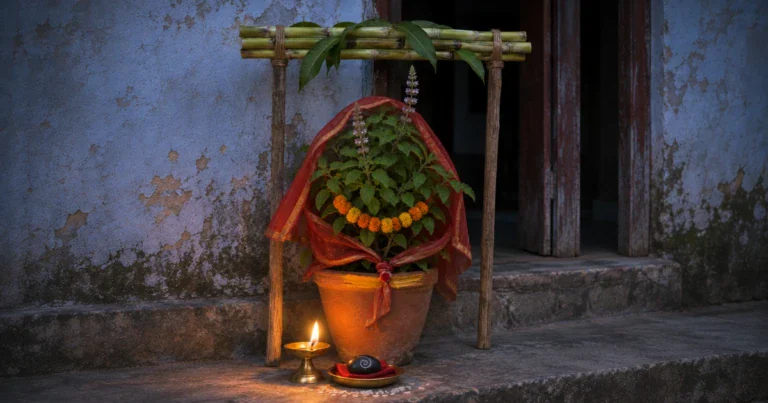
Arrange a simple lamp or a safe flameless equivalent.
Sit comfortably.
Take a few moments to feel the body and observe the breath.
Then reflect on three questions:
What in my life needs to be illuminated?
Perhaps there is a relationship requiring an honest conversation.
Perhaps there is a habit you have avoided examining.
Perhaps a decision has remained unresolved because the consequences frighten you.
What in my life needs genuine rest?
Not every challenge is solved by greater effort.
Sometimes the intelligence of life asks us to recover.
What deserves celebration?
Not achievement alone.
Perhaps the fact that you survived a difficult year.
Perhaps the kindness of someone who stood beside you.
Perhaps the continued presence of your parents, children, friends, or teachers.
Let gratitude become part of the celebration.
And when the practice is complete, bring that awareness into your relationships.
There is little value in lighting a lamp before a deity and then speaking harshly to the people with whom we share our home.
The real test of ritual is the quality of life that follows it.
10. The Festival Beyond the Festival
One of the dangers of modern life is that we are becoming very good at illuminating everything outside us while remaining remarkably unfamiliar with our inner experience.
Our cities are bright.
Our screens never sleep.
Information is constantly available.
Yet clarity does not automatically follow illumination.
We may know what is happening on the other side of the planet and remain unable to understand what is happening within our own hearts.
Perhaps the deepest lesson of Deepavali is not that darkness must be destroyed.
Perhaps it is that we must become capable of bringing awareness into whatever remains unseen.
The festival ends.
The decorations are removed.
The sweets are finished.
The lamps are extinguished.
But something can remain.
A renewed commitment to live consciously.
A greater willingness to participate in life.
A reminder that stillness and vitality need not oppose one another.
And the possibility that the light we celebrate outside is pointing toward a much more intimate illumination within.
May we celebrate Deepavali not merely by lighting our homes, but by becoming a little more aware of the lives we are privileged to live.
May the festival inspire not only brightness, but clarity.
Not only activity, but intelligent rest.
Not only prosperity, but generosity.
And not only the worship of light, but the courage to see.
Continue Exploring The Sacred Fire Code
Previously: The Forgotten Science of Lighting an Oil Lamp.
Next: Akasha — The Fifth Element and the Forgotten Dimension of Perception.
Also in this series: Conscious Stillness vs. Compulsive Inertia; The Flame and the Brain; When the Inner Fire Awakens, Ritual Becomes Unnecessary.
Sources and Further Reading
-
Bhagavad Gita, chapter 14, especially verses 14.6–14.13, on the three gunas.
-
Brihadaranyaka Upanishad 1.3.28, on the movement from darkness to light.
-
National Institute of Mental Health, Seasonal Affective Disorder — https://www.nimh.nih.gov/health/publications/seasonal-affective-disorder
-
Gooley et al. (2011), Exposure to Room Light before Bedtime Suppresses Melatonin Onset and Shortens Melatonin Duration in Humans — https://pmc.ncbi.nlm.nih.gov/articles/PMC3047226/
-
Encyclopaedia Britannica, Diwali, for regional and religious traditions — https://www.britannica.com/topic/Diwali-Hindu-festival
This article explores historical, spiritual, and scientific perspectives. Its reflections on seasonal vitality are not a substitute for assessment or treatment of depression.
Series Navigation
Previous: Part 1 · The Forgotten Science of Lighting an Oil Lamp
View the Complete Sacred Fire Code series
Next: Part 3 · Akasha: The Fifth Element and the Forgotten Dimension of Perception
Frequently Asked Questions
What is Deepavali really about, beyond the lamps?
Older festivals were never single-purpose. They marked seasons and agricultural cycles, renewed family and social bonds, and invited people to examine their lives, all at once. Deepavali, the festival of lights, is one of these integrated occasions. The outer lamps are a reminder to tend the inner fire: to bring light into the parts of ourselves and our relationships that have grown dim.
Why does the article say we have lost something about festivals?
Because somewhere along the way we split life into compartments: religion in the temple, health with a doctor, psychology with a therapist, astronomy for scientists, celebration as mere entertainment. Human life was never actually lived in those neat divisions. Deepavali is a chance to feel them re-integrated for a moment, a celebration that is also spiritual, social, seasonal and reflective all together.
How can I celebrate Deepavali more meaningfully?
Let the outer ritual point inward. As you light the lamps, treat it as more than decor, a deliberate act of bringing awareness to what needs light in your life right now: a relationship to mend, a habit to release, an intention to rekindle. The festival keeps the inner fire alive only if we let the lamps mean something.